Archive for January, 2015|Monthly archive page
What is the true purpose of corporations?
 Comments (6)
Illustration: Susan MacDonald
What’s the purpose of a corporation? Or, somewhat more abstractly, what’s the purpose of corporations in general?
That question is the topic of a big academic literature, but the question itself is far from academic. In fact, it has enormous practical importance. Take, for instance, the recent news that Target is leaving Canada, news that puts a rather fine point on the question.
Surely for the top executives (and presumably the Board) at Target, the decision to pull out of Canada was a tough one. But one suspects it was also entirely a ‘business’ decision — that is, one driven entirely by bottom-line considerations. CEO Brian Cornell pointed out, as part of the rationale for pulling out of Canada, that projections indicated that, if the company stayed in Canada, Target Canada would not expect to be profitable until 2021. Presumably shareholders were simply not going to put up with that. And from a fairly standard view about the purpose of the corporation, the wishes of shareholders matter a great deal. After all, or so the story goes, the entire purpose of a corporation is to make money for shareholders.
But of course, shareholders aren’t the only interested parties in this story. Consumers, too, have a stake. And despite the fact that many Canadians were sorely disappointed in Target’s initial efforts, many held out hope that Target Canada would eventually live up to the standards of their US counterparts, stores that are in fact a favourite cross-border shopping destination.
But among various stakeholder groups, the move is perhaps felt most acutely by Target Canada’s employees. Pulling out of Canada means Target is closing 133 stores and eliminating 17,600 jobs. For employees, the company was a source of jobs — jobs ranging from cashier to admin assistant to fairly senior executive posts. To the holders of those jobs, Target was a valued employer — a way to feed a family and pay the bills and maybe save for a vacation.
So now ask, again, what’s the purpose of a corporation? We’ve mentioned already the shareholder-wealth-building view. A more modern, critical view is to say that the purpose of a corporation is something more than the pursuit of shareholder wealth. Corporations, on this view, have a higher purpose as part of a community. The corporation has a social role, and that role goes far beyond attending to the interests of shareholders. Adherents of this view are indeed typically indignant at the very thought that anyone could think that corporations have so lowly a purpose as to merely make money.
And those critics are right, at least in part. It really is foolish to think that the purpose of a corporation is to make money. But that’s only because it’s foolish to think that corporations have purposes at all. That is, it’s foolish to think of a large, multifaceted organization as having a single, unitary “purpose” in the universe, rather than thinking of it as serving many purposes for many interested parties. Arguing over what a corporation is “really for” — building shareholder value? making products to make people happy? providing jobs? etc. — is a fool’s errand.
There are of course exceptions. If an individual or small group files the paperwork to form a corporation to serve some single, stated purpose, then it’s probably fair to say that that is what the corporation’s purpose is. But that’s seldom what’s at stake, at least as far as this debate goes. When you’re talking about a widely-held, multibillion dollar corporation like Target, talk of the organization’s “real purpose” just sounds silly.
But the fact that the corporation is many things to many people doesn’t mean that everyone is bound to consider all of those purposes, all of the time.
To see what I mean, consider a different, parallel question. What is the purpose of a job? Say, your job. If we think of your job as an abstract thing — a position in the marketplace that happens to be filled by you — what is its purpose? Does that question even make sense? You’ve got the job, and it (hopefully) helps you achieve your goals. How you should behave yourself in the course of that job, in pursuit of those goals, is a question of ethics. And that question is much more enlightening than some grand question about purposes.
American Apparel’s New Code of Ethics: A Good Start
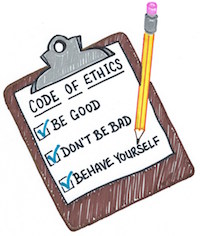
Illustration: Susan MacDonald
Retailer American Apparel has announced a new code of ethics. The move comes, not coincidentally, just a month after the board sacked controversial CEO and founder Dov Charney. Charney had been at the centre of a string of employee sexual harassment suits.
And the new code contains — again, not coincidentally — a substantial section on sexual harassment.
The move by AA to beef up its Code is an opportunity to emphasize several key points about the role and significance of a Code of Ethics in general.
The first point has to do with the insufficiency of a code, in spite of the admitted necessity of having one. A company the size of AA can’t not have a code. Having one is effectively ‘table stakes,’ at this point, and in some jurisdictions it’s legally required. But AA’s board also shouldn’t dream for a second that simply having a new code is going to fix the company’s problems, any more than simply removing Charney from the helm will do so.
What the company surely needs is a change in culture. Charney’s departure will surely help — tone at the top, etc., etc. — but it likely won’t be enough. Charney has surely left his imprint on the corporate culture, and it will take time for that to change. A new code may serve as a focal point for such change, but only if the code is noticed and taken to heart. And that will only happen if sufficient training takes place. In other words, AA needs to not do what too many organizations do: simply post the new code on the wall. Even sending each employee a copy and “requiring” them to read it won’t be enough.
The final point has to do with the relationship between ethics and the law. As should be obvious, ethics and the law are not identical. What’s legal isn’t always ethical, and vice versa. An ethics code typically tries to bridge the gap: they tell employees what’s ethically required, but they also typically threaten a penalty, most often termination of employment. Further AA’s code effectively advises employees to think of the code as a legal document:
“…we ask that if you have questions, ask them; if you have ethical concerns, raise them; if you believe something to be suspicious or inconsistent with the Company’s best interests, report it to the General Counsel…” [or to contact the company’s outside ethics hotline provider].
That’s fine, but given the importance of culture, it’s important that the legal implications of a code not dominate. And unfortunately, AA’s code was pretty clearly written by a team of lawyers. The wording is often legalistic. That’s not surprising. Ethics policies often are. The most we can hope is that the ethics training that should accompany the code’s launch focuses on the values that underpin the code, not on the punishment that could result form its violations.
So is American Apparel’s new code good news? Absolutely. Are the company’s worries over? Far from it.


 The Business Ethics Blog