Archive for September, 2014|Monthly archive page
Alibaba’s charity is good for the developing world—but its business is better
 Comments (2)
“When you have $1 million, you’re a lucky person. When you have $10 million, you have trouble. When you have more than $1 billion, you have responsibility.” So says Jack Ma, founder and executive chairman of the Alibaba Group. Alibaba — the Chinese e-commerce giant — gained international prominence after its recent record-breaking IPO.
The talk about responsibility is not just talk. Ma says he has earmarked $3 billion of his IPO earnings to donate to environmental and educational projects in China. So Ma is clearly a man who believes in giving back. On the corporate side, under his leadership Alibaba has pledged to donate 0.3% of profits to environmental protection initiatives. If 0.3% seems like a small amount, consider that that’s a percentage of revenue, not profits. And on annual revenues in the $7.5 billion range, 0.3% turns out to be something a little over $22 million. Nothing to sneeze at.
So let me ask a silly question: why do we think such charitable moves are a good thing? Well, pretty simply because we think they produce good outcomes.
But if we commend such moves, ethically, because they are likely to produce good outcomes, then we should also praise Alibaba’s business activities more generally. Ecommerce companies like Alibaba connect people together and enable commerce. They enable enormous quantities of mutually-advantageous exchange.
According to Wired,
Ma says part of his strategy for growing the company is to continue expanding into developing countries—countries where approximately 6.5 billion people don’t use e-commerce today. “That’s the opportunity we could have,” he says. “We’re trying to help Nigerian SMEs sell to the Philippines and the Philippines sell to Pakistan and Pakistan sell to Argentina.”
If Alibaba can achieve that, it will have done more good in the world — and deserve more moral praise — than Ma and Alibaba’s philanthropy combined.
Chris MacDonald is director of the Jim Pattison Ethical Leadership Program at the Ted Rogers School of Management, and founding co-editor of the Business Ethics Journal Review.
Ray Rice case shows how difficult it is for employers to deal with off-hours misconduct
What are an employer’s ethical obligations when an employee gets caught doing something bad off the clock? The example of the day, of course, is Ray Rice. As the entire universe now knows, Rice the football player who was caught on video savagely hitting his then-fiancée (now wife), knocking her unconscious. The incident, once it became public, left the his team (the Baltimore Ravens) and the National Football League with the question of what to do about it, and what to do about Rice.
Rice’s case apparently posed something of a dilemma for the court system, too: back in May, Rice was indicted for third-degree aggravated assault, but those charges were later dropped.
Consider also the case of Centerplate CEO Desmond Hague, who was caught on video viciously kicking a friend’s dog in an elevator. Hague was first suspended, and then eventually terminated in the wake of a public uproar.
Interestingly, in both cases the offences took place away from work. Neither offence was an offence against the employer, at least not directly. Yet it was widely believed that Rice and Hague’s employers needed to do something, something beyond whatever legal sanctions might apply.
Of course, in those two cases, the employers’ hands were forced by enormous public pressure. Bowing to such pressure is perhaps most understandable in the case of the NFL’s (eventual) response to the Rice case. Football players are exceedingly public figures, and many people see them as actual or potential role models for kids. Rice is a crummy role model, to say the least, and is therefore a public relations nightmare for the NFL. The same reasoning applies to athletes losing endorsement contracts: it’s no surprise at all that Tiger Woods, Mike Tyson, Kobe Bryant, and Michael Vick lost major endorsement contracts after their respective scandals. Advertisers are buying the athlete’s image and reputation. And when those are devalued, the athlete no longer has any value as a spokesman.
Legally, in Canada and the U.S., at least, employers don’t need to give much reason for firing an employee. But what about ethically? Is bad behaviour (or even criminal behaviour) away from work a good enough reason to sack someone?
There are a few circumstances in which an employer is clearly ethically justified in taking action. First, if the bad behaviour suggests that the employee is liable to act badly on the job in a way that is going to pose a risk to customers, to fellow employees, or to the general public. This might have been the case with Hague. Although we don’t have much evidence, the dog-kicking incident might suggest a man with a temper. What if he’s inclined to treat subordinates the way he treats helpless animals?
Second, an employer is likely to be ethically justified in acting if the bad behaviour directly implicates on-the-job performance. Consider, for example, an airline pilot caught buying cocaine. A coke-head pilot simply can’t be tolerated.
Third, if the bad behaviour in question suggests such poor judgment that the employee simply could no longer be trusted, then an employer might well be right to let him or her go. Some bad behaviour might just imply that the employee is a loose cannon. People are generally hired not just for their talent, but also for their judgment. No judgment means no job.
But what about beyond that? What about the sales clerk spotted smoking pot in the park? That’s technically illegal in most jurisdictions, but does the employer have any business firing her for it? Or what about the salesman who is known to have been arrested for hitting his wife, tried, convicted, and released after a minimal jail term? Should his employer fire him, or consider him already to have been punished? Certainly, domestic violence might make us worry about how he would treat female colleagues. But what if, for whatever reason, that’s not an issue? Is merely having done something bad in one’s personal life any of an employer’s business?
In some cases, such a wrongdoer would simply be impossible to work with, or impossible to have managing a team of employees. If the wrongdoing is widely known within the organization, reputation alone might be enough to make the employee a liability.
But it’s also worth considering that an employer who fires an employee simply based on the wrongdoing itself is effectively imposing a penalty — acting like judge, jury, and executioner — without any of the due-process protections that accompany a criminal trial. It also implies a kind of double jeopardy: being tried and possibly convicted twice for the same crime.
Further, it arguably represents an intrusion of the world of employment into our personal lives. Just maybe we want to keep those spheres separate, not to protect the wife beater but to protect the rest of us from nosy and self-righteous bosses.
There’s a saying in legal circles that “hard cases make bad law.” In other words, our judgments about extreme or unusual cases can induce us to generalize in unhelpful ways. I think that applies quite nicely to our ethical judgment about Ray Rice and Des Hague. Rice and Hague are both wealthy, powerful men who did things that most of us find unthinkable. Before we leap to the conclusion that hell yes they should lose their jobs, we ought at least to think through what that conclusion would imply for a few million lesser offences.
Apple’s new Watch and the Ethics of Disruption
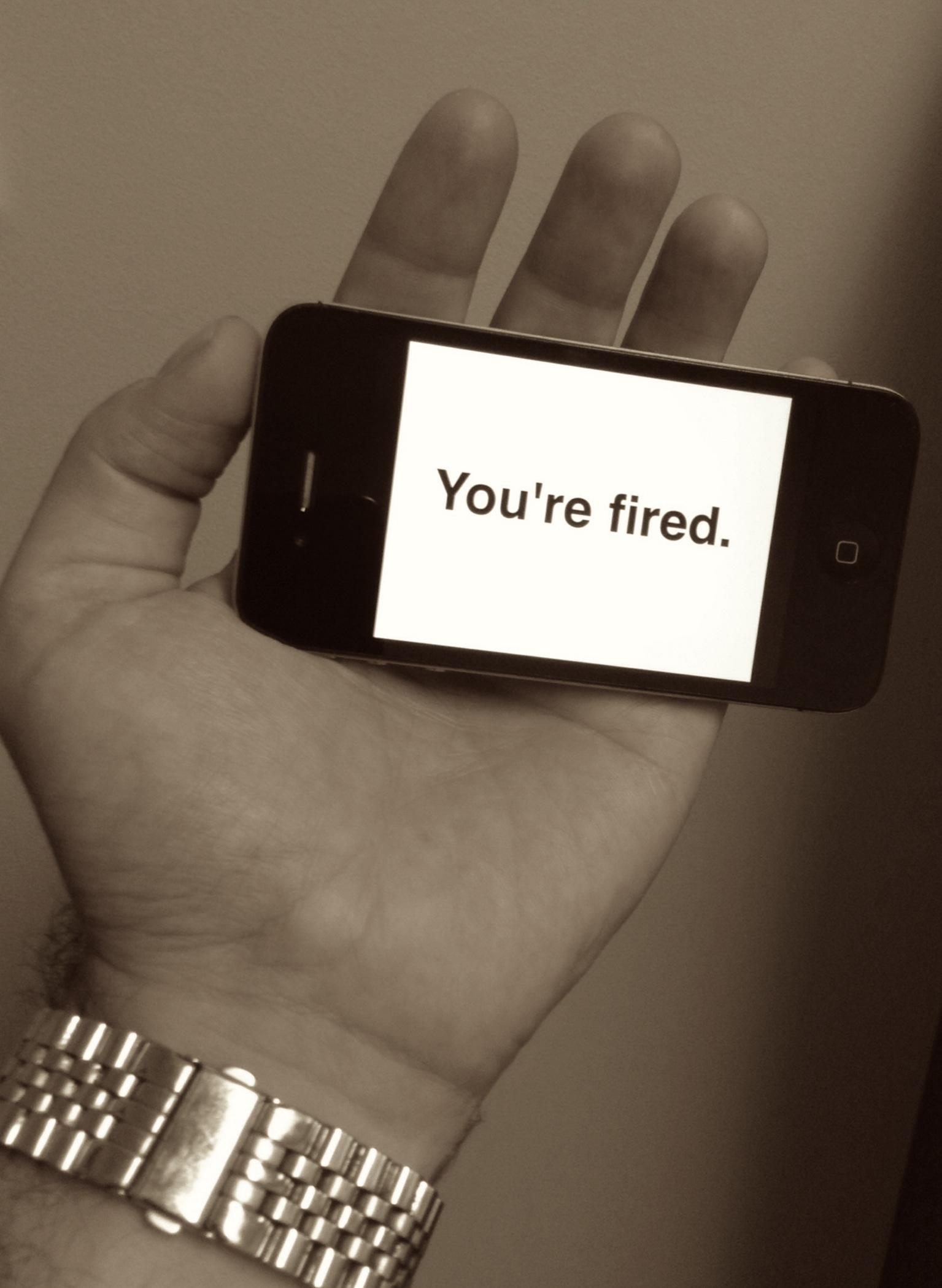 Ok, pop quiz. How many people did Apple put out of work this week, when the tech giant announced the Apple Watch and the Apple Pay point-of-sale technology built into the new iPhone 6? How many hopes and dreams were dashed?
How many would-be smart-watch entrepreneurs are saying to themselves, “oh, well, maybe I won’t go ahead with that Kickstarter campaign after all”? How many credit card company employees are now contemplating other lines of work? How many people at Samsung and BlackBerry and Pebble and Sony are going to be out of work, as the relevant corporate divisions get downsized as those companies lose market share to Apple’s new products?
The exact number is hard to guess, but it’s certainly not zero.
To lose one’s job, even temporarily, is generally a very bad thing. It jeopardizes one’s ability to house and feed oneself and one’s family. Causing such an outcome would, in most circumstances, be a bad thing to do.
But for all the cynicism about the launch event and the products it featured, no one criticized Apple for having made life hard for executives and employees at other companies. No one is blaming Apple for the fact that its nifty new products are going to put people out of work.
Why? Because that sort of disruption is what capitalism thrives on. Capitalism is, and must be, subject to ethical constraints, but those are effectively just the rules of the game, not a denial of the nature of the game itself, and not an attempt to render it impossible to play the game.
Just imagine what it would look like if companies really were expected never to hurt anyone. That would mean never putting anyone out of work, which means never inventing anything new and never improving one’s own products and processes in a way that might risk putting a competitor, no matter how poorly run, out of business. Such a standard is simply not plausible, not a reasonable limit on doing business.
For sake of comparison, consider a different set of limits on business competition, including things like the prohibition on violence, or the idea that you shouldn’t actively disrupt a competitor’s operations. Those are rules the observance of which doesn’t stop you from getting on with your own work. It’s entirely feasible to compete while observing those rules, where it’s not possible to compete while promising not to put anyone out of a job.
The point here is a simple but deep one. Business ethics isn’t about being a saint, or an angel, or about trying to make everyone happy. At heart, it’s about finding reasonable limits on the pursuit of profit, or, more personally, on how we go about making a living.
Uber’s tactics against rival Lyft crossed the ethical double-yellow line
 If all is fair in love and war, what about in business?
Uber is in the news again, and not for happy reasons. The car service company has been accused of trying to poach drivers from competitors like Lyft. And, in the process of poaching drivers, Uber has apparently been responsible, over a 1-year period, for 5,000 or so cancelled Lyft rides — rides that were ordered and then unceremoniously cancelled. According to Casey Newton, whose piece for the Verge broke the story:
Uber is arming teams of independent contractors with burner phones and credit cards as part of its sophisticated effort to undermine Lyft and other competitors….Using contractors it calls ‘brand ambassadors,’ Uber requests rides from Lyft and other competitors, recruits their drivers, and takes multiple precautions to avoid detection.The effort, which Uber appears to be rolling out nationally, has already resulted in thousands of canceled Lyft rides and made it more difficult for its rival to gain a foothold in new markets.
Uber, for it’s part, says its brand ambassadors never intentionally cancel rides. But as others have observed, doing so is a foreseeable consequence of their driver-recruitment strategy. If an Uber brand ambassador contacts a Lyft driver who happens already to have been contacted (and this can only be determined after the ride is booked), they realize their current call is pointless (and may well raise Lyft’s suspicions, resulting in the caller getting blocked) and so they cancel the ride.
Now, I’m no Uber hater. In fact, I’ll admit from the start to being an Uber fan. I use the service frequently here in Toronto, and I love the model. But that makes it all the more disappointing that a company with a great idea is using scummy tactics to gain and hold market share.
Vox’s Timothy B. Lee has defended Uber. Poaching other companies’ employees, according to Lee, is par for the course. That’s what companies do. And since the best way for Uber to speak Lyft’s drivers (not truly employees, but close enough) by posing as customers and ordering a ride, that’s naturally what they’re doing. As Lee points out, this is completely legal (Uber’s brand ambassadors are, after all, paying for the drivers’ time) and is arguably beneficial to drivers to the extent that it makes them aware of new opportunities.
But that defence is off-target. It’s not clear that ordering a Lyft ride is the only way to find new drivers (what about the huge number of taxi drivers not yet affiliated with either company?) Of all the ways there are to recruit drivers (putting up posters near where cabbies aggregate?), why choose the one that just happens to interfere with a competitor’s business? Lee claims that a few thousand cancelled rides pales in comparison to the size of Lyft’s fleet of drivers (roughly 60,000). But that argument fails. It’s the principle of the the thing — sabotage is not OK — not just the actual degree of interference experienced. (Compare: shoplifting isn’t OK just because a store’s sales volume is large.)
Uber is not, contrary to what Andrew Leonard suggested in Salon, an example of “no-holds-barred free-market competition,” precisely because there is no such thing as no-holds-barred free-market competition, at least not in a vaguely capitalist economy. Capitalism embraces competition, but the kind of competition it embraces is not unrestricted. It is competition based on innovation, and on a dedication to producing a better product at a better price than the other guy does. As others have pointed out, failure to compete (say, when such failure takes the form of collusion) is itself unethical and illegal. But that fact certainly doesn’t licence every imaginable competitive strategy. Hockey, too, is a rough game. And players are obligated not to generously share the puck with members of the other team. But the best hockey — and the best business — happens when competitors fight hard within the rules of the game, winning because of their superior talent, not because they busted the other guy’s knees.



 The Business Ethics Blog