Archive for the ‘food’ Category
Groupon Super Bowl Ad: Unethical
Filed under: advertising, brands, character, consumers, ethics, food, international, marketing, virtue |
 Comments (9)
  A collective gasp could be heard at one particular moment last night during the Super Bowl. No, I’m not talking about the gasp following Nick Collins’ 37 yard touchdown run in the first quarter. I’m talking about the gasp that issued at the punchline of the now-infamous Groupon.com commercial featuring Timothy Hutton.
You can see the 30-second spot here, on YouTube: Groupon – Tibet
And here’s the entire transcript:
“Mountainous Tibet — one of the most beautiful places in the world. This is Timothy Hutton. The people of Tibet are in trouble, their very culture is in jeopardy. But they still whip up an amazing fish curry. And since 200 of us bought at Groupon.com we’re getting $30 worth of Tibetan food for just $15 at Himalayan Restaurant in Chicago.”
Immediately following the commercial’s appearance, Twitter lit up with comments about how “offensive” and “tasteless” the Groupon.com commercial was. Media outlets today have been abuzz with criticism and commentary. The headlines tell the tale. According to NBC Chicago: “Groupon Super Bowl Ad Not a Good Deal”. CNN Money.com‘s headline was “Groupon spends big on controversial (tasteless?) Super Bowl spots”. Time asks: “And the Most Offensive Super Bowl Ad Goes To: Groupon?”
But the ad was more than just tasteless. It was unethical. To recruit — and then trivialize — the plight of the people of Tibet to sell Groupon’s services shows a jaw-dropping level of disrespect. And while we often think of disrespect as a matter of bad manners, showing suitable respect for other humans’ basic needs and interets is a core moral principle.
It’s also worth pointing out that the commercial played, perhaps unintentionally, on the unfortunate fact that, for many westerners, complex Asian societies are often most closely associated with exotic dinner fare. Yes, yes, Tibet is exotic and troubled. But hey, they make a yummy curry!
Who knows just what the fallout will be? There have been predictions that Groupon will lose business over this — it’s been suggested that the company may have found the limit of the notion that “there’s no such thing as bad PR.” And, predictably, there have already been calls for a boycott of Groupon.com. Timothy Hutton (once an Academy Award winner) will likely have to go into the spokesperson’s equivalent of rehab, perhaps by working with a pro-Tibet charity of some sort.
Of course, some will cling to the notion that Groupon.com intended all this — that they knew the ad would be controversial, and were aiming directly at the enormous amount of free media coverage they’re now getting. Maybe that’s true. But it was a helluva gamble to take. And, if it was a gamble, it was a gamble that treated the people of Tibet as just another Asian trinket to be tossed in among the poker chips.
—–
Addition:
It’s been pointed out to me (by @Changents on Twitter) that Groupon is apparently donating money to the causes featured in its commercials. See: http://savethemoney.groupon.com/. I’m not at all sure that that’s sufficient to overcome the worries discussed above, especially given that the disrespectful commercials is all that most people will see or know about. What do you think?
“Attacking a brand is like attacking a person”
Filed under: brands, consumers, corporations, definitions, food, honesty, labelling, personhood |
Comments (1) Last week on my Food Ethics Blog, I posed the following question: Fast Food Beef: What Matters? At the heart of that blog posting is a lawsuit that has been filed against Taco Bell, alleging that…
…Taco Bell’s “meat mixture”, which it dubs “seasoned beef” contained less than 35 % beef. If these figures are correct, the product would fail to meet minimum requirements, set by the U.S. Department of Agriculture, to be labeled as “beef”. The other 65% of the “meat” is made up of water, soy lecithin, maltodextrin, silicon dioxide, anti-dusting agent and modified corn starch
Today comes news that Taco Bell is fighting back. See this story from ABC News: Taco Bell Fights ‘Where’s the Beef’ Lawsuit
According to the ABC story, Taco Bell President Greg Creed says the allegations are simply false.
Well, sorting that out shouldn’t be too hard, for some unbiased food scientists.
More interesting is Creed’s moralized counter-attack:
“Attacking a brand is like attacking a person. It’s just unacceptable when there aren’t any facts to support it….”
Attacking a brand is like attacking a person? How so? Creed doesn’t expand on the question, but he make just mean that attacking a brand is “like” attacking a person in that both are wrong when they involve falsehoods — perhaps simply because lying is generally wrong.
But setting aside that line of argument, is it possible that a stronger thesis is justified, namely that a brand is something that deserves protection the way that a person deserves protection? Now, I’ve argued before that corporations need to be considered persons. And I’ve also blogged about whether corporations should have the right to sue for libel to protect their interests. But a brand isn’t the same as a corporation, so the arguments I’ve given about those don’t quite hold, here.
The most obvious way to think of the ethical justification (or requirement?) for defending a brand against attack is to think of the brand as a piece of property. If you damage the brand, you damage the interests of those who own it. Sometimes that will be justified (perhaps because the good done by damaging the brand outweighs the interests and/or rights of the brand’s owners), and sometimes it won’t. But I wonder if a still-stronger thesis is possible: is there any reasonable sense in which the brand could be thought of as an entity in its own right, with interests separable from those of its owners? Consider the world’s most valuable brand, Coca Cola. If all of the owners of stock in Coca Cola repudiated their ownership rights, and if all the employees of the company all quit en masse (eliminating another key stakeholder), what would we say about the Coca Cola brand? It would no longer, per hypothesis, have any “owners.” Would it cease to have any ethical significance at all? Would there be nothing either right or wrong that you could do “to” it? What about other brands, like the Red Cross or Greenpeace?
I don’t have good answers, but I think it’s an intriguing question, given the significance of brands in the early 21st century.
Can Employers Tell Employees What to Eat?
Filed under: discrimination, employees, ethics, food, values |
Comments (33)  All companies want their employees to be team players. But just how far can companies go in requiring that employees ‘toe the line’? Can that demand extend to cultural or religious or moral or dietary requirements?
How As a starting point, consider this story, from CBC News: No meat on menu for Montreal purse maker
A Montreal accessories company has taken its policy of using no animal products beyond the rack and has forbidden its staff from eating meat and fish at work.
A former employee says the policy violated her rights as a non-vegetarian….
(I’ve blogged on unusual forms of employee discrimination before. See Discriminating Against the Non-Blind and “Smokers Need Not Apply”.)
So, is it OK for a company to require that its employees not eat meat? Now, to be more precise, the company in question isn’t forcing people to be vegetarians. It’s just insisting that they not eat meat on the premises. But still, the requirement is an imposition. If an employee loves bologna sandwiches, why should she not be allowed to eat them on her lunch break at work? On the other hand, it’s not exactly a brutal requirement: a place that forbids employees from eating meat is not exactly ipso facto a Dickensian sweatshop. Of course, you might say that the whole conflict could be avoided by careful hiring: only hire people who are willing to uphold the company ethos. But that still amounts to a form of discrimination — and we would still have to ask whether such discrimination is justified or not. Besides, we would still have to worry about cases in which an employee is a devout vegetarian at time of hiring, but then (for whatever reason) changes her dietary habits at some point after being hired.
Whatever your instincts about this particular case, it’s worth performing a consistency test on your own conclusion. Try this: if you’re a vegetarian or vegan, and sympathetic to the company’s no-meat policy, ask yourself whether you would reach the same conclusion if the tables were turned, and a meat-packing company required employees to eat meat and forbade vegetarianism. (“Why would a vegetarian work at a meat-packing plant?” Well, times are tough. Stranger things have happened!) If, on the other hand, you think the company in the story above is engaging in unjustifiable discrimination, ask yourself whether you would reach the same conclusion if the company was one whose product embodied some value that you hold dear — something to do with your own religious or philosophical or political beliefs. That kind of consistency test is a good way to double-check that the conclusion you reach with regard to this particular case is rooted in good reasons, or whether instead your conclusion is based on an undefended bias.
—–
Addendum:
A couple of people have told me my counter-example above is unrealistic — after all, what employer is going to tell you you have to eat meat? That misses the point I was making, which was to suggest to people that we should think up some counter-example that involves some set of values that would challenge what seems to us to be the “obvious” conclusion, here. If you don’t like my example, feel free to suggest one!
—–
Thanks to NW for the story.
UNICEF’s Deal With Cadbury: A Trick, or a Treat?
Filed under: advertising, charity, corporations, food, health, protest |
Comments (10) 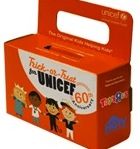 This is now an entire genre of ethics stories, involving a charity facing criticism for aligning itself with a corporate sponsor whose values seem inconsistent with its own.
Here’s the story, by Carly Weeks, for the Globe and Mail: UNICEF sold out by making deal with Cadbury, medical journal says
One of the world’s most influential medical journals is accusing UNICEF Canada of selling out its values by allowing candy giant Cadbury to use its logo to sell Halloween candy.
In an editorial published online Saturday, the Lancet slammed UNICEF Canada for accepting $500,000 from Cadbury Adams Canada Inc. over a three-year period for construction of schools in Africa in exchange for allowing the company to plaster the iconic – and valuable – UNICEF logo on millions of product packages a year….
Just a few thoughts:
1) It seems to me that the worry expressed in the editorial is really that UNICEF is promoting candy, and candy is unhealthy. I’m no marketing expert, but I strongly suspect that if UNICEF’s tacit endorsement does anything at all, it won’t be to boost anyone’s consumption of candy. Rather, it will be to increase sales of Cabury’s candy relative to other brands.
2) Candy isn’t evil. Eating too much candy, too often, is bad for you. But candy is fun. While obesity trends are not irrelevant, here, I’m not sure we need to demonize candy to such an extent that all association with it is considered toxic.
3) It’s worth thinking carefully about the mutual benefits that come from the UNICEF/Cadbury deal. As the G&M story points out,
“the relationship is…lucrative for corporate sponsors because many consumers look favourably on companies that are aligned with good causes, which can help drive sales.”
But why do consumers look favourably on companies that align themselves with good causes? To spell it out plainly, consumers do so because they think that it is a good thing for companies to contribute socially. So it’s not like there’s any trickery here. If consumers think Cadbury is doing something good, Cadbury will be rewarded.
4) Finally, is it worth it for UNICEF? I’m generally hesitant to hand out advice beyond my expertise. I’m not an experienced fund-raiser. So, far be it from me to tell the experts at UNICEF that the decision to align with a candy company is short-sighted. But it does seem plain to me that a charity only has one real asset: it’s brand, and the trust people place in it. In comparison, a carmaker can lose public trust and then regain it by proving that they really do make a great product. Charities make no product; all the public can judge is behaviour.
Happy hallowe’en, everyone!
Consumers’ Right to Information
Filed under: advertising, consumers, food, health, labelling, regulations |
Comments (5)  Over on my Food Ethics Blog, I recently posted a piece on the oft-proclaimed “right to know what I’m eating.” That right is often asserted, but seldom explained. Do we have a right to know everything about what we’re eating? Basically I argue that rights are a very serious kind of moral mechanism, to be used only to protect our most important, central interests.
Now, that blog entry was specifically about the right to know about your food. The (claimed or actual) right to information about your food is of course just one among many (claimed or actual) rights for consumers to know things about the products they’re buying.
Now, sometimes rights arise from government action: under food labelling laws in Canada and the U.S., for example, consumers have a right to know the basic nutritional characteristics — including calories — of the packaged foods they buy. So, does this right follow the pattern I suggested above? Is knowing the precise caloric content of a serving of Special K, or the amount of niacin it contains, essential to protecting or promoting my central interests? Clearly not. But take note: I’m not at all saying it’s not useful information; it clearly is. But people did manage to get by in life prior to such labelling rules. So having that information isn’t essential to protecting an individual’s interests.
Now, some will think this is a counter-example to the (very basic) theory of rights I proposed in my food info blog entry. Here, we have a socially-acknowledged right to a piece of information (calories in your breakfast cereal), despite the fact that it’s a piece of information that is hardly essential to my well-being.
But I think a better lesson can be drawn, here, and that’s that well-justified consumer-protection laws (like nutritional labelling laws) aren’t necessarily designed to protect the rights of individuals. They’re better thought of as being designed to promote the well-being of populations. Knowing how many calories are in a bowl of Special K might not be essential to protecting my interests. But (so the thinking goes) there’s a good chance that forcing companies to reveal that information will result in a more calorie-aware population, which is a good result.
The distinction ‘under the hood,’ here, is an important one. Sometimes we attribute rights to individuals (e.g., the right to a piece of information) because we think that right is owed, morally, to that person. And sometimes we attribute rights to individuals instrumentally, as ways of achieving broader social goals.
—–
Addendum:
I’ll likely return to this set of issues soon. There are lots of things consumers have an interest in knowing. For example, I’d love for the stereo salesperson at Best Buy to tell me if a competitor sells the same item cheaper. Do I have the right to that info? Stay tuned.
When Companies “Play Games” With Prices
Filed under: advertising, consumers, food, pricing, profits, retail |
Comments (10)  Is it ethical for companies — without deception — to make use of well-documented human tendencies and weaknesses in order to get us to buy more? Social scientists have long been aware that humans are subject to a range of cognitive biases that affect the way they think in fairly predictable ways. And, apparently, smart marketers know it, too.
For instance, check out this critique of Apple’s pricing, by Ben Kunz: “How Apple plays the pricing game”
Economist Dan Ariely, author of Predictably Irrational, gives the classic example of a Realtor who shows you a home that needs a new roof, right before taking you to a higher-priced house she really wants to sell. It’s hard to tell if a $400,000 colonial is a good deal – but compared with a $380,000 home that needs work, it looks quite good. Now consider, $499 for an iPad? Well, compared with a smaller one with fewer features, it suddenly looks great.
Decoys explain why Apple often sells each gadget in a pricing series, such as the new iPod Touch’s $229, $299, and $399 price points for different storage capacities. You may gladly spend $229 to get a hot media player, thinking it’s a deal compared with the highest-priced version and not blink that you could instead buy an iPhone 4 at the lower price of $199 with more features.
(Don’t put too much stock in the details of the prices quoted — as one of the comments under the article points out, Kunz may be comparing apples & oranges by comparing retail prices for iPod Touch to the discounted iPhone price that you get when you sign a 3-year contract with a phone company.)
At any rate, practices like the ones Kunz describes are by no means unique to Apple. Many restaurants, for example, will include one or two high-priced entrees. I’ve heard it said that those, too, are “decoys.” The restaurant doesn’t expect to sell much of the $35 Surf’n’Turf, but the fact that there is a $35 entree makes the $25 entrees look very reasonably-priced. Now notice that there’s no actual deception, here…just a reliance on the fact that most people will have their choices swayed by such pricing.
Here’s the short version of the case for such practices: Look, there’s no deception here. And consumers still have free will. And there’s no clear difference between using this kind of so-called “trick” and the “trick”, known by salesmen since time immemorial, that people will buy more stuff if you smile and are polite to them. The relationship between buyer and seller is an adversarial one, so buyer beware. (Notice also that a company can accidentally, unintentionally engage in such pricing. Maybe the restaurant really thought the #35 Surf’n’Turf would sell well. But it didn’t, and so the net effect is that the dish ends up acting as a decoy, but it’s hardly something you can blame the restaurant for.)
Here’s the short version of the case against such practices: The cognitive biases that such pricing preys upon are so strong that they effectively limit consumer autonomy. Preying upon them is therefore wrong. We put limits on marketing to young children, because we realize that young children aren’t fully capable of filtering messages, evaluating options, and choosing rationally. But the (sad) news from the psychological literature is that adults are likewise limited. We just aren’t as rational or autonomous as we think we are. Selling crack to a crack addict is unethical in part because the addict has no choice but to buy. She doesn’t rationally choose to buy the crack: her addiction ensures the sale. Now, cognitive biases of the kind describe above aren’t quite like addictions. But if a given cognitive bias is only effective “most” of the time (as opposed to an addiction’s near certainty) doesn’t the fact remain that the person doing the selling is relying on a kind of human compulsion, rather than on a rational choice that is likely to satisfy the consumer’s needs?
—
If you’re interested in this stuff, I highly recommend Dan Ariely’s book, Predictably Irrational. See also Judgment under Uncertainty: Heuristics and Biases, by they guys who basically invented the field, Daniel Kahneman, Paul Slovic, and Amos Tversky.)
Tip the Farmer?
Filed under: charity, consumers, food, international, quality, retail |
Comments (10)  In much of the world, patrons of restaurants and bars tip their waiters, waitresses, and bartenders, in recognition of a job well-done (and in recognition that, in some jurisdictions at least, such jobs are exempted from minimum wage requirements). More recently, tip jars have shown up at places featuring counter service only, like coffee shops. But if you’re going to tip your barista, why stop there? Why not show your appreciation to, say, the farmer who grew and harvested the coffee?
That’s precisely the idea behind this interesting project: TraceableCoffee.org
“We’re using technology to put a human face on a commodity product that Americans savor every day. Coffee lovers don’t think twice about providing a well-deserved tip to a barista, so why not use your smart phone or computer to tip the actual farmers who grew your coffee,” said Thaleon Tremain, General Manager, Pachamama Coffee Cooperative. “This isn’t charity, but a chance at a more direct and meaningful relationship with your coffee farmer.”
[That’s from this press release.]
Interesting idea. And far be it from me to object to a voluntary transfer of wealth. But I wonder about just why farmers are being chosen as the beneficiaries. The most straightforward answer, of course, is that the project is the brainchild of the coffee growers cooperative. It’s entirely (and not unreasonably) self-serving. But from a consumer’s point of view, why tip farmers, in particular? If you appreciate your coffee, and want to improve the lives of the underprivileged people who made it possible, why single out farmers? Why the farmer, and not the truck driver who brought the coffee beans to the processing plant? Or the longshoreman who loaded the coffee onto or off of the ship that carried it from Guatemala or Ethiopia? Or the shipping clerk who made sure that the paperwork got done? Chances are, none of these people is well paid.
My guess is that our continuing romanticization of farming makes it easier to be sympathetic to the plight of a (poor) farmer than it is to be sympathetic to the plight of a (poor) shipping clerk. But from an ethical point of view, the choice seems entirely arbitrary.
(For a recent blog entry about a project with similar intentions, see “Progressive Garment Factory, or Charity?”).
Interview: Andrew Potter and The Authenticity Hoax
Filed under: advertising, books, environment, food, greenwashing, health, honesty, labelling, natural |
Comments (38)  My pal Andrew Potter is a public affairs columnist with Maclean’s magazine (Canada’s premier newsweekly) and a features editor with Canadian Business magazine. He also has a Ph.D. in Philosophy.
Andrew’s new book, The Authenticity Hoax, is excellent. I interviewed Andrew recently, about the implications the issues discussed in his book have for a range of topics in Business Ethics.
————–
Chris MacDonald: Your new book, The Authenticity Hoax, is about the way our pursuit of authenticity is in many ways the pursuit of a mirage, and you argue that the pursuit of it is ultimately not just futile, but destructive. You say that one element of that — or is it a result? — is a lack of faith in the market. Presumably that plays out, in part, in a perception that business quite generally is unethical, on some level. Is that one of the deleterious effects of the pursuit of authenticity?
Andrew Potter: According to the theory I offer in the book, the quest for the authentic is largely a reaction to four aspects of the modern world: secularism, liberalism, technology, and the market economy. And I think you’re right, that hostility towards the market is probably the most significant of these. Why is that? That’s a whole other book! Though I think something like the following is at work:
First, markets are inherently alienating, to the extent to which they replace more gregarious and social forms of interaction and mutual benefit (e.g. sharing or gift economies, barter, and so on) with a very impersonal form of exchange. The second point is that the market economy is profit driven. This bothers people for a number of reasons, the most salient of which is that it seems to place greed at the forefront of human relations. Additionally, the quest for “profit” is seen as fundamentally amoral, which is why — as you point out — the mere fact of running a business or working in the private sector is considered unethical. Finally, you can add all the concerns about sustainability and the environment that the market is believed to exacerbate.
The upshot is that we have a deep cultural aversion to buying things on the open market. We think we live in a consumer society, but we don’t. We live in an anti-consumer society, which is why we feel the need to “launder” our consumption through a moral filter. That, I think, is why so much authenticity-seeking takes the form of green- or socially conscious consumerism.
CM: Claims to authenticity are a standard marketing gimmick at this point. In The Authenticity Hoax, you argue that authenticity isn’t the same as truth. Authenticity has more to do with being true to some essence, some deeper self. It strikes me that that makes for some very slippery advertising, including lots of claims that can’t be backed up, but can’t be disproven either. Is authenticity the ultimate marketing gimmick that way?
AP: Absolutely. What advertising and politics have in common is that they are both “bullshit” in the philosophical sense of term (made popular by Harry Frankfurt). What characterizes bullshit is that it isn’t “false”, it is that it isn’t even in the truth-telling game. That is why I think Stephen Colbert was dead on when he coined the term “truthiness” to refer to political discourse — he essentially means that it is bullshit.
What is interesting is that authenticity has the same structure as bullshit, in the following way: from Rousseau to Oprah, the mark of the authentic is not that it reflects from objective truth in the world or fact of the matter. Rather, the authentic is that which is true to how I feel at a given moment, or how things seem to me. As long as the story I tell rings true, that’s authentic.
And that fits in well with advertising, since advertising is all about telling a story. Everyone knows that most advertising is bullshit — for example, that drinking Gatorade won’t make you play like Jordan, or that buying a fancy car won’t make you suddenly appealing to hot women. But what a good brand does is deliver a consistent set of values, a promise or story of some sort, which fits with the idealized narrative of our lives, the story that seems true to us. That is why branding is the quintessential art form in the age of authenticity. Bullshit in, authenticity out!
CM: There’s an irony, of course, in the fact that so many companies are making claims to authenticity in their advertising and PR, since for most people the very term “PR” implies a kind of spin that is the exact opposite of authenticity. But that apparent irony echoes a theme from your previous book, The Rebel Sell (a.k.a. Nation of Rebels), doesn’t it? In that book, you (and co-author Joe Heath) argued that all supposedly counter-cultural movements and themes — things like skateboarding, hip-hop, environmentalism, and now add authenticity — are bound to be co-opted by marketers as soon as those ideas have gathered enough cultural salience. Is that part of what dooms the individual consumer’s pursuit of authenticity?
AP: Yes, that’s exactly right. Chapter four of my book (“Conspicuous Authenticity”) is a deliberate attempt to push the argument from the Rebel Sell ahead a bit, to treat “authenticity” as the successor value (and status good) to “cool”.
We have to be a bit careful though about using the term “co-optation”, because it isn’t clear who is co-opting whom. Both cool-hunting and authenticity-seeking are driven not by marketers but by consumer demand, in particular by the desire for status or distinction. And in both cases, the very act of marketing something as “cool” or as “authentic” undermines its credibility. Authenticity is like charisma — if you have to say you have it, you don’t.
That doesn’t mean marketers can’t exploit the public’s desire for the authentic, but it does mean they have to be careful about the pitch they employ; it can’t be too self-conscious. We all know that “authentic Chinese food” just means chicken balls and chow mein, which is why I actually think that things that are explicitly marketed as “authentic” are mostly harmless. It’s when you when you come across words like “sustainable”, or “organic,” or “local” or “artisanal”, you know you’re in the realm of the truly status-conscious authentic.
CM: I’ve got a special interest in ‘greenwashing.’ It occurs to me now that accusations of greenwashing have something to do with authenticity. When a company engages in greenwashing, they’re typically not lying — they’re not claiming to have done something they haven’t done. They’re telling the truth about something ‘green’ they’ve done, but they’re using that truth to hide some larger truth about dismal environmental performance. When companies greenwash, they’re using the truth to cover up their authentic selves, if you will. Do you think the public is particularly disposed to punish what we might think of as ‘crimes against authenticity?’
AP: I’m not sure. It is certainly true that in extreme cases of corporate bad faith the public reacts badly. The case of BP is a good example; as many people have pointed out, its “Beyond Petroleum” mantra is a very tarnished brand right now, and it is doubtful they’ll be able to renew its polish.
But at the same time, I don’t see any great evidence that the public as a whole is disposed to punish companies for greenwashing. Actually, I think the exact opposite is the case: I think the public is very much disposed towards buying into the weakest of greenwash campaigns. The reason, I think, goes back to the point I made earlier about most of us being fairly ashamed of living in a consumer society. Yet at the same time we like buying stuff, especially stuff that makes us feel good about ourselves and morally virtuous. Even the most half-witted greenwashing campaign is often enough for consumers to give themselves “permission” to buy something they really want.
CM: Let’s talk about a couple of product categories for which claims to authenticity are frequently made.
First, food. You argue that much of the current fascination with organic food, locally-grown food, etc., is best understood as the result of status-seeking. So the idea is basically that food elites start out looking down on everyone who doesn’t eat organic. But then as soon as organic becomes relatively wide-spread, suddenly eating organic doesn’t make you special, and so the food elite has to switch to eating local, or eating raw, or whatever else to separate themselves from the masses. And I find that analysis pretty compelling, myself. But a lot of devotees of organic and local foods are going to reject that analysis, and object that they, at least, are eating organic or local or whatever for the right reasons, not for the kind of status-seeking reasons you suggest. And surely some of them are sincere and are introspecting accurately. Does your analysis allow for that possibility?
AP: Sure. The key point is that these aren’t exclusive motivations. In fact, they can often work in lockstep: You feel virtuous eating organic, but you also want to feel more virtuous than your neighbour (moral one-upmanship is still one-upmanship, after all). And so you try to out-do her by switching to a local diet. And when she matches you and goes local too, you ratchet up the stakes by moving more of your consumption to artisanal goods (e.g. small-batch olive oil, handmade axes, self-butchered swine, and so-on).
And this would be a good thing if there were any evidence that these moves actually had the social and environmental benefits that their proponents claim for them. But unfortunately, the evidence is – at best – mixed; the more likely truth is that the one-upmanship angle has completely crowded out the moral calculations.
The more general point is that we need to stop assuming that something that gives us pleasure, or feeds our spiritual needs, will also be morally praiseworthy and environmentally beneficial. That assumption is one of the most tenacious aspects of the authenticity hoax, and it is one that we have no reason to make. There are good and bad practices at the local level, and artisanal consumption has its costs and benefits. Same thing for conventional food production — there are good things and bad things about it. It would be nice if the categories of good versus bad mapped cleanly on to the categories of local versus industrial, but they simply don’t. The belief that they do is nothing more than wishful thinking.
CM: What about alternative therapies? Much of the draw of those products — and at least some of their marketing — seems to revolve around authenticity. People who are attracted to alternative products seem to want to reject modern medicine, which they find alienating, in favour of what they perceive as something more authentic. Now most critics of alternative therapies such as homeopathy primarily object that there just isn’t good evidence that those therapies actually work. But your own analysis provides a further kind of criticism, rooted in the way that those who seek ‘authenticity’ via alternative medicine are engaged in what is more generally an unhealthy rejection of modernity. Is that right?
AP: There is a lot to dislike about modernity, and my argument is not that we should just suck it all up and live with it. My point is rather that modernity is about tradeoffs, and that we need to accept that for the most part, the tradeoffs have been worth making. Yes, some things of value have been lost, but on the whole I think it’s been worth it.
But if there is one part of the pre-modern world that is well lost, it’s the absence of evidence-based medicine. Yet for some bizarre reason, the longer we live and the healthier we get, the more people become convinced that we are poisoning ourselves, and that modern medicine is not the solution to our woes, but part of the cause.
The turn away from the benefits of modern medicine is one of the most disturbing and pernicious aspects of the authenticity hoax. My book has been interpreted by many as an attack on “the left”, but it perplexes me that things like naturopathy, anti-vaccination campaigns, and belief in the health benefits of raw milk are considered “left wing” or “progressive” ideals. As far as I’m concerned, this is part of a highly reactionary political agenda that rejects many of the most unimpeachable benefits of the modern world. We know that naturopathy and homeopathy is a fraud; we know that vaccines don’t cause autism and that public vaccination is the one of the greatest public health initiatives ever; we know that pasteurization has saved countless lives over the years.
But for reasons I cannot fathom, these and many other related benefits are ignored or shunned in favour of an “authentic” lifestyle that is an absolute and utter hoax.

Labelling Dangerous Foods (for Kids)
 In a blog posting a few months ago, I asked “Are Hotdogs Unreasonably Dangerous?” Some commentators suggested that the overriding concern with hotdogs ought to be their (lack of) nutritional value; but the immediate worry discussed in that blog posting was actually the choking hazard hotdogs pose for kids. And the question I posed was whether makers of hotdogs are in any sense responsible for deaths due to choking.
Here’s an update, based on a new story by Laurie Tarkan in yesterday’s New York Times: Labels Urged for Food That Can Choke.
This time, the issue is labelling. Here’s the bit I found interesting:
Some food manufacturers have voluntarily put warning labels on packages. “Two-thirds of hot dogs already have labels,” said Ms. Riley, of the National Hot Dog and Sausage Council. But Mr. Silverglade [legal director of the Center for Science in the Public Interest] said that was not enough….
What’s the weight of that statistic, in terms of how it should guide corporate behaviour? In an academic paper I co-wrote on the labelling of genetically-modified foods, I argued that consensus within an industry matters. When people’s safety is at stake, the fact that government hasn’t passed a law requiring companies to take action doesn’t mean those companies have no obligation to act.
When most companies in an industry think “this is how we ought to do business,” that means something. First, it means that people who know a given product best see a need for action. Also, when an entire industry gets behind a particular standard, that means that companies remain on a level playing field. Changing how you manufacture or label your product might otherwise put you at a competitive disadvantage. But when two-thirds of your industry is implementing the same standard, that argument pretty much falls apart.
PETA Goes Corporate
PETA — the organization best known for its attempts to annoy the world into conforming with its world-view — has found a new tactic:
PETA buys stock to gain influence in boardrooms
An animal-rights group known for sending out scantily clad demonstrators to protest fur and other provocative stunts has gained influence in boardrooms with a more traditional tactic: buying company stock.
People for the Ethical Treatment of Animals has been buying shares for seven years and now owns a piece of at least 80 companies, including McDonald’s and Kraft Foods.
Is this an obvious move, or a stunning one?
It’s somewhat amusing, of course, (and to some, I’m sure, horrifying) to know that, as shareholders, PETA will now start to benefit from the sale of the very meat products it so fervently opposes. But presumably this is an instance in which PETA believes that the ends justify the means. Another way to say the same thing is to say that PETA (to its credit?) is willing to get its hands dirty, in this case by profiting (in the short run) from a business it is trying to destroy. If (as seems likely to be the case) this strategy does succeed in giving the organization a significant voice in the corporate world, then it seems like a good move. I suspect the money they’ll spend on shares will have more impact than the same amount of money spent on publicity stunts. Presumably the only activists who will mind are ones who care less about animals and relatively more about opposing the standard pattern according to which those with money — in this case, PETA — are best able to make themselves heard.



 The Business Ethics Blog