Archive for the ‘honesty’ Category
Business Ethics in China
Filed under: accountability, honesty, international, product safety |
 Comments (4)
  There are significant problems with business ethics in the world’s second biggest economy, China. Witness the recent scandals involving tainted milk powder. Before that, lead paint used in toys was the big issue. Last year, there was a scandal involving injecting water into meat to increase its weight. And it’s not just a matter of a few scandals. According to Transparency International’s 2009 Corruption Perceptions Index, China ranks 79th (just a couple of notches below Columbia, and just above Swaziland and Serbia. (New Zealand is #1 — i.e., least-corrupt. The U.S. ranks 19th, and Canada is tied for 8th.)
Here’s an interesting piece on the topic of the special problems of business ethics in China, on Russell Flannery’s blog on Forbes: On The Front Line In China: Challenging Business Ethics. It’s well worth reading.
Here are just a few thoughts and questions:
1) It’s worth thinking about the relationship between ethics and success in the Chinese context. Three years ago, I blogged from a conference in Latvia, and I pointed out that many countries that were formerly part of the Soviet Union “are still struggling with establishing democratic institutions, and establishing the kinds of background conditions — including the rule of law and traditions of basic trust — that allow their populations to prosper.” In other words, at least some basic business ethics is necessary in order to have a flourishing economy. It’s a truth that many economists (including Nobel prize-winners like Ronald Coase and Amartya Sen) have written about. But China’s economy is booming, apparently despite serious problems related to basic integrity in business. Why?
2) Will foreign trade help? In particular, I wonder about the role of companies like Apple and Walmart. Apple and Walmart (and especially the latter) provide mechanisms for Chinese companies to sell stuff to wealthy westerners. But Apple and Walmart are also high-profile American companies, subject to constant, intense scrutiny. And both have the economic muscle to force Chinese suppliers to do things their way, if they decide to. In other words, if Apple and Walmart insist on (and verify) certain kinds of behaviour, it will happen. In some cases, of course, a company like Walmart — with its constant pressure on suppliers to cut costs — may be part of the problem. On the other hand, dealing with a company like Walmart is going to make all sorts of basic dishonesty very hard to get away with. Walmart famously pays close attention to the details.
3) What about western companies selling things in China? A while back, I blogged about the fact that there’s a lot to be gained by, for example, North American companies that figure out how to do business in China in a way that’s ethically acceptable to the folks back home. In this regard, Google and various pharmaceutical companies come to mind. Again, those are companies subject to significant scrutiny. Is there hope that those companies can raise the ethical tone of the Chinese industries they work in or with? Again, some may find it ironic to see anyone looking to Big Pharma to improve ethics anywhere. But despite its many failings, Big Pharma is heavily regulated, and those regulations (and the threat of litigation) force those companies to avoid behaviours that are likely very tempting to companies operating in places, like China, where regulations may be more lax.
BP’s Faked Photos
 Often when a person or company does something bad, it’s most reasonable to assume that stupidity is the cause, rather than malicious intent. Some behaviour of course is both stupid and unethical. At BP, it’s getting harder and harder to tell the difference.
Everyone’s least-favourite oil company has now been found to have been posting faked photos on its website. (A small excerpt of one photo is above. Lots of others can be found online, including in various news reports on the story. Even at low resolution, you can see tell-tale signs of photo-alteration. The bits of brightness around both men’s heads is evidence of a sloppy cut-and-paste job. Also, the image on the screen shown at bottom-centre of the photo is slightly crooked.)
MSNBC tech blogger Wilson Rothman provides this good, brief summary:
A site called Americablog spotted a press photo of BP’s Houston command center, ostensibly taken on July 16. The image had quite visibly been Photoshopped — badly — to include more on-screen camera action.
Once word got out — the story was picked up by the Washington Post, where it was then spotted by the tech blog Gizmodo and others — BP ‘fessed up. A spokesman admitted that the image was altered, said that a photographer had inserted shots where the TV screens were blank, and provided the original image….
(Here’s the Washington Post version, by Steven Mufson: More doctored BP photos come to light)
Now, it’s worth noting that the changes to the photos are not actually misleading in any material way. Nothing important is hidden, and the faked photos don’t really tell any lies. The changes are basically cosmetic. (In a sense, the photos were merely enhanced to make them more authentic.) But as MSNBC’s Rothman points out, “Though the command center alteration doesn’t seem to be an attempt to hide facts or confuse the public, it heightens skepticism for the company at a time when it should be trying to build trust.” And as WP’s Mufson points out, “While the changes were minor, the embarrassment was major, coming at a time when the oil giant is trying to convince the American public that it is being open and transparent about the oil spill.”
Both Rothman and Mufson are correct as far as P.R. goes. Being caught in even a trivial fib is pretty bad for BP at this point. But what about ethics? Are the faked photos a sign that we generally can’t trust BP? Or rather, since there’s pretty little trust for BP in the first place at this point, does the revelation that they faked these pics give us new, ethically-relevant information about the company? Probably not.
Perhaps most disturbing about this whole fiasco is BP’s attempt to blame the (unnamed) photographer involved. As some have already pointed out, the photoshopping is so clumsy that it’s hard even to believe that it was done by a professional photographer. But at any rate, passing the buck and blaming the photographer is the wrong way to go. If there’s anything the public wants from BP now even more than honesty, it is evidence of willingness to take responsibility.
Interview: Andrew Potter and The Authenticity Hoax
Filed under: advertising, books, environment, food, greenwashing, health, honesty, labelling, natural |
Comments (38)  My pal Andrew Potter is a public affairs columnist with Maclean’s magazine (Canada’s premier newsweekly) and a features editor with Canadian Business magazine. He also has a Ph.D. in Philosophy.
Andrew’s new book, The Authenticity Hoax, is excellent. I interviewed Andrew recently, about the implications the issues discussed in his book have for a range of topics in Business Ethics.
————–
Chris MacDonald: Your new book, The Authenticity Hoax, is about the way our pursuit of authenticity is in many ways the pursuit of a mirage, and you argue that the pursuit of it is ultimately not just futile, but destructive. You say that one element of that — or is it a result? — is a lack of faith in the market. Presumably that plays out, in part, in a perception that business quite generally is unethical, on some level. Is that one of the deleterious effects of the pursuit of authenticity?
Andrew Potter: According to the theory I offer in the book, the quest for the authentic is largely a reaction to four aspects of the modern world: secularism, liberalism, technology, and the market economy. And I think you’re right, that hostility towards the market is probably the most significant of these. Why is that? That’s a whole other book! Though I think something like the following is at work:
First, markets are inherently alienating, to the extent to which they replace more gregarious and social forms of interaction and mutual benefit (e.g. sharing or gift economies, barter, and so on) with a very impersonal form of exchange. The second point is that the market economy is profit driven. This bothers people for a number of reasons, the most salient of which is that it seems to place greed at the forefront of human relations. Additionally, the quest for “profit” is seen as fundamentally amoral, which is why — as you point out — the mere fact of running a business or working in the private sector is considered unethical. Finally, you can add all the concerns about sustainability and the environment that the market is believed to exacerbate.
The upshot is that we have a deep cultural aversion to buying things on the open market. We think we live in a consumer society, but we don’t. We live in an anti-consumer society, which is why we feel the need to “launder” our consumption through a moral filter. That, I think, is why so much authenticity-seeking takes the form of green- or socially conscious consumerism.
CM: Claims to authenticity are a standard marketing gimmick at this point. In The Authenticity Hoax, you argue that authenticity isn’t the same as truth. Authenticity has more to do with being true to some essence, some deeper self. It strikes me that that makes for some very slippery advertising, including lots of claims that can’t be backed up, but can’t be disproven either. Is authenticity the ultimate marketing gimmick that way?
AP: Absolutely. What advertising and politics have in common is that they are both “bullshit” in the philosophical sense of term (made popular by Harry Frankfurt). What characterizes bullshit is that it isn’t “false”, it is that it isn’t even in the truth-telling game. That is why I think Stephen Colbert was dead on when he coined the term “truthiness” to refer to political discourse — he essentially means that it is bullshit.
What is interesting is that authenticity has the same structure as bullshit, in the following way: from Rousseau to Oprah, the mark of the authentic is not that it reflects from objective truth in the world or fact of the matter. Rather, the authentic is that which is true to how I feel at a given moment, or how things seem to me. As long as the story I tell rings true, that’s authentic.
And that fits in well with advertising, since advertising is all about telling a story. Everyone knows that most advertising is bullshit — for example, that drinking Gatorade won’t make you play like Jordan, or that buying a fancy car won’t make you suddenly appealing to hot women. But what a good brand does is deliver a consistent set of values, a promise or story of some sort, which fits with the idealized narrative of our lives, the story that seems true to us. That is why branding is the quintessential art form in the age of authenticity. Bullshit in, authenticity out!
CM: There’s an irony, of course, in the fact that so many companies are making claims to authenticity in their advertising and PR, since for most people the very term “PR” implies a kind of spin that is the exact opposite of authenticity. But that apparent irony echoes a theme from your previous book, The Rebel Sell (a.k.a. Nation of Rebels), doesn’t it? In that book, you (and co-author Joe Heath) argued that all supposedly counter-cultural movements and themes — things like skateboarding, hip-hop, environmentalism, and now add authenticity — are bound to be co-opted by marketers as soon as those ideas have gathered enough cultural salience. Is that part of what dooms the individual consumer’s pursuit of authenticity?
AP: Yes, that’s exactly right. Chapter four of my book (“Conspicuous Authenticity”) is a deliberate attempt to push the argument from the Rebel Sell ahead a bit, to treat “authenticity” as the successor value (and status good) to “cool”.
We have to be a bit careful though about using the term “co-optation”, because it isn’t clear who is co-opting whom. Both cool-hunting and authenticity-seeking are driven not by marketers but by consumer demand, in particular by the desire for status or distinction. And in both cases, the very act of marketing something as “cool” or as “authentic” undermines its credibility. Authenticity is like charisma — if you have to say you have it, you don’t.
That doesn’t mean marketers can’t exploit the public’s desire for the authentic, but it does mean they have to be careful about the pitch they employ; it can’t be too self-conscious. We all know that “authentic Chinese food” just means chicken balls and chow mein, which is why I actually think that things that are explicitly marketed as “authentic” are mostly harmless. It’s when you when you come across words like “sustainable”, or “organic,” or “local” or “artisanal”, you know you’re in the realm of the truly status-conscious authentic.
CM: I’ve got a special interest in ‘greenwashing.’ It occurs to me now that accusations of greenwashing have something to do with authenticity. When a company engages in greenwashing, they’re typically not lying — they’re not claiming to have done something they haven’t done. They’re telling the truth about something ‘green’ they’ve done, but they’re using that truth to hide some larger truth about dismal environmental performance. When companies greenwash, they’re using the truth to cover up their authentic selves, if you will. Do you think the public is particularly disposed to punish what we might think of as ‘crimes against authenticity?’
AP: I’m not sure. It is certainly true that in extreme cases of corporate bad faith the public reacts badly. The case of BP is a good example; as many people have pointed out, its “Beyond Petroleum” mantra is a very tarnished brand right now, and it is doubtful they’ll be able to renew its polish.
But at the same time, I don’t see any great evidence that the public as a whole is disposed to punish companies for greenwashing. Actually, I think the exact opposite is the case: I think the public is very much disposed towards buying into the weakest of greenwash campaigns. The reason, I think, goes back to the point I made earlier about most of us being fairly ashamed of living in a consumer society. Yet at the same time we like buying stuff, especially stuff that makes us feel good about ourselves and morally virtuous. Even the most half-witted greenwashing campaign is often enough for consumers to give themselves “permission” to buy something they really want.
CM: Let’s talk about a couple of product categories for which claims to authenticity are frequently made.
First, food. You argue that much of the current fascination with organic food, locally-grown food, etc., is best understood as the result of status-seeking. So the idea is basically that food elites start out looking down on everyone who doesn’t eat organic. But then as soon as organic becomes relatively wide-spread, suddenly eating organic doesn’t make you special, and so the food elite has to switch to eating local, or eating raw, or whatever else to separate themselves from the masses. And I find that analysis pretty compelling, myself. But a lot of devotees of organic and local foods are going to reject that analysis, and object that they, at least, are eating organic or local or whatever for the right reasons, not for the kind of status-seeking reasons you suggest. And surely some of them are sincere and are introspecting accurately. Does your analysis allow for that possibility?
AP: Sure. The key point is that these aren’t exclusive motivations. In fact, they can often work in lockstep: You feel virtuous eating organic, but you also want to feel more virtuous than your neighbour (moral one-upmanship is still one-upmanship, after all). And so you try to out-do her by switching to a local diet. And when she matches you and goes local too, you ratchet up the stakes by moving more of your consumption to artisanal goods (e.g. small-batch olive oil, handmade axes, self-butchered swine, and so-on).
And this would be a good thing if there were any evidence that these moves actually had the social and environmental benefits that their proponents claim for them. But unfortunately, the evidence is – at best – mixed; the more likely truth is that the one-upmanship angle has completely crowded out the moral calculations.
The more general point is that we need to stop assuming that something that gives us pleasure, or feeds our spiritual needs, will also be morally praiseworthy and environmentally beneficial. That assumption is one of the most tenacious aspects of the authenticity hoax, and it is one that we have no reason to make. There are good and bad practices at the local level, and artisanal consumption has its costs and benefits. Same thing for conventional food production — there are good things and bad things about it. It would be nice if the categories of good versus bad mapped cleanly on to the categories of local versus industrial, but they simply don’t. The belief that they do is nothing more than wishful thinking.
CM: What about alternative therapies? Much of the draw of those products — and at least some of their marketing — seems to revolve around authenticity. People who are attracted to alternative products seem to want to reject modern medicine, which they find alienating, in favour of what they perceive as something more authentic. Now most critics of alternative therapies such as homeopathy primarily object that there just isn’t good evidence that those therapies actually work. But your own analysis provides a further kind of criticism, rooted in the way that those who seek ‘authenticity’ via alternative medicine are engaged in what is more generally an unhealthy rejection of modernity. Is that right?
AP: There is a lot to dislike about modernity, and my argument is not that we should just suck it all up and live with it. My point is rather that modernity is about tradeoffs, and that we need to accept that for the most part, the tradeoffs have been worth making. Yes, some things of value have been lost, but on the whole I think it’s been worth it.
But if there is one part of the pre-modern world that is well lost, it’s the absence of evidence-based medicine. Yet for some bizarre reason, the longer we live and the healthier we get, the more people become convinced that we are poisoning ourselves, and that modern medicine is not the solution to our woes, but part of the cause.
The turn away from the benefits of modern medicine is one of the most disturbing and pernicious aspects of the authenticity hoax. My book has been interpreted by many as an attack on “the left”, but it perplexes me that things like naturopathy, anti-vaccination campaigns, and belief in the health benefits of raw milk are considered “left wing” or “progressive” ideals. As far as I’m concerned, this is part of a highly reactionary political agenda that rejects many of the most unimpeachable benefits of the modern world. We know that naturopathy and homeopathy is a fraud; we know that vaccines don’t cause autism and that public vaccination is the one of the greatest public health initiatives ever; we know that pasteurization has saved countless lives over the years.
But for reasons I cannot fathom, these and many other related benefits are ignored or shunned in favour of an “authentic” lifestyle that is an absolute and utter hoax.

Chiropractic Referral Fees & Conflict of Interest
Filed under: conflict of interest, health, honesty, professionalism, regulations |
Comments (4) Sometimes, when consumers need two different, but related, goods or services, they rely on the advice of the provider of one product to select a provider of the second. That often makes sense, because providers in related businesses often have specialized knowledge that lets them give good advice (e.g., the guy who sells you your carpet likely knows who would be good at cleaning that carpet.) In such a case, people in related businesses can be a good source of expert, independent advice.
That is, if the advice is truly independent. And the most obvious way to eliminate independence is to inject a financial interest into the scenario. If the person you’re relying on for advice is financially beholden to the person he or she is recommending, you have every reason to doubt that advice.
And if that advice you’re after isn’t about something mundane, like carpets (something about which a great many non-experts know quite a lot) but is instead about your health, you have every reason to worry — especially when one of the service providers involved is taking active steps to put the person you’re relying on for advice into a Conflict of Interest.
Here’s an article (in which I’m quoted) about just such a situation. It’s by Yoni Freedhoff, MD, writing for the Canadian Medical Association Journal, Chiropractic clinic offered referral kickbacks
A chiropractic clinic with locations in Ontario, Nova Scotia and Manitoba offered lucrative kickbacks to physicians for referring clients to its five outlets until the College of Physicians and Surgeons of Ontario (CPSO) apparently stepped in to scuttle the payments as a result of CMAJ inquiries.
The offer of kickbacks, which were in the form of financial compensation, arising out of referrals from doctors, came to light as a result of a CMAJ request for a “doctor’s information kit” in accordance with instructions from an advertisement placed in the journal by the Low Back Clinic.
The kit included a document detailing appropriate patient referral criteria, which was followed by the proclamation: “In compliance with the C.P.S.O. standards, a $300 documentations fee will be provided once the patient completes care….”
Summary of problems:
- The payments put referring physicians into a conflict of interest;
- The payments, which are based on completion of a course of care, induce physicians to encourage patients to complete a course of care independent of whether that’s in the patient’s best interests;
- The payments risk jeopardizing patients’ trust in their physicians;
- The payments risk the professional reputation of the medical profession quite generally;
- Referring to the payments as being “In compliance with the C.P.S.O. standards” falsely implies that the payments are required by the C.P.S.O.
All in all, this scheme was a pretty bad idea. Perhaps the clinic offering the fee could be excused for not knowing that doing so was contrary to regulation. But health professionals certainly ought to know enough about conflict of interest to recognize that such a scheme is seriously ethically problematic.
Flexible Ethics in the Wake of Disaster
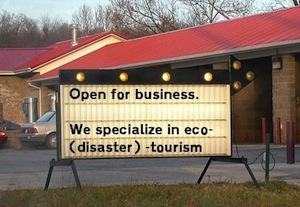 What do businesses in the tourism industry in areas affected by the BP oil spill owe to customers and potential customers? Or, to put it another way, just how closely do businesses in the stricken region need to adhere to the “usual” ethical rules of commerce?
Many businesses along the Gulf Coast have of course been very hard-hit. At this point, large stretches of the Gulf Coast are essentially unthinkable as vacation destinations, unless you happen to be into eco-disaster tourism. As a result, businesses there are fighting for their lives — all due to circumstances beyond their control, but very much within the control of a certain oil company whose name, by now, is all too familiar.
In such circumstances, businesses are likely to do just about anything to draw what tourists they can. Though I don’t know of particular cases, it wouldn’t be at all surprising to see some companies cutting corners, ethically speaking. For example, imagine a potential vacationer calls up a resort on the fringe of the affected area, wanting to know whether that particular stretch of beach is still vacation-worthy. And imagine that the usability of the beach is borderline. What answer should the owner of the resort give, over the phone? How scrupulously honest does she have to be, when the survival of her business (and the livelihood of her employees) is on the line?
The problem posed by the expectations of tourists and the way those are handled by resort owners is illustrated in this article by Mike Esterl, for the Wall Street Journal: In Alabama, a Fight for Tourists
“This is not what we expected,” said Clint Pope, 27, who drove his family to Gulf Shores from Thomasville, Ala., Friday for a weekend at the beach.
Mr. Pope’s 10-year-old son, Drew, and nine-year-old nephew, Nathan, still swam in this stretch of the Gulf on Friday afternoon, along with other tourists. But nobody was going into the water Saturday.
Now it’s tempting to say that the obligation of businesses to deal honestly with customers (and potential customers) is unchanged by current circumstances. But compare: many people thought that the looting that took place in the aftermaths of both Hurricane Katrina and the earthquake in Haiti was morally excusable. Some said it doesn’t even count as “looting” at all, when you’re fighting for survival. Does that principle hold true when the party in question is a small business owner, rather than an individual consumer? If stealing (within reason) is ethically permissible in the aftermath of a disaster, is bending the truth (or even lying) ethically permissible, too?
Now there are of course differences in the two cases. In the Katrina and Haiti cases, people were literally fighting for survival — it was literally life-or-death. Presumably no one in the Gulf Coast tourism industry is literally going to starve to death. But still, the general question remains interesting: to what extent can ethical rules legitimately be bent, when someone’s interests are seriously threatened?
Unethical Herbal Supplements
Filed under: advertising, health, honesty, labelling, natural, pharma, regulations, science |
Comments (1) Hey, what’s in that bottle of all-natural herbal supplements on your kitchen counter? Are you sure? What will those supplements do for you? Cure all that ails you? Something? Nothing? One way or the other, how do you know? The truth is, you probably shouldn’t feel so certain.
 Here’s the story, from Katherine Harmon, in Scientific American: Herbal Supplement Sellers Dispense Dangerous Advice, False Claims
[The lack of evidence for their effectiveness] …hasn’t stopped many supplement sellers from making the false claims and even recommending potentially dangerous uses of the products to customers, according to a recent investigation conducted by the Government Accountability Office (GAO). To obtain a sample of sales practices, the agency got staff members to call online retailers and to pose undercover as elderly customers at stores selling supplements.
Customers were not only told that supplements were capable of results for which there is no scientific evidence (such as preventing or curing Alzheimer’s disease); the advice and information also was potentially harmful (including a recommendation to replace prescription medicine with garlic)….
Some fans of herbal remedies are liable to complain that the relevant government agencies ought to be directing their efforts at the real culprits, namely Big Pharma. Why pick on people who package and sell “natural” herbal products when major pharmaceutical companies are, on a regular basis, found to have engaged in a whole range of dubious and sometimes deadly behaviours? But that’s roughly like a bank robber, upon his arrest, complaining that the cops ought to be out chasing white-collar criminals instead. The fact that embezzlement is a bad thing does nothing to diminish the badness of robbery. Both are wrong, and both are worthy of punishment.
Essentially, what we’re seeing here is history catching up with the makers of herbal supplements. Over the last decades, we’ve imposed increasingly tough rules on the pharmaceutical industry (though those rules still need to be tightened up in various ways). But herbal products are part of the “natural” products industry, and that industry is woefully under-regulated. Indeed, that industry is probably about as well-regulated today as the pharmaceutical industry was, say, 50 years ago.
(p.s. for information about which herbal supplements are and are not backed by good science, see Scott Gavura’s Science-Based Pharmacy blog.)
Pharmacists and Candour About Homeopathy
If someone selling something believes that it doesn’t work, should they tell you so? Does it matter if the person doing the selling is a licensed professional, someone with advanced training and a sworn duty to promote the public good?
From the BBC: New guidance for homeopathy use
The regulatory body for pharmacists in NI [Northern Ireland] has proposed that patients be told that homeopathic products do not work, other than having a placebo effect.
The draft guidance comes following a report on homeopathy published earlier this year by the House of Commons Science committee.
It reviewed the evidence base for homeopathy and concluded that it was “not an efficacious form of treatment”….
Of course, some people believe — despite the best available evidence — that homeopathy really works. But pharmacists (being educated in the scientific evaluation of evidence) generally do not. And as professionals, they have an obligation not just to be honest with customers about that, but indeed to be candid about it.
Here is the Code of Ethics for the Pharmaceutical Society of Northern Ireland. The Code calls upon Pharmacists to “Maintain public trust and confidence in [their] profession by acting with honesty, integrity and professionalism”. That’s pretty vague, so applying it requires interpretation. And in the literature on professional ethics, the argument is usually that what we need from professionals like Pharmacists is not just old-fashioned honesty, but candour. Why? Because mere honesty really just boils down to telling the truth when someone asks you a question. And that’s a very good start, of course. But in many situations — the kinds of situations where we turn to professionals for help — we often don’t know the right question to ask. So we rely on the professionals to be candid; in other words, we rely on them to be open and forthright, and to volunteer information that they think we would want and/or need. And health products are among the most difficult for consumers to understand. So, it’s not at all surprising that the professional body in this case advised its members to be candid with the consuming public about the lack of evidence in support of homeopathy. In fact, it’s barely even commendable, given that candour about such things is a basic professional responsibility.
Should Consumers Trust Big Pharma?
Filed under: accountability, conflict of interest, consumers, honesty, pharma, product safety, profits, risk, science |
Comments (9)  Lots of people don’t trust Big Pharma. And to a significant extent, that’s for good reasons. (I’ve blogged about some of those reasons here, here, here, here, here, here, here and here, just to cite a few examples. See also some of the entries on the other blog I co-author, the Research Ethics Blog.)
Trust in big pharma is an important issue. Pharmaceuticals are responsible for saving and improving a huge number of lives. Vaccines alone have prevented literally millions of deaths. Survival rates for many cancers are better than they used to be. And AIDS, once a death sentence, is now regarded as a chronic disease. So there’s real benefit from pharma, but also an undeniable track record of scandals and general unethical behaviour. What should we think?
The first thing worth noting is that the question in the title above is vastly oversimplified. The question isn’t “should consumers trust big pharma?”, it’s more like “To what extent, and under what circumstances, on what issues, should consumers trust big pharma?”
Setting aside the industry’s spotty track record, the main reason people tend not to think Big Pharma trustworthy is, of course, the fact that Big Pharma consists of profit-oriented organizations. And the general assumption is that money corrupts. Of course, money isn’t the only thing that corrupts judgment (so does love, reputation, ideology, etc etc), and big pharma is far from the only industry where big money is at stake. But still, there’s a real worry here (one I’ve blogged about before).
Now, what about the reasons in favour of trusting Big Pharma? What factors would tend to make Big Pharma trustworthy, to at least some extent?
Now I cannot emphasize this strongly enough: what follows is not intended to imply a general conclusion about the trustworthiness of Big Pharma. It’s just a list of important factors to keep in mind when assessing the trustworthiness of a particular claim, by a particular company, on a particular issue.
1) Ethics. Don’t just think about the organizations; think about the people who work at them. They’re mostly people like you & me. Most of them got into the business to try to help people (and, yeah, to make a living). And most of them were raised by their parents to be decent, honest folks. Most people tell the truth about most things most of the time.
2) Regulation. The pharmaceutical industry is heavily regulated, subject to lots of laws regarding the efficacy and safety of their products, as well as regarding advertising. Criminal and civil sanctions are possible when pharma companies misbehave. Now, that’s not to say that the current level of regulation is sufficient, or that enforcement is adequate. But companies (and individuals) have been subject to serious sanctions. Companies generally want to stay out of court, and so they’ve got a reason — not always a sufficient reason, but a reason — to behave in a trustworthy manner.
3) Peer Review. In few other industries is fundamental information about what makes your product work (or not work) open to public scrutiny. In order for a new drug to receive approval to be marketed, it has to show itself to be safe and effective in clinical trials, and the results and methods of those trials have to be published in peer-reviewed medical journals. Drug companies are not allowed to make claims based on secret data. “Peer reviewed” means that the articles reporting on the trials have to be vetted by a panel of qualified experts if they are ever going to see the light of day. It’s an imperfect system (all systems relying on human judgment are) but bad science tends to get weeded out pretty quickly. Then, once a study is published, it’s there for assessment, and potentially criticism and rebuttal, by hundreds or thousands of other experts.
4) Scientific Overlap. You sometimes hear it implied that physician-researchers (the ones who do most clinical research, as well as doing all that peer reviewing mentioned above) have all been corrupted by corporate money. And it’s true that there really is cause for worry here. Too many docs get too much money (and other perks) from pharma, and are insufficiently transparent about that. So: it’s good to worry…up to a point. Here’s the problem with the pharma-controls-everything theory. Physician-researchers publish in scientific journals that are read not just by other physicians (some of whom don’t have industry funding), but also by biologists, chemists, epidemiologists, statisticians, and so on, most of whom have no corporate funding whatsoever. Further, modern science more generally is an enormously complex process for finding mistakes and exaggerations in each other’s research. And it helps that there’s significant overlap between the sciences, so no one group of scientists is ever truly isolated and free from scrutiny. Oversimplifying, you could say that biologists are double-checking the work done by the physicians, chemists are checking up on the biologists, and physicists are checking up on the chemists. (That’s why any physician who tries to use “quantum theory” in writing about disease had better be careful: there are armies of physicists waiting to explain just how irrelevant quantum mechanics is to human physiology.)
5) Competition. People often talk about Big Pharma as if it’s a monolith, one big organization, rather than a bunch of companies with divergent interests competing savagely with each other. That competition gives them every reason to attack each other’s weaknesses, and to point them out to the public. Add to that the fact that there are hundreds of smaller firms nipping at the heels of the big players. It’s far from a cozy conspiracy. This vicious competition of course means that there’s sometimes an incentive to cut corners in unscrupulous ways; but it also means that when you cut a corner, there’s always someone out there ready to point it out.
Now, again, this list is not supposed to lead to any particular conclusion about just how trustworthy Big Pharma is. It’s just a list of social and institutional mechanisms we need to take into consideration, in addition to the obvious bad track record and obvious financial incentives. Each of those mechanisms will apply to a greater or lesser degree with regard to specific situations. For particular issues, we need to think carefully both about what’s at stake, and about whether the above factors are likely to be sufficient to reassure us.
——
Late-breaking Note:
I’ve been getting (and rejecting) comments full of unsubstantiated, and in some cases very dangerous, claims on some topics related to the above. When it comes to matters of health, if you’re not going to cite reliable sources, I cannot take responsibility for allowing your comments on here. There’s too much at stake, in terms of public health.
Modern Ethics: More Than Personal Integrity
Filed under: character, ethics, government, honesty, virtue |
Leave a comment  I blogged two weeks ago about Obama & Business Ethics.
Today, Wayne Norman (of Duke University’s Kenan Institute for Ethics), has this very good opinion piece in the Durham, NC News & Observer: “Honor and conflicts in the new age of ethics”.
Here are the first few paragraphs:
On his first full day in office, President Obama chose to shine the spotlight on “Ethics Commitments by Executive Branch Personnel.”
The executive order issued Jan. 21 requires all those appointed during Obama’s presidency to an executive agency to sign a pledge contractually committing them not to accept gifts from registered lobbyists or lobbying organizations, among other similar restrictions.
These reforms are primarily concerned with avoiding conflicts of interest and restoring public trust in Washington. They do not in any way lie along a traditional right-left continuum, but they do represent a paradigm shift in values, one that might best be described as “generational.”
Older generations of politicians cling to the belief that they can ensure government integrity merely by appointing honorable people to sensitive offices, even if these people have outside interests (say, had just worked or lobbied for a firm they are now supposed to regulate).
Obama and much of his team have come of age in an era which recognizes that organizational and professional ethics cannot be expected to piggyback entirely on the virtues and character traits of good individuals. In other words, designing and running an ethical organization now requires concepts and categories of values that nobody learned at their mother’s knee.
Wayne’s overall point is obviously not just about the Obama administration. It’s about the right approach to ethics in any complex institutional setting. Once upon a time, the best advice we could give to leaders and administrators was, “Do your best. Be honest. Don’t give in to temptation.” And that’s still good advice. But increasingly, good ethics has to be not just about the integrity of individuals, but about how to structure institutions so that they work as well as possible, in spite of the foibles and frailties of the best among us, and the machinations of the worst.
(Note: Wayne & I co-authored a chapter on Conflict of Interest for the forthcoming Oxford Handbook of Business Ethics. Wayne is also the author of Negotiating Nationalism: Nation-Building, Federalism, and Secession in the Multinational State.)



 The Business Ethics Blog