Archive for the ‘Uncategorized’ Category
Obeying the Law is Hard
 Comments (3)
 The The FCPA Blog recently published a useful roundup of enforcement actions taken under the US Foreign Corrupt Practices Act during 2011. It’s a fascinating window into what is a huge and fascinating topic, namely law-breaking by or at corporations.
For businesses, following the law doesn’t exhaust ethical responsibilities, but it’s an awfully good start. Most of us probably think that following the law is absolute minimally-decent behaviour for business. You absolutely must follow the law, and a business certainly shouldn’t be praised for achieving that basic minimum, right? But in fact, it’s not always so easy for companies to follow the law.
Part of the problem is that “the law” is not a simple, straightforward thing. Particular laws can be vague or ambiguous. And what counts as legal cannot always just be looked up, in part because so much depends on prosecutorial discretion. Many people have commented on the difficulty of knowing, in advance, what sorts of behaviours prosecutors are going to decide to take a swing at, whether in applying the Foreign Corrupt Practices Act or deciding when CEOs have neglected their duties to shareholders.
The other problem has to do with scale. If you operate a business with 100,000 employees, there’s a pretty high likelihood at any given moment that, despite your best efforts, one of those employees is doing something either illegal or in a legal grey zone. Compare how likely it is to achieve a zero crime rate in a town of 100,000 citizens. Of course, the citizens of a town aren’t part of an authority hierarchy the way that employees of a corporation are, but still you see the problem scale brings.
(Also compare this to the FDA’s food contaminant standards. The fact that there’s an allowable number of rodent hairs for a jar of peanut butter may be disgusting, but it shouldn’t be surprising: it is inconceivable that there could be a large-scale food-production system with zero contaminants.)
Another factor is the number and complexity of laws and regulations. For you & me, the legal rules to follow in our everyday lives are few and simple and minimally disruptive: don’t kill, don’t steal, etc. Not so for many companies. Companies in some industries are subject to perhaps hundreds or thousands of separate legal requirements. Note, for instance, that the full text of the Dodd–Frank Wall Street Reform and Consumer Protection Act is over 2000 pages long.
A final factor worth pointing out is the apparently-criminogenic nature of corporate workplaces. For a range of reasons much more complex than is commonly acknowledged, people seem more willing to break the law at work than they are at home. Among the likely factors are competitive zeal, the desire for career advancement, tunnel vision, and group-think.
The net result of all these factors is that, for a big company, consistently complying with the law is actually a significant achievement. Getting employees consistently to follow the law is in fact a fundamental managerial challenge. The US Federal sentencing guidelines reward companies for even attempting to do a competent job of implementing an ethics and compliance program.
But compliance with the law is unlikely to win a company kudos from very many observers, focused as so many are on the “above-and-beyond” stuff normally associated with Corporate Social Responsibility. But when a particular behaviour is so incredibly difficult, and so incredibly important, what on earth could possibly be more deserving of praise?
PhD Programs in Business Ethics: 2012
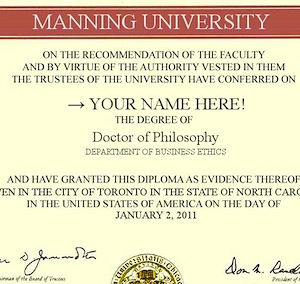 It is an indicator of the growing interest in the field of Business Ethics that a number of universities now offer opportunities for students to earn a PhD in the topic.
I often get email from students and professionals looking for advice on how and where to study ethics at the graduate level. I point out that there are two main ways to get a PhD in Business Ethics. One traditional way is to do a PhD in Philosophy like I did — Philosophy departments are the traditional home of ethics scholarship at universities — and focus on ethical issues in business. The other way is to find a Business school that offers either a PhD program specifically in Ethics, or one with a PhD program that is at least open to students who wish to specialize in ethics.
For students with a background in Philosophy, doing a Philosophy PhD is the obvious route [though not necessarily best route*], and there are literally dozens if not hundreds of Philosophy departments where you could do a PhD in Business Ethics — all that’s required, really, is a willing and qualified supervisor. But this route is typically only open to students with a background (at least an undergraduate degree, and preferably a Master’s degree) in Philosophy.
The situation is less clear for students with a background in Business — B-school programs are out there, but they’re harder to find. So I’ve done a bit of digging and prepared the following list.
Caveats:
The following information was gathered fairly casually by word-of-mouth. No guarantees, and no endorsement is implied. Please contact the directors of particular programs for further details.
Business School PhD Programs in Business Ethics:
In no particular order…
- Rutgers Business School (my pal Miguel Alzola, who now teaches at Fordham, got his PhD there, under the direction of Ed Hartman.)
- Wharton (at UPenn) has a PhD program in Ethics and Legal Studies
- The PhD program at the Darden School of Business lists ethics among the areas on which students can focus.
- The University of Groningen (in the Netherlands) doesn’t have a “program” in business ethics, but I’m told that both the Faculty of Philosophy and the Faculty of Economics and Business welcome applications from students interested in doing research in business ethics.
- Benedictine University has a Doctor of Philosophy/Doctor of Business Administration (Ph.D./D.B.A.) Program in Values-Driven Leadership
- Penn State: Ph.D. in Business Administration – Management and Organization
- The PhD program in Organizational Behaviour at Utah has several faculty members who specialize in ethics.
- PhD program at the Schulich School of Business (where my friends Andrew Crane and Dirk Matten teach) encourages work in Ethics and CSR.
- Students in the Ph.D. program in business at the University of Kansas can study topics in business ethics via the program’s Organizational Behavior concentration.
- Students at Nottingham University Business School can do a Phd in CSR.
If you know of programs that should be added to the list, email me.
For additional perspective, you can also find out which business schools take ethics seriously by looking at the “Beyond Grey Pinstripes” rankings — but not all of the schools listed there will have PhD programs.
(Note: This is an updating of the list I did back in 2008, based on an informal survey of colleagues, of PhD Programs in Business Ethics. The information there may still prove useful, though I haven’t been able to verify that all the schools listed there still allow or encourage PhD work in ethics.)
——
Addendum: I’m told that people have recently done ethics-related PhD’s at Michigan, Maryland, and Central Florida. I had originally omitted those schools because their PhD programs make no specific mention of ethics.
——
*Addendum 2: A reader has rightly pointed out to me that those with an undergraduate or MA in philosophy can also do a PhD in business, that doing so broadens a student’s perspective, and that doing so is likely to improve chances at employment.
Child Labour and Victoria’s Secret, Again
Two weeks ago I blogged about a Bloomberg story on the use of child labour in the cotton fields of Burkina Faso, and the purchase by Victoria’s Secret of the resulting cotton. I argued that while child labour is always bad, always regrettable, it isn’t on net always morally wrong. Victoria’s Secret isn’t necessarily doing anything wrong, despite the fact that some of their cotton is, yes, the result of child labour. Burkina Faso is desperately poor, and persistent child labour is a sad reality there: poor families simply cannot afford a better life for their children. And both the children and their families would be worse off were it not for the livelihood provided by VS.
But a soft line in child labour doesn’t sit well with everyone. And so, last week, my Canadian Business colleague Samson Okalow took issue with my arguments and posted a response. The solution to child labour, Okalow argued, is not as complex as I’d made it out to be.
Okalow makes a number of good points, and his commentary is well worth reading. But I’m standing by my original argument, and I’ll make just two points by way of explanation.
The first has to do with the facts of the case. In my original posting, I questioned what the net impact would be of VS volunteering to pay more for cotton. Would the extra money improve the prospects of child labourers, or just draw more people into the business and drive prices (and wages) down? In his commentary, Okalow rightly presses me on the details. But the fact that neither Okalow nor I knows the answers to those questions is just the point: we should be cautious about prescribing medicine without understanding its side effects.
The second point has to do more straightforwardly with ethics, with what VS (and other companies in similar situations) is obligated to do.
Okalow rightly points out that the plight of Burkina Faso’s child labourers needn’t be quite so bleak. VS could certainly do more to help; in particular, the company could opt to pay even more than it already does for premium organic fair-trade cotton, and therefore to make a smaller profit. As Okalow rightly points out, maximizing profits isn’t the only option VS has. It’s also possible to settle for merely sufficient profits: there certainly are organizations set up to operate that way.
The problem, here, is that it confuses the good with the obligatory. Helping those in need is a good thing to do. If Victoria’s Secret opted to donate money to the poor of Burkina Faso, by over-paying for cotton, they might well deserve praise, just as you would if you donated money to a charity set up to aid the desperately poor. But so far I see no reason why VS, in particular, or their customers or shareholders, in particular, are obligated to do so. All of the above are certainly obligated not to make the lives of children in Burkina Faso any worse. That’s the moral baseline for business everywhere, the thing that underpins the very legitimacy of private enterprise. But that’s different from being obligated to help; an obligation to help doesn’t just spring out of thin air.
And remember, VS (and its customers and shareholders) are already doing more for the children of Burkina Faso than other companies (and their customers and shareholders) are. To criticize a company like VS for daring to help (by investing in) Burkina Faso, without helping as much as it could, is not just hypocritical but surely also counterproductive. After all, it would be simpler for VS simply to buy American cotton and avoid all this controversy. And that would certainly make plenty of “Buy American” zealots happy. But it would also make the children of one of the world’s most brutally-poor countries worse off.
What’s Legal Isn’t Always Ethical
The fact that something is legal doesn’t make it ethical. You might think it’s obvious, but it’s not, as evidenced by the fact that a former student recently told me that his Finance professor explicitly told him that if something is legal, it’s ethical…full stop. Of course, the student — my student — knew better, and related the story to me while rolling his eyes.
So let’s make the case explicitly, and explain why legality doesn’t determine ethics.
First, we can proceed by enumerating a few counter-examples:
- Most kinds of lying are perfectly legal, but lying is generally recognized as being unethical;
- Breaking promises is generally legal, but is widely thought of as unethical;
- Cheating on your husband or wife or boyfriend or girlfriend is legal, but unethical, though the rule against it is perhaps more honoured in the breach;
- …and so on.
So, if you want to hold that what is legal is also ethical, you’ve got to bite an awful lot of bullets, and accept as ethical a lot of behaviours that you very likely don’t want to accept.
Of course, it could be that the aforementioned Finance professor wasn’t making a general claim about the relationship between ethics and law at all, but was instead making a more subtle point about ethical standards in competitive domains. After all, ethical rules are different in adversarial situations, and it might well be argued that in the highly-regulated world of commerce, businesses should feel justified in helping themselves to whatever strategies aren’t specifically outlawed.
But that rationale is, at best, incomplete, and leaves open a different line of argumentation, one that applies even within competitive domains, and one that should truly drive a stake through the heart of the “legal=ethical” nonsense.
The ultimate disproof lies in the hidden circularity of the Finance professor’s argument, which we can illuminate by contemplating the process by which something is made illegal.
Consider: on what general basis is something made illegal? Let’s set aside cases of unscrupulous legislators passing laws simply to benefit themselves or their friends. In all legitimate cases of lawmaking, the law always has a moral purpose — generally, either to make people’s lives better and safer (e.g., seatbelt laws) or to protect some important right (e.g., food-labelling laws).
But if the aforementioned Finance professor were right, there would be no possibility of finding a moral rationale for any new law. After all, according to him, if a behaviour is legal (right now) then it is ethically OK (right now). On what basis could new laws ever be passed? Certainly not on ethical grounds, because per hypothesis if something is currently legal is must be ethically OK. What if some horrible new toxin is discovered, the use of which by industry would pose significant risks to workers or consumers? Should it be banned? According to the Finance professor, it cannot be. After all, using it is legal, so it must be ethical; and if it’s ethical, it cannot be made illegal.
Anyone who tells you, or simply implies, that whatever is legal is also ethical is most likely indulging in self-serving rationalizations. When that idea comes up in the private sector, it’s likely that someone is trying to justify some profitable behaviour that is unethical but not-yet illegal. When that same idea comes up in academic circles, it’s more likely the self-interest they are trying to preserve is their own interest in avoiding the hard work of figuring out which business behaviours are unethical, and why.
(See also the entry on Law, from the Concise Encyclopedia of Business Ethics.)
Boycotting Hypocrisy
As you’ve probably all heard by now (and as Canadian Business reported last week) the fruit company Chiquita has joined a boycott of fuel originating in Alberta’s oilsands. The folks flying the “ethical oil” banner have responded by suggesting Canadians should boycott Chiquita.
This story of boycott and counter-boycott actually started last year when a group led by Forest Ethics and Corporate Ethics International called for a boycott of Alberta tourism.
Now, this is not just a matter of tit-for-tat; there’s more moral significance to it than that. To begin, you don’t have to be a big fan of the oil sands to acknowledge that it is with some justice that the “ethical oil” advocates suggest that what the boycott means, in practice, is that Chiquita is going to be getting its oil from sources at least as ethically-fraught as the oil sands. Defenders of the oil sands have also pointed out that Chiquita’s own history is not without its ethical blemishes. See, for instance, the fine Chiquita paid for its involvement with Columbian paramilitary groups.
OK, so nobody’s perfect. But should we really limit stone-throwing to those without sin? Probably not. Being a hypocrite is different from being wrong. And so if — if — Chiquita is right about oil-sands oil being not just bad, but the worst, then there’s nothing wrong with them expressing that view, that company’s own ethical shortcomings notwithstanding.
No, the real problem with this boycott is that, like most boycotts, it is such a disastrously blunt instrument. Although typically portrayed as sending a message, boycotts actually send their message through brute force: they are — if and when they work — a form of bullying. Boycotts are populist, rather than democratic. And maybe that’s OK. Power to the people, and so on. But I wonder how ready the average ‘green consumer’ is to wave the people-power banner, when the ‘people’ exercising the power are really corporate persons.
Victoria’s Secret and Child Labour
Child labour is always bad, but it’s not always wrong. And here’s why.
Of all of the issues that fall under the very broad heading of “business ethics,” child labour is among those least likely to be seen as grey. Most people agree, I think, that play, and learning, rather than labour, should be the dominant features of a child’s life. For a kid, learning to tidy up your own room is a fine form of “work,” as is taking out the garbage or helping dad rake the leaves on the weekend. But kids, most will agree, shouldn’t be working in factories or toiling in the fields.
Unfortunately, the world isn’t like that. Bloomberg yesterday featured an utterly heartbreaking story about child labour in the cotton fields of Burkina Faso. The story, which focused on the hard life of 13-year-old Clarisse Kambire, resulted in an avalanche of tweets aimed at Victoria’s Secret.
Why Victoria’s Secret? Because the lingerie company buys almost all of the cotton produced by Burkina Faso, under a deal that features 3rd-party monitoring intended to ensure that the cotton is organic and fair-trade. The root of the story is that the monitoring system failed, and cotton that was supposed to be harvested without the use of child labour was not. Desperately-poor farmers in Burkina Faso, it turns out, have been using their children (and the children of relatives and neighbours) in their cotton fields.
In other words, the company tried to do something good, and the good stuff it did turned out to be less-good than they thought it would be. But if all you saw were the breathless tweets and the headlines of the me-too stories, you’d swear that Victoria’s Secret models themselves were out in the fields, beating children to work faster, faster, to feed the world’s hunger for thongs.
The case of Victoria’s Secret’s cotton supply illustrates a clear failure of third-party supply-chain monitoring, but it is also an illustration of the complexity of third-party supply-chain monitoring. It’s a lovely idea to promise your customers organic, fair-trade cotton, but making good on the promise is another thing altogether.
The fundamental problem, though — the one that makes the life of a parentless child in Burkina Faso so miserable — is that Burkina Faso is a miserably poor country. The sad truth is that for some kids there, labour in the cotton fields is their best alternative; their families can’t really afford to feed them, let alone to send them to school. This is why I say that while child labour is always bad, it’s not always wrong.
So consider: what will the effect be of the spotlight currently being shone on the use of child labour in Victoria’s Secret’s supply chain? One possibility is that the rule will now be enforced. Clarisse Kambire will then be out of a job, and then what? Another possibility is that companies like VS will decide to keep their hands clean, and abandon Burkina Faso altogether. That would let them avoid nasty headlines in the future, but it would also mean a significant economic hit for a country that can’t exactly take it in stride.
But if Victoria’s Secret is truly committed to keeping its supply chain free of misery, couldn’t it simply offer to pay more for cotton, so that kids like Clarisse Kambire could get at least one solid meal a day and maybe attend a bit of school? Perhaps. But it’s not obvious how effective that would be. Pouring more money into a supply chain has complex effects. As I’ve pointed out before in regards to fair-trade coffee, paying more for something draws more people into the business, which increases supply, which drives down prices. Note also that if VS customers are willing to pay more for the cotton in their panties, that inevitably means they’re spending less money on something else — and spending less on something else means someone else, somewhere, is earning less money. Will that be someone who needs it more, or less, than Clarisse Kambire? I have no idea.
We should never, ever be complacent about child labour. But nor should we delude ourselves into thinking that good intentions, or a few extra pennies spent on a pair of panties, can make the problem go away.
Three Questions About Business and Human Rights
 I spent the last two days at a workshop on the human rights responsibilities of business, being held at Duke University’s Kenan Institute for Ethics.
It was a wide-ranging discussion, involving representatives from academia, NGOs, and industry. The discussion was focused on the “Guiding Principles on Business and Human Rights,” developed by UN Special Representative John Ruggie. The Guiding Principles are rooted in a “Protect, Respect and Remedy” framework, which says that governments have obligations actively to protect human rights, that businesses have an obligation at least to respect human rights, and that all individuals ought to have access to remedies when their rights have been violated. The hard part, of course, is putting that framework into action, a task that has fallen to a Working Group recently established by the UN, two members of which were at the Duke workshop in an unofficial capacity.
Here are three questions — food for thought, really — related to the implementation of a human rights regime intended to apply to transnational corporations. There’s nothing special about this short list of questions (many more arose over the 2-day discussion here at Duke), but it’s a starting point if you’re new to the topic.
1. How does human rights fit into the range of other issues related to “business doing the right thing”? This is both a conceptual question and a question about the practicalities of implementation, especially for companies already engaged in measuring, tracking, comparing, and training for performance in terms of CSR, sustainability, compliance, good governance, etc. Are there performance metrics typically understood as part of CSR reporting, for example, that could be repurposed as human rights measures?
2. How large does a company have to be in order to have “serious” human rights obligations? Obviously, all companies should respect human rights. But demonstrating respect can be done in a variety of ways. Big companies are increasingly expected to do much more than stay out of trouble: they’re expected to evaluate the risks their operations pose to human rights, and sometimes to report on such evaluations. Big companies — the Coca Colas and Walmarts of the world — have the resources to do this. But companies are enormously variable in size and capacity, from the sole proprietor through the SME all the way up to Walmart, ExxonMobil, and Toyota. Smaller companies may have neither the financial resources nor the know-how to implement rigorous human-rights monitoring and policy-making. Guiding Principle #15 says that “In order to meet their responsibility to respect human rights, business enterprises should have in place policies and processes appropriate to their size and circumstances….” But the word “appropriate” leaves a lot to be figured out.
3. Who will pay for increased monitoring, reporting, and policy-making within particular supply chains? Note that this is only loosely related to the question of who should pay. When a new set of costs are imposed on a value chain, which participant in that value chain foots the bill is an empirical question, but (as economists Tyler Cowen and Alex Tabarrok point out) the answer is likely to be determined in part by the relative (in)elasticity of supply of, and demand for, that particular product or service. Roughly speaking, a powerful retailer is likely to be able to force a less-powerful manufacturer to suck up the costs of making sure there are no downstream human-rights risks. This may bring about unanticipated consequences, including unintended reductions in the well-being of average workers. That’s not to say that such reductions in well-being wouldn’t be justified (after all, we’re trying to protect human rights, here). But it is to say that such risks ought to be considered.
No one questions very seriously the significance of human rights. But rights aren’t the only ethically-important constraint on business behaviour, and that raises problems. By their very nature, rights tend to resist efforts to achieve balance: they tend to be understood as absolutes, lines beyond which we must not step. That gives rights-based arguments a lot of potency. But it also means that businesses face serious challenges in doing the socially-responsible thing, namely balancing the pursuit and protection of human rights with other, arguably equally important moral obligations.
Soup, Safety, and Social Reponsibility
 Every product poses risks. Just how safe does your product have to be, in order for you to market it in good conscience? How unsafe does it have to be in order for you to take it off the market or redesign it?
Case in point: NPR recently ran a story on Why Burn Doctors Hate Instant Soup. The basic problem is that some brands of soup sold in styrofoam cups pose a hazard to kids. They’re tippy, and have a tendency to spill when kids grab them. And when boiling-hot water and noodles spill on a kid, serious burns can result.
What are we to say, ethically, about a risky product like this?
Part of the problem here is that risk is not an objectively-measurable quality. Sure, you can count the number of burns in a relatively objective manner. But you can’t objectively determine which burns were caused by bad design and which were caused by either unreasonable parental behaviour or pure accident. And while you can measure the angle at which various brands of soup tip, you cannot measure what degree of tippiness is reasonable.
But still. It’s kids, here. Kids getting seriously burned. And the NPR story notes that there’s a relatively simple solution: making the soup containers low and wide, rather than tall and narrow, reduces the risk of tipping considerably. But are companies morally obligated to redesign their soup packages?
I think this is a good example of a question best posed in terms of corporate social responsibility, rather than in terms of obligations to particular consumers. Consider the more individualistic alternative: is Nissin Foods obligated to reduce the risks of the soup they sell to me? To the average consumer? To the average parent? To the super-conscientious parent? To the negligent parent? After all, tippy containers might be perfectly reasonable as a product to sell to super-conscientious parent, and entirely unreasonable as a product to sell to the negligent parent.
But big companies don’t design their products for individuals; they design and sell them to a society of consumers. That effectively washes out the kinds of questions about individual contributory negligence that would be entirely appropriate in the context of an individual’s claim that she has been hurt by a product.
From a social point of view, a worst-in-class product that results in a pattern of harm to consumers seems to imply a clear obligation on the part of the manufacturer: redesign the product, or at very least take a long hard look at the tradeoffs involved between the cost of manufacturing and the risks of consumption.
Visa, Rwanda, and Trust
I bought lunch for a colleague yesterday, and left the restaurant without paying. Or at least, to an untrained eye, it would seem that I had done so. Rather, I had of course paid by means of a credit card. The restaurant, in other words, trusted the credit card company, which in turn trusted me, to pay up. None of this required that I have any cash at all in my pocket, nor even that I have money in my bank account. All that it required was trust rooted in knowledge of financial capacity. The financial capacity part, of course, was up to me. But all the capacity in the world would not have been enough without the relevant institutional mechanisms to verify it.
Such trust-based transactions happen billions of times each day. They are so much a part of everyday life that we take entirely for granted just how remarkable, and just how essential, they really are. This is probably the most important function of financial institutions. They make possible the wide range of commercial transactions that permit our modern standard of living. And that is what makes this next story worth reading.
Bloomberg reports that Visa, Inc. has “agreed to help develop Rwanda’s payments system and connect the African nation’s 11 million citizens to the global economy….”
And Rwanda is a country deeply in need of increased commerce, both domestic and international. In, 2010 the country ranked 165th in the world in terms of per capita GDP. (Not coincidentally, Rwanda also ranks among the worst countries in the world for infant mortality.) Giving its consumers and businesses a greater range of ways in which to receive and make payments is a step in the right direction.
The financial industry has received more bad press than good lately. But on the face of it, at least, this particular story seems like good news.
It’s no exaggeration to say that trust is the foundation of all commerce. Any company that gives people a mechanism that promotes trust, and hence facilitates commerce, is doing a genuine public service. But what are the chances that devotees of Corporate Social Responsibility will see this move by Visa as an example of that?
Crisis Management as Ethical Improv
 Ethics is often thought of in terms of rules: things we must do, and things we must not do. But ethics is also inevitably contextual. As moral agents we have to apply rules in a way that is sensitive to the situation. That doesn’t mean the rules go out the window. It just means that rules need to be interpreted, and applied to the particularities of the case at hand. This requires some judgment, and imagination.
Ethics is, in other words, a matter of improvisation.
The improvisational nature of ethics is particularly plain when a company is faced with an organizational crisis. A crisis is, by definition, an unexpected set of circumstances. And it requires, I think, a set of skills quite closely aligned to the skills required for musical improvisation of the kind manifested by, say, a good jazz musician.
Now let me be clear: when I refer to “crisis management,” I’m not talking about PR, about saying the right things to placate an angry public. I’m talking about genuinely figuring out the right thing to do, in a novel situation that requires urgent action. When your product is suspected of causing deaths, what should you do? When an executive is charged with a financial crime, how should your company respond? When disaster strikes in your community, what should your company do to help out? That a company has responsibilities in such contexts is clear; just what those responsibilities are is less clear.
Here are 5 specific ways in which ethical crisis management is like musical improvisation:
1. Perhaps most obviously, ethical response to a crisis must be creative. The right thing to do won’t be found in any pre-established script; it’s going to require an ability to adapt to the situation, and to exercise some moral imagination.
2. Ethical crisis management must be grounded in structure. Improv doesn’t mean hitting random notes. For a musician, improvisation (typically) means deviating from the melody while continuing to follow an underlying structure of some sort. Similarly, an organization is going to want to draw upon the relevant ethical principles, as well as its own basic ethical structure, consisting of things like its Code of Ethics and its Mission, Vision, and Values statements.
3. Responding ethically to a crisis requires collaboration. Improvising jazz musicians take their cues from, and draw inspiration from, each other. The best improv happens among musicians who have played together before and who trust each other. Likewise, response to ethical crisis is going to require close collaboration between senior leadership, the company’s technical experts, and perhaps its ethics-and-values staff.
4. Ethical response to crisis must be grounded in knowledge. In music, amateurs don’t really do well at improvising; their ‘improvisation’ is pretty hard to tell from, well, a series of beginners’ mistakes. The expert musician knows how to play the expected notes, knows how to stick to the melody, but chooses to deviate. The CEO responding to a crisis must likewise work from knowledge: knowledge of the nature of ethical obligation, knowledge of her company’s own values, and knowledge of the interests of various stakeholders.
5. To respond well to ethical crisis requires comfort with the relevant concepts and vocabulary. A master jazz musician reaches for unexpected notes and makes it look easy, natural. Likewise the CEO responding to crisis needs a degree of comfort with the material at hand. To respond well to ethical challenges requires that the CEO be comfortable talking about ethics and about moral responsibilities. She needs the comfort that comes from having thought about this stuff before. As I often tell my students, when the media cameras show up at your doorstep to ask about your company’s choices, the worst answer you can give is an awkward, “I’ve never really thought about it!”
The analogy between musical improv and ethical crisis management is not perfect, of course. For the CEO responding to crisis, the stakes are considerably higher than for the musician on stage. But I think it’s a useful way of framing the task of applying ethical standards to novel situations. Ethics should be neither rigid nor random. Responding to ethical crisis requires a sound understanding of the underlying principles, and a comfort and willingness to adapt them responsibly to the needs of the present situation.
———-
(This blog entry is based on a presentation I gave at a workshop called “Making the Changes: Ethics and the Improvising Business,” held at the University of Guelph on December 2, 2011. Special thanks to Mark Laver for the invitation to participate.)


 The Business Ethics Blog