Archive for the ‘Uncategorized’ Category
Labels for “Water Footprint” (And Everything Else)
 Comments (4)
 This is getting a bit crazy, don’t you think?
From The Guardian: Food products should carry ‘water footprint’ information, says report
Food and drink products should carry a new label to give consumers more information about their “water footprint” – the hidden amount of water used in the manufacturing process – two health and food lobby groups will recommend this week.
More transparency is needed about the huge volumes of water used to produce food, which most consumers are unaware of, said the joint report by the Food Ethics Council (FEC) and the health and food group Sustain.
It is calling for the proposed new label to reflect good practice, by taking into account the extent to which some companies and manufacturers are already working to use water in ways that are fair and environmentally sustainable….
Now, to be clear, I think water is very important. Clean, fresh water is critical for all life on this planet, and its continuing availability is in question. I also think consumer choice is important. Consumers understanding the products available to them, and choosing on that basis, is in fact fundamental to market capitalism.
But I’m increasingly skeptical that labelling products (especially food products) with everything that anyone thinks matters is the route to consumer empowerment. (My views on labelling GM foods, for example, are here.)
The basic problem is that “the market” is complex, as are consumers’ interests and desires. It’s far from clear what the best way is for consumers’ various interests to be accommodated (thinking both in terms of good outcomes, as well as in terms of other important values such as autonomy). It might be worth sketching a rough typology of options.
Option 1) Label everything in as much detail as possible. I suspect this is a bad option. I don’t think consumers are empowered by overloading them with information, particularly where that information consists in metrics that are the subject of disagreement among experts. (I can see it now. An ernest consumer approaches a shelver at the local grocery store and says, “I found the low-carbon-footprint, organic, shade-grown, FairTrade coffee, but I was looking for the low-carbon-footprint, low-water-footprint, organic, shade-grown, FairTrade coffee. Can you tell me where that is?”) It’s also worth mentioning that such labelling is likely to be disproportionately burdensome for small, local producers. How many small farmers know how many litres of water it takes to produce a pound of beef or a bushel of apples?
Option 2) Let the market handle it — in particular, let the market (subject to suitable taxes & regulations) determine how much of various scarce resources is consumed. Part of the reason a resource like water gets overconsumed is that it is either free or underpriced. If water was suitably priced, then as water prices climbed, the price of water-intensive foods would climb, and people would buy less of them. You wouldn’t need a ‘water footprint’ label, then; everything the consumer needed to know would be shown on the price tag. Similarly, as the price of oil climbs (as many people think inevitable) the price of goods made from petroleum will climb, and we’ll inevitably buy less of them.
Option 3) Let government handle it. This could be done in a variety of non-mutually-exclusive ways. With regard to water, government could alter the price of water (see #2 above) by taxing it. Or the government could tax companies that make water-intensive foods. Or they could simply ban certain kinds of foods on the grounds that they’re, e.g., water-wasteful.
Option 4) Educate consumers. If people had a better understanding of which kinds of products generally have which kinds of background characteristics (e.g., which ones take the most water or petroleum or whatever else to produce) then you wouldn’t need as much labelling on the product itself.
Option 5) Use admittedly-imperfect aggregate scoring systems. This apparently is what Walmart is up to with its forthcoming sustainability index. Of course, aggregating along even what is supposedly a single dimension (like sustainability) is hard and bound to raise controversies; aggregating along more than one dimension is fool’s gold. (How do you rate a product that is high-sustainability, but scores low in terms of human rights? Trying to do so amounts to a version of the ‘triple bottom line’ fallacy.)
Of course, what we’re likely to end up with is a mish-mash of the above options. Governments will ban or tax the hell out of some disfavoured products. They’ll require labelling of some product characteristics they see as particularly useful to know about (for food: ingredients, basic nutritional info, etc.) Governments & activists will also do what they can to educate consumers. And a few single-issue labelling regimes will capture the hearts and minds of a handful of well-intentioned single-issue consumers. The big prize goes to whomever can figure out a compelling general argument for what combination of mechanisms fits what categories of consumer goods.
Hybrid Technology: When Government Takes a Stake
From the National Post: Toyota slams Ontario’s plan to jolt hybrid sales
Toyota Motor Corp. is raising concerns over the Ontario government’s plan to offer rebates of up to $10,000 to people who buy plug-in hybrid and battery electric vehicles, saying the move looks like a deliberate ploy to help General Motors Co. — of which the provincial and federal governments are now minority shareholders….
(Now, to clarify: Toyota does make hybrid cars, but they’re behind GM in the specific kind of hybrid that the Ontario government is favouring.)
Basically, the accusation is that the government of Ontario is in a conflict of interest — and evidence of that conflict is to be seen in the government’s decision to favour one technology over another, with differential impact on auto-makers, including the one it now has a stake in. In essence, the Ontario government (and, through it, Ontario taxpayers) are now shareholders in GM, and are hence now in competition with shareholders of other companies.
Of course, there’s room for broader criticism. According to one industry analyst (Dennis DesRosiers) cited in the Post story:
A cynic would say this is just government subsidizing a product that is produced by a company they own. I think that is a bit too cynical. I just think it is bad policy from a variety of perspectives.
Perhaps what Mr. DesRosier has in mind is a worry (voiced by many already with regard to the auto-industry bailout) about government’s involvement in private industry. One relevant sub-set of such worries has to do with government attempting to influence decisions — including decisions about competing novel technologies — better left to the market. Not that there’s necessarily anything wrong with government promoting socially-beneficial technological change, but in the present case, it’s not clear that it’s time to declare one particular sub-type of hybrid best in that regard.
(p.s. On the issue of government involvement in industry, I found the following scholarly paper tremendously useful. It’s closely related to the topic at hand: Stakeholder Theory, Corporate Governance and Public Management: What can the History of State-Run Enterprises Teach us in the Post-Enron era? by Joseph Heath and Wayne Norman)
The Pope on Business Ethics
 A few people have asked me what I thought about the Pope’s recent Encyclical touching on business ethics, “Caritas in Veritate” (Charity in Truth).
Well, in truth, I haven’t read it. And I probably won’t get around to it. I’m relying on second-hand news sources, such as this piece from the Globe and Mail: Pope denounces profits at all costs. Based on those reports, the Pope’s essay seems a mixed bag. “Profit is useful if it serves as a means toward an end” — that’s a good bit. The globalized economy has “lifted billions of people out of misery” — also a good bit. “The economy needs…an ethics which is people centred” — not sure what he thinks the alternative is, but OK. “[P]eople from developed countries… have benefited more from the liberalization that has occurred in the mobility of capital and labour…” — I’m pretty sure that’s empirically false, if we’re talking relative benefit, but at very least it’s unsupported in the Encyclical itself (would it kill him to cite data?)
But really, my main reason not to bother with the Pope’s new essay — with all due respect to my friends among the several hundred million Catholics in the world — is that he’s writing from a particularly isolated sub-branch of one moral tradition, and the Pope’s particular train of thought is one that doesn’t seem interested in engaging with the broader conversation over the appropriate role of business in the world. Want proof? Check out the footnotes at the end of “Caritas in Veritate”. 159 footnotes, and not a single one refers to any modern scholar in business ethics or any cognate discipline. Not even to any of the many fine Catholic scholars in that field. The only footnote that isn’t to either the Pope himself, or to some past Pope, is a trivial footnote to the ancient, Pre-Socratic Greek philosopher Heraclitus. Why would I, or anyone else not especially fascinated by Catholic teachings, bother to pay attention?
Why the “C” in “CSR”?
 “CSR” stands for “Corporate Social Responsibility.” Just what “Corporate Social Responsibility” itself means is subject to more than a little debate within CSR circles. There’s no clear definition, though there seems to be rough agreement that it has something to do with corporations, and their social responsibilities.
(I’ve blogged before about problems with CSR: Down With CSR! Up With Business Ethics!)
Today’s question: Why is there a “C” in “CSR?” That is, why is CSR about specifically Corporate social responsibilities? To see why the “C” is odd, it’s important to note that not all businesses are corporations, and that at least some (maybe not all) CSR advocates define CSR in such a way that it at least seems relevant to all commercial organizations. (At least one CSR textbook goes so far as to define “business ethics” as a sub-topic within CSR.) Certainly lots of CSR advocates take the term to be at least roughly equivalent to, and perhaps a superior replacement for, the term “business ethics.” So why the focus on corporations in particular, rather than businesses in general?
Some possible answers:
1) Corporations have unique social responsibilities, ones that make it worth singling them out. Well, corporations do have some special characteristics (aggregation of labour & capital; separation of ownership & management; limited liability, etc.), but none of them is unique to corporations.
2) All the biggest, most important companies are corporations. That’s false. The accounting firm Ernst & Young, for example, is one of the biggest companies in the U.S., and it’s not a corporation. It’s a Limited Liability Partnership. Trusts and co-operatives can also be pretty big and pretty important commercial entities. Presumably they have social responsibilities too.
3) The word “corporate” in “CSR” doesn’t refer to Corporations in the narrow legal sense of a business corporation — it refers to the more general idea of a ‘corporate’ entity, a collective which may-or-may-not be involved in commerce. That makes some sense, technically. But in actual usage the term “CSR” is only used to refer to business corporations — not other ‘corporate’ entities such as clubs and charities.
4) Its just a term of convenience. The name doesn’t matter. When we say ‘corporate’ we mean ‘company.’ Well, OK. I have some sympathy for shorthand. But for people who are supposed to be experts, papering over an important distinction seems odd — especially when the details so often do matter, when it comes to attributing responsibilities.
If anyone has a better answer to why there’s a “C” in “CSR,” I’d be happy to hear it.
Regulating Yoga?
 Regulate yoga? Oh my, they want to regulate yoga? How could anyone want to impose rules and regulations on something as lovely and groovy as…yoga?
From the New York Times: Yoga Faces Regulation, and Firmly Pushes Back
Citing laws that govern vocational schools, like those for hairdressers and truck drivers, regulators have begun to require licenses for yoga schools that train instructors, with all the fees, inspections and paperwork that entails. While confrontations have played out differently in different states, threats of shutdowns and fines have, in some cases, been met with accusations of power grabs and religious infringement — disputes that seem far removed from the meditative world yoga calls to mind….
The rationale for regulation? Well, ostensibly, it’s consumer protection:
Regulators said licensing the schools would allow states to enforce basic standards and protect customers who usually spend $2,000 to $5,000 on training courses, not to mention provide revenue for cash-starved governments. “If you’re going to start a school and take people’s money, you should play by a set of rules…”
Now at least some of the opposition to regulation is off-base. The notion of “forcing [an] ancient tradition to conform to Western business practices” isn’t silly at all if by “Western business practices” you mean record-keeping and assuring customers of quality and if that ancient tradition is being used as a way to make money.
The “playing by a set of rules” thing sounds great — except that, as businesses, yoga schools are of course already bound by a set of rules, namely the set of rules that govern commercial transactions more generally. The question at hand is whether you need a regulatory structure specific to yoga. On that matter, the NYT story isn’t all that helpful (i.e., the people interviewed for the story aren’t that helpful). I’m a big fan of regulation where it serves to protect customers. But in all but the most dangerous of situations, I’m also a fan of waiting to see a problem actually happen, before leaping in to fix it.
—–
Thanks to Wn for this story.
You Are Starbucks
I took this picture at my cozy neighbourhood Starbucks yesterday:
 The poster advertises the company’s “10-year partnership with Conservation International to make the world a better place for coffee farmers — and everyone else.”
But what struck me was the “Everything we do, you do” part. On one hand, it’s a cute little bit of feel-good advertising. (“Wow, by spending $5 for a fancy coffee, I’m making the world a better place!) On the other hand, it’s an interesting point about the metaphysics of corporations. Now, I don’t buy the idea that corporations are merely legal fictions, incapable of intending things, taking action, being responsible for things, and so on. But there’s a perfectly good sense in which the corporation’s actions do depend quite crucially on the actions of various human beings, and that includes managers, employees, shareholders and, yes, customers. Everything Starbucks does is funded by sales of coffee (etc.). So everything they do does depend on its customers. Of course, customers aren’t directly responsible for any particular action by the company. So, question: what actions — good or bad — can sensibly be attributed, in some sense, to a company’s customers? And are all customers equal in that regard?
Paying More (or not) for “Ethical” Food
From Reuters: UK shoppers want ethical food without paying more
They want ethical food, but don’t want to pay more. My, that is news. I guess shoppers in the UK are unlike the rest of us, who prefer unethical food and want to pay more for it.
Anyway, here’s the first bit of the story:
Britons have an appetite for ethical food, but as the recession bites shoppers are anxious to spend less.
Sales of ethical food, such as organic produce grown without chemicals, and Fairtrade products for which farmers in poor countries are paid more to help improve living standards, are both slowing.
“There is a huge propensity for people wanting things to be done in an ethical manner,” said Jonathan Banks, U.K.-based business insight director with market research firm the Nielsen Company.
“But they are not going to make repeat purchases on something that is not good value for money,” he said…
OK, funny headline aside, there’s plenty of interesting stuff, here.
First, there’s the oddness of the term “ethical food.” The article gives examples: organic produce, fair trade products, etc. (Presumably the list would include things like low-carbon-footprint food, union-made food, shade-grown coffee, etc.) Is each of those characteristics, on its own, sufficient to call food “ethical?” (I’ve blogged about this problem before: “Organic:” Not Synonymous With “Ethical”.) What about food priced low enough that a working-class family can buy it and still afford health insurance? Is that “ethical” food, too?
Second, there’s the fact that — my joke aside — some people really do want to pay more. Purveyors of various fair-trade (not necessarily just FairTrade) products do their best to convince customers voluntarily to pay more for products (such as coffee). It’s not just that such customers are willing to pay more; they’re volunteering to. (See also this new book: Cheap: The High Cost of Discount Culture, by Ellen Ruppel Shell, which I haven’t read yet.)
Finally, there’s the hard problem of how to translate even widespread concern for X into collective action on X. It’s relatively easy to get people to say they prefer to buy food with various ethical characteristics. But (even setting aside controversy over what counts as ethical food) it’s harder to get people to act on that preference. First, in many cases there’s the sense that individual choices don’t matter much; in others, there’s the sense that they don’t matter at all. It’s hard to motivate people under such circumstances, even if they want to do the right thing. Add onto that the issue of price, and it’s tempting for each of us to go for the cheap option, and let everyone else save the world. Of course, if enough of us think that way, the world just doesn’t get saved, even though we all want it to. (See also the “problem of collective action in the provision of public goods.”)
Green Luxury
 Money can’t buy love, but can it buy a conscience?
According to the Wall Street Journal, furs aren’t the only environmentally friendly (?) luxury good. Here’s the story:
Luxury-Goods Makers Brandish Green Credentials
The bad economy and a fundamental shift in the market for luxury goods are forcing an industry that reveres names like Chanel and Versace to embrace a different icon: Mother Nature.
Over the past year, many of the world’s best-known luxury labels have started to introduce ecofriendly products, snap up brands that tout their social responsibility and weave environmental themes into their advertising and marketing. In May, French luxury conglomerate LVMH Moët Hennessy Louis Vuitton took a stake in Edun, an organic-clothing company founded by the singer Bono and his wife.
Other companies have begun to advertise steps they took years ago to promote resource conservation. This summer, the windows of Tiffany & Co.’s retail stores world-wide feature images of coral reefs, publicizing Tiffany’s commitment since 2002 not to use coral in its designs….
I suspect many people’s reaction, here, will be similar to their reaction to the reaction to (Product) Red. Is this really supposed to do some good for the world, or is it just a way to make people feel better about rampant consumerism? Is this just high-end greenwashing?
I think we can usefully tease apart two questions here. First, what’s the motive behind the greening of luxury brands? And second, what will be the effect? As to the first question: well, who knows? We can make assumptions, but that doesn’t seem useful, except to the extent that we think the answer to the first question tells us something about the answer to the second. So, what will be the effect of greener luxury goods? A few points:
1) There’s been talk lately about how going green is itself a luxury: what people want during a recession is cheap goods, whether or not they are the most environmentally friendly products available. That probably doesn’t apply, though, to a $700 Louis Vuitton handbag. If the eco-conscious version happens to cost a few bucks more, the fashionista is unlikely to care.
2) On the other hand, the market for luxury goods is a tiny market. So how much effect can greening it really have?
3) In terms of promoting environmentalism as a trend, the greening of luxury brands has to be a good thing. After all, there are plenty of people out there who will follow faithfully whatever example Jennifer Aniston sets.
4) It’s also worth considering that environmental promises made by high-end brands may be among the most reliable such promises out there. They’ve presumably got the resources required to do very careful sourcing, in order to make sure that the organic, low-carbon, union-made, fair-trade cotton that goes into their $200 t-shirts really is what it claims to be. And furthermore, these brands also have plenty to lose if they don’t live up to their eco-rhetoric.
Are Small Businesses More Ethical?
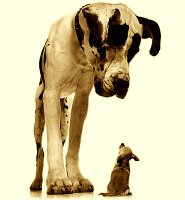 I like small businesses. They make me comfortable. My favourite coffee shop is small & independent — I only resort to Starbucks when I have to. My favourite pub is small. My favourite place to buy groceries is a small, independent greengrocer. I’ve never worked for a big company; I find them hard to relate to, hard to interpret. Small businesses are run by real, live people who you can talk to and relate to and understand.
The popular understanding of ethical and unethical behaviour in business happens to line up nicely with my own prejudices. Big businesses are supposed to be evil; small ones, benign. But is there good reason to believe that?
Certainly, I know of no evidence that small business generally behaves more ethically than big business. The fact that big business is responsible for all the business ethics headlines is of course not a reliable measure: Walmart, for example, is monitored much more closely than the thousands of small retailers who try to compete with the retailing behemoth, so you would expect Walmart’s transgressions to be made public more often. Headlines are a lousy measure of ethical conduct in business, just as they’re a lousy measure of airline safety or child abductions or shark attacks.
I was walking through a vibrant Toronto neighbourhood today, with literally hundreds of small retailers about whom I know next to nothing. Are they all ethical? All unethical? A mix? The latter is probably the case, but who knows? If you did investigate thoroughly, and found out that those small retailers were playing fast and loose with employment standards, with paying their fair share of taxes, or with health and safety regs, what would you want to do about it? One solution, of course, would (in theory) be to unite all those hundreds of small businesses into a single, larger business that you could monitor more closely. They’d lose much of their character, that way, much of their charm. They’d be less fun. But would they be less ethical, or more?
Pocket Change: Can Banning Pockets Reduce Bribery?
Sometimes it’s not all about character. Sometimes the solution isn’t to tell people, “hey, look inside yourself and you’ll see what’s right and wrong.” Sometimes, you just need to give people new pants.
From the BBC: Nepal bans airline staff pockets
Staff at Nepal’s main international airport are to be issued with trousers without pockets, in an attempt to wipe out rampant bribe-taking.
The country’s anti-corruption body said there had been growing complaints about staff at Kathmandu’s Tribhuvan airport.
A spokesman said trousers without pockets would help the authorities “curb the irregularities”.
I know what some of you are thinking: “Pockets don’t take bribes; people with pockets take bribes.” And since people are the problem, some of them may well find ways around Nepal’s proposed sartorial solution.
But the serious point here is about 2 different kinds of solutions to problems like corruption. On one hand, you use what might be called “people” solutions: you can hire carefully, give your employees ethics training, and try through leadership to instill and promote the right values. The other kind of solution we could call broadly “technological.” Like eliminating pockets, or making sure a safe can only be opened by a combination of 2 keys held by 2 different employees. Also in this category are rules about who may or may not be at the table while a particular decision is made, as a way of avoiding conflict of interest.
I think there’s a lot to be learned by thinking about the difference between those two types of solutions, and thinking about which one is appropriate for what kinds of ethical problems.



 The Business Ethics Blog