Archive for the ‘Uncategorized’ Category
Madoff: Biggest Financial Scam in History
 Comments (2)
 On Thursday, investment advisor Bernard L. Madoff (chairman of Bernard L. Madoff Investment Securities) has been arrested and charged in what may be the biggest fraud case in history.
Not just “big.” “Epic” would be more like it. We’re talking about a possible $50 billion fraud, here. As with the recent Blagojevich case, it’s hard not to marvel at the sheer audacity of the man at the centre of this case.
Here’s the story from the NYT: “Now Accused of Fraud, Wall St. Wizard Had His Skeptics”
For years, investors, rivals and regulators all wondered how Bernard L. Madoff worked his magic.
But on Friday, less than 24 hours after this prominent Wall Street figure was arrested on charges connected with what authorities portrayed as the biggest Ponzi scheme in financial history, hard questions began to be raised about whether Mr. Madoff acted alone and why his suspected con game was not uncovered sooner.
(For those not familiar with what a “Ponzi scheme” is, the Times explains that it’s “a type of fraud in which earlier investors are paid off with money raised from later victims — until no money can be raised and the scheme collapses.”)
How on earth did this happen? And what on earth made him think he could get away with it indefinitely?
As the title of the Times story suggests, there were those who had doubted Madoff for years. One financial advisor quoted by the Times suggested that it was “highly likely that the account statements themselves were just pieces of paper that were generated in connection with some sort of fraudulent activity.” Quoth another expert: “There were no smoking guns, but too many things that didn’t add up.” But, as is so often the case with successful cons, it seems like enough people were taken in by Madoff’s reassuring smile and his reassuring claims about past achievements for the thing to snowball into something far bigger than it ever should have.
It goes without saying that Madoff did a bad thing, here. Very bad. But I think interesting questions arise about what morally-significant forces made or allowed him to do it. One hypothesis, of course, is that he’s simply a very, very bad man, whose own greed and lack of concern for others allowed him to tell a long series of lies that ended in the ruin of people who trusted him. That would be the boring, “money-is-the-root-of-all-evil” hypothesis. But the many-years duration of the scam, and the robbing-Peter-to-pay-Paul nature of a Ponzi scheme, suggests the possibility, at least, of something more complicated.
I took a look at the Wikipedia page about Charles Ponzi, the guy who lent his name, back in the 1920’s, to this particular brand of scam. (Wikipedia is not always reliable (see Wiki-warning here), but certainly suggestive in this case.) The biographical sketch offered hints that at least part of Ponzi’s story was that his own entrepreneurial zeal got the better of him: at some level, he really thought his scheme could work, and that he & his investors really could all get rich.
So, Madoff may have been suckered by his own years of success: it’s not clear how early his Ponzi phase began, but it almost certainly didn’t encompass his entire career as a stock market guru. For his first couple of decades, at least, Madoff seems to have garnered a pretty decent return on his clients’ investments. Maybe, at some level, he thought he could keep doing it. And maybe each time he lied about it, he convinced himself it was only a slightly bigger lie than the last time, or maybe not really a lie at all.
None of this hypothesizing about moral psychology is intended, in any way, to exonerate the man or even to mitigate culpability. But when the scale of the wrong is so vast, and when eventually getting caught ought so clearly to have been foreseeable, it seems worth enquiring what it is that could have made a widely-respected, and apparently smart, man do something like this.
—–
See also: The Rise and Fall of Bernard L. Madoff, from Business Week
—–
Relevant Books:
Ponzi’s Scheme: The True Story of a Financial Legend .
Advertising, Documentaries, and Cultural “Exploitation”
 Burger King has just released a new ad campaign that has the blogosphere in an uproar. The campaign revolves around a 7-minute documentary-style commercial, in which the documentarians seek out “Whopper Virgins,” people who (because of they live in isolated villages in Romania, Greenland and Thailand) have never eaten Western-style hamburgers, and ask them to participate in a taste-test pitting BK’s signature sandwich against a Big Mac. Some have suggested that the ad — sorry, I can’t resist the pun — is in bad taste. Others have called it downright exploitative.
See for yourself. Here’s the site: Burger King Whopper Virgins.
As note above, the blogosophere has taken offense. (Warning: thinly disguised bad words ahead!)
Feministing doesn’t pull punches, entitling their blog entry about the ad “F@ck you, Burger King”:
I know fast-food ads are not typically paragons of feminism or anti-racism, but this [ad is] so incredibly offensive.
The PunkAssBlog asks, rhetorically, “What the Bloody F@ck is Wrong With Burger King?”
This is easy exploitation of other people; the “poor savages” practically comes screaming off the add. (Don’t even have a word for “Burger”? WTF? I bet they have a word for “sandwich” and I also bet that they have plenty of words we don’t have in English). Additionally, Whoppers and Big Mac would probably make them sick; most countries on the planet are not used to the high fat, high sugar, high beef, high salt diets of Americans. So, they’re giving them food, but they’re going to probably be immediately sick afterwards.
Enzo, at a blog called RumourHas.it admits that he has mixed feelings, but puts his moral qualms this way:
From a moral point of view, it feels totally outrageous to invade under-developed countries with drastically different cultures and try to change their eating habits. I find it kinda crazy to be spreading this ‘burger love’ in these remote lost areas, especially when nowadays burgers are the reason why so many people are so obese and unhealthy in this world.
Of course, the clever folks at BK aren’t exactly shocked. The ad was apparently designed to provoke. Check out this bit from Ad Age: Controversy Is Just What BK’s ‘Whopper Virgins’ Is After
The reaction was expected, even welcomed by the agency. “Advertising is designed to be talked about, and hopefully people notice it,” said Rob Reilly, co-executive creative director and partner at Crispin. “I’m not surprised that people are writing about [‘Whopper Virgins’], positive or negative, because that’s the design of how we approach things as an agency.”
He added: “We go into every project thinking: Is it an idea that the press — and not necessarily the advertising press — will write about? If it’s not, then maybe it’s not such a good idea.”
Brian Gies, VP-marketing impact at Burger King, emphasized that the company had undertaken a variety of initiatives to avoid cultural insensitivity, including using anthropologists and working with local governments. He said the company isn’t planning to apologize, much less take the campaign down, “because we haven’t done anything wrong.”
The company is right. I don’t see anything much wrong with the taste-test behind the ad. The criticisms are more smoke than fire: negative reactions not backed up, as far as I’ve seen, by reasoned criticism. And when (as implied by the profanity above) the wrong is supposedly obvious, well, we should pause to ask whether it really is.
For starters, charges of ‘exploitation’ are easier to toss around than to explain. No one was harmed. Personally, I wouldn’t eat either a Whopper or a Big Mac, but I have to admit that no one is going to be harmed by eating just one. No one was forced to do anything in the making of this ad, nor do I see any evidence of undue inducement. Another worry, I guess, might be that the people in the ad are, in some sense being “used” to sell product. “Used” in what sense? They’re certainly portrayed. But so are indigenous peoples in National Geographic documentaries (sure, sure, that’s for our education, but also mostly for our entertainment). Is it the fact that BK wants is featuring these people as part of an attempt to make money? That’s just another lame instance of the “filthy lucre” fallacy. Some have said that the ad makes use of cultural stereotypes. I’m not sure how real people can be stereotypes, in the pejorative sense, if they’re real people chosen precisely for their unique perspective.
I won’t claim that I couldn’t be persuaded that there’s something insensitive about the Whopper Virgin campaign, but critics are going to have to come up with something better than our beloved blogosphere has done so far.

Quick p.s.: Some people have suggested that the title of the ad is kinda tasteless and/or creepy. I agree on that point.
p.p.s. Was the costuming staged? Dunno. Even if so, if that means getting people to get their “Sunday best” out of the closet for the big event, I don’t see the harm, given that part of the point of the commercial is to conduct the taste test among people so radically different from us, culturally, that they’ll be naive (in the non judgmental sense) about BK vs McD. The clothes help establish that point.
“Business Ethics Leadership Alliance:” What’s in a Promise?
 What’s in a promise? Sometimes a promise is big news, even if we’re not entirely sure what it adds up to. See, for example, the promise being made by the members of the new “Business Ethics Leadership Alliance.” Members of that alliance (including General Electric, PepsiCo, and Wal-Mart, among others) have been brought together by the Ethisphere Institute to make a highly visible promise that their organizations are committed to a high standard of ethical behaviour.
The unethical actions of a few businesses are creating a negative global impact. The public’s rush to assign blame will negatively affect businesses worldwide. A higher standard for business ethics is expected.
The Ethisphere Institute, in cooperation with leading corporations and global institutes, is designing that higher standard, the business ethics leadership alliance, so the public and investors can more easily identify which companies operate ethically.
Here’s the story, from the Financial Times: US companies launch ethical standards push.
The cynic’s take on this: To the cynic, this looks like yet another round of empty promises, an opportunity for a handful of corporate execs to hold a press conference, wring their hands about the current state of things, and say heart-warming things about how much they value ethics. What are the odds, asks the cynic, that this will amount to any measurable change? Enron had a wonderfully complete code of ethics, full of promises and supposed aspirations. Blagojevich famously touted the importance of ethics, and we all know how much that amounted to, in terms of behaviour. And even if these companies are sincere, seriously, how much can a few companies, even big ones, do to change the overall ethical tone of the world of commerce?
The optimist’s take on this: This is a positive step — a baby step, maybe — but a positive one. It embodies the recognition by some very big companies that, in the modern context, they simply must do business in a way that demonstrates recognition that they have to take into account the interests of a broad range of stakeholders. And where the cynic espouses skepticism that the actions of a few can make a difference, the optimist muses about the possibility that a few big players, making very public promises, could push the culture of business past some sort of ethical tipping point, for the better.
There’s no need to plant one’s feet firmly in either the cynic’s or the optimist’s camp, of course. We probably should view an initiative like this with a kind of guarded optimism, with a bit of wait-and-see added in. One thing we should be clear on, though: at least one of the reasons behind this initiative is bunk, and that’s the notion that we’re at some sort of ethical low-point. See, for example, this quote from the FT story:
Mr Hill [Wal-Mart’s chief ethics officer] said that unethical behaviour was on the rise in corporate America, reversing a trend sparked by the regulatory clean-up that followed the Enron collapse.
If there’s convincing evidence for that claim, I’ve never seen it. People have been saying things like that — the world is going to hell in a handbasket, young people today have no values, commerce and/or politics is increasingly corrupt — for literally centuries. (My friend Andrew Potter calls this sort of thing “declinism.”) Guess what? There was no Golden Era of business ethics. It may well be that we see more evidence of corporate wrongdoing in 2008 than we did in 1908. Why? One reason might be the higher levels of regulation and higher standards more generally (i.e., more business practices are considered wrongful now than were considered wrongful in 1908). Consider also the increase in access to information about corporate behaviour. Part of that is semi-voluntary: companies simply disclose far more about their behaviour, now, than ever before. And part of it is the increased access to information fostered by communication technologies like ye olde World Wide Web. 100 years ago, even 50 years ago, you can bet there was just as much corruption as there is today, going on quietly behind the scenes. And there was surely a heck of a lot more, for example, overt, unpunished racism, sexism, sexual harassment, and general abuses of employees. Things have arguably gotten a lot better, over all, rather than worse.
If promises like those being made by the Business Ethics Leadership Alliance really are going to be effective, they probably should aim at continuing the general, lumpy, upward trend in ethics, rather than halting the so-called decline.
—–
Thanks to LH for the story.
Blagojevich and Ethics
 Yesterday I blogged provocatively (I hope) about “Why I Don’t Care About Blagojevich”. I argued that, titillating as the story is, I don’t care (much) about the story professionally because it’s not about business, and not really about ethics.
24 hours later, I’m ready to say something a little more nuanced.
I said yesterday that Blagojevich’s story was not an ethics story; that of course overstates the truth. Blagojevich being arrested and charged with a crime is not an ethics story; it’s a legal story. That he was arrested — or even that he’s guilty, assuming he is — doesn’t prove he’s unethical. And if he’s acquitted, that doesn’t prove he did nothing wrong. But of course, setting aside that logical nicety, there’s much less doubt about his lack of ethics than there is about his criminal culpability. All indicators suggest that this is no paragon of virtue.
There is, to be sure, an ethics story to be told about Blagojevich. But that story isn’t about his arrest; it’s about everything that he did up to the point where he began doing things that are against the law. That is, the chances are very slim that Blagojevich woke up sometime in the last year and decided to start abusing power in ways that would draw the attention of the Justice Department. Much more likely is that this bold, foolish, criminal move was the culmination of a life of pettier wrongdoing. We have good evidence, certainly, that the recent attempt to sell Obama’s senate seat was not the beginning: Blagojevich had been the subject of a federal corruption investigation for years. So there might well be an interesting story (you can bet investigative journalists have been, and are, working on it) about what personal and situational factors make a guy do stuff like this. What got him started? Petty influence peddling? Shady backroom deals? What lessons are there to be learned, in terms of personal or institutional ethics?
The other part of the story that is clearly about ethics, and relevant for those of us interested in ethics, is about the political culture of Illinois in general and Chicago in particular. If politics is a dirty game, politics in Illinois is, by all accounts, about as dirty as it gets. Much of that dirt involves issues that are ethical issues. Conflict of interest, lying, and influence peddling are all major ethical problems, even when there are no laws governing them. That’s bad news for the people of that state. But the interesting challenge is what to do about it. Zealous enforcement is a good start, clearly. But just what combination of incentives and (ahem) leadership is required is a good question.
Both of those ethics stories have parallels in the corporate world. Take the issue of how (or whether) petty infractions lead reliably to more grievous wrongs. The people at the centre of various corporate scandals don’t just wake up one morning and say, “hey, I think I’ll screw my shareholders” or “today I think I’ll try to increase my wealth by selling adulterated apple juice.” In business and the professions, major wrongdoing pretty certainly starts with small indiscretions. Similarly, there are, in Blagojevich’s story, parallels with important questions about corporate culture. It’s kind of a truism of corporate ethics that corporate culture has a huge, perhaps even overriding, effect on behaviour. And hard questions abound about how to manage corporate culture effectively, for the better.
So, a final thought: given current popular cynicism about ethics in both politics and business, do we look to business for insight into political ethics, or to politics for insight into business ethics? More specifically — and there’s a researchable topic here — what institutional structures do organizations in one of those domains get right, that ought to be imported into the other domain, for the improvement of ethical behaviour?
Why I Don’t Care About Blagojevich
 I don’t much care about this: Illinois Governor in Corruption Scandal (NY Times).
“Gov. Rod R. Blagojevich of Illinois was arrested by federal authorities on Tuesday morning on corruption charges, including an allegation that he conspired to effectively sell President-elect Barack Obama’s seat in the United States Senate to the highest bidder.”
Seriously, I don’t care. I know that sounds awful. But I don’t. I mean, as a news-watcher I like a good scandal as much as anyone. And as political scandals go, this one’s a doozy. I’ve been asked if I’m going to blog about it. And I guess the fact that you’re reading this means that I am. But it’s really not a business ethics story.
For starters, and most obviously, it’s not a business story. Well, except in the degenerate sense that it’s a story about a guy selling something you’re not supposed to sell. It’s good fodder, I guess, for philosophy seminar discussions (or MBA seminar discussions) about just why it is that there are certain things it’s not acceptable to put up for sale.
But secondly, it’s not an ethics story. Not really. Of course, it will get framed in terms of ethics, and called one more symptom of the crisis of ethics in government (and elsewhere). Indeed, the Chicago Tribune has some nice quotes from Blagojevich, speaking about ethics back in 2003:
“We have to seize this moment and enact meaningful ethics reform. After all we’ve been through, we cannot expect the people just instinctively to trust their government. We can’t just pay lip service to the need for ethics reform and expect them to go along.”
But I repeat, this is not an ethics story. If Blagojevich did what they’ve charged him with, he’s not (merely) unethical, he’s a criminal. Not that there’s no overlap between the unethical and the criminal. There’s plenty. It’s just that — with very few exceptions — serious violations of law aren’t ethically interesting. There are lots of interesting ethical questions about all kinds of debatable, borderline activities, ones that reasonable people might disagree over. But when something is so bad (for example, something that threatens the democratic foundations of our society) that the people, through their legislative and judicial representatives, decide to punish it with criminal sanctions, well, at that point, the people probably don’t need a philosopher to chime in on the subtleties of the situation.
College Football, Academics, and Conflict of Interest
 American college sports are a big deal. Some people say too big, as big-money sports teams threaten to overshadow the presumptive first mission of universities, which is education. Here’s a story about a possible conflict of interest at the University of Michigan, involving sports teams and the the university committee put in place to oversee academic progress of student athletes.
From The Ann Arbor News: Profs’ bowl perks look like conflict to U-M auditors (by Dave Gershman). It’s a good, in-depth story, worth a thorough read. Here are the first paragraphs:
University of Michigan professors who help oversee the academic
welfare of student athletes receive free vacations to Michigan
football bowl games that are paid by the Athletic Department. It’s a
perk that has raised conflict of interest questions in a university
audit and among some faculty on campus.The issue is scheduled to be debated by elected faculty
representatives at a meeting on Monday.Academic and athletic department administrators say the trips for
members of the Committee on Academic Performance do not influence the
recipients to make decisions that favor the athletic department or its
athletes.The issue arose when the university’s internal auditors noted the
practice in an audit in 2007….
Could a trip worth thousands of dollars have any influence on the decisions of an committee member? Could it be seen as doing so? Could that perception affect the reputation of the committee, or the university? Some of the profs on the committee are indignant at the very suggestion. “Why,” asks one of them, “would anyone care unless one was impugning without any evidence, with no actual suggestion that this has happened, misconduct by members of the (committee).” The Provost of the university sings the same tune: “These are faculty members of great integrity …. To imply otherwise would be unjustified.”
Let me say this clearly: pointing out a conflict of interest is not the same as accusing anyone of anything, or impugning anyone’s character. When we point out a COI, we are merely noting the structure of a certain situation — we are noting that someone trusted with the authority to make a decision is situated so that a factor (financial or otherwise) that clearly ought not influence that decision could do so. Of course, once a COI has been noted, and found to be avoidable, what you do next absolutely does reflect on your character.
—–
Favourite COI Books:
Conflict of Interest in the Professions, by Davis and Stark, and Conflicts of Interest: Challenges and Solutions, edited by Moore et al.
See also:
Ethics and the University, by Michael Davis and Ethics and College Sports, by Peter French.
—–
Thanks to Jeff for the story.
York University Labour Dispute
 Is YouTube the new medium of the oppressed?
Labour relations are a serious and difficult business ethics issue. Negotiation can, in some circumstances, result in “win-win” outcomes, but more often a gain by one side is a loss for the other. And the pointy-end of the labour-relations stick — the strike or lockout — is particularly harsh. Strikes at public institutions (such as hospitals, schools, universities) have an added dimension: both sides typically claim to be fighting for some version of the public good. You would think that would imply a kind of common ground — if everyone is fighting for the same thing, at least in part, then agreement should be easier than, say, in the auto industry or steel industry. But that seldom actually seems to be the case. Public sector strikes can be bitter indeed.
Case in point: the current strike at Toronto’s York University. The union on strike is Local 3903 of CUPE (the Canadian Union of Public Employees), and represents the university’s contract faculty and (grad student) teaching assistants. The university cancelled classes (for some 50,000 students) when the strike began on November 6, and the doors have been shut ever since. Reports from the mediator appointed by the provincial government don’t sound at all optimistic.
(Here are a couple of recent news items on the strike: “Job security key, York U. strikers say”, from The Toronto Star, and “Nervous York students demand gov’t action”, from Maclean’s.)
Since the beginning, there has been consternation on the part of at least some members of the union at the University’s reluctance to negotiate, and with some apparently misleading financial analyses released by the University. Now, in the face of calls for the provincial government to pass back-to-work legislation, the battle for public (and in this case, undergraduate) opinion is heating up. One of the latest salvos in the dispute takes the form of a series of YouTube videos riffing on Apple’s famous “Mac vs PC” commercials and illustrating the union’s side of the story. Welcome to labour relations in the 21st Century.
[Disclosure: I’ve got friends among those currently on strike at York, and also among the non-striking York professoriate. So I’m likely not unbiased about this stuff.]
—–
Addendum:
Relevant Books: The Ethics of Human Resources and Industrial Relations and Negotiating For Dummies.
Book Review: The Elements of Ethics for Professionals, by Johnson & Ridley
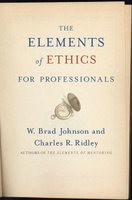 I don’t generally review books on my blog. Today’s is an experiment. The publishers of The Elements of Ethics for Professionals (written by W. Brad Johnson and Charles R. Ridley) sent me a copy, and, in keeping with its style as a reference book, I’ve read just a handful of its 75 very short chapters, rather than the whole book. My impression is based on that very cursory glance.
The Elements of Ethics is patterned on Strunk and White’s classic style & grammar guide, The Elements of Style. It gives concise advice on a wide range of ethical challenges faced within professional life. Each entry begins with an anecdote (presumably fictional or fictionalized) illustrating one of those challenges, proceeds with a brief discussion that explains the issue and teases out relevant distinctions, and ends with 4 or 5 bullet points of advice. As the authors put it,
Our purpose is to distill the voluminous research, theory, and philosophical underpinnings of ethics into a pithy, pragmatic resource.
On the whole (and again, based on reading just a few entries) I’d say the book is a qualified success. I found some genuinely good advice. The tone is pragmatic: high-minded, but not preachy.
The entries I read were:
39. Avoid Conflicts of Interest: This entry is really quite good. The authors rightly point out that conflict of interest (COI) is all too easy to fall into, and that finding oneself in a COI is not in itself blameworthy. It’s not always a sign of actual bias or corruption. The advice given for avoiding and managing COI is quite sound.
48. Attend to More Than the Bottom Line: This section was somewhat disappointing. It starts, oddly, with an anecdote about the chair of a professional association’s ethics committee. The situation illustrated has to do with the challenge of administering professional standards without letting discussion spiral down into gossip, ridicule, and contempt. But there’s nothing in it about attending to more than the (financial) bottom line, which is what readers will surely be expecting. Reading the rest of the entry, it becomes clear (I think) that the authors intend “bottom line” to mean something like “abstract principles.” The lesson, then, is that we ought not devalue persons in pursuit of principles. Part of the entry does talk about profits, and the importance of not putting profits ahead of people, but mixing the two issues together in one entry is likely to confuse readers, more than enlighten. (I can’t avoid noting that this entry gives an approving nod to the misguided and misleading triple bottom line idea.)
24. Honor Human Differences — all of them: Here again, the anecdote isn’t well matched to the entry. The anecdote that begins the entry is about instituting policy changes to fight sexism at a military college. The rest of the entry is about accepting differences, and avoiding stereotypes and bias in one’s personal judgments. In fact, the anecdote doesn’t fit the title, either. Just to be clear: it’s an interesting anecdote, and a pretty good entry on avoiding bias, but the two don’t go together well at all.
52. Discriminate Fairly: This entry does a pretty good job of making clear the distinction between wrongful discrimination — discrimination “based on irrelevant or arbitrary factors” — and the fair discrimination (i.e., judgment) that must be exercised in hiring qualified workers or assigning grades based on merit.
In conclusion: I suspect it’s a useful book, even with its uneven entries. It’s reasonably priced, and I suspect many people would find it handy. It’s not a scholarly work, but then it doesn’t intend to be. I think the litmus test for a book of this kind is this: is a professional, faced with an ethical dilemma, likely to find some wisdom on the relevant page of this book? I’m guessing that for The Elements of Ethics, the answer is “yes.”
One final note: There’s also room for improvement in the Index. For a reference guide, a thorough index is a must. For example, the index has an entry for “Discrimination” but not one for “Sexism” or “Racism.” Similarly, it has an entry for “Conflict of Interest,” but not one for “Self-Dealing” or “Moonlighting” (both of which are common problems that not all readers will recognize as falling under the “Conflict of Interest” heading.) These gaps would be easy to fix.
—–
Disclosure: As is implied above, I was offered and accepted a free copy of this book. I told the publisher I might not have time to read the book, and if I did, I might or might not review it, and that they might or might not like my review. They were OK with that.
—–
p.s. here’s the publisher’s page about the book.
Tort Law & Business Ethics: Wal-Mart Worker’s Family Suing
 By now everyone knows the story: an employee was trampled in a Black Friday Sale stampede at a suburban New York Wal-Mart. (I blogged about it Friday and again Tuesday.)
The latest (not terribly surprising) development: the victim’s family is suing.
From MSNBC: Victim’s kin sue in Wal-Mart stampede death
The family of a worker trampled to death in a “Black Friday” crush of bargain hunters at a Long Island Wal-Mart store filed a wrongful-death lawsuit on Wednesday, claiming store ads offering deep discounts “created an atmosphere of competition and anxiety” that led to “crowd craze.”
The lawsuit claims that besides failing to provide adequate security for a pre-dawn crowd estimated at 2,000, Wal-Mart “engaged in specific marketing and advertising techniques to specifically attract a large crowd and create an environment of frenzy and mayhem and was otherwise careless, reckless and negligent.”
Good. I’m glad they’re suing. Not because I necessarily think Wal-Mart is really in the wrong, here, and deserve to be sued. They may well be, but that’s not my point. My point is that some things really are best handled by people (and companies) suing each other. This falls under the heading of tort law — roughly the branch of law that pertains to private lawsuits (as opposed to criminal prosecutions) seeking remedy for personal wrongs or harms.
Recall that I mentioned in Tuesday’s posting that New York lawmakers were contemplating enacting legislation in response to this incident, and also that a couple of customers caught up in the stampede were suing. I suggested the latter was likely to be more fruitful. Now it’s time to say more about why.
Tort law is one way we regulate corporate behaviour. There are many others: corporate law, contract law, labour law, and criminal law, just to name a few. Those methods all tend to rely on government to exercise judgment, in advance, about just how companies should behave. Tort law works differently. Basically, the system of tort law says that if companies screw up in ways that harm people, those people can sue. Companies know this, and so they’re motivated — obviously, not always sufficiently motivated — not to screw up in ways that harm people. But if they do hurt someone, they can be sued. And if the court buys the plaintiff’s case, the plaintiff will win, and the court will make the defendant (the company) pay the plaintiff some money. And if the amount awarded is high enough (or if the publicity from losing such a case is bad enough) the company will do things differently next time. It will change its behaviour.
Many people are big fans of tort law as perhaps the best way to regulate corporate behaviour. Why enact specific regulations in advance, they ask, when you can issue the general guidance that, hey, if you hurt someone an just about any way (even ways we can’t foresee) we (the courts) will help your victims to hurt you back. It’s a one-size-fits-all solution. Critics argue that that approach is flawed (at least if relied upon exclusively) because it is too reactive: it’s about fixing problems after someone has already been harmed — in the present case, killed — and because it’s too slow & cumbersome.
I don’t have a view on the exact extent to which we should rely on tort law (as opposed to regulation) to control corporate behaviour. But it seems to me that in the present case, tort law is the answer. In order for regulation to work, it requires bureaucrats to figure out, in advance, how to run a retail store. Not a particular store (regulations can’t be about particular entities) but retail stores in general. And it’s unlikely that they’ll be able to figure that out. Are they really going to be able to specify the right number of security guards per store? For stores of what size? Maybe the right number of guards for every 1000 square feet of retail space? Are they going to be able to specify detailed procedures for appropriate crowd control? How the barricades should be set up? Whether customers waiting outside must be forced to line up single-file, or two-by-two? All of that seems unlikely. But losing a lawsuit — or settling out of court, which seems more likely here — is likely to inspire Wal-Mart managers to do what managers are supposed to do: respond creatively to the specifics of a challenging situation.
—–
Thanks to my pal Andrew Potter for the heads-up on this development.
Update: Outrage Over Auto Execs’ Corporate Jets Prompts Silliness
Here’s another update on a recent blog entry. Last week I blogged about Bailouts, Corporate Jets, and Moral Outrage. For those of you who missed the story, it was about the furor caused when the CEOs of Ford, GM, and Chrysler flew to Washington on private jets to ask Congress for a bailout. The incongruity caused some people (including some members of Congress) to rail at the apparent irony of it. I suggested that moral outrage might be out of place, but that a more thoughtful question might be whether the apparent insensitivity of that particular voyage was part of a larger pattern; if so, the pattern would be a more suitable target for criticism.
Apparently the CEOs have seen the error of their ways. Here’s the latest.
GM, Ford CEOs taking company cars to Washington
Eager to avoid another scathing lecture about corporate excess from members of Congress, the CEOs of America’s two biggest automakers will travel to Washington this week in hybrid vehicles made by their companies.
Ford Motor Co. CEO Alan Mulally left for Washington Tuesday afternoon, driving in a Ford Escape small sport utility vehicle that runs on gas and electricity, while General Motors Corp. CEO Rick Wagoner will travel in a hybrid Chevrolet Malibu.
This is, of course, slightly ridiculous. Hard to blame the CEOs for the silly demonstration that they really really really understand fiscal restraint, given the public spanking last week. But still. Silly. The details are particularly hilarious. For example, it’s not enough that they’ll be going by car. They have to actually drive. Like, they have to be behind the wheel, for some reason:
Ford and GM announced that Wagoner and Mulally would drive, with both CEOs taking the wheel for at least part of the roughly nine-hour, 520-mile trip.
Is that actually important? This sounds more like a college-kid road trip than a trip to lobby Congress. Gee, I wonder what CD’s they’ll listen to along the way? Are they going to stop for donuts and coffee? Enquiring minds want to know. But alas, details are being kept hush-hush:
GM spokesman Tony Cervone would not say if Wagoner would stop along the way or even when he would depart, in part for security reasons and also to avoid being followed by reporters.
“There’s a lot of security concerns. There’s also the idea of a circus that we’re trying to avoid,” Cervone said.
No no, wouldn’t want to look silly.



 The Business Ethics Blog