Author Archive
Deadly Crashes, “Agency Theory” & the Challenges of Management
Filed under: accountability, complexity, corporations, decision-making, employees, ethics, excuses, governance, management, product safety, quality, risk, technology |
 Leave a comment
  Sometimes for a corporation to “do the right thing” requires excellent execution of millions of tasks by thousands of employees. It thus requires not just good intentions, but good management skills, too.
For an example, consider the story of the crash of a Concorde supersonic jet a decade ago. The conditions leading up to the crash were complex, but one factor (according to the court) was negligence on the part of an aircraft mechanic. Whether (or to what extent) that mechanic’s employer is responsible for that negligence, and hence at least partly responsible for the crash, is a difficult matter.
Here’s the story Saskya Vandoorne, for CNN: Continental Airlines and mechanic guilty in deadly Concorde crash
The fiery crash that brought down a Concorde supersonic jet in 2000, killing 113 people, was caused partially by the criminal negligence of Continental Airlines and a mechanic who works for the company, a French court ruled Monday.
Continental Airlines was fined 202,000 euros ($268,400) and ordered to pay 1 million euros to Air France, which operated the doomed flight.
Mechanic John Taylor received a fine of 2,000 euros ($2,656) and a 15-month suspended prison sentence for involuntary manslaughter….
I don’t know the details of this story well enough to have any sense of whether the mechanic in this case really did act negligently. But what intrigues me, here, is the issue of corporate culpability. Note the difficulty faced by airline executives who (for the sake of argument) want desperately to achieve 100% efficiency and never, ever to risk anyone’s life. In order to achieve those goals, executives have to organize and motivate hundreds or perhaps thousands of employees. They need to design and administer a chain of command and a set of working conditions (including a system of pay) that is as likely as possible to result in all those employees diligently doing their very best, all of the time. That challenge is the subject of an entire body of political & economic theory known as “agency theory.”
Agency theory and the various mechanisms available to motivate employees in the right direction are things that every well-trained business student knows about, because those are central challenges of managing any corporation, or even any small team. What is recognized too seldom, I think, is just how central a role agency problems play in assessing and responding to ethical challenges in particular.
Four Myths About Business Ethics
Filed under: decision-making, definitions, economics, ethics, government |
Comments (2) Here are four important myths about business ethics. There are surely many myths about business ethics, but these 4 in particular cause trouble, and pose significant challenges for anyone trying to have a productive discussion about right and wrong in the world of business.
Myth #1. “Business ethics” is an oxymoron.
The idea that “business ethics” is somehow a contradiction in terms is based on a serious misunderstanding of what ethics is and what the world of commerce is like. Indeed, it’s much closer to the truth to say that the term “business ethics” expresses a redundancy, since commerce is quite literally impossible without ethics. Every single commercial transaction requires some level of trust, and without a shared commitment to some level ethical behaviour, you simply do not get trust. Indeed, economists are more than ready to point out the huge range of ethical norms that underpin the modern economy and make it run more efficiently.
Myth #2. Ethics is just a matter of opinion.
Again, false. While ethics does of course have something to do with having an opinion, it’s also about having opinions that you can defend to other people. While there certainly are a few really tough moral questions about which we might agree to disagree, we should also recognize that on many ethical issues there are better and worse answers. Poor answers to ethical dilemmas are typically rooted in factual mistakes and logical inconsistencies. We shouldn’t settle for those. We should talk them through. (And, as a I blogged recently, having an opinion doesn’t come to much if you can’t sell that opinion to others.)
Myth #3. There’s no such thing as “business ethics,” because ethics should be the same everywhere.
There are two main reasons why ethics, while essential to business, isn’t just exactly the same in business as it is in other domains of life.
First, business poses special challenges. The enormous productive capacity of corporations and other large organizations also brings the potential to do substantial harm, both to the lives of stakeholders and to the natural environment. So we face questions in the world of commerce that we just don’t face in other parts of our lives. Second, the special social role of business implies a tailor-made set of ethical principles. One of the defining characteristics of business is that it is competitive: companies are naturally driven to do better than others in their field. This kind of behaviour is socially beneficial — consumers benefit when companies compete vigorously to produce a better product, at a better price, than the other guy. In practice, we can really look at business ethics as having two importantly different components. One component consists of the rules needed to civilize a tough, competitive game. This part of business ethics essentially has to do with the norms-and-principles that ought to govern business’s behaviour with regard to outsiders. The other component of business ethics is about the ethical rules that ought to be embodied in relationships within the organization. Here, we do value cooperative behaviour; so managers work hard to shape corporate culture to enable employees to trust each other and to work together toward shared goals. Business is morally complex that way.
Myth #4. Business ethics is just a matter of laws and regulation.
This is not just false, but dangerous. The tendency to confuse ethics and law is tempting, especially in an age in which the business section of the newspaper increasingly refers to “ethics laws” and “ethics regulations.” But we shouldn’t be misled by that short-hand way of speaking. If you think about it for just a minute or two, there are in fact lots of ways in which law and ethics come apart. There are plenty of things that are legal but unethical; and there are also behaviours that are illegal, but arguably ethically OK. The short explanation for the fact that law & ethics don’t overlap perfectly is this: laws are made & enforced by government. But governments can’t be everywhere, and if they could, we wouldn’t want them to be!
These surely aren’t all the myths there are about business ethics. But these strike me as four that are particularly common, particularly troublesome, and particularly clearly wrong.
Ethics as Strategy and Marketing
Ethical decision-making can helpfully be thought of as a matter of strategy and of marketing. This way of framing ethics is, I think, likely to be particularly useful in talking about ethics with either MBA students or business executives.
First it is worth noting that there is of course a cynical sense in which ethics can be a matter of strategy and marketing, and that’s when companies adopt an ethical posture because they see it as a good strategic move or as a smart marketing maneuver. That’s a good topic, but it’s not what I’m talking about here.
What I’m talking about is the sense in which very often, in the world of business, acting on one’s ethical convictions requires that one think in terms of strategy and marketing. An example may help.
Picture yourself working in a team-based work environment. Now imagine that the team decides to adopt a particular course of action, but it is one that you, after careful consideration, sincerely believe to be ethically problematic. OK, so you’re pretty sure you’re right.
Now what?
Well, knowing that you’re right doesn’t do much to change things, at least not automatically.
First comes a strategic decision. You need to choose a strategy, a course of action tailored to the situation. At the most basic level, your first strategic decision is whether to act or not. Maybe you’ll decide that discretion is the better part of valour, and end up holding your tongue. Maybe the issue is too small to be worth rocking the boat. But if the issue is worth pursuing, you’ll need to decide on a strategy for doing so. The thing that makes strategic decision-making difficult is the thing that differentiates strategic decisions from other sorts of decisions, which is that strategic decisions are decisions that need to take into consideration the decision-making of other people or institutions. (The contrast, technically, is with what are called “parametric” decisions, decisions that need only take into account facts about the non-decision-making bits of the world, such as “what is the weather like today?” or “how much money is in my pocket?”) So, in making a strategic decision about whether and how to voice concerns, you will need to think carefully about how other people are behaving, and how they will react to you — in other words, you need to think about what their strategies are likely to be, which is no trivial problem. That is the essence of strategic decision-making.
Next comes a marketing decision. (For practical purposes, the marketing decision might not be separable from the strategic one, but I’ll separate them for discussion purposes here.) Once you’ve decided that your strategy will indeed be to voice your concerns, how will you actually broach the topic? At a team meeting, or by means of quiet discussion with one or more key team members? If you need to seek like-minded allies, who will they be? And what will your sales pitch be? Will you cautiously express moral doubt, or will you pound your fist on a desk and declare the current course of action “unacceptable”? And just what will you be trying to sell the team — a small-but-meaningful shift in course, or a total about-face? The point is that you have not just to arrive at an opinion, but to sell it, too.
What we see here is that ethics is more complicated than simply knowing (or figuring out) the right thing to do.
But what I think we also see here is one more way to connect ethics with issues that managers and MBA students already take seriously. It’s a way of pointing out that ethics is far from the “soft” topic it is often accused of being. As someone with a Ph.D. in philosophy, I know that ethics is far from “soft” because I know a fair bit about the incredibly technical theoretical literature on the topic. But to many in the world of business, ethics is considered soft (while accounting, for example, is hard — firmly rooted in concrete realities). Pointing out that solving practical problems in ethics requires, among other things, solving challenging problems in strategy and marketing is yet another way to attempt rescue ethics from unfortunate perceptions of the topic.
What do “Higher Standards” for Business Look Like?
Filed under: accountability, definitions, ethics, standards, values, white collar crime |
Leave a comment When we see what seems to be an increase in misbehaviour, we need to ask: is that because behaviour has gotten worse, or because expectations have gotten higher?
See this piece, by Theresa Tedesco, for Financial Post Magazine: Farther. Faster. Higher.
…Business leaders are on trial like never before. Public outrage over recent ethical crises and the dramatic failures of corporate governance, most notably the stunning collapse of Enron Corp. and the financial crisis of 2008, have fuelled assumptions that government and regulators are stepping in and that ethical standards of business must be on the rise as a result. Certainly, public awareness is heightened in the aftermath of spectacular corporate collapses. But are ethical standards actually getting higher as a result? Or are shareholders, employees and other stakeholders simply more aware of the moral considerations in the wake of these scandals and crises, considerations that are soon to be forgotten? Either way, the role of the modern CEO and other senior executives has become much more complex, driven almost reflexively by the velocity of change in social values, technology, regulation and, increasingly, public opinion….
(I’m also quoted, making a point I’ve made before, namely that business is more ethical today than it has ever been in the past.)
But there’s also an interesting philosophical question, here, about what counts as a “higher” standard.
In some cases, “higher standards” might actually mean that we attribute to business obligations in domains in which they previously were seen as having basically no obligations at all. Environmental concern might be one such domain. Once upon a time, pollution just wasn’t an issue. At even once pollution was “on the radar,” so to speak, specific types of pollution (e.g., CFC’s) still weren’t seen as important. In that sense, it’s clearly true that we see “higher standards” imposed, and observed, by business today.
A second kind of “higher standards” might involve stricter requirements for things like honesty and product safety and truth in advertising. Once upon a time, the rule really was “buyer beware.” That’s no longer the case. Social expectations, often backed by law, mean that businesses face (and generally adhere to) standards far higher than we’ve ever seen before in history.
A third kind of “higher standard” might have to do with social expectations with regard to the impact business has beyond its interactions with its own customers and employees. Now, it has long been the case that many businesses make social contributions through things like charitable donations. But today, it is utterly run-of-the-mill for companies to have CSR departments that consider not just things like charitable donations, but how to track and report on the business’s net social impact. This is yet another way in which businesses face, and face up to, higher expectations.
But there is also a fourth kind of higher standard, one which is less-obviously being met. And that is in the area of individual decision-making. When the average person (or the ethicist, for that matter) surveys the world of business, he or she still sees examples of bad behaviour — people lying, cheating, embezzling, and defrauding. Most of us get our data in that regard from the media, which is far from a fair accounting of the issue. But still, the cases are out there. And it’s in that sense that people are very fair to observe that, at very least, things don’t seem to be getting better, dammit. Then again, I know of no credible evidence that things are getting any worse in this regard.
I suspect different people mean different things when they talk about whether “ethical standards” are higher or lower in business today. I suspect that the first 3 kinds of “higher standards” above are the crucial ones, since I suspect that the 4th, which depends on the character of individual human beings, is less susceptible to long-term change on a population basis.
Intellectual Property and the Chilean Miners
Filed under: contract, ethics, honesty, intellectual property, international, law, profits, workplace safety |
Comments (1) Last month I posted about some Ethical Issues for the Chilean Miners. There, I pondered the moral force of the contract that the 33 trapped miners signed while still underground, promising each other to share equally the eventual profits of any future publicity. This month, I’m quoted in an article on that same topic, in Canadian Business. Here’s the online version: Intellectual property: Underground dealing in Chile, by Angelina Chapin
The story of “los 33,” the Chilean miners stuck underground for 69 days has all the makings of a good narrative: complication, action, mystery and a happy ending. Presciently, the miners made a pact while they were underground to share whatever profits come from telling their story and are rumoured to have decided to collectively author a book. According to The Guardian, they even had a lawyer send down a contract to make the “blood pact” legal, meaning when Hollywood producers come knocking, they’ll have a whole group to bargain with.
Not much is known about its content, but the circumstances under which the contract was signed have experts wondering about its validity and whether the specifics should be abided by now that they’ve survived the rescue….
The article gives the last word to Toronto-based lawyer Calin Lawrynowicz, who makes a simple, practical suggestion: rather than wonder about the force of the subterranean contract, the miners ought to sit down to talk about it:
Lawrynowicz says, since the miners don’t have 33 lawyers explaining their individual rights, the group should reconvene with an arbitrator to make amendments to the contract, allowing for reductions and benefits in terms of the wealth distribution.
“It’s like a shotgun wedding in Vegas,” he says. “You may be able to have a great relationship after the fact, but have to reconfirm why you got together in the first place.”
Can Employers Tell Employees What to Eat?
Filed under: discrimination, employees, ethics, food, values |
Comments (33)  All companies want their employees to be team players. But just how far can companies go in requiring that employees ‘toe the line’? Can that demand extend to cultural or religious or moral or dietary requirements?
How As a starting point, consider this story, from CBC News: No meat on menu for Montreal purse maker
A Montreal accessories company has taken its policy of using no animal products beyond the rack and has forbidden its staff from eating meat and fish at work.
A former employee says the policy violated her rights as a non-vegetarian….
(I’ve blogged on unusual forms of employee discrimination before. See Discriminating Against the Non-Blind and “Smokers Need Not Apply”.)
So, is it OK for a company to require that its employees not eat meat? Now, to be more precise, the company in question isn’t forcing people to be vegetarians. It’s just insisting that they not eat meat on the premises. But still, the requirement is an imposition. If an employee loves bologna sandwiches, why should she not be allowed to eat them on her lunch break at work? On the other hand, it’s not exactly a brutal requirement: a place that forbids employees from eating meat is not exactly ipso facto a Dickensian sweatshop. Of course, you might say that the whole conflict could be avoided by careful hiring: only hire people who are willing to uphold the company ethos. But that still amounts to a form of discrimination — and we would still have to ask whether such discrimination is justified or not. Besides, we would still have to worry about cases in which an employee is a devout vegetarian at time of hiring, but then (for whatever reason) changes her dietary habits at some point after being hired.
Whatever your instincts about this particular case, it’s worth performing a consistency test on your own conclusion. Try this: if you’re a vegetarian or vegan, and sympathetic to the company’s no-meat policy, ask yourself whether you would reach the same conclusion if the tables were turned, and a meat-packing company required employees to eat meat and forbade vegetarianism. (“Why would a vegetarian work at a meat-packing plant?” Well, times are tough. Stranger things have happened!) If, on the other hand, you think the company in the story above is engaging in unjustifiable discrimination, ask yourself whether you would reach the same conclusion if the company was one whose product embodied some value that you hold dear — something to do with your own religious or philosophical or political beliefs. That kind of consistency test is a good way to double-check that the conclusion you reach with regard to this particular case is rooted in good reasons, or whether instead your conclusion is based on an undefended bias.
—–
Addendum:
A couple of people have told me my counter-example above is unrealistic — after all, what employer is going to tell you you have to eat meat? That misses the point I was making, which was to suggest to people that we should think up some counter-example that involves some set of values that would challenge what seems to us to be the “obvious” conclusion, here. If you don’t like my example, feel free to suggest one!
—–
Thanks to NW for the story.
Business Ethics Blog’s 5th Blogaversary
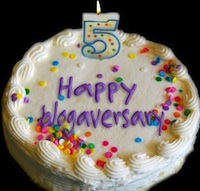 Five years ago today, I posted my very first blog entry. It had no real substance, but it was a start. Five years later, I’m still blogging. And given that the average lifespan of a blog is something less than the average lifespan of a fruit fly, I think I now get to call myself a veteran blogger.
Over the last five years, I’ve written over 720 blog entries. I’ve written on topics big and small and ridiculous. I’ve written about the collapse of major financial institutions, and ethical issues for small business, and monkeys working as waiters and the ethics of soccer balls. I’ve written about the auto industry, the wind industry, and the donut industry. I’ve written things that were pretty uncontroversial, as well as things that no one agreed with. And in terms of topics, I’ve covered environmental ethics, workers’ rights, corporate governance, and much more. And my audience has been just as varied. I know for a fact that this blog is read by corporate insiders, by CSR consultants, and by professional colleagues and their students.
And in case you’re wondering, my 3 most popular blog entries from 2010 happen all to be about disasters:
- BP and Corporate Social Responsibility
- Boycotting BP is Futile and Unethical
- Should Trapped Miners Be Paid?
Thanks to all of you who keep reading, commenting, and encouraging. Knowing that you’re out there, reading and reflecting, is what makes this blog worth writing.
MBA Ethics Education: Speaking Up
 This is the fourth (and final?) installment in a series of postings on ethics education for MBA students.
The fourth element of MBA ethics education that I want to talk about is the willingness and ability to speak up.
Often one of the biggest barriers to doing the right thing lies in not knowing what to do or say in a hierarchical or group context. Think first of hierarchies. Pretty much all organizations are hierarchical in nature, with each individual answerable to, and performing tasks assigned by, someone in the layer above. In such contexts, when your performance evaluations (and maybe your very job) relies on your boss’s perceptions of you, it can be pretty tough to “speak truth to power,” as the saying goes, even when your conscience says you should. Next think of groups. Business involves a lot of teamwork — a lot of MBA education revolves around that fact — and on teams there can be pressure to conform, to go with the flow, to be a ‘team player.’ But more often than not, if something unethical is about to be done, and least one person on the team realizes that it’s wrong. The question in such cases is whether that one person will have what it takes to speak up. Part of MBA ethics education should be aimed at giving people what it takes to do so.
At a first approximation, I’d say that speaking up when you see something unethical (or maybe just something thoughtless, with potentially bad consequences) requires three things.
First, you need the understanding — the ethical sensitivity, if you will — to notice that something is wrong.
Second, you need to be motivated — you need to care, and you need the courage to act in the face of the pressures of hierarchy and teamwork. You need some understanding of just what your obligations really are. (Among other things, this requires a refusal to indulge in self-serving excuses.)
Third, you need the skills to actually formulate and voice an objection. You need to know things like how to express ethical doubts in a non-threatening way. You need to know how to seek out allies who might share your ethical qualms. And you need a vocabulary in which to express your concerns. In these regards, I highly recommend a book from which I’ve learned a lot, namely Mary Gentile’s recent book, Giving Voice to Values: How to Speak Your Mind When You Know What’s Right. It is a truly wise piece of writing, and “wise” is not a word I use very much.
None of this is intended to exaggerate the complexity of the simple act of raising one’s voice. But all the available evidence suggests that at least sometimes (and likely too often) it actually is difficult, in organizational settings, to speak up when we get the sense that something isn’t right. And (as discussed in a previous blog entry) it’s just not plausible to think that the people who fail to speak up are all somehow morally defective. Too often, bad things happen because good people don’t speak up. We need to make sure that MBA students (and, surely, others too) graduate with the skills to do so.
MBA Ethics Education: All Decisions are Ethics Decisions
 This is the third in a series of blog entries on ethics education for MBA students (the first two are here and here).
One of the key challenges involved in teaching MBA students about ethics is to figure out just what the scope of the topic is. Just which issues are “ethical issues?”
As management guru Peter Drucker once pointed out, “there are no finance decisions, tax decisions, or marketing decisions; only business decisions.”* In other words, decisions that seem to be about a particular aspect of a business cannot (or at least should not) be made as if they have nothing to do with other aspects of the business. And decisions taken by people who are primarily responsible for one area (e.g., marketing) cannot be made as if they have no implications for the work of people in other areas — or as if those decisions could not benefit from input from those other areas. Likewise, the leaders of a company cannot plausibly delegate such decisions and thereby wash their hands of them. Delegation may be necessary, but it can never be complete. A tax decision or a product design decision is not “merely” a tax decision or a product design decision — it is a decision that can affect the fate of the company as a whole.
In a similar vein, it’s worth pointing out that there really is no clear distinction between “ethical” decisions in business and straightforward business decisions. Every decision made within or by a business affects someone. HR decisions have a clear ethical component, as do decisions about things like purchasing (recycled paper or no?) and waste disposal. A decision to allocate resources — money, time, authority — to one person or project is inevitably going to advantage some over others. Even design decisions privilege one view about what is beautiful or useful over others, and what kinds of tradeoffs to make between, for example, price and utility and simplicity. Those are ethical matters. Essentially if any individual or group is helped or harmed, if rights or privileges are at stake, then it is an ethical decision. As a result, it is hard to think of any decision made in business that has no ethical element to it. For this reason, it is wrong to think of “ethical” decisions as some quirky species of decisions. All business decisions are ethical decisions. Of course, it is true that some decisions will present themselves as “ethical” decisions because the stakes are so high, or because the values involved conflict so significantly. So it makes a kind of intuitive sense to call those kinds of decisions “ethical decisions.” But we shouldn’t be misled, by that shorthand way of speaking, into thinking that other decisions don’t have an ethical component.
The dilemma this poses for business education is this: should business students (MBA students in particular) be required to take a separate course in ethics, or should ethics somehow be made part of each of the courses that an MBA student takes? Both approaches have their downsides. On one hand, designating (and requiring) a course on ethics establishes the topic as a serious topic, one to be taught to MBA students alongside Finance and Marketing and Strategy and so on. But if you put ethics into a separate course, you risk ghettoizing the topic, and implicitly encourage professors in other disciplines to say things like, “Don’t worry about the ethics, here — you’ll learn that in your ethics course.” But there are risks inherent in the alternative strategy, too. If you try to weave a bit of ethics into every course, then ethics ends up being taught by profs who may not have any particular expertise in, or passion for, the topic. Indeed, ethics may get pushed to the end of the syllabus, and may have a tendency to fall off the agenda altogether when other topics take longer than expected.
Ideally, an MBA program should probably have both — a dedicated ethics class as well as a concern for ethics woven throughout the curriculum. Ultimately, an integrative approach is required. That means designing a curriculum that finds ways to weave ethics into classes on Accounting and Organizational Behaviour, but that likewise takes Accounting and OB seriously in the way it teaches ethics.
—–
*Drucker is quoted in Roger L. Martin’s 2007 book, The Opposable Mind: How Successful Leaders Win Through Integrative Thinking, (p. 79). Martin is Dean of the Rotman School of Management.
MBA Ethics Education: Avoiding Excuses
Filed under: accountability, education, ethics, excuses, management, MBA |
Comments (9)  This is the second in a series of blog postings on ethics education for MBA students.
We all want MBA students to leave school with a good chance of being able to do the right thing when the going gets tough. Sometimes, doing the right thing simply requires that we avoid the temptation to do the wrong thing. Positive role models are definitely a good thing, but we also need to understand why things sometimes go wrong.
We can gain insight into that by looking at why it is that people do bad things in the first place. The best short treatment of that topic that I know of, as it applies to Business Ethics, is a paper by my pal Joseph Heath.* Business seems to be, in Heath’s words, a “criminogenic” setting (i.e., a setting that seems to generate criminal behaviour, along with other forms of wrongdoing). If we want to improve ethical conduct in business, we need to understand what characteristics of the world of business are responsible for that pattern.
Heath points out that most of the “folk” theories of wrongdoing have long since been dispensed with by the experts who have spent the most time studying the topic, namely criminologists. Those folk theories hold that wrongdoing is caused 1) by defects of character, 2) by greed, or 3) by deviant values. But the available evidence just doesn’t support any of those explanations. That’s not to say that those things never play a role; it’s just to say that none of those 3 provides anything like a general explanation for wrongdoing. Instead, the existing criminological literature points to the fact that wrongdoers exhibit patterns of “neutralization” with regards to their crimes. That is, they describe their behaviour differently than an observer would. They define words differently, in order to attempt to rationalize their behaviour. In essence, what this allows them to do is to admit that they did the thing, without admitting that it was actually wrong.
The following are the “techniques of neutralization” that Heath gleans from the criminological literature:
- Denial of responsibility — e.g., “I had no choice!”;
- Denial of injury — e.g., “No one really got hurt anyway”;
- Denial of the victim — e.g., “They just got what they deserved.”;
- Condemning the condemners — e.g., “Those who accuse me are just out to get me.”;
- Appeal to higher loyalties — e.g., “I have a family to support!”;
- “Everyone else is doing it;”
- Claim to entitlement — e.g., “I built this company, I can do what I want!”
The final section of Heath’s paper deals briefly with business ethics education. He argues that what we know about the genesis of wrongdoing has clear implications for what we teach in business ethics classes. The techniques of neutralization are psychologically attractive, but in most cases they are logically faulty. So we need to teach business students to recognize them, and to recognize why they are faulty. (I’ve got lots to say on how to do that, but I’ll leave it for another time.)
Even more important, perhaps, Heath nods to the role of managers as designers. (See also yesterday’s blog entry, “MBA Ethics Education: Designing the Designers”.) The fact that managers are involved in the design of the work environments they manage implies that they need to be taught how to incorporate an understanding of the significance of techniques of neutralization into their design choices. They need the tools with which to build work environments in which certain kinds of excuses, in other words, are psychologically unattractive and socially unacceptable.
_______
*See Joseph Heath’s “Business Ethics and Moral Motivation: A Criminological Perspective,” Journal of Business Ethics 83:4, 2008. Here’s the abstract.



 The Business Ethics Blog