Author Archive
The Oil Sands, and the Battle of the Boycotts
Filed under: accountability, boycott, consumers, CSR, environment, protest |
 Comments (10)
  The Athabasca oil sands (in Alberta, Canada) are not pretty. But they are vast, constituting one of the largest deposits of oil in the world — something in the range of 150 billion barrels, enough to help make Canada a net exporter of oil.
The oil sands (also known, colloquially and sometimes pejoratively, as the “tar sands”) are also environmentally controversial. The process of extracting oil from oil sands is not a clean one; it has a significant impact on land, air, and water. In fact, the process is so messy that it is only worth doing when the price of oil is relatively high, as it is right now. For environmental groups and other critics, the oil sands are just not worth it.
It’s worth noting that the oil sands do have their defenders. Matt Ridley, for example, in his recent book, The Rational Optimist, argues that the oil sands are a much more sane solution to current energy needs than things like wind (too unreliable and too little output) and biofuels (wasteful use of land).
Back in July, two US-based groups (Forest Ethics and Corporate Ethics International) called for a boycott of Alberta as a tourism destination. (See the Financial Post story, here.) More recently, though, the boycott has expanded to include a number of American retailers who have promised to refuse to use any petroleum products from the oil sands. See the Scientific American story, by Tina Casey, Boycott of Petroleum Products from Alberta Tar Sands Gathers Steam:
In a sign of things to come for corporate activism, The Gap, Timberland, Levi Strauss and Walgreens have just joined Whole Foods and Bed, Bath and Beyond in a boycott of petroleum products sourced from the notorious Alberta Tar Sands. As reported by Bob Weber of The Canadian Press, Federal Express has also adopted a policy that appears to lead toward joining the boycott….
(A more recent story suggests that Levi Strauss is not, in fact, participating in the boycott.)
A few points:
First, I’m generally skeptical about boycotting an entire jurisdiction (as the original boycott of Alberta tourism seemed to intend) on the grounds that you don’t like one particular business there. It’s entirely unclear how boycotting Alberta tourism was supposed to convince the government of the province to shut down the oil sands. (Note that while tourism is not exactly trivial in the Albertan economy, neither is it crucial. And besides, international visitors to Alberta account for just 7% of the province’s tourism.) Note also that the principle supposedly at play here doesn’t generalize very well. If you don’t like Walmart, do you boycott Arkansas, where Walmart is headquartered? Is anyone calling for a boycott of the U.K.? After all that’s where BP is based.
But I’m even more interested in the corporate boycott by Whole Foods etc.
As this opinion piece points out, anyone thinking of boycotting oil from the oil sands needs to think about what they’re choosing instead:
Where are they going to buy their gas from, if not Canada?
Saudi Arabia? Could there be a more unethical barrel of oil than one from that racist, misogynistic, terror-sponsoring dictatorship? Venezuela, to enrich strongman Hugo Chavez? Iran, with its nuclear plans?
In other words, if you’re really going to get picky about where your oil comes from, you’d better just stop using it at all.
The same opinion piece (by Ezra Levant) pointed out that many of the companies participating in the boycott are not exactly angels themselves. Walgreens (a pharmacy chain) was fined $35 million for defrauding Medicaid. And pretty much everyone knows that The Gap has been the target of its fair share of criticism over the labour practices at the third-world factories that produce the clothes it sells. Now, being hypocritical doesn’t mean being wrong, but it might well lessen these companies’ moral authority somewhat. (And notice that Levant suggests a tit-for-tat boycott of The Gap, etc., by Albertans.)
Next, an economic point. I’m no economist, but my guess is that if the corporate boycott has any impact at all, it will be roughly as follows. The reduction in demand for oil-sands oil will reduce the price it can command. And when you lower the price of something? Yup, you make it easier for other people to buy it. So, more — not less — will end up being used.
Finally, the points above leave us with the conclusion that the corporate boycott of oil from the oil sands is largely symbolic. Well, that’s not necessarily a bad thing, is it? I guess that depends on who is sending, and who is receiving, that symbolic message. And in this case, the message certainly isn’t going to have — indeed, can’t possibly be intended to have — any effect on decision-makers in Alberta. So the only real possibility is that Whole Foods, The Gap, etc., are sending a message to consumers. What message? “We’re green,” I guess, or “We care.” But the message being heard by anyone looking at this carefully is, “We haven’t thought this through.”
[Thanks to MW for suggesting I blog on this.]
Forbes.com’s New White Collar Crime Blog, by Walt Pavlo
 Here’s a new blog worth checking out. Walt Pavlo is now blogging for Forbes.com, a blog called simply White Collar Crime.
Walt is a special sort of expert on white collar crime: he was for a couple of years better known as “Inmate Number 52071-019” in the U.S. penal system. You see, Walt did time in a federal penitentiary for his part in the multi-million-dollar MCI-Worldcom fraud. So when he writes about white-collar crime — what motivates it, what allows it, and what its punishment looks like — he writes from experience.
I first blogged about Walt Pavlo in August of 2006, soon after meeting him in person (we were both speakers at the same event for MBA students at the University of Tulsa). Then, a couple of months later, I interviewed Walt to get his unique perspective on the 24-year sentence that had just been handed down to Enron’s Jeff Skilling.
Now, not everyone wants to hear what an ex-convict has to say. Fair enough. (As Walt himself wrote in his first blog entry, Not Every Felon Is Worth Hearing From.) For my part, I’ve already blogged on why I think convicted white-collar criminals are worth listening to. So for now, all I’ll say is that in my experience, Pavlo is a thoughtful and insightful guy. I’ll be reading his blog.
—–
Addendum:
Here’s a link to Pavlo’s book about his own role in the MCI fraud, Stolen Without a Gun.
Should Trapped Miners Be Paid?
Filed under: disaster, employees, government, risk, taxpayers, wages, workplace safety |
Comments (20)  Most people don’t expect to be paid when they’re not doing work. Sure, most people get paid during coffee breaks, and lucky folks get paid vacations. And some people get paid sick days. But what about when you’re not working for months on end? Does any employer have an obligation to pay you under those conditions? What about when you’re not working, but physically at work, for months on end?
That’s the issue faced by 33 miners trapped 2,300 feet below ground, in a collapsed Chilean mine.
Here’s the story, written by Nick Allen for the Daily Telegraph, but featured in the Ottawa Citizen: Trapped miners may not be paid
The 33 Chilean miners trapped underground may not be paid for months while rescuers try to reach them, leaving their families with no income.
The San Esteban company, which operates the mine, has said it has no money to pay wages and is not even taking part in the rescue.
It has suggested that it may go bankrupt and its licence has been suspended.
Evelyn Olmos, the leader of the miners’ union, called on Chile’s government to pay the workers’ wages from next month….
My initial impulse: yes, of course the miners deserve to get paid. Granted, they’re not exactly doing productive work, but that’s not their fault. Even though they’re not working, they are in fact still on the job. The problem, of course, is that the company seems financially incapable of paying them, not just unwilling. Legal means can be attempted, but if it’s really true that the company is bankrupt — well, you can’t get blood from a stone. (Note also that, for what it’s worth, the mine’s owners have asked the miners for forgiveness.)
So that leaves the government (i.e., the citizens) of Chile. Should they pay? Now, to be clear — and this is a crucial distinction — I’m not just asking whether it would be a good thing if the miners end up getting paid. I’m asking whether Chilean taxpayers have an obligation to pay them. I think the answer to that is less clear than the question of whether a financially-capable company would have an obligation to pay them. Now, this isn’t a public policy blog, it’s a business ethics blog, so I don’t often delve into what constitutes the morally-best decision for government. But it’s worth thinking about what principles might apply to this case not just from the point of view of government’s obligations to citizens in need, but from the point of view of government’s obligations to take up the slack when industry undertakes dangerous operations that can end up requiring considerable financial resources when things go wrong. Is government’s willingness to clean up the mess part of what lets mining companies put miners at unreasonable risk in the first place? Or should we think instead that the government’s willingness to help out is just part of the insurer-of-last-resort role that we want government to take on, and that allows all sorts of companies (responsible or otherwise) to be in business in the first place?
As a post-script, I should point out that the moral parallels between the Chilean mine rescue and the BP oil spill cleanup, in this regard, are striking.
—-
Also of interest, on the Research Ethics Blog:
Could Research be Done on the Trapped Miners?
BP and Corporate Social Responsibility
Filed under: consumers, corporations, CSR, energy, environment, honesty, shareholders, stakeholders |
Comments (12) I’ve long been critical of the term “CSR” — Corporate Social Responsibility. (See for example my series of blog postings culminating in my claim that “CSR is Not C-S-R”.) Too many people use the term “CSR” when they actually want to talk about basic business ethics issues like honesty or product safety or workplace health and safety — things that are not, in any clear way at least, matters of a company’s social responsibilities.
But the BP oil spill raises genuine CSR questions — it’s very much a question of corporate, social, responsibility.
BP is in the business of finding oil, refining it, and selling the gas (and propane, etc.) that results. In the course of doing business, BP interacts with a huge range of individuals and organizations, and those interactions bring with them ethical obligations. Basic ethical obligations in such a business would include things like:
a) providing customers with the product they’re expecting (rather than one adulterated with water, for example),
b) dealing honestly with suppliers,
c) ensuring reasonable levels of workplace health and safety,
d) making an honest effort to build long-term share value,
e) complying with environmental laws and industry best practices, and so on.
Most of those obligations are obligations to identifiable individuals (customers, employees, shareholders, etc.). There’s nothing really “social” about those obligations (with the possible exception of compliance with law, which might better be categorized as an obligation of corporate citizenship, or more directly an environmental obligation). And it’s entirely possible that BP, in the weeks leading up to the spill, met most of those ethical obligations. The exception, of course, is workplace health and safety — 11 workers were killed in the Deepwater Horizon blowout. But even had no one been killed or even hurt during the blowout, a question of social responsibility would remain.
So, what makes the oil spill a matter of social responsibility? Precisely the fact that the risks (and eventual negative impacts) of BP’s deep-water drilling operations are borne by society at large. The spill has resulted in enormous negative externalities — negative effects on people who weren’t involved economically with BP, and who didn’t consent (at least not directly) to bear the risks of the company’s operations.
Now, all (yes all) production processes involve externalities. All businesses emit some pollution (directly or indirectly via the things they consume) and impose some risks on non-consenting third parties. So the question of CSR has to do with the extent to which a company is responsible for those effects, and (maybe) the extent to which companies have an obligation not just to avoid social harms (or risks) but to contribute socially (beyond making a product people value). From a CSR point of view, then, the question with regard to BP is whether the risks taken were reasonable. Most of us would say “no.” But then most of us still want plentiful cheap gas.
Thus the BP oil spill provides an excellent way to illustrate the way we should understand the scope of the term “corporate social responsibility,” and how to keep that term narrow enough for it to retain some real meaning.
———-
p.s., here are a few relevant bits of reading:
1) Did you know that, in 2005, BP made it onto the Global 100 list of the “Most Sustainable Companies in the World”, a feat the company repeated in 2006. (And yes, that’s a reason to be skeptical about such rankings!)
2) See also this bit on Which is the Most Ethical Oil Company?
3) And finally here is BP’s own take on CSR, from 2002, see this speech: The boundaries of corporate social responsibility
———-
Addendum:
Here are a few books on ethics & CSR in the oil industry. No endorsement is implied.
- Drowning in Oil: BP & the Reckless Pursuit of Profit
- Corporate Social Responsibility Failures in the Oil Industry
- Price of Oil: Corporate Responsibility and Human Rights Violations in Nigeria’s Oil Producing Communities
- The Tyranny of Oil: The World’s Most Powerful Industry–and What We Must Do to Stop It
Business Ethics in China
Filed under: accountability, honesty, international, product safety |
Comments (4)  There are significant problems with business ethics in the world’s second biggest economy, China. Witness the recent scandals involving tainted milk powder. Before that, lead paint used in toys was the big issue. Last year, there was a scandal involving injecting water into meat to increase its weight. And it’s not just a matter of a few scandals. According to Transparency International’s 2009 Corruption Perceptions Index, China ranks 79th (just a couple of notches below Columbia, and just above Swaziland and Serbia. (New Zealand is #1 — i.e., least-corrupt. The U.S. ranks 19th, and Canada is tied for 8th.)
Here’s an interesting piece on the topic of the special problems of business ethics in China, on Russell Flannery’s blog on Forbes: On The Front Line In China: Challenging Business Ethics. It’s well worth reading.
Here are just a few thoughts and questions:
1) It’s worth thinking about the relationship between ethics and success in the Chinese context. Three years ago, I blogged from a conference in Latvia, and I pointed out that many countries that were formerly part of the Soviet Union “are still struggling with establishing democratic institutions, and establishing the kinds of background conditions — including the rule of law and traditions of basic trust — that allow their populations to prosper.” In other words, at least some basic business ethics is necessary in order to have a flourishing economy. It’s a truth that many economists (including Nobel prize-winners like Ronald Coase and Amartya Sen) have written about. But China’s economy is booming, apparently despite serious problems related to basic integrity in business. Why?
2) Will foreign trade help? In particular, I wonder about the role of companies like Apple and Walmart. Apple and Walmart (and especially the latter) provide mechanisms for Chinese companies to sell stuff to wealthy westerners. But Apple and Walmart are also high-profile American companies, subject to constant, intense scrutiny. And both have the economic muscle to force Chinese suppliers to do things their way, if they decide to. In other words, if Apple and Walmart insist on (and verify) certain kinds of behaviour, it will happen. In some cases, of course, a company like Walmart — with its constant pressure on suppliers to cut costs — may be part of the problem. On the other hand, dealing with a company like Walmart is going to make all sorts of basic dishonesty very hard to get away with. Walmart famously pays close attention to the details.
3) What about western companies selling things in China? A while back, I blogged about the fact that there’s a lot to be gained by, for example, North American companies that figure out how to do business in China in a way that’s ethically acceptable to the folks back home. In this regard, Google and various pharmaceutical companies come to mind. Again, those are companies subject to significant scrutiny. Is there hope that those companies can raise the ethical tone of the Chinese industries they work in or with? Again, some may find it ironic to see anyone looking to Big Pharma to improve ethics anywhere. But despite its many failings, Big Pharma is heavily regulated, and those regulations (and the threat of litigation) force those companies to avoid behaviours that are likely very tempting to companies operating in places, like China, where regulations may be more lax.
Conflict Kitchen: Business as Activism
 “What do we want? Sandwiches! When do we want them? Now!”
Businesses are not infrequently the targets of protests, boycotts, and other forms of activism. But what about business as a form of activism?
I’m not just talking about using a market-based approach to achieve certain kinds of social goals, as in various kinds of social enterprise. What about a business whose very purpose is to raise consciousness on a particular ethico-political issue?
Witness Conflict Kitchen, a Pittsburgh take-out restaurant “that only serves cuisine from countries that the United States is in conflict with.” But it’s more than just food: the business is “augmented by events, performances, and discussion about the the culture, politics, and issues at stake with each country we focus on.”
Cool idea. Here are just a few thoughts:
1) Inevitably, there are people who find the idea of highlighting the food & culture of America’s enemies objectionable. See, for example, in the comment section of this page, the claim that those operating the restaurants are “traitors.” I’m guessing that debate over what counts as loyalty, in contexts involving political and military conflict, is just the sort of thing the people behind Conflict Kitchen were hoping for. So, as they say, mission accomplished.
2) Some people may find the mission of Conflict Kitchen offputting in a different way. Maybe they just want lunch, minus the sermon (or even just minus having their consciousness raised). Is there a bait-and-switch, here? Get them in the door by promising yummy treats, and then bring on the politics…
3) Conflict Kitchen also represents an interesting (novel?) way of funding activism. Most kinds of activism rely on donations, and some on tax dollars. Conflict Kitchen says it receives no tax dollars, though it does have a number of non-profit supporters. But its activities are funded at least in part by selling food. I’d be curious to see to what extent the food is subsidizing, rather than being subsidized by, the activism. Other kinds of activism are, of course, funded by selling things. All kinds of groups sell t-shirts, videos, etc., to support their work. But this strikes me as different.
4) I suspect this approach is bang-on correct, psychologically. I suspect sitting down over food is a great way to foster mutual understanding. Unfortunately, I suspect the people who most need it are the least likely to partake.
—
Thanks to NW for alerting me to this story.
Ethics, BP, & Decision-Making Under Pressure
Filed under: complexity, disaster, employees, management, quality, technology |
Comments (12)  Over the last couple of months, criticism of BP has become an international pastime. It’s hard not to get the impression that most members of the public believe that senior managers at BP (and quite possibly everyone employed at BP) are bungling fools. And probably lazy too.
But of course, that’s patently absurd. And maybe nobody actually believes it. We all know that the relevant people at BP are smart and highly-trained. They wouldn’t have the jobs they have if they weren’t. True, no one was very happy with the amount of time it took to get the oil well capped. And almost certainly mistakes were made. But the capping of the well was a feat of enormous technical difficulty and complexity, carried out under intense scrutiny. Few of us, if we are honest with ourselves, can imagine performing well under those circumstances.
Here’s a story that speaks to the difficulty of those circumstances, by Clifford Krauss, Henry Fountain and John M. Broder, writing for the NYT: Behind Scenes of Gulf Oil Spill, Acrimony and Stress. Here’s just a sample, though the whole article is well worth reading:
Whether the four-month effort to kill it was a remarkable feat of engineering performed under near-impossible circumstances or a stumbling exercise in trial and error that took longer than it should have will be debated for some time.
But interviews with BP engineers and technicians, contractors and Obama administration officials who, with the eyes of the world upon them, worked to stop the flow of oil, suggest that the process was also far more stressful, hair-raising and acrimonious than the public was aware of….
So, after reading the NYT piece, ask yourself these questions:
1) If, in the middle of the well-capping operation, you (yes you) had been invited to stop playing armchair quarterback and become part of the team working on a solution, would you have? Assume you had some relevant expertise. Would you have agreed to help? I’m not sure I would have. I would have been seriously reluctant to subject myself (and my family!) to that kind of experience.
2) Assuming you accepted the above invitation, how confident are you that you would have performed well?
3) Finally, setting aside your own willingness and ability to help, do you know of any organization that you are confident could have performed well in a) a task of that technical difficulty and complexity, while b) under similar conditions of intense scrutiny?
None of this is intended to be fully exculpatory. It’s quite likely that there were ethical lapses that contributed to the blowout and the oil spill that resulted. But when we’re thinking about BP’s response to the disaster, our assessment of the company’s performance — and specifically the performance of the thousands of individuals who actually did the work — ought to be informed by an appreciation of the nature of the task performed. Ethical decisions are never made in a vacuum. And in some cases, they’re made in the middle of a hurricane.
Success at Selling Less
A few months ago, I posted about Pepsi promising to stop selling its sugary drinks to kids at school (see The Ethics of Selling Less.) I pointed out that there’s a significant problem for a company that sells a product that, when consumed in moderation, is totally harmless, but which when over-consumed is dangerous. It’s hard to know what counts as success. Moderation is a nice word, but it’s a hard corporate goal.
I’m interested in the general idea, so I’m curious to find examples from other industries. So, my questions:
1) What other products or services are there that we want or need in some quantity, but that, socially, we want to use less of?
Some obvious examples:
- sugary beverages;
- legal advice;
- healthcare;
- electricity;
- gasoline.
In each case, we need (or want) to have access; but we wish that overal usage were lower. We’re glad the companies supplying these things exist, but we don’t necessarily want maximum consumption of their products. Of course, the reasons are different in different cases. We need gas, but we want reduced consumption because burning gas causes pollution. For healthcare, on the other hand, we want the right amount (rather than the maximum) because we don’t want people to need much healthcare, and we don’t want to provide unnecessary care (and face unnecessary side effects).
Now, the 2nd question:
2) Are there cases in which the providers of those products or services have been successful at acting socially responsible, by finding ways to remain in business while also actively finding ways to reduce sales? Small examples are relatively easy. Good and ethical lawyers, for example, will help their clients find ways to stay out of court (even though going to court is lucrative for lawyers). And there have been programmes launched by various electrical and water utilities to reduce consumption (e.g., by promoting use of energy-efficient appliances or water-efficient shower heads).
Can you think of other cases in which:
a) we’re glad the company exists (or at least neutral about it);
b) it’s bad (socially or individually) if too much of their product is consumed; and
c) the company has made non-trivial efforts to limit sales in some way.
Tip the Farmer?
Filed under: charity, consumers, food, international, quality, retail |
Comments (10) 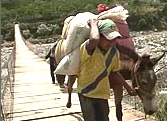 In much of the world, patrons of restaurants and bars tip their waiters, waitresses, and bartenders, in recognition of a job well-done (and in recognition that, in some jurisdictions at least, such jobs are exempted from minimum wage requirements). More recently, tip jars have shown up at places featuring counter service only, like coffee shops. But if you’re going to tip your barista, why stop there? Why not show your appreciation to, say, the farmer who grew and harvested the coffee?
That’s precisely the idea behind this interesting project: TraceableCoffee.org
“We’re using technology to put a human face on a commodity product that Americans savor every day. Coffee lovers don’t think twice about providing a well-deserved tip to a barista, so why not use your smart phone or computer to tip the actual farmers who grew your coffee,” said Thaleon Tremain, General Manager, Pachamama Coffee Cooperative. “This isn’t charity, but a chance at a more direct and meaningful relationship with your coffee farmer.”
[That’s from this press release.]
Interesting idea. And far be it from me to object to a voluntary transfer of wealth. But I wonder about just why farmers are being chosen as the beneficiaries. The most straightforward answer, of course, is that the project is the brainchild of the coffee growers cooperative. It’s entirely (and not unreasonably) self-serving. But from a consumer’s point of view, why tip farmers, in particular? If you appreciate your coffee, and want to improve the lives of the underprivileged people who made it possible, why single out farmers? Why the farmer, and not the truck driver who brought the coffee beans to the processing plant? Or the longshoreman who loaded the coffee onto or off of the ship that carried it from Guatemala or Ethiopia? Or the shipping clerk who made sure that the paperwork got done? Chances are, none of these people is well paid.
My guess is that our continuing romanticization of farming makes it easier to be sympathetic to the plight of a (poor) farmer than it is to be sympathetic to the plight of a (poor) shipping clerk. But from an ethical point of view, the choice seems entirely arbitrary.
(For a recent blog entry about a project with similar intentions, see “Progressive Garment Factory, or Charity?”).
Business Ethics in Film
 As September approaches, many of us are thinking about the start of school. Those of us who teach Business Ethics are thinking about how to ease our students into the topic without throwing them into deep philosophical waters right off the bat.
One way to do that is through film. Regular readers will know that I occasionally review movies here (both documentaries and fiction). Now I’ve set up a special page, on my EthicsWeb Bookstore, with links some of my reviews, along with Amazon links to let you buy the DVDs. Here it is: Ethics on Film.
My list is far from complete — I’ve kept the list minimal, sticking to movies I’ve reviewed on this blog or used in the classroom. So I’ve left out classics like Wall Street, for example). But if you have suggestions (especially for films that you’ve used successfully to foster discussion of business ethics) let me know.


 The Business Ethics Blog