Author Archive
Ethics and the SME
Here’s a very nice short article on business ethics, with a particular focus on SMEs (small and medium enterprises).
By Hendri Pelser, writing for Times Live (South Africa), Play fair and you will win:
With the effects of the global credit crunch still with us, it is pertinent to consider business ethics – the lack thereof helped create the recession.
But how does one approach business ethics? In the academic world, it is a philosophical discipline. For companies, it’s often a large volume of rules and regulations.
In the arena of small and medium enterprises, however, it simply comes down to the way you and your business behave – and decision makers face a myriad ethical challenges every day. These range from the way the tea lady is treated to the non-payment of suppliers or even bribes and kickbacks….
This piece is nice in a number of ways. Too little has been written, generally, about ethical challenges faced by SMEs, and this article says a lot of smart things about that. But the article really is a good brief primer on business ethics, and an interesting read throughout.
My one quibble is with the title of the article, which is misleading (but which probably wasn’t chosen by Pelser, so it’s not his fault). Nothing in the article actually implies that if you play fair, you’ll win. Certainly there’s a suggestion that good ethics leads to a good reputation, which in turn can help a business achieve success. But the relationship between ethics and business success is clearly complicated. In some cases, success is what gives a business a bit of leeway to engage in the kind of overt ethical behaviour that will build its reputation. In such cases, the truth is closer to “win, and you can afford to play fair.” Also, it just cannot be denied that in at least some cases, you’ll play fair and lose. Or, more generally, there are situations in which you’ll lose no matter how you play — perhaps because other companies have better products, better staff, better marketing, economies of scale, whatever. That complexity, of course, is precisely what makes ethics in business a challenge. If acting ethically were a straightforward recipe for business success (and if it were uncontroversial just what counted as acting ethically), we’d see a lot less unethical stuff going on in the world of commerce.
Oxford Handbook of Business Ethics (Reviewed)
 Here’s a useful review of an excellent new reference volume: “The Oxford Handbook of Business Ethics, Reviewed by Matt Zwolinski, University of San Diego”.
I’ll admit right away that I’m biased: I’m co-author of a chapter in the Handbook (the chapter on Conflict of Interest) and Matt has nice things to say about our chapter in his review. But I’m pointing to the review as a way to make a point about the breadth of this thing we call “Business Ethics.”
Regarding the likely audience for the Handbook, Matt says the following:
The book will obviously be of interest to those for whom philosophical business ethics is a main area of interest. But the entries are clear and accessible enough to make the book of special value to at least two other groups: those whose approach to business ethics is not primarily philosophical will find here a useful ‘crash course’ in an alternative methodological approach to their own subject, and those philosophers who are not primarily interested in business ethics will be treated to a volume that makes clear the connection between business ethics and more standard philosophical subjects, and that will almost certainly provide them with new ways of thinking about both business ethics and other topics in value theory and political philosophy that are connected with business ethics in ways they might not have previously recognized.
Matt’s analysis of potential audiences is insightful, but I’d like to propose a further audience, namely those people who have a particular interest in business ethics, but who don’t know they’ve got a particular interest in Business Ethics. The people I have in mind here are the many many management professors, consultants, writers, and activists who have a deep (and sometimes professional) interest in ‘business doing the right thing’, but who do not (for one reason or another) identify with the term “Business Ethics.” That includes at least some professors who teach courses on “Business and Society” or “Corporate Social Responsibility,” and others whose work involves terms like “sustainability,” or “social responsibility” or “corporate accountability.” People working in those areas may, through an unfortunate fluke of language, be intellectually cut-off from mainstream academic Business Ethics, and a volume like the Oxford Handbook could be an excellent remedy for that.
(p.s., for a previous blog entry by me concerning the vocabulary of business ethics, see Barriers to Talking About Doing the Right Thing.)
(You can buy the Handbook via Amazon, here: Oxford Handbook of Business Ethics.)
World Cup Fever and Employee Productivity
 The FIFA World Cup is one of the few events capable of diverting the world’s attention from the BP oil spill. I’m sure for many it’s a relief not to have a world-class disaster as the focus of their attention during every waking moment. In that regard, even for non-soccer fans, the World Cup is a welcome diversion. Of course, for many, it’s much more than that. It’s an obsession. It’s also a month-long diversion from other obligations.
Here’s a story about how businesses are dealing with the ways in which World Cup fever is affecting employee productivity. By Susan Krashinsky and Iain Marlow, for the Globe & Mail: The World Cup in the workplace – no keeper can stop it
[A]t its call centre in Brampton, the Canadian telecommunications giant [Rogers Communications] has wheeled in four giant projection screens to allow employees to catch World Cup games.
In Brampton, Rogers has opted to face head-on the possibility of lost productivity during this global sports event. Almost all World Cup matches will take place during regular work hours in North America. Rather than pretend employees won’t be focused on the tournament, Rogers is supplying the screens – some playing silently for those taking calls, and one that will sit in the cafeteria, volume cranked up….
Two main ethical questions arise, here. One: what do employees owe their employers? The other: what do employers owe their employees? Alternatively, we can combine the two into the single question, ‘How should an important-but-time-consuming cultural event like the World Cup be integrated into the workplace? Obviously, cases will differ. In an Air Traffic Control tower, where distractions could be fatal, no one (hopefully) is going to make an argument for installing a big-screen TV to watch whatever game is on. On the other hand, if you happen to work in a sports bar, the question is again kind of trivial but for the opposite reasons.
Setting aside those extremes, what about your average, middle-of-the-road office environment? Clearly any sensible solution has to involve a formulation of shared expectations. Managers and employees need to come to an understanding about how (as opposed to “whether”) employees are going to check in on World Cup games. In principle, any mutually-agreeable solution is ethically acceptable. But I would think really wise managers would find ways to turn employees’ interest in the World Cup into a benefit, rather than a liability. The most obvious way is by using the World Cup as part of various morale-boosting activities. More subtly, companies might draw on sports analogies — analogies that should be particularly vivid during the World Cup — in order to create training activities, perhaps ones that provide lessons on teamwork and courage. Indeed, they could even draw on the world cup to create training activities that focus on ethics, building on the analogy between sports and business as two competitive domains that can and should be productive endeavours, but that are more likely to be so when played within the boundaries of a well-thought-out set of rules.
Flexible Ethics in the Wake of Disaster
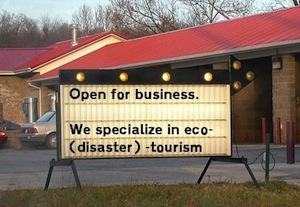 What do businesses in the tourism industry in areas affected by the BP oil spill owe to customers and potential customers? Or, to put it another way, just how closely do businesses in the stricken region need to adhere to the “usual” ethical rules of commerce?
Many businesses along the Gulf Coast have of course been very hard-hit. At this point, large stretches of the Gulf Coast are essentially unthinkable as vacation destinations, unless you happen to be into eco-disaster tourism. As a result, businesses there are fighting for their lives — all due to circumstances beyond their control, but very much within the control of a certain oil company whose name, by now, is all too familiar.
In such circumstances, businesses are likely to do just about anything to draw what tourists they can. Though I don’t know of particular cases, it wouldn’t be at all surprising to see some companies cutting corners, ethically speaking. For example, imagine a potential vacationer calls up a resort on the fringe of the affected area, wanting to know whether that particular stretch of beach is still vacation-worthy. And imagine that the usability of the beach is borderline. What answer should the owner of the resort give, over the phone? How scrupulously honest does she have to be, when the survival of her business (and the livelihood of her employees) is on the line?
The problem posed by the expectations of tourists and the way those are handled by resort owners is illustrated in this article by Mike Esterl, for the Wall Street Journal: In Alabama, a Fight for Tourists
“This is not what we expected,” said Clint Pope, 27, who drove his family to Gulf Shores from Thomasville, Ala., Friday for a weekend at the beach.
Mr. Pope’s 10-year-old son, Drew, and nine-year-old nephew, Nathan, still swam in this stretch of the Gulf on Friday afternoon, along with other tourists. But nobody was going into the water Saturday.
Now it’s tempting to say that the obligation of businesses to deal honestly with customers (and potential customers) is unchanged by current circumstances. But compare: many people thought that the looting that took place in the aftermaths of both Hurricane Katrina and the earthquake in Haiti was morally excusable. Some said it doesn’t even count as “looting” at all, when you’re fighting for survival. Does that principle hold true when the party in question is a small business owner, rather than an individual consumer? If stealing (within reason) is ethically permissible in the aftermath of a disaster, is bending the truth (or even lying) ethically permissible, too?
Now there are of course differences in the two cases. In the Katrina and Haiti cases, people were literally fighting for survival — it was literally life-or-death. Presumably no one in the Gulf Coast tourism industry is literally going to starve to death. But still, the general question remains interesting: to what extent can ethical rules legitimately be bent, when someone’s interests are seriously threatened?
Soccer Ball Ethics
Filed under: advertising, quality, sponsorship, sports, technology |
 Comments (5)
  Amidst all the excitement over the start of the FIFA World Cup, one of the oddest bits of excitement has surrounded the innovative ball being used in the tournament, namely Adidas’ new “Jabulani.” Although the ball was designed to have superior aerodynamic properties, critics have attacked the ball for the particular way it flies though the air. Here, for example, cites Brazilian goalkeeper Julio Cesar as saying “It’s terrible, horrible. It’s like one of those balls you buy in the supermarket.”
Two things are interesting about this controversy.
One has to do with fairness. The controversy over the Jabulani — the ball that all teams will play with during the tournament — reminds us that the “level playing-field” metaphor so often appealed to in business is a sporting metaphor. It’s a reference to the fact that we think it desirable, generally, to make sure that no team has an unfair advantage. We want a level playing-field because if we play on a hill, one team is seriously disadvantaged by having to attempt to advance the ball up-hill, which requires considerably more effort. The point generalizes to any factors (including changes in the game) that give one side an unfair (dis)advantage. A change in the game is one thing, but a change that creates a differential advantage is quite another. And with regard to the Jabulani, even some critics have admitted that the fact that this change affects everyone equally mitigates the criticism. As English goalkeeper David James put it, “It’s horrible, but it’s horrible for everyone.”
But it’s worth noting the limits of this level-playingfield argument. While it’s true that all teams are subject to the same change, it’s not true that everyone is affected equally. First, it seems to be goalkeepers that are complaining most, suggesting that there’s a differential impact on them compared to other players — and that matters, at very least in terms of the ego of goalkeepers vs the egos of those scoring the goals. (In fact some suspect that this is an intentional outcome of the change in the ball: it will result in more goals, and hence more excitement, hence making it a better TV sport for North American viewers in particular.) Second, it’s not clear that all teams will be affected equally. Particular ball characteristics are liable to suit some teams’ strengths and strategies better than others. So why the “field” may be “level” at a superficial level, we may need to look deeper if we’re really interested in deciding whether this particular change is, in fact, a fair one.
The second interesting thing about the controversy has been the response from Adidas, the company that designed the ball. The response from Adidas has mainly focused on the science, and on pointing out that change is always difficult at first. But Adidas also had a more interesting defence, namely accusing (some) critics of conflict of interest. (See this definition of ‘conflict of interest’.) In particular, the claim is that most of the critics are subject to a possible financial bias. According to this story,
[Adidas spokesman Brueggen] pointed out that if you look closely at the players and goalies making these accusations you’ll notice one common thread among them: the all have contracts with Adidas’ competitors.
Now certainly not all critics have been affiliated with Adidas’ competitors. The soccer-gear website ‘Soccer Cleats 101,’ for example, reviewed the Jabulani back in January, and expressed some of the same concerns. Still, it’s an interesting accusation. And as always with such accusations, interesting questions arise. First, can Adidas’ claim be backed up empirically? If we actually count up the critics and look at what companies they’re sponsored by, will we see the pattern that Adidas claims? If Adidas hasn’t done such a tally (but is simply working from a rough impression) is it fair to make the accusation? Is the suspicion enough? And if we do confirm such a pattern of bias, what’s the specific explanation for it? Is it a matter of players consciously promoting the interests of companies they’re affiliated with, or is it more likely to be a more subtle, subconscious bias? And, finally — setting aside the fact that professional sport is, itself, a big business — what lessons can we learn from this sports story, and apply to the world of business more generally?
(p.s. Those of you with an interest in ethical dimensions of sports should be sure to check out Wayne Norman’s blog, This Sporting Life.)
What Does BP Owe its Shareholders? Nothing.
 People have generally been dismayed at the behaviour of BP execs in the wake of the disastrous oil spill. CEO Tony Hayward has been roundly criticized, both for his overall handling of the situation, and for asking dumb questions like “What the hell did we do to deserve this?” The unmistakable impression is that BP’s ‘heart’ really isn’t in it when it comes to fixing this mess, and that they’re more interested in preserving what’s left of their reputation and in protecting profits.
How, ethically, ought BP’s execs to be behaving? Where do their obligations lie? Should they be focused 100% on cleanup? Should they be trying to preserve and build shareholder value? Should they be balancing those 2 objectives?
Generally, the task of corporate managers is to build wealth for shareholders. Don’t forget, executives are hired to run a business they don’t own, so it’s not up to them to decide how to run it. The standard view is that their job is to serve the shareholders. As long as they do so in constructive ways — through innovation, efficiency, etc. — and as long as innocent bystandards aren’t hurt, such profit-seeking is in fact socially beneficial. So one way to think about business ethics is that managers are free to compete aggressively, focused primarily on shareholder value, as long as they’re not misleading customers, abusing monopolistic power, or foisting costs on bystanders (i.e., imposing what economists call “negative externalities”). Those behaviours represent the boundaries of the ‘game,’ as it were. Within those boundaries: play ball!
This view implies that as long as a company keeps its nose clean, they don’t need to feel bad about pursuing profits, even when doing so means, for example, putting a competitor out of business, resulting in a loss of jobs, etc.
OK, so now consider BP. A year ago, BP’s managers might have been able to say something like this: Our job is to build shareholder value. We do that by producing a product society needs and is willing to pay for. As long as we don’t pollute too much (after all, all industry creates at least some pollution) it’s ethically OK for us to focus on our the interests of our shareholders.
Now, fast-forward to right now, to June of 2010. BP’s managers can’t exactly help themselves to the above argument, can they? The condition that normally justifies the zealous pursuit of profits doesn’t obtain, here, because BP’s managers haven’t been anywhere near sufficiently careful about avoiding imposing costs on others. Indeed, they’ve imposed massive costs (massive negative externalities) on the people of the Gulf Coast states, and (less directly) on the rest of us too.
So, when BP’s managers look around them, at the wide range of individuals and groups with a stake in their current decision-making, how much weight are they justified in giving to the interests of their shareholders, i.e., to the people who benefited from their profit-seeking behaviour in the first place?
I’d say “roughly zero.”
(The philosophical version of the argument for the basis, and limits, of profit-seeking behaviour can be found in Joseph Heath’s “An Adversarial Ethic for Business: or, When Sun-Tzu met the Stakeholder,” Journal of Business Ethics, 69, 2006. A downloadable version is on Joe’s page here.)
Boycotting BP is Futile and Unethical
 Do not boycott BP.
I know you’re mad. I am too. But a boycott won’t accomplish any of the things you’re trying to accomplish. And it’s unethical.
The push to boycott BP (as a punitive response to the Deepwater Horizon oil spill, obviously) comes from the advocacy group Public Citizen, which encourages you to: “Boycott BP: Take the Beyond BP Pledge today!” There’s also the inevitable Facebook group, Boycott BP.
This move is well-intentioned, but entirely wrong-headed, for a number of reasons.
The first reason has to do with alternatives. Sharon Begley at Newsweek, with the sarcastic title “Boycott BP! Because it’s much better to give your money to Exxon.” It’s highly unlikely that those who participate in this boycott are going to eschew gas purchases altogether. With a few exceptions, they’re much more likely to simply start buying their gas at the non-BP station down the street. And, as Begley points out, as far as the oil companies providing the oil go, good luck finding one that meets your high ethical standards — or even minimally decent ones. Every oil company you can name is in roughly the same moral category. So boycotting BP just means jumping out of the frying pan and into the fire.
Second, there’s the fact that a boycott of BP gas stations won’t actually hurt the organization you’re trying to hurt. In practice, “boycotting BP” means boycotting BP-branded retail outlets. And as an editorial in the LA Times pointed out, “BP stations are independently owned, so a boycott hurts individual retailers more than London-based BP.” So, sure, boycott BP stations — that is, if your goal is to hurt a bunch of small businesses already operating on razor-thin profit margins. Put a few minimum-wage gas jockeys and cashiers out of work. The difference simply will not be felt at BP’s head office. (The same naturally goes for vandalism of BP stations, which is both unethical and criminal.)
Finally, there’s the question of tokenism. Buying gas for your car is far from the only way many of us indirectly buy from BP on a regular basis. As “DanH” points out in the Comments section of this blog entry, (see comment at June 3rd, 2010 2:52 pm) BP also makes home-heating fuel, airline fuel, ingredients for plastics, and the natural gas from which much electricity is generated. Oh, and solar panels — BP makes those, too. If you want to make this boycott real (which you shouldn’t) you’ve got to boycott those things, too.
Can consumers take action? Sure they can, by doing things — long-term things — to reduce their reliance on fossil fuels. They can also write their elected representatives to encourage tougher regulation of risky practices like deep-water drilling. And so on. I know, I know: in the immortal words of Homer Simpson, “But I’m mad now!“ Well, then direct the righteous indignation you’re feeling now toward change that will make the world better for the future.
It’s fine to be angry about this disastrous oil-spill. Being angry is entirely appropriate. And it’s good to want to do something. But do the right thing, not the first thing that comes to mind.
(Tip of the hat to AP.)
BP: Not Really “Beyond Petroleum,” Just Greenwash After All
 When British Petroleum rebranded itself a few years ago as just “BP,” it adopted the tagline “Beyond Petroleum,” in an attempt to signal a commitment to new energy technologies, and to new ways of doing business.
Of course, there were skeptics. Back in 2000, CorpWatch had this to say about the rebranding:
BP’s re-branding as the “Beyond Petroleum” company is perhaps the ultimate co-optation of environmentalists’ language and message. Even apart from the twisting of language, BP’s suggestion that producing more natural gas is somehow akin to global leadership is preposterous. Make that Beyond Preposterous.
So, the accusation was basically one of greenwash — essentially, an attempt to mask a lousy environmental record with a thin patina of environmental commitment. Had I commented back in 2000, I might have suggested that it was too early, then, to confidently accuse the company of greenwash. Sometimes companies do undergo substantial changes — changes in policy, in culture, and in leadership. The worry then is that if we criticize or mock a company’s stated intention to turn over a new-and-greener leaf, we may actually be doing more harm than good by taking the wind out of the sails of what might actually be positive change.
OK, fast-forward to 2010, to the biggest oil spill in U.S. history and to the Center for Public Integrity stating that BP accounts for “97 percent of all flagrant violations found in the refining industry by government safety inspectors over the past three years”.
Greenwashing? Case closed, as far as public opinion of BP is concerned. And perhaps more importantly, it now becomes just that much harder for the public to take seriously any big company’s claim that it really wants to improve its environmental performance.
Galarraga’s Corvette
Filed under: advertising, governance, government, management, shareholders |
Comments (2)  By now everyone probably knows the background story: Detroit Tigers pitcher Armando Galarraga didn’t get credited with the perfect game he pitched last Wednesday, due to a bad call made by the umpire. Fast-forward a day to General Motors tapping into international sympathy felt for Galarraga by giving the ballplayer a red Corvette convertible. A public-relations coup…pure genius, right?
Well, unless you’re given to armchair micromanagement, in which case you slam GM for wasteful spending.
Here’s the story, by the New York Times’ Nick Bunkley: G.M.’s Gift of a Luxury Car Stuns a Few.
A free sports car for a Detroit Tigers baseball player was not among the reasons the government saved General Motors from financial collapse. Nor was a year’s supply of diapers and other gifts for a Minnesota woman who gave birth behind the wheel of a Chevrolet Cobalt.
General Motors has given away both in recent weeks — marketing ploys that would have barely raised an eyebrow in the past. But now that American taxpayers collectively own a majority of the carmaker, executives are learning that there are more than 300 million potential second-guessers out there.
The complaint, of course, is ridiculous. Never mind the fact that it’s so patently obvious, even to those of us who are not experts, that this was a brilliant move by GM. The bigger point here is that most of us (including the critics mentioned in the NYT story) are not experts, either in public relations or in corporate management more generally.
Now, that’s not to say that non-experts can’t express an opinion. (The fact that I have a “Comments” section on my blog essentially constitutes an invitation to experts & non-experts alike to comment.) The point is that shareholders in GM (including, now, indirectly, all U.S. citizens) have little business feeling aggrieved over each and every minor managerial decision, even ones they suspect are misguided. Shareholders hire managers to manage — to make decisions. Courts have long recognized that, once you empower someone to run a business, you basically need to back off and let them do their job. There are exceptions, of course. The American people now hold a major stake in GM, and they should be worried if they see GM managers heading in any truly disastrous directions. But being a shareholder neither qualifies you, nor entitles you, to have a say in day-to-day decision making. So critics of GM’s gift should feel free to play armchair umpire; but they shouldn’t expect anyone to take them seriously.
The BP Disaster: Regulating (and Managing) Complexity
Filed under: complexity, disaster, environment, management, product safety, regulations, technology |
Comments (3)  In my previous blog posting on the BP oil-rig disaster, I pointed to the disaster’s ethical complexity, measured in the sheer number of relevant ethically-interesting questions that we might be interested in.
But the issue of complexity arises in a much more straightforward way in the BP disaster, namely in the fact that the oil rig on which the disaster took place was itself a terrifically complex piece of technology.
See this nice piece by Harvard economist Kenneth Rogoff, The BP Oil Spill’s Lessons for Regulation.
The accelerating speed of innovation seems to be outstripping government regulators’ capacity to deal with risks, much less anticipate them.
The parallels between the oil spill and the recent financial crisis are all too painful: the promise of innovation, unfathomable complexity, and lack of transparency (scientists estimate that we know only a very small fraction of what goes on at the oceans’ depths.) Wealthy and politically powerful lobbies put enormous pressure on even the most robust governance structures….
Rogoff’s point is about regulation, but it could just as easily be about management, and/or the relationship between the two. And to Rogoff’s examples of complexity-driven disasters, you can add Enron and a couple of NASA shuttle explosions. Now, none of these cases can be explained entirely in terms of the difficulty of managing complex systems; each of those cases include at least some element of bad judgment and probably unethical behaviour. But in each of them one of the core problems was indeed complexity — either for those inside the relevant organizations or for those outside trying to understand what was going on inside. When systems (financial or mechanical) are mind-numbingly complex, it becomes all the easier for poor judgment to produce catastrophic results. It also makes for good places to hide unethical behaviour.
So, if we’re going to build fantastically complex systems, we also need to learn how to manage those systems in highly-reliable ways. In other words, we need management systems — effectively, social technologies — that are as sophisticated as the physical and economic technologies they are intended to govern. We already know a fair bit about error-reduction and the design of high reliability organizations. Aircraft carriers are a standard example of one type of seriously complex organization that, through careful design of management systems, has managed to achieve incredibly high levels of reliability — i.e., incredibly low levels of error, despite their complexity. Similar thinking, and similar design principles, could presumably be applied pretty directly to the design and management of oil rigs. Presumably, that’s already the case to at least some extent, though as BP has proven, more needs to be done. The bigger question is whether business firms are ready and able to apply those principles to the design of all of their complex systems — whether mechanical or financial — such that we can continue to reap their benefits, without suffering catastrophic losses.
(Thanks to Kimberly Krawiec for showing me Rogoff’s article.)



 The Business Ethics Blog