Author Archive
Galarraga’s Corvette
Filed under: advertising, governance, government, management, shareholders |
 Comments (2)
  By now everyone probably knows the background story: Detroit Tigers pitcher Armando Galarraga didn’t get credited with the perfect game he pitched last Wednesday, due to a bad call made by the umpire. Fast-forward a day to General Motors tapping into international sympathy felt for Galarraga by giving the ballplayer a red Corvette convertible. A public-relations coup…pure genius, right?
Well, unless you’re given to armchair micromanagement, in which case you slam GM for wasteful spending.
Here’s the story, by the New York Times’ Nick Bunkley: G.M.’s Gift of a Luxury Car Stuns a Few.
A free sports car for a Detroit Tigers baseball player was not among the reasons the government saved General Motors from financial collapse. Nor was a year’s supply of diapers and other gifts for a Minnesota woman who gave birth behind the wheel of a Chevrolet Cobalt.
General Motors has given away both in recent weeks — marketing ploys that would have barely raised an eyebrow in the past. But now that American taxpayers collectively own a majority of the carmaker, executives are learning that there are more than 300 million potential second-guessers out there.
The complaint, of course, is ridiculous. Never mind the fact that it’s so patently obvious, even to those of us who are not experts, that this was a brilliant move by GM. The bigger point here is that most of us (including the critics mentioned in the NYT story) are not experts, either in public relations or in corporate management more generally.
Now, that’s not to say that non-experts can’t express an opinion. (The fact that I have a “Comments” section on my blog essentially constitutes an invitation to experts & non-experts alike to comment.) The point is that shareholders in GM (including, now, indirectly, all U.S. citizens) have little business feeling aggrieved over each and every minor managerial decision, even ones they suspect are misguided. Shareholders hire managers to manage — to make decisions. Courts have long recognized that, once you empower someone to run a business, you basically need to back off and let them do their job. There are exceptions, of course. The American people now hold a major stake in GM, and they should be worried if they see GM managers heading in any truly disastrous directions. But being a shareholder neither qualifies you, nor entitles you, to have a say in day-to-day decision making. So critics of GM’s gift should feel free to play armchair umpire; but they shouldn’t expect anyone to take them seriously.
The BP Disaster: Regulating (and Managing) Complexity
Filed under: complexity, disaster, environment, management, product safety, regulations, technology |
Comments (3)  In my previous blog posting on the BP oil-rig disaster, I pointed to the disaster’s ethical complexity, measured in the sheer number of relevant ethically-interesting questions that we might be interested in.
But the issue of complexity arises in a much more straightforward way in the BP disaster, namely in the fact that the oil rig on which the disaster took place was itself a terrifically complex piece of technology.
See this nice piece by Harvard economist Kenneth Rogoff, The BP Oil Spill’s Lessons for Regulation.
The accelerating speed of innovation seems to be outstripping government regulators’ capacity to deal with risks, much less anticipate them.
The parallels between the oil spill and the recent financial crisis are all too painful: the promise of innovation, unfathomable complexity, and lack of transparency (scientists estimate that we know only a very small fraction of what goes on at the oceans’ depths.) Wealthy and politically powerful lobbies put enormous pressure on even the most robust governance structures….
Rogoff’s point is about regulation, but it could just as easily be about management, and/or the relationship between the two. And to Rogoff’s examples of complexity-driven disasters, you can add Enron and a couple of NASA shuttle explosions. Now, none of these cases can be explained entirely in terms of the difficulty of managing complex systems; each of those cases include at least some element of bad judgment and probably unethical behaviour. But in each of them one of the core problems was indeed complexity — either for those inside the relevant organizations or for those outside trying to understand what was going on inside. When systems (financial or mechanical) are mind-numbingly complex, it becomes all the easier for poor judgment to produce catastrophic results. It also makes for good places to hide unethical behaviour.
So, if we’re going to build fantastically complex systems, we also need to learn how to manage those systems in highly-reliable ways. In other words, we need management systems — effectively, social technologies — that are as sophisticated as the physical and economic technologies they are intended to govern. We already know a fair bit about error-reduction and the design of high reliability organizations. Aircraft carriers are a standard example of one type of seriously complex organization that, through careful design of management systems, has managed to achieve incredibly high levels of reliability — i.e., incredibly low levels of error, despite their complexity. Similar thinking, and similar design principles, could presumably be applied pretty directly to the design and management of oil rigs. Presumably, that’s already the case to at least some extent, though as BP has proven, more needs to be done. The bigger question is whether business firms are ready and able to apply those principles to the design of all of their complex systems — whether mechanical or financial — such that we can continue to reap their benefits, without suffering catastrophic losses.
(Thanks to Kimberly Krawiec for showing me Rogoff’s article.)
Business Ethics & Alternative Medicine
Filed under: health, natural, pharma, product safety, regulations, retail, Uncategorized |
Comments (2)  This is a “meta” blog posting, bringing together the various blog entries of mine over the last couple of years on the single topic of business ethics and alternative medicine.
Alternative medicine (includes things like homeopathy, herbal supplements, Traditional Chinese Medicine, acupuncture, therapeutic touch, and so on) raises some interesting ethical issues. On one hand, most of it doesn’t work (or to be more accurate, most of it is unproven, and much of it is disproven), and we tend to think people should only sell products that work as advertised. But on the other hand, alternative medicine has many fans, and we generally think consumers ought to be able to choose for themselves what products are good for them.
Two other factors make alternative medicine interesting, from a business-ethics point of view.
One factor is that both the safety and efficacy of alternative therapies varies. Some therapies (e.g., homeopathy) are entirely implausible, whereas others such as some herbal therapies probably are effective. Not surprisingly, the pattern is reversed for safety: homeopathy is entirely safe (unless the consumer does something foolish like forgoing real medicine in favour of homeopathic remedies for the treatment of a serious illness), while on the other hand some herbal remedies pose significant dangers.
The second important factor is that alternative medicine is generally under-regulated. In Canada, for example, herbal supplements are categorized as “natural health products” and subject to only minimal oversight. The result is that neither consumers nor companies can assume that the law is providing significant oversight. In the absence of strong consumer-protection legislation, there’s a particularly strong obligation for companies to act ethically.
Here are my blog postings on this topic, in reverse-chronological order:
- Pharmacists and Candour About Homeopathy (May 2, 2010)
- Consumer Protection & Homeopathy (April 12, 2010)
- Which Alternative Therapies is it Ethical To Sell? (March 8, 2010)
- Charities, Stakeholders, and Guilt By Association (August 28, 2009)
- Ethical to Teach a Bogus Therapy? (August 25, 2009)
- Second Plea to Alternative Health Practitioners: Help With Health Reform! (June 17, 2009)
- British Chiropractors Retreating from Publicity (June 10, 2009)
- I Need A Homeopath or Naturopath (May 17, 2009)
- Marketing Useless (Magnetic) Products (October 21, 2008)
By the way, to the best of my knowledge, there is not a single scholarly paper that looks at the selling of alternative medicines from a business-ethics point of view. If you know of one, please let me know!
International Trade: Commerce, or Aid?
 Early this week I attended the annual meeting of the Canadian Philosophical Association, where I gave comments on a very good paper presented by Cristian Dimitriu, entitled “Human rights and development as fair background conditions of international trade.” Basically, the question at issue was whether, in engaging in international trade, it is ethically obligatory for companies to promote human rights. (Note the significance of the word “promote,” here. An obligation to promote human rights is much more demanding than an obligation simply to respect human rights.)
One of the suggestions I offered in my comments was a reminder that commerce, generally, is an adversarial game, and that in adversarial games, we generally have fewer and less-restrictive obligations. Business, like football, is a competitive domain, one in which the normal rules of polite society get relaxed in certain ways. The justification is basically that business, like football, is a game that harnesses competitive behaviour for socially-beneficial purposes. (The clearest enunciation of this view can be found in Joseph Heath’s essay “An Adversarial Ethic for Business or When Sun-Tzu met the Stakeholder” [download the PDF here].) Since international trade is, after all, a kind of commerce, then it’s worth remembering that whatever rules and limits it is subject to are part of the set of rules governing an adversarial game.
But international trade is not, of course, only a kind of commerce. It’s also a part of international relations, and governments engage in trade treaties and set trade policies based on a whole range of ethically-relevant considerations, including national economic interests, friendship (between nations), and a sense of obligation to help other, poorer, nations to build their own economies. Consider, for example, the fact that trade policy is one tool governments have at their disposal for enacting what they take to be their national obligations in the realm of international development. That is, one way a wealthy nation can help a poorer nation is — instead of sending them cash — to engage in trade with them.
What this suggests is that international trade involves the intersection of two very different games, with different objectives, and very likely subject to different ethical demands. So, this poses an interesting (and I think difficult) question. How should individual businesses navigate this intersection of games? Do businesses have an obligation to go some way towards fulfilling national obligations, or is that (perhaps by definition) solely the obligation of national governments?
Unethical Herbal Supplements
Filed under: advertising, health, honesty, labelling, natural, pharma, regulations, science |
Comments (1) Hey, what’s in that bottle of all-natural herbal supplements on your kitchen counter? Are you sure? What will those supplements do for you? Cure all that ails you? Something? Nothing? One way or the other, how do you know? The truth is, you probably shouldn’t feel so certain.
 Here’s the story, from Katherine Harmon, in Scientific American: Herbal Supplement Sellers Dispense Dangerous Advice, False Claims
[The lack of evidence for their effectiveness] …hasn’t stopped many supplement sellers from making the false claims and even recommending potentially dangerous uses of the products to customers, according to a recent investigation conducted by the Government Accountability Office (GAO). To obtain a sample of sales practices, the agency got staff members to call online retailers and to pose undercover as elderly customers at stores selling supplements.
Customers were not only told that supplements were capable of results for which there is no scientific evidence (such as preventing or curing Alzheimer’s disease); the advice and information also was potentially harmful (including a recommendation to replace prescription medicine with garlic)….
Some fans of herbal remedies are liable to complain that the relevant government agencies ought to be directing their efforts at the real culprits, namely Big Pharma. Why pick on people who package and sell “natural” herbal products when major pharmaceutical companies are, on a regular basis, found to have engaged in a whole range of dubious and sometimes deadly behaviours? But that’s roughly like a bank robber, upon his arrest, complaining that the cops ought to be out chasing white-collar criminals instead. The fact that embezzlement is a bad thing does nothing to diminish the badness of robbery. Both are wrong, and both are worthy of punishment.
Essentially, what we’re seeing here is history catching up with the makers of herbal supplements. Over the last decades, we’ve imposed increasingly tough rules on the pharmaceutical industry (though those rules still need to be tightened up in various ways). But herbal products are part of the “natural” products industry, and that industry is woefully under-regulated. Indeed, that industry is probably about as well-regulated today as the pharmaceutical industry was, say, 50 years ago.
(p.s. for information about which herbal supplements are and are not backed by good science, see Scott Gavura’s Science-Based Pharmacy blog.)
Authenticity in Advertising
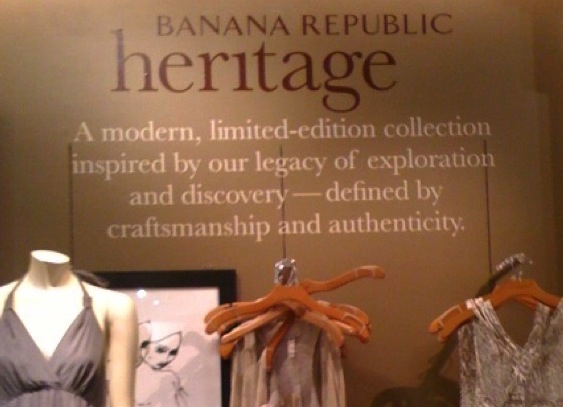 I took this picture in a Banana Republic store in Toronto this morning. This sign on the wall caught my eye, mostly because I’ve been reading my pal Andrew Potter’s wonderful new book, The Authenticity Hoax.
Note the explicit claim of authenticity, in this ad. As Andrew’s book points out, the language of authenticity is increasingly common in advertising today. It’s interesting to ask just what the claim to “authenticity” means in an ad like this, or in any other ad. Here, does it mean these dresses are historical reproductions? Surely not. So there’s no question of interrogating Banana Republic on the accuracy of either their styles or the accuracy of their claims. So what does “authenticity” refer to, here? It seems to be a straightforward attempt to tap into the widely-shared (but, as Andrew argues, ultimately misguided) desire to flee all that is superficial and phony, and get “back” to something more “real.”
Two further things are worth pointing out. One is that here, as is so often the case, finding authenticity seems to require buying something that is a self-proclaimed rip-off from fashions of days gone by. You get “real” through imitation. The other is that Banana Republic (among many others) recognizes that they can’t get away with simply doing something authentic…consumers actually need to be told these clothes are authentic, in order to recognize them as such.
(Watch here for an interview with Andrew Potter, about authenticity and business ethics, coming soon.)
Questions About the BP Oil Disaster
There’s been an enormous amount of reporting and commentary about the disaster at BP’s Deepwater Horizon oil rig and the ensuing oil spill. One of the challenges of blogging about this story, from an ethics point of view, is figuring out where to begin. The story of the Deepwater Horizon is such a rich and complex one that Business Ethics profs will be teaching this case for decades.
Of course, what questions we need to ask depends in large part on what our purposes are. But the meta-question (“Which question is the right question?”) is still worth asking, not least because at least some of the questions currently being asked may not be a) fruitful or b) answerable.
So, what’s the right question to be asking about the worst oil spill in U.S. history?
Here’s a very incomplete list of possible questions:
- Who is to blame? BP’s CEO? BP as a whole? The rig’s foreman? The crewmembers directly involved? Transocean (the owner of the rig)? Halliburton (subcontractor for a crucial element of the drilling operation)? The U.S. Government’s Minerals Management Service? Or, more appropriately, we could ask: what’s the right way to apportion blame among those individuals and organizations?
- What role did the pursuit of profit play? Are there other, more important, ideas likely to have influenced the mind-set of the persons most directly responsible?
- Who is (ethically) responsible for cleaning up the mess — BP? The U.S. government? Coastal state governments? (Note that that question is in principle different from the one above.)
- What penalties should companies pay in the aftermath of an oil spill? (See the discussion at the excellent Marginal Revolution blog, here.)
- Is there anything ethically unique about the Deepwater Horizon disaster, or is it “just” another disaster like others we’ve seen before?
- Assuming that oil spills, big or small, are more-or-less inevitable, are such spills an acceptable cost of our unfortunate addiction to oil? As the old saying goes, “you can’t bake a cake without breaking a few eggs.” Does that apply here?
- What cultural factors within BP are likely to have played a positive or negative role? Or, since most of us don’t know much about the corporate culture at BP, what might be the crucial variables here? What should we want to know about BP’s (or Halliburton’s) corporate culture?
- If you were a senior executive at another oil company, how would or how should your day tomorrow look different than a randomly-selected day before the blowout on the Deepwater Horizon? That is, is there anything for other companies to learn, here?
- Beyond the massive cleanup to be carried out over the coming years (and it will be years), what should be on BP’s agenda for the next few years? What should BP (and Transocean and Halliburton) learn from this?
- Does this incident prove that regulations are too lax? After all, no system of regulation is perfect. Even tough laws against murder don’t bring the murder rate to zero. Did this disaster happen because of, or in spite of, the current regulatory regime?
- Would your own moral reaction to the Deepwater Horizon spill be different if you were an employee of BP (say, an employee not directly involved)? Or if you were a BP shareholder?
- Should shareholders in BP feel bad about this? If you think they should feel bad, should they feel more, or less, responsible than, say, BP’s customers?
So, if there’s anything to be learned from this disaster, what questions should we be asking?
I should add the one thing I know for sure about the questions listed above: none of the presents an easy, obvious answer.
Labelling Dangerous Foods (for Kids)
 In a blog posting a few months ago, I asked “Are Hotdogs Unreasonably Dangerous?” Some commentators suggested that the overriding concern with hotdogs ought to be their (lack of) nutritional value; but the immediate worry discussed in that blog posting was actually the choking hazard hotdogs pose for kids. And the question I posed was whether makers of hotdogs are in any sense responsible for deaths due to choking.
Here’s an update, based on a new story by Laurie Tarkan in yesterday’s New York Times: Labels Urged for Food That Can Choke.
This time, the issue is labelling. Here’s the bit I found interesting:
Some food manufacturers have voluntarily put warning labels on packages. “Two-thirds of hot dogs already have labels,” said Ms. Riley, of the National Hot Dog and Sausage Council. But Mr. Silverglade [legal director of the Center for Science in the Public Interest] said that was not enough….
What’s the weight of that statistic, in terms of how it should guide corporate behaviour? In an academic paper I co-wrote on the labelling of genetically-modified foods, I argued that consensus within an industry matters. When people’s safety is at stake, the fact that government hasn’t passed a law requiring companies to take action doesn’t mean those companies have no obligation to act.
When most companies in an industry think “this is how we ought to do business,” that means something. First, it means that people who know a given product best see a need for action. Also, when an entire industry gets behind a particular standard, that means that companies remain on a level playing field. Changing how you manufacture or label your product might otherwise put you at a competitive disadvantage. But when two-thirds of your industry is implementing the same standard, that argument pretty much falls apart.
PETA Goes Corporate
PETA — the organization best known for its attempts to annoy the world into conforming with its world-view — has found a new tactic:
PETA buys stock to gain influence in boardrooms
An animal-rights group known for sending out scantily clad demonstrators to protest fur and other provocative stunts has gained influence in boardrooms with a more traditional tactic: buying company stock.
People for the Ethical Treatment of Animals has been buying shares for seven years and now owns a piece of at least 80 companies, including McDonald’s and Kraft Foods.
Is this an obvious move, or a stunning one?
It’s somewhat amusing, of course, (and to some, I’m sure, horrifying) to know that, as shareholders, PETA will now start to benefit from the sale of the very meat products it so fervently opposes. But presumably this is an instance in which PETA believes that the ends justify the means. Another way to say the same thing is to say that PETA (to its credit?) is willing to get its hands dirty, in this case by profiting (in the short run) from a business it is trying to destroy. If (as seems likely to be the case) this strategy does succeed in giving the organization a significant voice in the corporate world, then it seems like a good move. I suspect the money they’ll spend on shares will have more impact than the same amount of money spent on publicity stunts. Presumably the only activists who will mind are ones who care less about animals and relatively more about opposing the standard pattern according to which those with money — in this case, PETA — are best able to make themselves heard.
Facebook and Dangerous Ideas
 Of all the ideas that a CEO can have, is the most dangerous one the idea that his main objective should be to generate profits for shareholders?
How about a belief in the idea that your privacy — the privacy of millions of customers, whose information he holds in the palm of his hand — just doesn’t matter? That’s roughly what Facebook CEO Mark Zuckerberg seems to believe.
Venture Beat’s Kim-Mai Cutler looked around and found a bunch of evidence about just what Zuckerberg believes, including this gem:
“You have one identity,” he emphasized three times in a single interview with David Kirkpatrick in his book, “The Facebook Effect.” “The days of you having a different image for your work friends or co-workers and for the other people you know are probably coming to an end pretty quickly.” He adds: “Having two identities for yourself is an example of a lack of integrity.”
What Zuckerberg is really talking about when he talks about people having “two identities” is privacy. He means revealing more or different information to some people than you do to others. And far from betraying a deep character flaw (“lack of integrity”), giving differential access to information about ourselves is widely regarded as an important part of how we develop and maintain intimate relationships. Your friends (including Facebook “friends”) are more or less just people who have access to information about you that most people don’t have. What it means to be intimate with someone (sexually or otherwise) is to give them access that you don’t give to everyone. It’s what makes them special. For someone like Zuckerberg not to understand this is truly scary, given how much information he controls.
And as usual, my point here is more about the general question than about the particular instance. The point of this blog entry isn’t to add one more voice to the chorus of criticisms levelled against Facebook recently. I’m just using Facebook as an example, to illustrate the point. Many people believe that the belief in the importance of profits is the big, dangerous idea we need to worry about. But it’s not. There is nothing wrong with zealously pursuing profits, so long as you don’t do so through anti-social means.
So here’s a CEO with a truly scary belief, but it’s not the belief in the importance of profits.
No, the real danger doesn’t lie in a commitment to making profits; the danger lies in what you’re willing to do to make those profits.