Archive for the ‘consumers’ Category
Is 7-Eleven My “Neighbour”?
Filed under: consumers, corporate citizenship, corporations, decision-making, public relations, stakeholders |
 Comments (1)
 I live on the edge of Toronto’s Little Portugal. There are two corner stores in my neighbourhood. One is a 7-Eleven. The other is a small, family-owned convenience store. I shop at both stores from time to time — to pick up eggs, bread, whatever.
Is there any ethical difference between shopping at 7-Eleven, on one hand, and shopping at the little Portuguese place, on the other?
At least some advocates of the “buy local” movement would say I absolutely ought to shop at the locally-owned Portuguese place. After all, it’s a part of my community, whereas 7-Eleven is a multinational corporate entity. But wait…7-Eleven is a franchise. So even though the parent company isn’t local, the owners of the franchise very likely are. The owners of that franchise are just as much part of my community as the owners of the Portuguese place are…minus the franchise fee they pay to Seven-Eleven Japan Co. Ltd. (Does that count?)
But still, the 7-Eleven, even if locally-owned, is still part of the 7-Eleven empire. When I shop at my 7-Eleven, I’m patronizing that empire. I am, to some extent, entering into a relationship with the parent company. So this question occurs to me: is Seven-Eleven Japan Co. Ltd. in any sense my “neighbour”, one to which (or to whom!) I owe the neighbourly obligation of shopping at their franchise?
Major corporations are increasingly expected to think of themselves as good neighbours, and as having obligations to local communities. But the “neighbour” relation is generally thought of as being reciprocal, as are the duties it implies. If you are my neighbour, then I am your neighbour, and vice versa. So if 7-Eleven, and other major corporations, are expected to act as good a neighbour, should we all reciprocate, and act as good neighbours to them in turn?
I don’t have an answer to offer to this question. But I think the reciprocity that is normally a feature of the concept “neighbour” ought to be part of the larger conversation about how we think of the role of business corporations not just in our economy, but in our communities.
Business Ethics & Pride in a Job Well Done
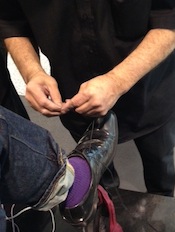 One of my shoe laces gave out today, on the way out the door heading to the airport. Luckily the shoe-shine guy, in addition to giving an excellent shine at a good price, also had reasonably-priced laces which he happily threaded and tied for me.
For some strange reason, it always comes as a shock to me when a shoe lace gives out. The odd thing is that I usually cannot remember how old the disappointing lace actually is. I honestly cannot tell you whether the lace that gave out today is 3 months old or a year old or three years old. Nor do I know what brand it was, or where I bought it. So — setting aside, for a moment, its trivial price — I have no idea who I would complain to if I thought the lace had given out sooner than it ought to have.
Given this lack of accountability, one has to wonder just what it is that motivates makers of shoe laces (or other small, cheap, anonymous products) to rise above the bare minimum in terms of quality. Shoe laces are not, presumably, a highly-regulated industry. So they could presumably get away with using cheap raw materials, keeping costs down and profits high.
One obvious answer is “ethics.” The people who make shoe laces presumably have some pride in their work, and want people to be satisfied with their laces, and feel that it’s their responsibility to produce a decent product.
Another answer might have something to do with supply chains. Maybe I can’t easily hold the maker of my laces accountable, but the store I bought them at can. Maybe the purchasing agents for the store I bought them at asks lots of tough questions and demands access to technical specifications for laces before buying. I hope that’s the case. But that just pushes the question one link higher up the supply chain. Why does the purchasing agent care, given how likely consumers are to express their disappointment, in the event that they are dissatisfied? Again, the likely answer here is “ethics,” a big part of which is the simple motivation to do a good job and treat people fairly.
OK, so this is a trivial little example. But it seems to me that it points to an important lesson. People too often think of the word “business ethics” as implying an attempt to define and achieve saintly behaviour in business. And that’s a mistake. What we’re really talking about are reasonable constraints, and reasonable standards of achievement, in the world of commerce. We’re all out there, trying to make a living, and there are better and worse ways to do that. And whether you’re manufacturing shoe laces or complex financial instruments, the starting point has to be basic pride in a job well, and fairly, done.
Ethical Consumerism is Hard
Filed under: complexity, consumers, decision-making, ethics, values |
Comments (4) 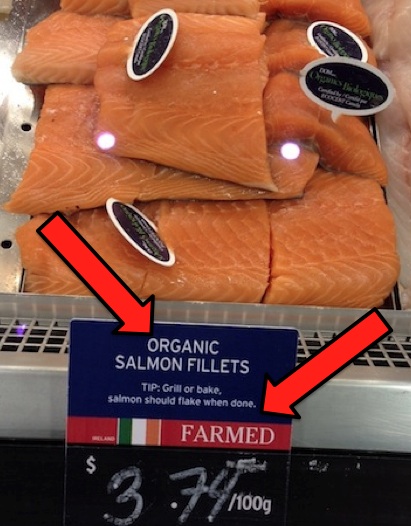 It’s not easy being an ethical consumer, these days — especially if you’re hoping to buy products that embody all or most of the ethical values you care about.
Here’s an example. If you like salmon, and if you’re the sort of consumer who wants to eat ethically, should you buy organic salmon or buy wild salmon? After all, there’s a huge effort these days to promote organic foods as ethical — gentler on the earth, and so on. Of course, others aren’t so sure that there’s much benefit to organic foods, and some even argue that the organic label is more a status symbol than anything else.
Now what about wild vs farmed? Some people think that farmed salmon is always bad. Others, like food-policy expert James McWilliams, argue that for whatever its current flaws, farmed fish provides our best hope for a future that includes significant amounts of protein at acceptable environmental costs. Eating wild fish, on the other hand, puts pressure on fragile wild populations.
But still, there are plenty of people who are dedicated to eating organic, and plenty of people who are quite insistant upon eating only wild fish.
The problem is, you can’t have it both ways. Wild salmon cannot, by definition, be organic, because it’s impossible to control what wild salmon eats. It can only be truly organic if it’s raised in captivity. Damned if you do, damned if you don’t.
This is just one tiny example of the challenges of ethical consumerism. Any given product can embody any number of incommensurable values — values that can’t just be added up to arrive at a total “ethics quotient.” The same problem applies to wind power (which produces no air pollution but kills birds) and oil from Canada’s oil sands. (which is produced in a democracy but is environmentally-dodgy).
Of course, none of that means that it’s not worth some effort to try to buy conscientiously. It just means that, as often as not, values-based consumerism is going to mean purchasing according to values that matter to you, rather than hoping to buy in a way that is ‘truly ethical,’ in some grander sense.
How Can Business ‘Give Back’ to Society?
Filed under: consumers, contract, corporate citizenship, corporations, government, markets, philanthropy, public relations, stakeholders, taxpayers |
Comments (1) A recent story quotes Fred Green, the CEO of the Canadian Pacific Railway, as saying that he won’t sacrifice safety in pursuit of profits. In his words, he won’t violate the terms of his company’s unwritten ‘social licence’ to operate.
The notion of a ‘social licence to operate’ reflects the notion that in order for a business to be successful, in the long run, the support and goodwill of society is essential. This includes everything from the willingness of a local community to walk into your store to buy things, to the willingness of neighbours to put up with the noise of your trucks driving past, to the willingness of duly elected representatives of the people to pass the kinds of legislation that makes modern commerce possible.
This raises the question: just how does a company earn, and maintain, its social licence to operate? How, in other words, can — or should — a business show its gratitude, or pay its debt to society?
There are a number of ways, and they are not mutually exclusive.
One option is through charitable donations. Corporate philanthropy is as old as the hills, but is generally pooh-poohed by proponents of modern CSR, who favour instead things like collaborative efforts to build local skills and capacity.
Another way is by paying special attention to social impacts, beyond what is required by law. For example: selling junk food is perfectly legal, and arguably fully ethical, at least on a case-by-case basis. But a food seller that looks to the aggregate social consequences of its junk-food sales, and tries to mitigate negative impacts, might be said to be doing so as part of its social licence to operate.
Another way is by paying its taxes. That might seem trivial, a mere matter of following the law. But given the complexity of the tax code, the number of loopholes, and the size of some companies’ accounting departments, a commitment to paying your fair share is probably non-trivial.
Another way a company can earn and keep its social license to operate is by a commitment to looking for ‘win-wins.’ In this category, we could place various efforts at seeking energy efficiency and waste reduction. Of the many ways a company can look to save money, some are socially valuable, and opting to pursue those over others might be seen as supportive of a company’s social licence.
And finally, there’s the old (and true) point made by Milton Friedman years ago, which is that companies contribute socially by making goods and services that people want. What does Merck ‘give back?’ It gives us pharmaceuticals that relieve pain and suffering. What does BP contribute? It finds and refines the oil without which our economy would literally grind to a halt. What does my local coffee shop do for the community? It provides a place to get in out of the rain, have a cup of coffee, and chat with a friend.
Now it’s quite likely that no one of these is sufficient. Each of them is a plus, and counts towards a company’s social licence, but likely some combination is necessary. From this range of options, each company chooses how it thinks it can best earn and keep its social licence to operate. Different mixes will make sense for different companies in different industries. There’s no one right combination that will let a company merit its social licence. Innovation and variety are a good thing, here. Let a hundred flowers blossom!
Should Americans Buy American?
Filed under: activism, consumers, critical thinking, economics, trade |
Comments (2) One of the most amazing — and perhaps depressing — facts of current American politics is that the Occupy Wall Street folks and the American political right are apparently unified in their support for a “buy American” policy. The need to appease the political right is reportedly the entire reason for the “buy American” provision in Obama’s new jobs bill. The very same sentiment is embodied in the recent 99 Percent Declaration. (See Point #14: “End Outsourcing.”)
The “buy American” thing is just a special case of the more general plea we often hear to “support your local economy.” But maybe even less well-justified. And more cynical.
There are plenty of reasons to worry about the “buy American” slogan. For a start, it’s the slogan for the kind of protectionism that is generally understood to reduce economic efficiency (and hence to reduce human well-being). Bigger markets are generally better, and the right solution to the negative side-effects of globalization isn’t to build walls around your economy. Plus, protectionism tends to result in arms races, in which Country A erects trade barriers, to which Country B responds, and so on and so on. And in some cases, “buy American” (or “buy Canadian” or “buy UK” or whatever) is a thin disguise for xenophobia, and perhaps racism. As in, “Buy American rather than from…you know…foreigners.”
But the flip-side of the consumer-oriented question posed in the title of this entry is the question faced by businesses (and this is, after all, a blog about business ethics.) Should businesses play into the protectionism implied by the “Buy American” slogan? As I’ve pointed out before, one of the most general obligations businesses have is not to reduce the efficiency of markets, for it is that very market efficiency that provides the moral underpinning for their general pattern of aggressively competitive behaviour. So businesses generally have a responsibility not to play upon consumers’ lack of economic sophistication, or their xenophobia. So, on the lips of a captain of industry, “buy American” betrays either a lack of understanding, or a cynical willingness to damage the public good in order to turn a profit. What it betokens on the lips of politicians or protestors, I leave for others to speculate.
Oil Poll: Human Rights or Environment?
Filed under: consumers, decision-making, environment, excuses, human rights, international, pollution, values |
Leave a comment A few days ago, I blogged about the notion of “ethical oil”. That’s the label one advocacy group is applying to oil from Canada’s oilsands, to distinguish it from oil from Saudi Arabia, a country with a less-than-admirable human rights record. That, of course, is a gross oversimplification.
But it’s still an interesting ethical issue. I said,
In principle, we could look at this as a matter of “choose your poison.” Do you want the oil that’s associated with human rights violations, or the oil that’s associated with environmental destruction?
It’s important to point out that there are two reasons this is a false dilemma. One is that consumers don’t actually get to choose: oil isn’t labeled by country of origin. The other reason is that neither of the nations named above is perfect, from a social and human rights point of view; nor is either country perfect from the point of view of environmental protection.
But it’s a philosophical thought-experiment worth conducting. So, let’s imagine: you’re driving your car, and your tank is near empty. You’re at an intersection with two gas stations. One is the Saudi brand and the other is the oilsands brand. Which one would you choose?
(Again, I do realize this is a gross oversimplification. It’s not a real choice. It’s a thought-experiment to get you to think about the relative value of the environment and human rights. Let’s all be thankful it’s not a choice we actually have to make.)
Facebook, It’s Not OK to Suck
Filed under: advertising, consumers, entertainment, internet, pricing, privacy, quality, technology |
Comments (12) Facebook users should keep complaining, complaining bitterly, complaining in every possible forum.
Oddly, for all the controversy over Facebook implementing yet another round of changes to its layout and user experience, that controversy has almost been drowned out by arguments over whether it’s appropriate for users to complain about Facebook. Yes, the burning debate among users is over whether there should be a burning debate among users.
Much of the force of the “stop complaining!” camp is rooted in the claim that, hey, after all, it’s a free service and no one’s forcing you to use it anyway. But contrary to what you might have heard, Facebook isn’t optional, and it isn’t free. Let me explain.
First, let’s talk price. Lots of people have already pointed out that while Facebook doesn’t charge users for an account, that doesn’t mean it’s free. The service is supported by advertising, just like TV shows have been since the days of early soap operas. So you are “paying” to use Facebook — you’re paying with your eyeballs. You’re paying with attention, however fleeting, to those ads along the side of the page. And — the more worrying fact — you’re paying with your privacy, as Facebook uses what seems to be increasingly-ornate ways to gather information about you, your preferences, and your web-surfing habits. As the saying goes, there’s no such thing as a free lunch. Facebook isn’t an exception.
Think of it this way: Facebook is like a gas-station bathroom. It might be “free”, but that doesn’t mean that quality doesn’t matter. In both cases, the “free” service being offered is there as an inducement. In the gas station’s case, it’s an inducement to stop there for gas (and increasingly for snacks, magazines, etc.). In Facebook’s case, being able to post stuff for “free” for your friends to see is an inducement to look at those ads, and to share your web-surfing habits with that advertising agency. So they have reason to want you to be satisfied, and you have every right to demand excellence in return for your attention.
Second, is Facebook optional? Whether a product is optional or not matters, ethically, because when a product is truly optional, customers can simply exit the relationship, either buying the product from someone else or not buying it at all. Given the option to exit, the dispute between producer and consumer evaporates as the two simply agree to disagree and go their separate ways. (The classic source on this is Albert O. Hirschman’s book, Exit, Voice, and Loyalty.) But Facebook isn’t optional. Ok, I know. Strictly speaking yes it’s optional. But then, so is email, or having a telephone, or having a car. Optional but, for many of us, functionally essential. In this regard, Facebook is a victim of its own success. It has no real competition, and the service is one that many of us cannot simply walk away from. In essence, Facebook has gained a virtual monopoly on what has become part of our social infrastructure. Complaining about Facebook is no sillier than complaining about the state of your local roads or the consistency of your supply of electricity.
So if you don’t like Facebook’s new layout, or if you don’t like Facebook’s approach to privacy, do not hesitate to complain. You’re well within your rights. And if Facebook listens, you might just help make the on-line world a better place.
Pet Sales, Municipal Rules, and Social Responsibility
Filed under: consumers, CSR, government, regulations, retail |
Comments (5) Toronto’s city council has just told an entire category of retail stores that they must only sell second-hand goods. No, the move isn’t some ‘green’ initiative aimed at encouraging recycling. It’s an animal-welfare edict, a move to force pet stores to sell dogs and cats sourced exclusively from “shelters, rescue groups or people giving up animals for free.” In other words, no more puppy-mill puppies or kitten-mill kittens are to be sold in Toronto.
See the story here, by Carys Mills for the Globe & Mail: Toronto Council bans pet shop sale of dogs, cats, unless they come from shelters.
The motion was passed unanimously, with all councillors bravely taking a pro-puppy stand. And it’s not surprising to see unanimity, even regarding a restriction on commerce, when that restriction can plausibly claim to protect not just helpless animals, but customers (including children) too.
One interesting point about this is the focus — both legal and ethical — on retail. Regulation (in this and many other cases) has, in principle, 3 possible targets: producers, consumers, and retailers. Council has chosen to focus on retailers — rather than, say, pass rules about how dog breeders should operate. Partly that’s a matter of jurisdiction: the municipal government has some authority over how business is conducted within its territory, but no jurisdiction over production processes at puppy mills in far-flung rural locales. But it’s not just a matter of jurisdiction: enforcement can be a lot more efficient when it can focus on just a handful of retail outlets. Retailers are the intermediaries between producers and consumers, and so they’re effectively gatekeepers. That makes them a good target for regulation, but it also means that as crucial links in the flow of ‘product’ (i.e., pets, in this case), they have power — and with power comes responsibility.
The other interesting point here has to do with the public good. The sale of a pet is notoriously likely to result in ‘externalities’ — that is, to have an effect on people not party to the transaction. Poorly-socialized puppies may grow into dangerous dogs. Unwanted dogs and cats may be abandoned, turning into social nuisances, and straining municipal resources such as dog-catchers, bylaw enforcement officers, etc. Unhealthy pets may transmit communicable diseases to other people’s pets. So the policies and practices that a pet store follows affect the interests not just of customers and suppliers, but of society at large. In other words, we see here good examples of that subset of ethical issues that truly are about the social responsibilities that businesses have.
Ethical Oil: Choose Your Poison
Filed under: accountability, activism, advertising, boycott, brands, consumers, critical thinking, energy, human rights, markets, pollution |
Comments (3) There’s oil, and then there’s oil. Right? Or is there only, you know, oil? Does it matter, ethically, where the oil we consume comes from?
That issue has arisen very recently and caused a minor diplomatic dust-storm: a Canadian ad offering a moral critique of Saudi Arabian oil specifically has apparently offended the Saudis, who have asked that the ads be taken off the air.
See this summary, by John Terauds for the Toronto Star: Canadian ethical oil ad stirs Saudi ire
A Canadian-made television ad that speaks out against oil imported from Saudi Arabia has raised the ire of the Middle Eastern nation, prompting it to send a threatening legal notice to broadcaster CTV.
The 30-second ad, produced by Toronto-based ethicaloil.org, focuses on discrimination against women in the conservative Muslim country….
But the ad in question isn’t just anti-Saudi oil; it’s a defence, by means of contrast, of good ol’ Canadian oil, derived primarily from the oilands (a.k.a. tarsands) of Alberta. Yes, the same oilsands that have themselves generated so much criticism on environmental grounds. Now it’s certainly not the first time someone has been accused of greenwashing the tarsands. But to slam Saudi oil as unethical in order to proclaim tarsands the ‘ethical alternative’ really does strain credulity.
Now the critique of Saudi oil isn’t entirely without merit. Saudi cultural standards for the status and treatment of women are ethically indefensible. But the “ethical oil” claim for the oilsands is a serious stretch, at least if it’s supposed to point to a bright and clear difference not just in particular ethically-salient characteristics, but in overall ethical goodness.
In principle, we could look at this as a matter of “choose your poison.” Do you want the oil that’s associated with human rights violations, or the oil that’s associated with environmental destruction? Interesting dilemma, in principle. But for most of us, it’s a moot point: oil (and the gas that comes from it) is an undifferentiated commodity, and we don’t get to choose based on nation-of-origin. So it’s not like the ad in question is really intended to help consumers make more ethical consumption choices.
More likely, what the group behind the ad is doing is the rhetorical equivalent of fracking, injecting the novel term “ethical oil” into existing debates over the oilsands, not because the term actually makes any sense, but simply in the hopes of stirring something up.
—–
Update: Take a hew poll on this topic, here: Oil Poll: Human Rights or Environment?
Stem Cell Fraud
Filed under: consumers, critical thinking, fraud, health, marketing, product safety, science, technology, trust |
Leave a comment Stem cell science is pretty sexy. And as the saying goes, “sex sells.” And if something sells, someone is liable to make a buck off it, whether it’s right to do so or not.
See this opinion piece (in The Scientist) by Zubin Master and David B. Resnik: Reforming Stem Cell Tourism.
As with many new areas of technological advancements, stem cell research has received its fair share of hype. Though much of the excitement is warranted, and the potential of stem cells promising, many have used that hype for their own monetary gain. … Young and elderly patients have died from receiving illegitimate stem cell treatments; others have developed tumors following stem cell transplantations….
Master and Resnik point to the need for patient education, and to the limits of international guidelines, but their main focus is on the ethical responsibilities of scientists — including the responsibility not to cooperate in various indirect ways with unscrupulous colleagues. (It is very, very hard to do clinical science in a vacuum, and so isolating unscrupulous scientists may be one way to put them out of business.)
But it’s important to point out that this is as much a story of business ethics as it is of scientific ethics. The unscrupulous individuals preying upon the sick aren’t doing it for free. What these clinics are doing is committing fraud, and endangering their customers in the process.
Now there’s nothing ethically subtle about that. You don’t need a Ph.D. in philosophy to know that fraud is bad. But there’s another, subtler, issue here, namely an underlying theme about the general lack of scientific literacy on the part of consumers and the ability of business to use it to their advantage. Companies of all kinds can do a lot of good in the world by promoting scientific literacy, and by being scrupulously careful about having the facts straight when they present their products to consumers and tell them, “this works.”
Now of course, we’re never going to prevent such behaviour entirely. As long as there are desperate people in the world, there will be snake-oil salesmen eager to make a buck from their misery. But as Master and Resnik suggest, that doesn’t mean we shouldn’t try.



 The Business Ethics Blog