Archive for the ‘CSR’ Category
Wikileaks & Mastercard: Should Companies Do Government’s Bidding?
Filed under: accountability, corporate citizenship, corporations, CSR, environment, government, law, politics, values |
 Comments (4)
  The controversy over Wikileaks has raised the question of whether companies should do government’s bidding. One popular suspicion is that Mastercard, Visa, and PayPal stopped acting as conduits for donations to Wikileaks not on principled grounds, but rather due to government pressure. If that’s true, is it ethically acceptable for business to act that way, as a tool of government? I’m not talking about government contractors, including military contractors like Blackwater, though I suppose the comparison is not entirely ridiculous. I’m thinking broadly of companies (ones not in the employ of government) helping to enact public policy or to implement the will of government more generally.
From a moral point of view, the question has to hinge in part on the moral quality of the particular thing business is being asked to do, and that may in turn hinge in part on the moral character of the particular government involved. Think, for example, of the controversy over Google participating in censorship in China. Many people thought it was wrong for Google to implement government policy in that case because they believe the Chinese government’s censoring of its citizens’ internet access to be morally problematic.
It’s worth pointing out that there are times and places where participating in implementing government objectives has been seen as unobjectionable, even patriotic. During both World Wars, companies were expected to participate in the ‘war effort’ by ramping up production, by shifting production to products needed for the war, and by conserving key raw materials. And that sort of active, corporate civic responsibility isn’t limited to times of war. Note that the US Department of Homeland Security expanded its “If You See Something, Say Something” to…
…hundreds of Walmart stores across the country – launching a new partnership between DHS and Walmart to help the American public play an active role in ensuring the safety and security of our nation.
I think it’s also instructive here to consider the relationship between “the state” (roughly, the government) and society. Many people are happy to think of corporations as instruments of society — that’s what motivates much of the CSR movement. We think it right for businesses to be environmentally responsible because we, as a society, value the environment. We want to conserve our resources, and we expect business to do its part. But the democratic state, like it or not, is a legitimate instrument of society. Now, government (including democratic government) is notoriously imperfect. As Churchill said, democracy is the worst system in the world, except for all the rest. But it’s hard to see how you can approve of (or insist upon) corporate implementation of social objectives and at the same time object entirely to corporate implementation of government objectives when those objectives are the reasonable objectives of a relatively-legitimate government.
In the end, it seems to me that if the behaviour in question is not intrinsically unethical (as Microsoft and Yahoo helping China’s government spy on dissidents arguably was) and if the behaviour doesn’t violate the firm’s fiduciary obligations to its shareholders, then it is at least permissible (though not necessarily obligatory) for a business to help implement public policy.
Walmart & Free Shipping: Who Will Suffer?
Filed under: competition, consumers, CSR, internet, marketing, pricing, profits, retail, SME, strategy |
Comments (7)  Once again, Walmart is making headlines with a business practice that will be good for its customers, and bad for its competitors. Here’s the story, by Stephanie Clifford for the NYT: Wal-Mart Says ‘Try This On’: Free Shipping
For years, Wal-Mart has used its clout as the nation’s largest retailer to squeeze competitors with rock-bottom prices in its stores. Now it is trying to throw a holiday knockout punch online.
Starting Thursday, Wal-Mart Stores plans to offer free shipping on its Web site, with no minimum purchase, on almost 60,000 gift items, including many toys and electronics. The offer will run through Dec. 20, when Wal-Mart said it might consider other free-shipping deals….
Not surprisingly, Walmart’s competitors are alarmed. Smaller on-line businesses don’t get the kinds of sweet shipping rates that Walmart gets from UPS and FedEx, and they don’t have the regional distribution centres that allow Walmart to keep its shipping costs low. It’s pretty clear that this move by Walmart is going to put serious pressure — maybe even fatal pressure — on some of its competitors.
Just 2 quick points to make:
1) It’s worth noting (for the benefit of those who don’t know) that Walmart’s profit margins are already razor-thin. Yes, the make big profits overall, but that’s due to their mind-bogglingly huge volume of sales. On a per-sale basis, their profit is very small. So the money for shipping a given product (for free) isn’t coming out of the profits on sales of that product — the profits just aren’t there. Something has to give. One possibility is that it really is a short-term gimmick, perhaps intended precisely to drive competitors out of business. That would potentially count as an instance of predatory pricing, which would be at least arguably unethical and potentially illegal — in spite of the short-term benefits to consumers.
2) Normally when we think about Walmart’s effect on competitors, we think about its effect on its very small competitors, the ‘mom & pop’ operations. But I wonder whether that’s the case here. I’m no expert on the structure of the industry, but it seems that the companies most likely to be hurt are Walmart’s large and mid-sized competitors, i.e., companies that occupy roughly the same strategy space as Walmart. It seems to me (and it’s just a hypothesis) that most small retailers will have significantly different business strategies than Walmart, and hence won’t be competing directly with Walmart in ways that would let them fall victim to this latest maneuver. If I’m right, then if Walmart really can sustain this free shipping policy (and they haven’t claimed they’ll even try to) it would be very bad for its medium-sized and large competitors. If that’s the case, will people have the same kinds objections as they tend to have when Walmart’s consumer-friendly strategies are instead bad for small businesses?
Social Responsibilities of Business
Filed under: corporations, CSR, Friedman, pollution, shareholders |
Comments (13) The question of what a company’s social obligations are is an interesting one, and a vexed one. Unfortunately, the question is complicated by the fact that the very term “Corporate Social Responsibility” (“CSR”) has come to be associated with a particular view about the right answer to that question. As I’ve argued here before, the term “CSR” is now (regrettably) typically used to refer to the particular point of view that says that companies have an obligation to contribute socially, beyond the contribution they make by providing a valued product or service, by providing jobs, by providing investment opportunities, and by paying taxes.
That point of view was preemptively (but, to many, unconvincingly) criticized by economist Milton Friedman, in his famous 1970 article The Social Responsibility of Business is to Increase its Profits. Friedman asked whether it made sense to say that a corporation (or rather, a corporation’s management) has responsibilities to engage in such pro-social activities as:
- keeping their prices low, in order to fight inflation;
- spending more than required by law to reduce pollution;
- hiring the hard-core unemployed (rather than simply focusing on hiring the most-qualified candidates).
Oversimplifying somewhat, Friedman argued that a corporation’s managers have neither skill-set, nor the obligation, nor indeed the right, to use shareholders‘ money for such objectives. What they ought to do, according to Friedman, is to stick to what they know best — which also happens typically to be the job they were entrusted to do, namely to make profits for shareholders within the boundaries of law & general ethical rules.
Here are 2 modern examples of opportunities for companies to do business in a way that is explicitly aimed at positive social outcomes:
- Pharmaceutical companies have choices about how to focus their research & development efforts. For example, they can focus their efforts at producing lifestyle drugs (for things like erectile dysfunction or hair loss), or they can aim at producing “me-too” drugs in categories that are already well supplied (e.g., ), Or they can focus on cures for so-called “orphan” diseases. Or they can search for new antibiotics in response to the growing problem of drug-resistant infections. The latter would meet a real social need. I don’t know how promising such lines of research would be, nor how lucrative. In the absence of such information, could we still say that pursing the development of new antibiotics is a social responsibility of drug companies?
- With U.S. unemployment rates just below the double-digit mark (and Canada’s just slightly lower), governments are looking to industry (and sometimes to particular industries, such as biotech) to boost employment. And some people are liable to point to a social responsibility on the part of corporations to do some hiring. Certainly, people are prone to call it socially irresponsible when profitable companies lay off employees. But then, employment for its own sake is unlikely to be good for a company. If employees aren’t needed, then hiring them (or keeping them) is liable to reduce profits, and indeed liable to reduce the viability of the company as an entity that produces all kinds of benefits for a range of stakeholders.
Whatever you think of such purported social responsibilities, one thing is clear. If they really are responsibilities, they are at very least genuine examples of social responsibilities — responsibilities to promote the interests of something like society as a whole (as opposed to the interests of one particular stakeholder, like customers or employees).
Management Ethics & Oaths Without Professionalization
Filed under: accountability, CSR, honesty, management, MBA, professionalism |
Comments (2) Here’s a piece I wrote as part of a debate on the MBA Oath, in a recent Canadian Business magazine: The MBA oath helps remind graduates of their ethical obligations.
In the article, I express the view that the MBA Oath, in its current incarnation, is “not a revolutionary thing, not a perfect thing, [but] definitely a good thing.” The real thrust of my defence of the Oath is that most of the criticisms of it are simply off-base. Critics either expect too much of a simple oath, or conversely underestimate the value of having people stand up and say “I promise.”
My conclusion:
But overall, the main problem with the MBA oath isn’t really a problem with the oath at all — it’s a problem with people’s expectations. Dismissive critics say that no oath will solve the deep and abiding moral problems that beset the world of business. That’s surely true, but no one could seriously have thought otherwise. It’s trite, but also true, to say that the world of business is increasingly complex. The ethical demands on business are higher than ever. In particular, business executives are called upon with increasing regularity to account for their actions and their policies, and to justify them to an increasing range of stakeholders. Add to that the enormous, lingering cultural rift regarding the proper role of corporations and markets. The MBA oath is of course not going to solve all of the ethical challenges that arise in such a context. Nor is it going to ensure that none of its signatories ever crosses the line into regrettable or disreputable or even disgraceful behaviour. But if given half a chance, the MBA oath might just turn out to play a small but not insignificant role in keeping the discussion alive.
Now, I do think there are some valid criticisms of the MBA Oath. One kind of criticism has to do with its content. I think, for example, that the Oath needs to be more clear regarding the balancing of the interests of various stakeholders. Note also that the current version of the Oath has MBA’s swearing not to engage in “business practices harmful to society”, a category so broa and contentious as to provide practically zero moral guidance.
But another set of criticisms has to do not with the Oath’s content, but with the its goals. At least some supporters of the Oath liken it to the Hippocratic Oath, and look to the day when Management can take its place alongside professions like Medicine, law, Accounting, and others. That, I think, is a mistake.
To see why, you can begin with this very recent piece by Ben W. Heineman, Jr., on his Harvard Business Review Blog: Management as a Profession: A Business Lawyer’s Critique.
Heineman’s focus isn’t on the question of oaths, but (as the title implies) on the question of professionalism more generally. He suggests that people who promote ethics in management by analogy to the professions misunderstand the nature of professionalism — and in particular, misunderstand his own profession, law. Heineman agrees that business schools face serious ethical questions. But, he says:
…these significant questions for business schools can be addressed without putting them in a context of the imperfect and potentially misleading analogy to legal professionalism
Another view on the question of professionalism is provided by Roger Martin (Dean of the Rotman School of Management), on his Harvard Business Review Blog: Management Is Not a Profession — But It Can Be Taught.
Martin points out two key characteristics of “the professions,” as those are traditionally understood. One is information asymmetry — basically, professionals like physicians and lawyers know stuff that their patients or clients generally do not. For example, I can of course look up basic facts of anatomy on Wikipedia, but it takes a trained dermatologist to tell me if that little bump is a harmless cyst or a potentially-deadly carcinoma.
The other element of professionalism that Martin points to is regulation. Information asymmetry is a problem in lots of industries, but only in some cases does it result in professionalization:
[When such a service]…is delivered by an identifiable individual practitioner, it tends to become a regulated profession. Doctors are regulated professionals because if they screw up, people die….
So, failure by identifiable individuals, says Martin, is the key:
The higher the cost of failure, the more likely the individual practice in question is to become a regulated profession.
That, he says, is why managers are unlikely every to be professionals in the narrow sense. For managers…
…[f]ailure is seen as the product of a team of managers doing a poor job in concert, rather than the product of one manager. Of course, CEOs get singled out for disproportionate blame. But the question is not whether being a CEO should be a profession but rather whether management should be a profession.
Of course, none of this is to say that managers can’t be expected to behave “like professionals” or to “conduct themselves in a professional manner,” in the looser sense of the word “professional.” The information asymmetry that exists between corporate managers and (for example) the company’s shareholders is very considerable, and it ought to be seen as bringing real responsibilities. The same goes for most front-line workers; lacking high-level business education and lacking direct access to the company’s books, they are left to trust senior managers to keep the company solvent in order to maintain job security. Being a manager may not make you a professional, but it is an awful lot like being a professional, in ethically-important ways. It is in that looser sense that the MBA Oath ought to be understood as seeking to instill in MBAs a sense of professionalism.
—–
(p.s. I blogged about this back in May of 2009: Harvard Students Take Ethics Pledge.)
Corporate Governance and Ethics
Filed under: accountability, boards, corporations, CSR, governance, shareholders |
Comments (10)  “Corporate governance” is the term used to refer to the policies and processes by which a corporation (or other large, complex institution) is controlled and directed. It refers especially to the way power and accountability flow between shareholders, boards of directors, CEOs, and senior managers.
For most corporations, the basic governance structure is this: shareholders vote for, and hence empower, a board of directors, who then have a fiduciary responsibility to look out for shareholders’ interests. The board hires a CEO, who is accountable to the board. The CEO (sometimes with input from the board) hires a management team, and so on. At each step, there is a flow of power down the chain (from shareholders through to front-line employees), and a flow of accountability back up that chain. And there are all sorts of rules — including various policies and principles of good governance — that establish how that power and accountability is to be implemented. There will be internal rules, for example (partly determined by relevant corporate law), about how board elections are to be carried out. There are also governance principles that apply to things like the inclusion of external, “independent” directors on the board.
In case it’s not obvious, I’ll say it explicitly: corporate governance is out-and-out a matter of ethics. It is about who is responsible to whom, and for what, and under what conditions.
Now, to an investor, governance might look first and foremost like a matter of economics: no one particularly wants to invest in a poorly-governed company. And governance is also legal matter (for example, the Sarbanes-Oxley Act of 2002 includes a number of requirements about corporate governance). Governance is properly a legal matter because (at least arguably) shareholders need protection from unscrupulous or merely lazy boards of directors and executives, and because the public interest is at stake when large companies are mis-governed. Enron used to be the prime example of poor governance practices having a devastating effect on shareholders and the broader public. These days we could probably look to a few major financial institutions for object lessons in the ill effects of bad governance.
But even where the law is silent, governance remains important: regardless of whether you think in terms of a narrow, shareholder-driven, profits-first perspective, or instead in terms of a broader ‘stakeholder’ approach, you simply have to agree that the way decisions get made, and the interests that corporate policies tell decision-makers to serve, are ethically important matters.
My mind is on governance a lot lately, not least because I’m currently a Visiting Scholar at the Clarkson Centre for Business Ethics and Board Effectiveness (at the University of Toronto’s Rotman School of Management).
While I’m at Clarkson, I’m helping out with the CCBE blog. The blog is focused primarily on governance and board effectiveness, but in most cases the ethical implications of those issues are pretty clear. Today, for instance, the blog features a posting about changes in the way boards of directors are elected — and how at last some companies (including one Canadian company, Linamar Corp.) have been slow to catch on. Here’s the blog entry: Trend Watch: How are Directors Elected?
See also: the entry on Corporate Governance in the Concise Encyclopedia of Business Ethics.
- What Directors Need to Know: Corporate Governance, by Carol Hansell (the focus of this book is on Canada, but much of it is generally applicable)
- Harvard Business Review on Corporate Governance
Chevron Agrees
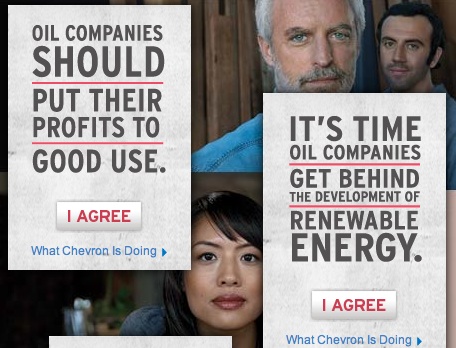 Chevron has just announced a new ad campaign to highlight the various ways in which the company and its critics actually agree on a number of ethically-important points. Things like:
- “Oil companies should put their profits to good use.”
- “It’s time oil companies get behind the development of renewable energy.”
- “Oil companies should support the communities they’re a part of.”
- etc.
Here’s the press release announcing the new campaign: Chevron Launches New Global Advertising Campaign: ‘We Agree’. There’s also a YouTube channel where you can see the TV ads.
Many people will detect a whiff of greenwashing, here. And you don’t have to be much of a cynic to be somewhat skeptical. Back in 2001, another oil company, British Petroleum, claimed to be turning over a new leaf when it branded itself as just BP, which it suggested stood for “Beyond Petroleum.” We all know how that turned out.
The We Agree website of course features all kinds of nifty-sounding illustrations of Chevron’s commitment to being socially responsible. It’s mostly the usual kinds of stuff. But what’s interesting here, philosophically, is the attempt to point to the underlying agreement on values. And (this campaign aside) I do think it’s important for people on different sides of any given debate to understand just how much they probably do agree on, at the level of basic values. Now, if we could just agree on how those shared values ought to be implemented, we would really be getting somewhere.
—–
(Note: as I blogged last night, this Chevron campaign got spoofed by pranksters who issued their own version of the Chevron press-release, pointing to a very-convincing-but-fake campaign website. I was temporarily fooled, myself. You can find out about the spoof via the NYT‘s Media Decoder blog: Pranksters Lampoon Chevron Ad Campaign.)
Spoof Chevron Ad Campaign: Too Dumb to be True
Filed under: activism, advertising, corporations, CSR, energy, protest |
Comments (2)  I should have known.
Earlier this evening, I briefly posted a blog entry about a too-dumb-to-be-true ad campaign, supposedly by Chevron. The spoof ad campaign made Chevron look very dumb. And say what you will about the oil giant: it ain’t dumb.
I won’t say who is (apparently) behind the spoof, because a) that’s exactly the kind of publicity this stunt was intended to generate, and b) from what I can tell (from this and previous stunds) this gang is only good at media manipulation, and does nothing to promote smart solutions.
Tomorrow, I’ll post about the real Chevron ad campaign. (And yes, the image above is real, from the Chevron “We Agree” website.)
Chilean Miners: What is Rescue Worth?
Filed under: aid, CSR, disaster, employees, government, pricing, risk, workplace safety |
Comments (8)  Happily, rescue crews seem to have made better progress than anticipated toward rescuing 33 Chilean miners trapped deep underground since August.
Here’s a recent story giving details, by Alexei Barrionuevo and Christine Hauser writing for the NYT: Drill Reaches Miners in Chile, but Risks Remain
As the rescue proceeds, most of us will (rightly) be focused on the human side of this story, the ordeal those 33 men have gone through. But this story also has an important business- and economic component. Last month, I blogged about whether the trapped miners ought to be paid, and by whom. But another issue is that the rescue effort itself is likely to be exceptionally expensive. What should the companies doing the drilling be paid? Back in April, after a mine collapse in West Virginia, I blogged about the Ethical Obligation to Save Trapped Miners, and pondered the extent of the financial obligations of the mining company and the government in the face of such a disaster. Today, I’d like to look at the question from a different angle. How much should drilling companies involved in such a rescue be charging for their work?
Now, just to be clear, I’m not talking about the actual companies involved.
Brandon Fisher, founder & president of US-based Center Rock Inc., the company that made the drill used, is reported to have nobler motives:
He says the Chilean government is paying for his time and equipment — “that’s the plan anyway.” But he is not at the Mina San Jose for the money. He is there for the miners.
“I don’t know that there’s 10 minutes that you’re out here that you don’t look down there and think, ‘There’s 33 guys 600 feet below our feet,’ ” he said. “Whenever you’re tired, it’s real easy to think, ‘Hey, I’m out here seeing sunlight and breathing fresh air. It’s time to suck it up and get these guys out of here.’ ”
It’s also worth noting that, in fact, this is a competitive arena — there are apparently quite a few companies with relevant capacities, and they’re likely competing with each other to bid for the work. Perhaps they’re even charging less for this high-profile job than they normally would, because it’s good advertising. But let’s set that complication aside for the moment.
So, a thought experiment: what if there were only one company qualified to do the rescue work, or only one company available locally? What should that company charge?
A few quick options:
1. They should charge whatever the market will bear, which would essentially amount to charging the most the Chilean government and/or the mining company involved are willing to pay.
2. They should charge nothing. They should be happy to be involved, and to charge anything would be to put a price on human lives, which is unacceptably exploitative.
3. They should charge just enough to cover their own costs — machinery, fuel, and maybe their own workers’ wages.
4. They should charge exactly the same to drill this hole as they would to drill any other hole of similar size, depth, and complexity. No more (that would be exploitative), and no less (that would be foolish).
Do you favour one of those four? On what grounds? Or can you suggest another principled answer?
—–
Addendum: I found a story that offers the following relevant detail: “Local newspaper La Tercera reported that the rescue efforts, expected to last three to four months, will cost anywhere from $10 million to $20 million.”
Corporate Participation in the Death Penalty
 Drug companies are often accused of engaging in, or of complicity in, all manner of wrongdoing.
It’s less often (though certainly not unheard of) that they’re accused of participation in actual killings, or offered the opportunity to save a life. This is one of those cases.
The story begins here, with a heinous crime not committed by any corporation: Jury Finds Steven Hayes Guilty In Connecticut Triple Murder
Steven Hayes was found guilty today in the deadly home invasion that left a woman and her two daughters brutalized and murdered, making him eligible for the death penalty….
Hayes may well be executed, but only if a subsequent legal proceeding results in that decision, and only if the state of Connecticut has the help of a particular corporation, namely the one that supplies the drug necessary for lethal injection. And that help can’t be assumed. To begin, there are reports that one of the suppliers is having trouble supplying a key drug used in lethal injection.
Not everyone thinks that shortage is a bad thing. See this piece, by Jim Edwards, writing for Bnet: Why Hospira Should Stop Supplying Prisons With Lethal Injection Drugs
Hospira (HSP), the company that makes the lethal injection Pentothal used in death row executions, says the restricted supply of the drug that has halted executions across the country is caused by supplier issues and has nothing to do with the company’s distaste for the death penalty. But why shouldn’t Hospira cut off prisons from their supply of Pentothal?
Now, I don’t know whether Hospira is the company that Connecticut relies on to facilitate its executions (Ewards’ article lists only Oklahoma, Kentucky, Virginia, Arizona and California). But the drugs they use come from somewhere, either Hospira or another drug company.
So, I’m going to ask you to engage in an exercise in imagination. Forget, for a moment, what your own view on the death penalty really is. Ask yourself these two questions:
- IF the death penalty is morally justified, is Hospira (or another company) required to sell the requisite drug to the state in question? May they opt out? Must they remain in some sense “neutral” on this hot-button issue?
- IF the death penalty is morally unjustified, is Hospira (or another company) required not to participate? Or is the company blameless for its participation? If the company is blameworthy for participating, are we likewise to blame the company that makes the gurney that Hayes will lie in as the drug is injected? The company that makes the needle? Why or why not?
Again, even if you have strong views on the death penalty itself, please do your best to set that aside and consider more specifically the ethics of business participation in the practice.
California’s Marijuana Industry: Ethical Issues
Filed under: competition, consumers, CSR, employees, health, law, natural, pharma, politics, product safety, profits, regulations, retail, snacks, wages |
Comments (4)  I’ve blogged about the insurance industry, the mining industry, the auto industry, even the donut industry. But the pot industry? Yes, it’s time.
From the Sacramento Bee: Growth of California’s Pot Industry is Good News for Unions
As Californians prepare to vote on a November ballot initiative that would expand legalization to recreational pot use, labor groups see the potential for perhaps tens of thousands of unionized jobs.
United Food and Commercial Workers Union, Local 5, which has 32,000 members in California working in trades including the grocery and food processing industries, began organizing marijuana “bud tenders,” greenhouse workers, packagers and laboratory technicians last spring….
So, here a budding industry, built around a controversial product that is illegal in most jurisdictions. There’s plenty of grass-root support for broader legalization (both for medicinal and recreational use). But there may be enough opposition to blunt the enthusiasm of law-makers about sudden moves. The support of politically-powerful unions is another ethically-significant factor — as is the potential capture of this new industry by unions.
This is such a rich and interesting story that there’s too much in it for me to try to hash it out by myself without resorting to quick, potted answers. So here are a handful of questions to seed the discussion. I’ll let you weed the good from the bad.
- Ryan Grim reports that “The teachers union, citing the revenue that could be raised for the state, is also backing the initiative.” Is that sufficient reason? You don’t have to be an anti-pot puritan to worry about anything that might (inadvertently) encourage use of pot by school-age kids.
- What business ethics issues are faced by producers and sellers of pot in the illegitimate parts of the drug industry? What new issues will the newly-legitimized industry face?
- What CSR-type responsibilities does the (expanding) legal marijuana industry have?
- Why are California Beer & Beverage Distributors lobbying against the proposed change? (See useful discussion over at Marginal Revolution).
- What sorts of regulations should the industry seek? What motives will be foremost in industry’s mind in his regard — protecting revenues? protecting its image? protecting consumers?
- Will the other drug industry — the pharmaceutical industry — move into this line of business? Why or why not?
- Is the unionization of this industry generally a good or bad thing? Unionization improves the lot of workers, but also tends to raise prices. Since unionization itself is controversial, let’s ask it this way: is the case for unionization stronger or weaker, with regards to the marijuana industry?
I’ll open the floor for discussion.



 The Business Ethics Blog