Archive for the ‘protest’ Category
Should Companies Judge the Ethics of Those With Whom they Do Business?
Filed under: accountability, corporate citizenship, decision-making, government, NGO, protest, stakeholders |
 Comments (10)
  The Wikleaks backlash continues. I suggested here two days ago that Mastercard was probably justified in ceasing to act as a conduit for donations to Wikileaks. I said that, at very least, it’s not surprising that a company whose business depends on its reputation as a trustworthy keeper of secrets would find it hard to endorse the behaviour of an organization that exists entirely for the purpose of exposing secrets.
But quite a few people have suggested that Mastercard (and Visa and PayPal and perhaps others) have been inconsistent, and perhaps even hypocritical, in deciding to cut off Wikileaks. As an editorialist for the Guardian pointed out…
while MasterCard and Visa have cut WikiLeaks off you can still use those cards to donate to overtly racist organisations such as the Knights Party, which is supported by the Ku Klux Klan.
For that matter, you can use Mastercard or Visa to donate to any number of controversial charities and political causes, from PETA to the NRA to Planned Parenthood — all of which are organizations about which at least some people have serious moral reservations. Similarly, you can use either card to buy cigarettes, to buy guns, to buy drug paraphernalia, to reserve the services of a call girl, or to pay for hardcore pornography online. So, really, just how careful are Visa and Mastercard with regard to the companies they deal with?
And if Visa & Mastercard are on thin ice with regard to judging Wikileaks morally, that reduces the force of their ostensible reason for cutting off the organization, and lends credibility to the claim that all they’re doing is caving to government pressure.
Trying to divine the actual motives of the credit card companies here is probably nearly impossible. But this also raises the very general question of whether companies should pass moral judgment on their customers and business associates. Is it OK for a company to refuse to do business with someone — whether that someone is an individual or another company — because they have ethical objections to their behaviour?
(I touched on this topic a couple of years ago, in discussing the right of a bakery not to decorate a cake with the name “Adolf Hitler” on it. And more recently I blogged about corporate participation in the death penalty.)
Now in some cases, of course, moralistic discrimination is simply impossible, because the grounds upon which a company might choose to discriminate are invisible to them. In many markets, companies simply don’t know enough about their customers to pass judgment. The store I buy my groceries from has no idea how I live my life, what my values are, etc. Maybe if they knew more about me they would refuse to sell to me. But they don’t, so they can’t, and they aren’t likely to start going to the trouble of finding out more.
And in many (most?) cases, discrimination on moral grounds is off the agenda simply because it reduces profits. Maybe you have moral qualms with the behaviour or character of 25% of the population (or maybe even with the 50% who don’t vote the way you do), but are you really going to refuse to do business with them, and accept the resulting huge reduction in income?
And clearly, generally, this paucity of moralistic discrimination is a good thing. A lack of discrimination likely leads to greater economic efficiency (good for the community as a whole). And the fact that businesses are generally (though unfortunately not always) unable to discriminate based on, e.g., what they see as moral objections to someone’s sexual orientation, is a good thing for gays, lesbians, the transgendered, etc.
On the other hand, there are some clear cases in which it is widely accepted that companies will and should discriminate based on the character and behaviour of their customers. Think of banks, which are obligated (often legally required) to “discriminate” against criminal organizations by, for example, reporting large financial transactions to the government.
Note also that many people believe that companies should judge other companies they do business with, for example with regard to their environmental record and labour standards. In fact, lots of companies have faced serious criticism for failing to do so. Companies today are supposed to care about the ethical standards of their suppliers.
So, is it OK (or even good) for companies like Visa and Mastercard and PayPal to judge the morality of Wikileaks? Your initial answer to that is likely to depend on your opinion of Wikileaks more generally. I’d be curious to know if there’s anyone out there who says either:
- “Wikileaks is evil, but Mastercard, Visa, and PayPal should stay neutral and continue funneling funds to them,” or
- “Wikileaks is great, but Mastercard, Visa, and PayPal are fully justified in cutting them off.”
UNICEF’s Deal With Cadbury: A Trick, or a Treat?
Filed under: advertising, charity, corporations, food, health, protest |
Comments (10) 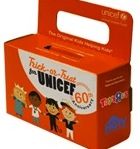 This is now an entire genre of ethics stories, involving a charity facing criticism for aligning itself with a corporate sponsor whose values seem inconsistent with its own.
Here’s the story, by Carly Weeks, for the Globe and Mail: UNICEF sold out by making deal with Cadbury, medical journal says
One of the world’s most influential medical journals is accusing UNICEF Canada of selling out its values by allowing candy giant Cadbury to use its logo to sell Halloween candy.
In an editorial published online Saturday, the Lancet slammed UNICEF Canada for accepting $500,000 from Cadbury Adams Canada Inc. over a three-year period for construction of schools in Africa in exchange for allowing the company to plaster the iconic – and valuable – UNICEF logo on millions of product packages a year….
Just a few thoughts:
1) It seems to me that the worry expressed in the editorial is really that UNICEF is promoting candy, and candy is unhealthy. I’m no marketing expert, but I strongly suspect that if UNICEF’s tacit endorsement does anything at all, it won’t be to boost anyone’s consumption of candy. Rather, it will be to increase sales of Cabury’s candy relative to other brands.
2) Candy isn’t evil. Eating too much candy, too often, is bad for you. But candy is fun. While obesity trends are not irrelevant, here, I’m not sure we need to demonize candy to such an extent that all association with it is considered toxic.
3) It’s worth thinking carefully about the mutual benefits that come from the UNICEF/Cadbury deal. As the G&M story points out,
“the relationship is…lucrative for corporate sponsors because many consumers look favourably on companies that are aligned with good causes, which can help drive sales.”
But why do consumers look favourably on companies that align themselves with good causes? To spell it out plainly, consumers do so because they think that it is a good thing for companies to contribute socially. So it’s not like there’s any trickery here. If consumers think Cadbury is doing something good, Cadbury will be rewarded.
4) Finally, is it worth it for UNICEF? I’m generally hesitant to hand out advice beyond my expertise. I’m not an experienced fund-raiser. So, far be it from me to tell the experts at UNICEF that the decision to align with a candy company is short-sighted. But it does seem plain to me that a charity only has one real asset: it’s brand, and the trust people place in it. In comparison, a carmaker can lose public trust and then regain it by proving that they really do make a great product. Charities make no product; all the public can judge is behaviour.
Happy hallowe’en, everyone!
Spoof Chevron Ad Campaign: Too Dumb to be True
Filed under: activism, advertising, corporations, CSR, energy, protest |
Comments (2)  I should have known.
Earlier this evening, I briefly posted a blog entry about a too-dumb-to-be-true ad campaign, supposedly by Chevron. The spoof ad campaign made Chevron look very dumb. And say what you will about the oil giant: it ain’t dumb.
I won’t say who is (apparently) behind the spoof, because a) that’s exactly the kind of publicity this stunt was intended to generate, and b) from what I can tell (from this and previous stunds) this gang is only good at media manipulation, and does nothing to promote smart solutions.
Tomorrow, I’ll post about the real Chevron ad campaign. (And yes, the image above is real, from the Chevron “We Agree” website.)
Back to Playboy…errrr School
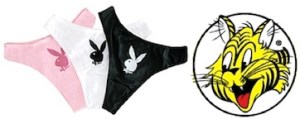 Marketing to kids is always a touchy subject. But even worse is when a company accidentally markets to kids. And when you accidentally market to kids something that is seriously adult-oriented…watch out!
Check out this story, from the Globe & Mail‘s Business section: Firm regrets back-to-school ad for Playboy thongs, bras
Giant Tiger, a discount retailer with outlets across Canada, says it made a big mistake when it marketed Playboy-branded underwear in a back-to-school flyer. Many parents complained to the retailer over the ads for bras, thongs and other items with Playboy’s logo.
…
Giant Tiger has apologized to the parents, and Playboy, according to the news agency, is working with the retailer to ensure that such items are aimed at women over 18. Playboy, the spokeswoman said, has strict rules that prohibit marketing to minors….
Now, the actual offense here is pretty modest (no pun intended). And there’s every reason to believe both companies when they say it was all a mistake.
I wonder if this is another, quite different, kind of example of the little ethical lapses (or lapses in quality more generally) that can occur when things are done cheaply. (For those of you not familiar with the chain, Giant Tiger stores are a couple of notches down-scale from Walmart, in most regards. Discount products, cheaply displayed.) Without casting aspersions on the skill or judgment of the workers who put together Giant Tiger’s flyers, I have to wonder whether slips of this kind aren’t more likely at bargain-basement retailers. If you shop at GT, you’re either shopping there because you can’t afford to shop somewhere more fancy, or you’re choosing to in order to save money to spend on other things. And, at risk of overgeneralizing, if you want stuff cheap, you’re going to get things done cheaply. Sweatshop labour may be the most high-profile result, but you’re also going to get things like shoddy marketing. On the other hand, I wonder if this could have happened at that most famous of discount retailers, Walmart? They’re famous for cutting costs, but they’re also famous for efficiency.
The Oil Sands, and the Battle of the Boycotts
Filed under: accountability, boycott, consumers, CSR, environment, protest |
Comments (10)  The Athabasca oil sands (in Alberta, Canada) are not pretty. But they are vast, constituting one of the largest deposits of oil in the world — something in the range of 150 billion barrels, enough to help make Canada a net exporter of oil.
The oil sands (also known, colloquially and sometimes pejoratively, as the “tar sands”) are also environmentally controversial. The process of extracting oil from oil sands is not a clean one; it has a significant impact on land, air, and water. In fact, the process is so messy that it is only worth doing when the price of oil is relatively high, as it is right now. For environmental groups and other critics, the oil sands are just not worth it.
It’s worth noting that the oil sands do have their defenders. Matt Ridley, for example, in his recent book, The Rational Optimist, argues that the oil sands are a much more sane solution to current energy needs than things like wind (too unreliable and too little output) and biofuels (wasteful use of land).
Back in July, two US-based groups (Forest Ethics and Corporate Ethics International) called for a boycott of Alberta as a tourism destination. (See the Financial Post story, here.) More recently, though, the boycott has expanded to include a number of American retailers who have promised to refuse to use any petroleum products from the oil sands. See the Scientific American story, by Tina Casey, Boycott of Petroleum Products from Alberta Tar Sands Gathers Steam:
In a sign of things to come for corporate activism, The Gap, Timberland, Levi Strauss and Walgreens have just joined Whole Foods and Bed, Bath and Beyond in a boycott of petroleum products sourced from the notorious Alberta Tar Sands. As reported by Bob Weber of The Canadian Press, Federal Express has also adopted a policy that appears to lead toward joining the boycott….
(A more recent story suggests that Levi Strauss is not, in fact, participating in the boycott.)
A few points:
First, I’m generally skeptical about boycotting an entire jurisdiction (as the original boycott of Alberta tourism seemed to intend) on the grounds that you don’t like one particular business there. It’s entirely unclear how boycotting Alberta tourism was supposed to convince the government of the province to shut down the oil sands. (Note that while tourism is not exactly trivial in the Albertan economy, neither is it crucial. And besides, international visitors to Alberta account for just 7% of the province’s tourism.) Note also that the principle supposedly at play here doesn’t generalize very well. If you don’t like Walmart, do you boycott Arkansas, where Walmart is headquartered? Is anyone calling for a boycott of the U.K.? After all that’s where BP is based.
But I’m even more interested in the corporate boycott by Whole Foods etc.
As this opinion piece points out, anyone thinking of boycotting oil from the oil sands needs to think about what they’re choosing instead:
Where are they going to buy their gas from, if not Canada?
Saudi Arabia? Could there be a more unethical barrel of oil than one from that racist, misogynistic, terror-sponsoring dictatorship? Venezuela, to enrich strongman Hugo Chavez? Iran, with its nuclear plans?
In other words, if you’re really going to get picky about where your oil comes from, you’d better just stop using it at all.
The same opinion piece (by Ezra Levant) pointed out that many of the companies participating in the boycott are not exactly angels themselves. Walgreens (a pharmacy chain) was fined $35 million for defrauding Medicaid. And pretty much everyone knows that The Gap has been the target of its fair share of criticism over the labour practices at the third-world factories that produce the clothes it sells. Now, being hypocritical doesn’t mean being wrong, but it might well lessen these companies’ moral authority somewhat. (And notice that Levant suggests a tit-for-tat boycott of The Gap, etc., by Albertans.)
Next, an economic point. I’m no economist, but my guess is that if the corporate boycott has any impact at all, it will be roughly as follows. The reduction in demand for oil-sands oil will reduce the price it can command. And when you lower the price of something? Yup, you make it easier for other people to buy it. So, more — not less — will end up being used.
Finally, the points above leave us with the conclusion that the corporate boycott of oil from the oil sands is largely symbolic. Well, that’s not necessarily a bad thing, is it? I guess that depends on who is sending, and who is receiving, that symbolic message. And in this case, the message certainly isn’t going to have — indeed, can’t possibly be intended to have — any effect on decision-makers in Alberta. So the only real possibility is that Whole Foods, The Gap, etc., are sending a message to consumers. What message? “We’re green,” I guess, or “We care.” But the message being heard by anyone looking at this carefully is, “We haven’t thought this through.”
[Thanks to MW for suggesting I blog on this.]
Wind Turbine Hush Money
Filed under: energy, environment, health, protest, regulations |
Comments (14)  In Oregon, the “whoosh, whoosh, whoosh” of wind turbines is being partly drowned out by another sound: “Hush, hush, hush….”
What are we to think when a company starts paying people substantial sums of money not to complain about the effects of their projects? Is that illicit hush money, or is it a company facing up to its impact and paying due compensation?
Here’s the story, by William Yardley, for the New York Times: Turbines Too Loud? Here, Take $5,000.
IONE, Ore. — Residents of the remote high-desert hills near here have had an unusual visitor recently, a fixer working out the kinks in clean energy.
Patricia Pilz of Caithness Energy, a big company from New York that is helping make this part of Eastern Oregon one of the fastest-growing wind power regions in the country, is making a tempting offer: sign a waiver saying you will not complain about excessive noise from the turning turbines — the whoosh, whoosh, whoosh of the future, advocates say — and she will cut you a check for $5,000.
“Shall we call it hush money?” said one longtime farmer, George Griffith, 84. “It was about as easy as easy money can get….”
The effects that a production process (such as a wind farm) has on people other than its paying customers are what are called “externalities” — effects that are external to some voluntary transaction. And in principle, compensating those who suffer externalities is the right thing to do — it means that a company (and its customers) are paying something closer to the full cost of production. Otherwise, externalities amount to a cost foisted on someone else involuntarily.
OK: so far, so good. The company involved here is attempting to (as an economist would put it) internalize its externalities, by compensating those affected by noise from its windmills. But what about the price set? Note that the price was an apparently invariable $5,000. Why? After all, different people are likely to be affected differently, and some will be more noise-tolerant than others.
So, why one price? According to the company, the reason is fairness:
“What we don’t do in general is change the market price for a waiver,” [Caithness Energy’s] Ms. Pilz said. “That’s not fair.”
Of course, equal payment for all is one version of fairness, but it’s not the only one.
One last theme to pick up on is the tension between what’s good for the individual and what’s good for society. The company involved, here, attempted to play the “social good” card:
Some people who did not sign said that Ms. Pilz made them feel uncomfortable, that she talked about how much Shepherd’s Flat would benefit the struggling local economy and the nation’s energy goals, and that she suggested they were not thinking of the greater good if they refused.
It’s a good rhetorical move on the company’s part, not least because there’s more than a grain of truth to it. A project of this size is bound to benefit the local economy (though perhaps not as much as locals might hope). Add to that the fact that this is, after all, clean energy that’s being produced, the kind of energy that most people now figure is essential to weaning us off our collective addiction to petroleum products.
So, let’s put this on the table as a fundamental truth: there are no centralized forms of energy production, clean or otherwise, that will not have a negative impact on anyone, and that hence won’t be subject to someone’s objections. So the question is not whether anyone will be negatively affected (or even merely inconvenienced), but rather who will be negatively affected, and how much, and what to do about it.
Boycotting BP is Futile and Unethical
 Do not boycott BP.
I know you’re mad. I am too. But a boycott won’t accomplish any of the things you’re trying to accomplish. And it’s unethical.
The push to boycott BP (as a punitive response to the Deepwater Horizon oil spill, obviously) comes from the advocacy group Public Citizen, which encourages you to: “Boycott BP: Take the Beyond BP Pledge today!” There’s also the inevitable Facebook group, Boycott BP.
This move is well-intentioned, but entirely wrong-headed, for a number of reasons.
The first reason has to do with alternatives. Sharon Begley at Newsweek, with the sarcastic title “Boycott BP! Because it’s much better to give your money to Exxon.” It’s highly unlikely that those who participate in this boycott are going to eschew gas purchases altogether. With a few exceptions, they’re much more likely to simply start buying their gas at the non-BP station down the street. And, as Begley points out, as far as the oil companies providing the oil go, good luck finding one that meets your high ethical standards — or even minimally decent ones. Every oil company you can name is in roughly the same moral category. So boycotting BP just means jumping out of the frying pan and into the fire.
Second, there’s the fact that a boycott of BP gas stations won’t actually hurt the organization you’re trying to hurt. In practice, “boycotting BP” means boycotting BP-branded retail outlets. And as an editorial in the LA Times pointed out, “BP stations are independently owned, so a boycott hurts individual retailers more than London-based BP.” So, sure, boycott BP stations — that is, if your goal is to hurt a bunch of small businesses already operating on razor-thin profit margins. Put a few minimum-wage gas jockeys and cashiers out of work. The difference simply will not be felt at BP’s head office. (The same naturally goes for vandalism of BP stations, which is both unethical and criminal.)
Finally, there’s the question of tokenism. Buying gas for your car is far from the only way many of us indirectly buy from BP on a regular basis. As “DanH” points out in the Comments section of this blog entry, (see comment at June 3rd, 2010 2:52 pm) BP also makes home-heating fuel, airline fuel, ingredients for plastics, and the natural gas from which much electricity is generated. Oh, and solar panels — BP makes those, too. If you want to make this boycott real (which you shouldn’t) you’ve got to boycott those things, too.
Can consumers take action? Sure they can, by doing things — long-term things — to reduce their reliance on fossil fuels. They can also write their elected representatives to encourage tougher regulation of risky practices like deep-water drilling. And so on. I know, I know: in the immortal words of Homer Simpson, “But I’m mad now!“ Well, then direct the righteous indignation you’re feeling now toward change that will make the world better for the future.
It’s fine to be angry about this disastrous oil-spill. Being angry is entirely appropriate. And it’s good to want to do something. But do the right thing, not the first thing that comes to mind.
(Tip of the hat to AP.)
PETA Goes Corporate
PETA — the organization best known for its attempts to annoy the world into conforming with its world-view — has found a new tactic:
PETA buys stock to gain influence in boardrooms
An animal-rights group known for sending out scantily clad demonstrators to protest fur and other provocative stunts has gained influence in boardrooms with a more traditional tactic: buying company stock.
People for the Ethical Treatment of Animals has been buying shares for seven years and now owns a piece of at least 80 companies, including McDonald’s and Kraft Foods.
Is this an obvious move, or a stunning one?
It’s somewhat amusing, of course, (and to some, I’m sure, horrifying) to know that, as shareholders, PETA will now start to benefit from the sale of the very meat products it so fervently opposes. But presumably this is an instance in which PETA believes that the ends justify the means. Another way to say the same thing is to say that PETA (to its credit?) is willing to get its hands dirty, in this case by profiting (in the short run) from a business it is trying to destroy. If (as seems likely to be the case) this strategy does succeed in giving the organization a significant voice in the corporate world, then it seems like a good move. I suspect the money they’ll spend on shares will have more impact than the same amount of money spent on publicity stunts. Presumably the only activists who will mind are ones who care less about animals and relatively more about opposing the standard pattern according to which those with money — in this case, PETA — are best able to make themselves heard.



 The Business Ethics Blog