Archive for the ‘Uncategorized’ Category
Carbon Offsetting: The Gullible Ethical Ethics Prof
 Leave a comment
I’m blogging from “the road” again, this time en route to the Society for Business Ethics meeting in Philadelphia. The airline I’m flying, Air Canada, kindly offered me the opportunity to pay a little extra to offset the carbon dioxide emissions that resulted from my flight.
Air Canada and Zerofootprint have joined efforts to give you the opportunity to minimize the impact of your travel. Every flight you take releases carbon dioxide (CO2) into the atmosphere and contributes to climate change. When you offset your flight and contribute to certified environmentally friendly projects, you remove from the atmosphere an amount that corresponds to your share of CO2 generated by your flight.
Carbon offsetting is not without its critics. Making it voluntary like this pretty much ensures that only a trivial percentage of CO2 emissions will actually be offset in some way. And if the offsetting ends up being trivial, then it might well amount to a way for suckers like me (apparently) to make themselves feel better, without actually having any real impact.
Anyway, here’s what the calculation looks like, showing how much CO2 my being on that flight resulted in, and how much I had to pay to atone for it.

Here’s my proof of purchase:
Cynics: don’t worry, I only paid to offset the first leg of my trip. I guess I’m just not that irrational.
Bre-X Executive: “Not Guilty”

The 7-year trial over the largest mining scandal in history ended yesterday, with Bre-X’s Chief Geologist, John Felderhof, being found not guilty.
Here’s the story, from the Globe & Mail:
Bre-X: ‘The end of the trail’
TORONTO — Investors burned by the world’s biggest mining fraud were dealt a blow yesterday when John Felderhof, former vice-chairman of Bre-X Minerals Ltd., was found not guilty of illegally selling $84-million worth of shares in the company.
Mr. Felderhof, 67, was the only former Bre-X official to stand trial over the firm’s collapse. He was charged with four counts each of illegal insider trading and issuing false press releases but was not accused of involvement in the fraud that saw $6.1-billion of shareholder wealth eradicated in 1997 when tests found virtually no gold at Bre-X’s much-touted Busang site in Indonesia.
Is this really the end of the trail? Maybe, maybe not. There’s still a class-action suit in the offing. And at least some commentators say the not-guilty verdict is a sign that Canada’s securities legislation is in need of revision. See, for example:
Canadian laws too weak
and
Bre-X case an ’embarrassment’ for Canadian law: expert
More links, different angles:
From Forbes.com: Former Bre-X Executive Acquitted
From ResourceInvestor.com: The Bre-X Scandal Ends: Chief Geologist Found Not Guilty
From Bloomberg.com: Former Bre-X Geologist Acquitted at Insider Trial
From CTV: Former Bre-X geologist acquitted of insider trading
And finally, from the CBC’s digital archives: Stranger than Fiction: The Bre-X Gold Scandal
Economist Tyler Cowen on Business Ethics

Economist Tyler Cowen, of Georgetown University, co-writes an excellent blog called Marginal Revolution.
Last week, Tyler offered to post a personalized podcast for anyone who bought an advance copy of his new book, Discover Your Inner Economist: Use Incentives to Fall in Love, Survive Your Next Meeting, and Motivate Your Dentist.
It’s not every day a star economist offers to answer any question you pose, so I ordered the book (which I had wanted to read anyway) and emailed Tyler my question. Now, I’m often more intrigued by what smart people think about what counts as an “interesting question,” than by their answers to those questions. So my question for Tyler was this:
What do YOU think is the most interesting challenge or problem associated with ethics in commerce, and why?
Here’s Tyler Cowen’s response. [4 minute audio clip]
Roughly: Tyler’s answer is about the doctrine of fiduciary obligation and its application to CEO’s. He notes that a fiduciary obligation to maximize profits (subject to legal constraints) is on one hand pragmatically necessary, but on the other hand philosophically hard to defend. He also makes an interesting comparison to the case of national leaders, and their fiduciary duties to their citizens.
———-
Update
I now have a transcription of Tyler’s podcast. It should be a fairly accurate transcription, but no guarantees. Apologies to Tyler for any errors:
Hi, this is Tyler Cowen. Thanks so much for pre-ordering my book “Discover Your Inner Economist” and thanks for reading the blog. First let’s have a statement of your question.
Q. I’m often more intrigued by what smart people think about what counts as an interesting question than by their answers to those questions. I’m a philosopher who specializes in business ethics. So, my question: What do you think is the most interesting challenge or problem associated with ethics in commerce and why?
A. Thanks. That’s a very good question. I suppose the one I tend to worry about the most relates to issues of fiduciary responsibility. It seems to me quite obvious that at the practical level we need something like a doctrine of fiduciary responsibility. That is, if someone is appointed as CEO of a corporation it’s entirely reasonable on one hand to expect that person to maximize the corporation’s profits, at least subject to a legal constraint, and that if this sort of contract were not allowed the whole corporate structure would seem entirely unworkable, we would all be quite poor, people would die early, civilization would more or less collapse, and so on. But on the other hand, when one looks at the doctrine of fiduciary responsibility more philosophically, I think it’s really quite difficult to defend.
What is it that would give one person the right, obligation, whatever we’re going to call it, to do something other than that which is best for the world as a whole? So if you take Parties A, B, and C. Lets say Party A is the CEO, Party B the contracting shareholders, and Party C is someone else; the consumer, citizen, person in another country affected by the corporate actions. Party C may well feel that Party C ought to have some voice in what Party A does because party C is affected by Party A. And if you tell Party C, well, the actions of Party A are entirely just because Party A wrote a contract with Party B to do it, there is really no reason why this should carry much weight for Party C. Party C says, look I’ve never been part of this contract, what Party A really has is an obligation to somehow do what is best or take my welfare into account. And philosophically that argument, to me, seems to be strong. So we have this clash of perspectives that at the rule-based level we need something like fiduciary responsibility, but in particular cases when looked at critically I think the doctrine collapses almost immediately. And finding some kind of reasonable rapprochement between these perspectives – I know there’s a lot written on this issue but I’ve never seen much that I find very convincing.
And you find a lot of issues come up at the level of the nation state also. So libertarians for instance will say, well we should be cosmopolitans. But then if you ask them, take a national government: should it maximize just the welfare of its citizens or the welfare of the world as a whole, there’s a bit of stumbling. It seems hard to imagine how we could arrange things that national governments look after the whole world, but on the other hand we don’t think a national government can just do whatever it wants to the citizens of other countries. And if you ask Milton Friedman, who’s been a free-trade cosmopolitan when he was alive, ‘well Milton you say a CEO can maximize profit, does that mean a politician is justified in maximizing votes or that a national government can use protections to enrich itself at the expense of other countries?’ Milton would probably stumble a bit and be critical but exactly what’s the difference between these two cases? Again I come back to wanting to see a lot more good work on that issue.
Anyway, thanks a lot for the question. I will think about it some more in my spare time, as they say on Monty Python. And I hope you enjoy the book. Bye!
Retailers Balk at Cigarette Rules
Today, a local story, from the province where I live:
From the Halifax Chronicle Herald: Smoke sellers fume over display rules (by Sherri Borden Colley)
On the eve of new rules that ban the display of tobacco products behind counters, some 200 Nova Scotia convenience store owners will meet … today to fight the way the province is implementing the legislation.
One of the key complaints is cost. According to the story, retailers are claiming that renovations to bring their stores into compliance will cost “anywhere from $4,000 to $10,000 per store.” The retailers’ association is even (implausibly) asking the province to compensate them financially for (some of?) those costs.
So, yeah, on one hand, that’s a lot to cough up to revise the method by which a legal product is sold. On the other hand, you can’t expect much sympathy when you’re selling a lethal, addictive product.
Biotech: An Industry in SEARCH of Regulation

Here’s a great example of how sometimes industries actually want regulation. In this case, it’s the biotech industry, which has realized that public trust depends on establishing safeguards, and that investors aren’t as willing to gamble on technologies that don’t have clear regulatory path to the marketplace.
Here’s the story, from today’s NY Times: Without U.S. Rules, Biotech Food Lacks Investors
Here’s a snippet of the story:
Some scientists and biotechnology executives say that by having the Food and Drug Administration spell out the rules of the game, big investors would finally be willing to put up money to create a market in so-called transgenic livestock.
“Right now, it’s very hard to get any corporate investment,” said James D. Murray, a professor at the University of California, Davis, who developed the goats with the infection-fighting milk. “What studies do you need to do? What are they looking for?” he said, referring to government regulators. “That stuff’s not there.”
….
[So]…the biotechnology industry is actually pushing for the tougher standards.
“Our overarching goal is to have public confidence in our products,” said Barbara Glenn, the managing director for animal issues at the Biotechnology Industry Organization, a trade group. “We won’t have that unless we have a very strong review process.”
Getting Hip to Conflict of Interest
Here’s a quick one:
Study Renews Conflict-Of-Interest Debate (by Lindsey Tanner writing for the Associated Press)
A new study showing that padded hip protectors didn’t prevent fractures in the elderly has renewed questions about hidden drug industry ties to medical research.
Three of the authors of the study on bone breaks didn’t tell editors of an influential medical journal, which is publishing their research Wednesday, that they had consulted for or received research money from the makers of bone-strengthening drugs. That potential conflict was discovered by The Associated Press.
OK, here’s the business ethics angle. There’s no claim, in this story, that the makers of bone-strengthening drugs had any direct involvement. The worry rather is that the three researchers failed to disclose a financial relationship that might reasonably be expected to influence their professional judgment. The question: do the companies involved (i.e., in the background) bear any responsibility? Could they be considered vicariously liable (I mean ethically, not legally)? Would tacit condoning of failure-to-disclose be anything like condoning perjury?
———-
p.s., anyone interested in the pharmaceutical industry absolutely MUST check out this blog: Pharmalot
Corruption in Sport: Ethics & Economics

I love economists. Seriously. Economists rock. Far from its reputation as “the dismal science,” I consistently find the work of (good) economists englightening and engaging and it makes me want to be more clear, concise and consistent in my own thinking.
Case in point: this terrific piece by economist Justin Wolfers, in today’s NY Times: Blow the Whistle on Betting Scandals
Wolfers’ commentary is about the recent basketball wagering scandal involving referee Tim Donaghy. Wolfers has studied sports wagering in detail, and he knows a lot about related scandals:
[S]ports betting scandals are fairly common. They are the result of persistent economic incentives that can be traced to the structure of sports gambling markets. And these incentives can be changed.
The activity known as “point shaving” gets at the heart of the problem: a corrupt player or official is rarely asked to throw a game to one team or the other. Instead he is asked to influence something rather immaterial, like the winning margin. This is profitable because gamblers typically bet on whether a team will exceed some point differential — the “Vegas Spread” — rather than whether a certain team will win.
So gambling gambling itself isn’t the problem?
Not all gambling leads as easily to corruption. For instance, if betting were allowed only on which team would win a game or a series, then corrupt gamblers would find it much more difficult to get referees or players to cooperate with them.
Wolfers’ solution?
[T]ry to find a way to encourage the types of bets that do not promote corruption. When faced with a betting scandal, a sports league usually hardens its anti-gambling stance. But that doesn’t work. A smarter approach would be to become more tolerant of some kinds of gambling in an effort to crowd out the bets that create incentives for scoreboard manipulation.
That’s right: Legalizing wagering on which team wins or loses a particular game, while banning all bets on immaterial outcomes like point spreads, would destroy the market for illegal bookmakers and make sporting events less corruptible by gamblers.
You don’t have to agree with Wolfers’ proposed solution to see how much his economic analysis — his economist’s point of view — helps us understand the problem here. “It’s All About Character” might be a great slogan, a great title for an after-dinner speech. But sometimes what you really need is to look carefully at the motivational structure of a situation.
—–
Thanks to Marginal Revolution for the pointer to the Wolfers article, and thanks to Mark Rowe for encouraging me to blog about ethics in the business of sport.
CSRwire Remains Independent

From CSRwire — a news-service all about corporate social responsibility — here’s a story about, well, CSRwire, from a few days ago: CSRwire Remains Independent.
Recently, [Berkshire Hathaway subsidiary] Business Wire presented CSRwire with a compelling validation of their mission to raise awareness of good corporate citizenship. Business Wire presented CSRwire with an ultimatum – Provide your services through our news wire ‘exclusively’ or we will create our own CSR distribution channel.
…
“The fact that they were interested in an exclusive arrangement and a ‘right of first refusal’ to purchase the company certainly validated our efforts” said Joe Sibilia, President of CSRwire. However, company executives also admit that Business Wire didn’t quite understand the real mission of CSRwire. “Exclusivity is not in concert with our mission. Our mission is to further the ideals that socially responsible business practices are good for business and good for society. Consequently, we want to distribute and archive this news to and for the widest possible audience”, explains Sibilia.
Here’s Business Wire’s website. No word yet as to whether they’ve made good on the treat to start their own CSR channel.
Signs of (Eventual) Lawfulness @ the CBC
A couple of weeks ago I blogged about The Social Responsibility to Follow the Law.
Today I learn that, until recently, the Canadian Broadcasting Corporation’s HQ in Toronto featured a very large illegal billboard:
That sign has now come down.
The sign was illegal because you need a permit for such signs in Toronto, and CBC didn’t get one. Then, when the city gave the CBC fourteen days to take the sign down, they didn’t. They left it up for another year. And according to this website, a lot of the signs in Toronto are illegal. Some don’t have permits, and some have permits that were fraudulently obtained (by giving false information on permit applications).
——-
Thanks to my pal Paul, who writes a blog about life, the media, and everything.
Mattel in China: Ethics & Prudence
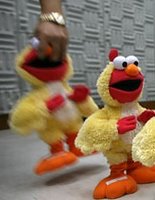
Here’s an interesting story from today’s NY Times: Dancing Elmo Smackdown
SHENZHEN, China, July 19 — Inside Mattel’s sprawling test lab here, scores of technicians are doing their worst: setting Chicken Dance Elmo dolls on fire, wrecking Hot Wheels cars and yanking at the limbs of Dora the Explorer. The lab workers are paid to break toys, pick apart their innards, and analyze the raw materials that go into them.
The goal is to protect young children from the serious harm that poor construction or dangerous components can bring. But it is also to protect Mattel, the world’s biggest toy maker, from what is increasingly viewed as the risk of doing business in China.
The story also mentions Prof. Prakash Sethi, of the City University of New York (actually, though the story doesn’t mention it, Sethi is president of CUNY’s International Center for Corporate Accountability — I presented at a conference there last month). The story notes that Sethi has worked as a consultant/inspector for Mattel for about a decade.
Mr. Sethi would make unannounced visits to Mattel’s factories and vendors’ plants. He insisted that he would only monitor Mattel if the toy maker let him post his reports publicly and uncensored.
One other interesting thing to note about this story: the number of timest the word “ethics” is used in the story? Zero. Nice example of how, sometimes, we don’t actually need to use the e-word.
———
Update: here’s a video of a session on Mattel at the aforementioned conference: Intervention at the Factory Level: The Mattel Experience


 The Business Ethics Blog