Archive for the ‘Uncategorized’ Category
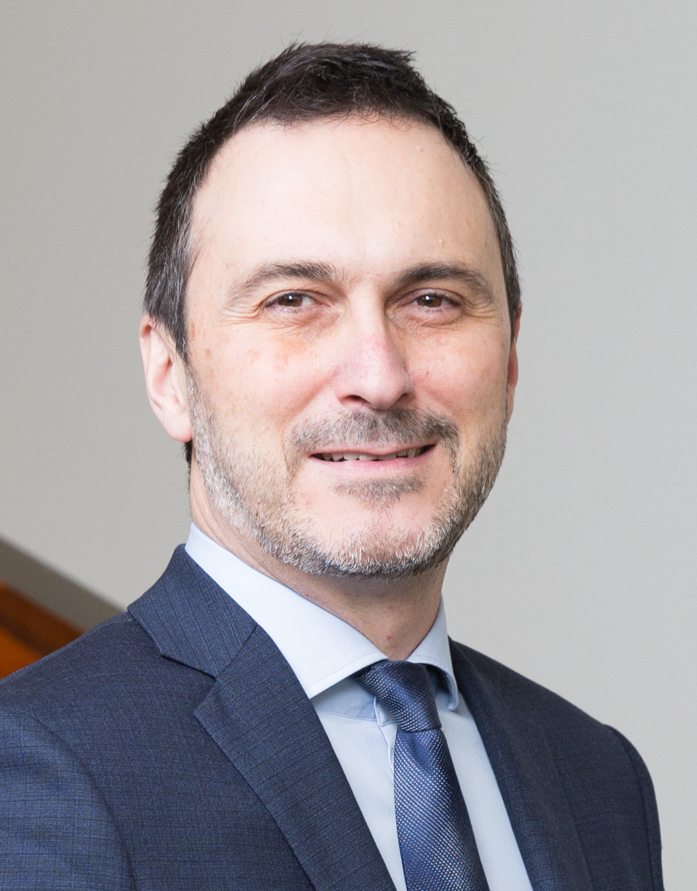
Melissa Whellams, M.A. (and CSR consultant)
 Leave a comment
Today’s blog entry is an unusual one.
I’m blogging today not about a news story, but about a terrific student of mine who has just graduated and is now on the job market.
Regular readers of this blog will recall Melissa Whellams’ name. She’s co-authored articles with me on GM Foods and Greenwashing. Junior grad students don’t normally do much publishing. But Melissa is unusually smart and mature and a very good writer.
Melissa just completed her M.A. in International Development Studies, and I had the honour of supervising her thesis. Her thesis was on Corporate Social Responsibility in the South American Mining Industry. In particular, it was about whether the CSR efforts of mining companies can contribute to sustainable development in local communities. To answer the question, Melissa spent 3 months in Peru and Bolivia this summer, studying the CSR initiatives of Newmont Mining. She conducted semi-structured interviews with a wide range of informants, from corporate executives to local farmers, and with NGO’s that are supportive of and NGO’s that are critical of Newmont’s efforts. She came back with a treasure trove of insights into a very complicated set of problems.
I’ve already told Melissa that portions of her thesis are suitable for publication in scholarly journals, but (any publishers out there?) her thesis would work even better as the core of a short book. It’s a fascinating topic, and one that she handles with a combination of optimism and clear-headedness.
Anyway, the point is that she’s out of school, and looking for work in the realm of CSR consulting.
(Melissa’s undergrad degree is in Business, and she worked for several years in the oil industry before going back to school to get her M.A.) So, if anyone out there knows of relevant job opportunities, email Melissa. The company that snaps her up will be very lucky to have her.
Cloned Meat & Milk
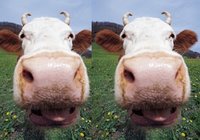
The U.S. Food & Drug Administration has moved a step closer to permitting the marketing of meat and milk from cloned animals. Here’s the story from the Washington Post‘s Rick Weiss: FDA Says Clones Are Safe To Eat
Taking a long-awaited stand in an emotionally fraught food fight, the Food and Drug Administration yesterday released a 678-page analysis concluding that milk and meat from cloned animals pose no unique risks to consumers.
The decision, subject to change after a period of public comment, stops short of approving the sale of food from clones and leaves in place for now a long-standing government request that farmers keep their clones off the market.
The story also suggests that a number of companies are waiting in the wings, ready to supply clones of prize-winning animals to serve as breeding stock for genetically-superior herds. Once the FDA gives its go-ahead (perhaps withing the next year), these companies will ramp up production, so that meat and milk from cloned animals may be available for purchase within 3 years. Inevitably, this prospect has resulted in demands for labelling:
Several groups are pushing for a requirement that cloned food be labeled as such, allowing consumers to avoid it. Sundlof said such labels would be inconsistent with a long-standing FDA policy to reserve labels for scientifically substantive issues.
As far as I can see, the argument I presented a few weeks ago regarding demands for labelling Genetically Modified foods applies equally well to demands for labelling cloned food. They key is that there just is no evidence that cloned food is any different, in any important way, from non-cloned food. Of course, lack of evidence of danger doesn’t constitute proof of safety…but it is meaningful in situations (like the present one) in which evidence has been sought out through appropriate methods used by the relevant experts.
My argument has been — and remains — not that judgments issued by the FDA or some blue-ribbon panel is going to settle the matter once & for all, but rather that such judgments can reasonably be relied upon by conscientious companies.
[Thanks to Cindy for forwarding the story.]
New “Wal-Mart Ethics” Webpage
This is just a note to announce a new “Wal-Mart Ethics” page I’ve just launched. It’s intended to be sort of a clearing-house for websites & articles related to ethical issues at Wal-Mart. It’s very much a work-in-progress, and suggestions are welcome (email me). (Don’t send me blog entries, though, unless they’re by someone noteworthy.)
GM Foods, the Environment, and Corporate Obligations

Dominic Martin, a doctoral student at the Université de Montréal, has posted some thoughtful comments [link dead; deleted by CM, March 2009] about a presentation I made there a couple of weeks ago. (Merci bien pour tes remarques, Dominic!)
Briefly: my presentation (based on a forthcoming paper), was about the labelling of genetically-modified (GM) foods. I argued that corporations could only be obligated to label GM foods if one of 4 conditions obtained:
- a legal requirement;
- a recognition within the industry that labeling is appropriate;
- a threat to human health;
- a consumer right to information about the GM content of their food.
I further argued that none of these 4 conditions obtains. Hence, there’s no corporate obligation to label.
Martin objected (both during the discussion following my presentation, and now on CEA’s blog) that I’d neglected environmental concerns. He’s right. Part of my response to his critique (as he notes) was that to an extent, environmental concerns can be subsumed under point #3 above: if the anticipated impact of environmental concerns were such as to jeopardize human well-being, then there would indeed be a plausible argument in favour of an obligation for corporations to label (because even if the threat is not immediate and direct, consumers should have the option of not buying products that are, through their production, contributing to hurting people). But as Martin notes, this argument is firmly anthropocentric (i.e., human-centred) and that’s not the only possible moral perspective on the environment.
Alternatively, what if we regard the environment (as many people do) as having not just “instrumental” value (i.e., value because it’s useful to us humans), but “intrinsic” value (i.e., value for its own sake) as well?
My argument here (one I’m working out more fully in a follow-up paper) is roughly this: even if the environment is of intrinsic value (i.e., even if it should be protected for its own sake), it’s not clear that an obligation to label GM foods follows. In order for a duty to protect the environment to imply a duty to label, we would need to be reasonably sure of the following 3 things:
- the production of GM foods actually jeopardizes the environment;
- informed choice by individual consumers would be an effective way to protect the environment from this risk; and
- labelling (by individual companies) of GM foods as GM is an effective way of informing consumers to enable to them to act upon their environmental beliefs and/or duties.
I take it that none of these 3 is clearly true — I suspect I’ll face most opposition on #1, but note that all 3 need to be true to imply a corporate obligation. So, I think that no matter how deeply we value the environment, there’s no corporate obligation to label GM foods. But of course all of this is consistent with (though it does not imply, and I don’t advocate) believing either a) that governments ought to require labelling, or b) that companies ought not produce GM foods at all.
[Note: the forthcoming paper upon which my Montréal presentation was based was co-authored by Melissa Whellams. But Melissa shouldn’t be blamed for the half-baked extension of our argument presented here.]
“Ethics Pays!” (or at least: “Lack of Ethics Costs!”) Part II
Apparently there are limits to the public’s appetite for sleaze.
From today’s NY Times: Editor Fired After Uproar Over Simpson
Judith Regan, the firebrand editor who stirred up decade-old passions last month with her plan for a book and television interview with O. J. Simpson, was fired on Friday by HarperCollins, the publishing company that oversaw her book business.
HarperCollins announced the firing, “effective immediately,” in a two-sentence news release…
Of course, this only happened after HarperCollins, & their parent company (Rupert Murdoch’s) News Corporation, got tired of all the public criticism. It’s not exactly like the companies had their finger on the moral pulse of the nation.
So, the positive ethics-spin: “Look! HarperCollins & News Corporation are responsive to public values!”
The negative ethics-spin: “HarperCollins & News Corporation love ya when it looks like you’ll make them money, and hates you when it looks like a project is going to hurt the company’s image.”
Trust & Efficiency at Non-Profits
Though dominated by discussion of for-profit, publicly-traded corporations, Business Ethics is not limited to that topic. Business Ethics is really the study of ethics in organizations of all kinds, whether they be for-profit or not-for-profit, publicly-traded corporations or customer-owned cooperative. Hence the relevance here of this story about the charitable organization Mothers Against Drunk Driving, featured in Saturday’s Toronto Star: MADD’s ‘exorbitant costs’ anger charity’s volunteers
People who donate to Mothers Against Drunk Driving are told by the charity that most of the $12 million it raises annually is spent on good works — stopping drunk driving and helping families traumatized by fatal crashes.
But a Star investigation reveals most of the high-profile charity’s money is spent on fundraising and administration, leaving only about 19 cents of each donor dollar for charitable works.
How charities spend their money is crucially important, especially to the donating public. Everyone wants to think that every penny of their donation is going to fight the good fight. But every charity has expenses — from office paper, to rented office space, to TV ads, to paid telemarketers — and so charities basically never spend 100% of the money they collect to promote the causes they advocate for. What’s crucial is the percentage of money taken in that gets spent on such expenses. Very efficient charities boast expenses as low as 10% (i.e., they are 90% efficient at turning donations into good works.) For the least efficient charities, the ratio is reversed: up to 90% of what’s taken in gets burned up on expenses, with only 10% left over for doing good stuff. (In cases of truly corrupt — rather than merely inefficient — charities, sometimes less than 1% of what’s taken in actually goes to doing good.)
Part of the reason MADD’s numbers are in dispute is that there’s disagreement over whether the efforts of MADD’s paid telemarketers should count as a pure expense or as part of the charities good works: critics say that’s just a fundraising expense, while management at MADD says that their telemarketers aren’t just fundraisers, they’re also serving as educators — and educating the public about the dangers of drunk driving is big part of the charity’s mandate.
At any rate, the criticism is hitting home. The Star published this update yesterday: MADD suspends fundraising
MADD Canada has stopped fundraising across the country pending an internal review of allegations that most donor money stays with professional telemarketers and door-knockers.
But leading volunteers with the anti-drunk driving charity say that’s not enough. They want chief executive officer Andrew Murie to bring in an outside firm to scour the $12 million-a-year charity’s books.
Here’s MADD Canada’s response, in the form of a letter to the Editor. The letter starts out:
Mothers Against Drunk Driving (MADD Canada) is disappointed and offended by the Toronto Star’s recent series of one-sided, misleading and inaccurate stories….
One thing’s for sure: this story is bound to hurt MADD’s fundraising efforts (and the Christmas season is crucial for MADD, as it is for many other charities.) The truth is, charitable organizations depend almost entirely on their good reputation for their livelihood. (Michael McDonald, Wayne Norman and I wrote about this in our 2002 paper, Charitable Conflicts of Interest.) Charities not only have to run a tight ship, they have to be seen as running a tight ship. A charity that doesn’t earn and maintain the public’s trust will soon see its coffers run dry.
Related Links:
From MacLean’s: It’s a mad, MADD world: A uniquely powerful charity suddenly finds itself on the defensive
[Thanks to Garrett for suggesting this topic.]
You’ve Come a Long Way, Baby!

Somehow I missed this last month, even though I did mention the big turn-around at Nike. You can get some sense of just what I meant by checking out this Press Release from Nike, which starts out like this:
Nike’s commitment to industry-leading transparency in its social responsibility reporting has led to the company being named the top U.S. company and one of the world’s top 10 in the current SustainAbility Global Reporters Program ranking released today.
Here’s the SustainAbility ranking that Nike’s press-release refers to: Tomorrow’s Value: Leading companies
The ranking is the result of a
benchmarking survey of leading practice in corporate sustainability reporting, published in partnership with the United Nations Environment Programme (UNEP) and Standard and Poor’s. Entitled Tomorrow’s Value, the report ranks the world’s leaders in corporate sustainability reporting, transparency and disclosure.

In case you’re unfamiliar with Nike’s history, the company’s appearance in the Top 10 here is striking because, not so long ago, the company was widely reviled as a villain in the world of the international garment industry.
Of course, this is a ranking of transparency, not social performance. It’s possible, in principle, to be open & transparent about lousy performance and to do little or nothing of substance to do any better. But there’s nearly universal agreement that transparency is a pretty good start. Sunshine, as they say, is the best disinfectant.
p.s. This makes my prediction about Wal-Mart seem even more plausible. Some of you may recall that, back in March, I predicted that “within 5 years, Wal-Mart will be at the TOP of at least some business ethics / corporate social responsibility / corporate citizenship rankings.” Skeptics may say that it won’t happen, but the Nike case illustrates that it could.
[Thanks to Laura Hartman for the note.]
Top 10 Health Business Ethics Stories
The current issue of The Harvard Health Letter features the “Top 10 Health Stories of 2006.”
What the casual reader of the HHL story might not have noticed is that most of their top 10 health stories are also significant business ethics stories.
Here’s their list, with quick pointers to the business ethics issues. (The bolded headlines are theirs; the comments after are mine.)
- A new shot in the arm against cancer. I already blogged about this story a few months ago. I pointed out that marketing a product aimed at girls in their pre-sexual years, with the aim of preventing sexually transmitted disease, is going to pose some challenges.
- Trans is fat non grata. Restaurants and manufacturers of food products are getting slammed for selling foods that contain trans fats. Thing is, no one business is going to sell enough to an individual in order to be responsible for the net effect of a high-trans-fat diet on that individual. I blogged about this story just last week.
- Has Massachusetts figured it out? (Universal health insurance coverage, that is.) On the surface, this is a public policy issue, not a business ethics issue. But of course, lots of businesses are involved in lobbying to influence public policy. Do companies with a place at policy-making tables have an obligation to use their influence for the public good, or for the good of shareholders? Or both?
- New treatment for macular degeneration. No obvious business ethics angle, except to the extent that there are always ethical issues involved in bringing a “promising” new drug to market, especially when potential patients have something as valuable as their eyesight at stake.
- Germ warfare—and the germs are winning some battles. If — and I say if — drug companies are really dedicated to saving lives and promoting human health, they should work harder on finding new and innovative antibiotics, and work less hard on developing more “lifestyle” drugs.
- Vaccines, kid stuff no more. What looks to physicians like extending a treatment to a new group of patients looks to pharma marketers as expanding their market. Not that there’s anything wrong with that. But we should always be ready to ask questions about new categories of health expenditures like this.
- Drug approvals—with strings attached. The aforementioned strings come in the form of an obligation for companies to engage in careful monitoring of patients/customers. Pharma’s track-record at this sort of thing is spotty. What’s the right set of incentives to put in place to make sure that companies that are of course seeking profits don’t jeopardize human health in the process?
- Bird flu preparations: Don’t chicken out now. This is probably a classic case of a situation where private innovation can’t be relied upon…unless it’s private innovation stimulated by big fat public subsidies.
- Calls for FDA reform getting louder and clearer. Among the key reforms being proposed: do more to monitor the safety and efficacy of drugs after they’re on the market. The pharma industry can make this harder, or easier. It’s an important ethical decision (or, really, the net result of dozens of decisions made in particular cases.)
- Finally, a vitamin makes the grade. OK, this story about Vitamin D has me stumped. No clear business ethics angle. But by now, you get the point…
The lesson: across the world, most health care is delivered either by, or with the help of, business. (Even in places like Canada — with its wonderful publicly-funded healthcare system — corporations do a lot of research and development, and pretty much all pharmaceuticals and medical devices are made and distributed by corporations.) The decisions corporations make matter to our health. So, it follows almost trivially that most health-related news is also going to be related to business ethics.
[Thanks to the Women’s Bioethics Project Blog for the pointer.]
Self-Regulation in the Fashion Industry: Too-Skinny Models
 They used to say that you can never be too rich or too thin. I guess one out of two ain’t bad, at least in the fashion industry.
The fashion industry has long been criticized for demanding of its models, and hence promoting among fashion-conscious women & girls, a standard of thinness that is both unrealistic and dangerous. In September, organizers of Madrid Fashion Week announced that they would no longer contribute to the trend, and would in fact ban models whose Body Mass Index fell below the level associated with good health.
Now, another industry group has joined in, according to this story from the NY Times: U.S., Italy Addressing the Health of Models
…representatives of the Italian government and its fashion trade group, the Camera Nazionale, said this week that they would promote a national campaign against anorexia and what they described as “a national manifesto of self-regulation.” Independently the Council of Fashion Designers of America, the trade group based in New York, plans to address the issue with a response that has not been formalized.
Why is this story — a story from the NY Times “Fashion & Style” section — a business ethics issue? Well, first let’s establish that it’s a business story: the fashion industry is clearly a huge business, big enough that the new move by the Council of Fashion was actually first reported in the Wall Street Journal. And it’s a story about business ethics because it’s about companies, through their industry organization, taking action to change behaviour that has been subject to reasoned criticism in the past.
Two main business ethics issues arise here.
One is a matter of, for lack of a better term, workplace health & safety. Anorexia Nervosa — the world’s most deadly psychiatric illness — is said to be relatively common among models, and even models who don’t fit the diagnostic criteria for Anorexia can suffer significantly negative health impacts from being underweight. As the Times story notes, two models have died this year already. Some will say ‘but wait!’…this is all voluntary, right? Models get paid a lot of money, and if in return they have to meet certain physical standards, even dangerous physical standards, at least it’s voluntary. Lots of people have dangerous jobs. We don’t forbid that, so long as the decision to take such jobs is free & informed. Being a model is, in this sense, like being a coal-miner. Right? No. That argument is faulty, and the analogy is misleading. While it’s true that we do acknowledge that some jobs are more dangerous than others, and that people may freely choose to do those jobs in return for the right combination of pay, job satisfaction, etc., we none the less require that employers do what they can, within reason, to reduce risks. So in wealthy, industrialized nations, at least, we condone the still-dangerous work that miners do partly because the operators of coal mines have put in place a wide range of safety measures to make coal-mining as safe as it could reasonably be. (No endorsement of the mining industry is implied, here: I’m just saying the dangers of coal mining are not without limit.) So, likewise, the fashion industry is obligated to take reasonable steps to keep its workers safe.
The other issue here is a question of social impact. Fashion models set the beauty standard — no, they are the beauty standard — for millions of women and girls. To keep things simple, let’s avoid competent adults and focus on teen girls. The faces and bodies that teenage girls see on magazine covers and on TV footage of the runways of Paris, Milan and New York are bound to influence how they feel, how they act, how they eat. Of course, we can only hold the fashion industry responsible for so much. Evidence of a direct link between fashion industry standards and teenage Anorexia is hard to come by. None the less, it seems naive to imagine there’s no impact at all (even if the impact is limited to adding to the already-significant burden of teenage angst). So at least with regard to the vulnerable teen portion of their audience, it’s at least plausible that the fashion industry has an obligation to be part of the solution, rather than part of the problem.
Finally, note also the significance of collective action in this story. Changing corporate behaviour is difficult when doing so implies a competitive disadvantage. If, for whatever reason, people in the industry see skinny models as central their success, it will be hard for any one company to deviate from the norm, for fear that other companies (other design houses, in this case) will gain a market advantage. So it’s essential in cases like this that change happen more-or-less in unison. Industry self-regulation is one way to achieve that. Government regulation is the other.
(I swear that it’s pure coincidence that this blog has featured photos of models two weeks in a row. I don’t make up the business ethics news, I just blog about it.)
“Ethics Pays!” (or at least: “Lack of Ethics Costs!”)
Does everyone remember that story from September, about allegations that Hewlett Packard used unethical, perhaps illegal, methods to determine who on their board was leaking information to the press? I blogged about it here and here.
Well, the first part of this fiasco (i.e., the civil case) is settled, and HP comes out not looking so swell. Here’s the story, from CNN: HP pays $14.5m to settle lawsuit
Hewlett-Packard Co. agreed to pay $14.5 million to settle a lawsuit brought by state Attorney General Bill Lockyer accusing the company of unfair business practices in its crusade to unmask the source of boardroom leaks to the news media.
Interestingly, the Attorney General had some words of praise for HP:
“Fortunately, Hewlett-Packard is not Enron,” Lockyer said. “I commend the firm for cooperating instead of stonewalling, for taking instead of shirking responsibility, and for working with my office to expeditiously craft a creative resolution.”
Anyone care to guess how much recalcitrance would have cost HP?
Final note: there are still criminal charges outstanding. Among the accused is “former ethics chief Kevin Hunsaker.” As I mentioned in my Sept. 18 posting, Hunsaker (a lawyer) isn’t mentioned on HP’s website. That leads me to suspect that he has no actual expertise in corporate ethics (or else HP would surely have bragged about that). I guess you get what you pay for.


 The Business Ethics Blog