Archive for the ‘values’ Category
Which Oil is the More Ethical Oil?
Filed under: boycott, energy, environment, ethics, greenwashing, human rights, marketing, values |
 Comments (15)
 It’s a clever marketing strategy. But is there really such a thing as ethical oil?
In today’s National Post, the Fraser Institute‘s Mark Milke argues that there is, and that “the ethical oil tag is useful shorthand for why Canada’s oil is preferable to that extracted elsewhere.” But “preferable” is a pretty grand, global conclusion. It implies that, all told, Canada’s oil is better, ethically. And that may well be, but it’s certainly not obvious. Don’t get me wrong — I’m a patriotic Canadian, proud of my country and its accomplishments. But I’m also a critical thinker, and a critical thinker can’t accept unreflectively a conclusion that happens to coincide with his own biases. Indeed, the fact that Milke’s conclusion conforms so neatly to my own biases is a strong reason for me to look at his argument more closely.
His argument is basically that Canada’s oil is ethically preferable to the oil produced in other places, considering especially places with serious histories of violating human rights.
OK, so let’s try it out. Let’s look at a rough sketch of the perceived negative ethical implications of oil from the top 10 countries listed by oil production….
Russia — widespread political & economic corruption;
Saudi Arabia — oppressive regime; human rights abuses;
United States — capital punishment; crazy war on drugs; irresponsible financial institutions;
Iran — human rights violations; insane political leaders;
China — human rights violations;
Canada — environmental degradation; poor treatment of indigenous peoples;
Mexico — widespread corruption; ongoing drug war;
United Arab Emirates — undemocratic;
Brazil — crushing poverty; immense social inequality;
Kuwait — undemocratic; human trafficking and abuse of migrant workers.
Feel free to add your own potential points of criticism to the list. And, of course, you can add significant environmental concerns to the worries for all oil-producing nations. That goes with the turf.
Now we absolutely must not make the mistake of treating this like a checklist, or treating all of the ethical “bads” listed above as equally bad. They’re not. And the other problem with this list is that it presumes that the only alternatives are various countries’ oil. Presumably much of the criticism of tar-sand oil isn’t that it’s so environmentally-evil that it’s ethically worse than, say, Saudi oil. Rather, the criticism has to be that tar-sand oil is worse than renewable energy sources that we ought to be developing, like solar and wind and geothermal.
So while I think the “ethical oil” label is rather, well, crude, I think the people promoting that label are at least doing us the unintentional service of reminding us that it’s far from clear what counts as an ethical source of energy. (If you use slave labour to build a wind turbine, is that an ethical source of energy?) As my friend Andrew Crane points out there are many dimensions along which to evaluate the ethics of any product — including not just the intrinsic properties of the product but also things like the process of production and nation of origin. That certainly applies to oil. I just wish I could believe that the people pushing the “ethical oil” label for my country’s oil were doing it to advance the debate, rather than to score points in it.
—–
Update: Take a hew poll on this topic, here: Oil Poll: Human Rights or Environment?
Reverse Discrimination in High-Profile Hiring
Filed under: activism, decision-making, discrimination, governance, leadership, stakeholders, values |
Comments (5) Discrimination has a bad name, in part because what we typically mean by the word “discrimination” is more like “unjustified discrimination” or “discrimination on morally-irrelevant grounds.” But discrimination per se — even discrimination based on normally-irrelevant characteristics like race or disability — is not always bad. In a very few cases, discrimination is rooted in bona fide job requirements. The classic example is that it’s OK to discriminate against the visually impaired if you’re hiring pilots; having good eye-sight is a bona fide requirement for being a pilot. Being white, on the other hand, is not.
For a recent controversy over reverse discrimination (or rather over a failure to engage in such discrimination) see this recent case from Halifax, Nova Scotia. By Clare Mellor, for the Chronicle Herald: Africville trust hiring prompts some anger: Choosing white minister ‘insulting’
Some members of Nova Scotia’s black community say they are outraged that a white person has been hired as executive director of the Africville Heritage Trust and are calling for her resignation.
“I find it insulting to all black people,” said Burnley (Rocky) Jones, a local lawyer and well-known human rights activist.
“Surely we, within our community, have many people fully qualified to do such a job.”
The trust was set up to establish a memorial to Africville, a major African-Nova Scotian community destroyed on the orders of Halifax officials in the 1960s.
The trust’s board of directors, which includes six representatives of the Africville community, recently hired Carole Nixon, a white Anglican minister, for the position….
So-called “reverse discrimination” is challenging, ethically. Preferential hiring of individuals from historically-disadvantaged groups can be a ham-fisted way to right past wrongs. But in at least some cases — particularly cases involving high-profile positions — the symbolic significance of the job in question has to at least be considered. (A very similar controversy arose a couple of years ago, when the Canadian National Institute for the Blind hired its first non-blind CEO.)
The first thing to note about the Halifax / Africville case is that it’s not primarily a black-vs-white dispute. It’s clear that those who oppose the hire don’t speak for Halifax’s entire black community. The Board of Directors of the Africville Trust is the body that did the hiring, and although detailed information about the composition of the Board is hard to find, the article cited above does say that the Board “includes six representatives of the Africville [i.e., black] community.” That doesn’t change the fundamental ethical questions at stake, but it does sweep away any thought that this is just an us-vs-them debate.
It’s also worth pointing out a legal worry, here. Hiring based on race is generally wrong, and typically illegal. It’s not clear to me (a non-lawyer) that excluding non-blacks from consideration for a job like this would even be legal. Do the critics of this hire simply think that the job posting should have said “Whites Need Not Apply?” Likely not. But a subtler position is logically open to them, anyway, namely a position that says something like “if in doubt, give the job to the black candidate” (based perhaps on a presumption of greater personal understanding of the issues at stake). But again, I don’t know whether that would be legal. (Does anyone reading this know?) And surely no on really wants to settle, as one activist quoted in the story suggests, for a candidate who is merely “fully qualified”. After all, there might well be a number of “fully qualified” candidates, and so you’re still going to need to make a decision. And if the job is important, then we likely want it filled not just by someone qualified, but by the most qualified person.
But on the other hand, critics of this decision do have a point, and that has to do with the symbolic value that would attach to putting a black person in charge of the Africville Trust. It’s not hard to see that selecting a black man or woman for this kind of leadership role would send a certain kind of message, and maybe give black kids in Halifax another positive role-model, one more non-white individual occupying a position of prestige and influence.
All in all, I’m not sure what to think about this one. But one thing I’m pretty sure of is this: if you think a case like this has a clear and simple answer, you’re probably not thinking about it hard enough.
Charity: Does Apple Do its Share?
Filed under: CEOs, charity, corporate citizenship, definitions, philanthropy, profits, values |
Comments (23) Forget what your accountant tells you is tax-deductible. What counts as a charitable donation, ethically?
There have been a few rumbles around the internet recently about the lack of corporate philanthropy at Apple Computers, and about now-retired CEO Steve Jobs’ own lack of philanthropic donations. See for instance by John Cary and Courtney E. Martin, on CNN: Apple’s philanthropy needs a reboot
Apple’s…charitable identity — or egregious lack thereof — disappoints us. It’s time for Apple to start innovating in philanthropy with the same ingenuity, rigor and public bravado that it has brought to its every other venture….
Cary and Martin acknowledge Apple’s participation in the Product Red program (which has raised tens of millions for relief of AIDS in Africa, and for which Bono recently praised Jobs). But Apple made $14 billion in profits last year, and Cary and Martin think it’s pretty clear that Apple is obligated to give some of that away. They’re not so clear on where that obligation comes from, except to point to precedent within the computer industry. Both Google and Microsoft have well-established philanthropy programs — both of which, as Cary and Martin note, have drawn fire. Hmmm.
The interesting thing here is that Cary and Martin’s criticism implicitly raises interesting questions about what counts as philanthropy.
Take, for example, Apple’s sizeable donation to the fight against Proposition 8, California’s anti-marriage-equality effort. Was that a charitable donation, or a piece of political activism? Is there a difference?
Apple has also been known to donate computers to schools, and regularly gives students (and, ahem, professors like me) a discount on computer purchases. Of course, critics will propose that those are really marketing gimmicks. But then, no sane person thinks that corporate philanthropy stops being ethical when it’s a win-win proposition.
But then, back to the issue of why. Why are corporations obligated to give to charity? One group of critics is fond of pointing out that profits belong to shareholders, and so when corporate execs donate corporate funds to charity, they’re giving away other people’s money. And even within the modern Corporate Social Responsibility movement, the saner folks are at pains to emphasize that CSR isn’t about charity. It’s about making some sort of social contribution, preferably one that makes use of a company’s special capacities and core competencies.
And as a recent piece in The Economist pointed out that, if you’re talking about doing good in the world, you really must look at what Apple has done to put beautiful, highly-functional, productivity-enhancing devices in the hands of millions of consumers. That’s not exactly the same as feeding the world’s starving masses, but then neither is a corporate donation to build an opera house, or to get your company’s name on a plaque in the lobby of the local business school. The questions we ought to be concerned with are questions about a corporation’s net impact on the world, and the methods it uses along the way. A focus on corporate philanthropy risks obscuring both of those questions.
Highest Standards Aren’t Always Best in Ethics
Filed under: accountability, character, conflict of interest, decision-making, ethics, government, regulations, standards, trust, values |
Leave a comment No one wants low ethical standards, but it’s also a mistake to aim at the highest possible standards — at least it can be, depending on what you mean by “highest.”
See, for example, this useful piece on defence contractors, by Noah Shachtman for Wired: Pentagon Probe Will Review Every Darpa Contract
Since Regina Dugan became the director of Darpa [Defense Advanced Research Projects Agency], the Pentagon’s top research division has signed millions of dollars’ worth of contracts with her family firm, which in turn owes her at least a quarter-million dollars. It’s an arrangement that has raised eyebrows in the research community, and has now drawn the attention of the Defense Department’s internal auditors and investigators…
The story usefully points out that aiming for the highest possible standards of integrity can also cause trouble:
[A former director’s] bright ethical guidelines had unintended consequences. If a company allowed an employee to take a sabbatical to join Darpa, the firm was essentially blocking itself from millions of dollars in agency research projects.
The result, of course, is that under the old rules the agency risked cutting off useful sources of expertise. That’s not to say that the old rules were worse. It’s just to point out that there’s a legitimate trade-off here.
There’s a very general lesson to be drawn from this. When thinking about ethics, the goal isn’t always to be squeaky-clean. The goal is to find standards that are high enough to merit the trust of relevant stakeholders, and to do so without sacrificing other, possibly-equally important, values.
Consider this graphic, which illustrates the challenge of choosing experts to make decisions. On one hand, we want people with real expertise. On the other hand, we want to avoid conflict of interest. That is, we want maximum expertise and minimal risk of bias. So the upper-left quadrant of this graphic is the sweet spot:
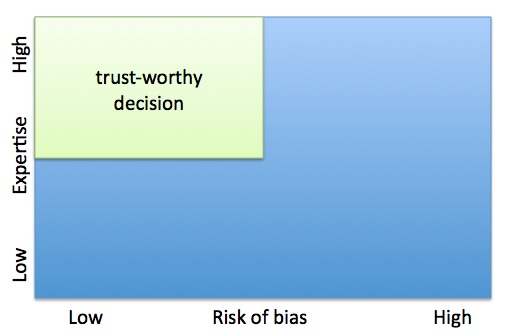
Note that what we’re looking for here is not the “highest possible” standard of integrity (i.e., the standard that implies the lowest possible risk of bias among decision-makers), but a system that makes the optimal tradeoff between risk of bias, on one hand, and relevant expertise, on the other. The point here is not that we’re trading off ethics and expediency. The point is that we’re trading off competing, ethically-significant values.
The point in thinking about ethics is not to aim at the highest standards, but at the best standards. We do enormous damage both to the functioning of organizations and to people’s willingness to talk openly about ethics when we talk about “high standards” in a way that comes off as unthinkingly pious.
Deaf Nudists, Rights, and the Responsibilities of Business
Filed under: corporate citizenship, discrimination, law, rights, values |
Leave a comment Here’s another “tempest in a teapot” story with much larger implications.
By Daniel Wiessner, for Reuters: Deaf man complains nudists would not provide interpreter
A deaf man has accused a nudist park in upstate New York of violating federal law by refusing to provide him with a sign-language interpreter at an annual festival.
Tom Willard, 53, of Rochester, filed a complaint with the U.S. Justice Department claiming Empire Haven Nudist Park violated the Americans with Disabilities Act (ADA) by refusing his requests for an interpreter.
“I am fed up with being turned away every time I try to do something, by idiots who somehow feel the ADA does not apply to them,” Willard wrote in the complaint….
Now it’s true that the ADA‘s “Public Accommodations” does require businesses and nonprofits to take reasonable steps to reduce barriers for the disabled. But according to this page explaining the application of the ADA, Willard is probably out of luck, legally speaking:
Q. Will a bookstore be required to maintain a sign language interpreter on its staff in order to communicate with deaf customers?
A. No, not if employees communicate by pen and notepad when necessary.
In other words, a business doesn’t have to provide a customer’s chosen accommodation, as long as they do something to achieve a fair outcome. (If someone reading this understands the application of the ADA better, please comment!) At a bookstore, you don’t need a translator as long as you’ve got a pen and paper. The same would pretty clearly apply at a nudist park.
Now all that is about the law, not about ethics per se. Ethics and the law are two different things, and that goes for the legal and ethical responsibilities of business, too. But that doesn’t mean that legal issues are “merely” legal issues. The legislation with regard to how businesses need to accomodate disabilities is right there, in black and white. But such legislation is must be interpreted, and interpretation inevitably involves the application of ethical principles, and the relevant ethical principles here include not just the principle that we ought to do more to lower barriers, but also a principle of reasonableness that says that the needs of the disabled have to be balanced against the legitimate interests of businesses and other organizations (and of their other stakeholders). Judges and juries end up having to apply such principles, among others, when discrimination cases reach court. In the 99.999% of cases that never end up near a courtroom, it’s up to businesses — and the people who work for them — to do their best to apply those principles too.
Topless in Not-Quite-“Public”
According to a CBC story, a Toronto woman was chastised by security guards after taking her shirt off (leaving only her rather modest black bra) at Toronto’s Festival of Beer.
Here’s the story: Toronto woman told to put her top on
…Jeanette Martin was at the annual Toronto beer gathering on Sunday when she took up a dare from one of her friends and took off her shirt. She was wearing a bra but apparently that wasn’t enough for organizers.
“Within 10 seconds flat I had a security guard telling me to put my top back on or else I’d be escorted out of the grounds,” Martin told CBC News….
The CBC story rightly points out that, 20 years ago, a young Canadian woman named Gwen Jacobs fought and won a legal battle for the right to go topless — entirely topless — in public.
What the CBC story misses, however, is that the Festival of Beer is not a public place. It’s a business venue. As we all know, there are plenty of business establishments with a policy: “No shirt, no shoes …no service!” The basic ethical principle here is that private establishments get to make their own rules about the tone they want to set.
In fact, the Beer Festival’s rules aren’t limited to proper attire. According to the Festival’s FAQ, there are plenty of rules, including for example:
What can’t I bring with me?
No pets
No children
No opened water
No food
No chairs
No coolers
No large video cameras
No cameras other than for personal use
Of course, these rules aren’t all about attire, but you see the point. A private business gets to set rules, including ones that set the tone for their events, and attire is a significant part of that. Bars and nightclubs in particular very often have dress codes — many forbid ripped jeans, for example, or require that men wear shirts with collars. (For interesting reading, see the rules for attire for customers of Harrod’s department store.) Now pointing out that companies generally have the right to make their own rules for decorum doesn’t mean that there are not ethical limits on such rules. It’s not hard to imagine truly morally obnoxious rules they could impose. For example, if a company imposed Victorian standards on women but put no limits at all on what men could wear, that would be unfairly discriminatory. But requiring shirts is far from that.
Unfortunately, while the Beer Festival’s organizers may have been within their rights to establish rules of decorum for their event, the reasons offered by the event’s organizers were weak ones. According to the CBC,
Martin was told that she would attract unwanted attention from men and her safety was at risk.
As Martin herself suggested (along with many who posted comments on the story), if men are behaving badly, then security should deal with them, rather than blaming Martin.
——–
Update (Aug. 12): I’ve learned through other news outlets that Martin says there were women wearing bikini tops at the Beer Fest on the day in question. That makes Security’s objections harder to understand. A business is still within its rights, but the distinction between a bra and a bikini top is, well, skimpy.
Are they Competing, or Just Trying to Sell You Something?
Filed under: competition, complexity, corporate citizenship, CSR, definitions, sustainability, values |
Comments (2) Peaceful coexistence isn’t always a good thing. In the marketplace, competition is what drives different producers of a good to improve their wares, and having one producer explain the superiority of his or her product is — embellishment and puffery aside — how consumers learn to differentiate among products. When different suppliers fail to engage in competition, the consumer is left in the dark. Let me give you two examples.
Here’s the first example. One of the problems — or rather, one of the warning signs — about so-called “alternative” medicine is that there are dozens of different kinds of alt-med, all making different and presumably conflicting assumptions about how the human body works, and yet they all get along cozily together. Nowhere do you find homeopaths, for example, explaining why their methods are superior to those of acupuncturists. Nor do you find Reiki therapists dissing Ayurveda. Crystal therapy gurus are unlikely to tell you about the problems with Traditional Chinese Medicine. And so on. As Robert Park wrote with reference to alt-med, in his book, Voodoo Science (p. 65), “there is no internal dissent in a community that feels itself besieged from the outside.” Of course, the existence of different alt-med treatments isn’t in itself surprising or problematic. Mainstream medicine too uses different treatments for different illnesses. But the different treatments offered by mainstream medicine are all, without exception, underpinned by a single coherent body of theory: the heart circulates blood, germs cause infection, physiological effect varies according to drug dosage, and so on.
So the fact that various systems of alternative therapy, underpinned by very different understandings of the human body (and indeed of metaphysics), can get along so chummily is a huge red flag. It suggests that purveyors of alt-med either a) aren’t thinking critically, or b) are more interested in sales than in healing.
Roughly the same concern arises with regard to different perspectives on how businesses should behave. Some will tell you that the obligations of business are all rooted in the notion of sustainability, with its indelible environmental overtones. Others will say no, it’s a matter of CSR — Corporate Social Responsibility. Still others say it’s all about values. Or leadership. Or citizenship. Or the (ug!) Triple Bottom Line. And each of those seems, at least, to be underpinned by a different understanding of the nature of the firm, its role in society, and what it is that makes an action right or wrong. And yet all kinds of folks seem to want to cleave to all of the above, or to glom onto one of them seemingly at random, as if it doesn’t matter which one you choose.
Again, this should be a big red flag.
I’m sure I’m going to be told that these different schools of thought don’t need to compete with each other — what’s really important, they’ll say, is that, you know, we focus on fixing the way business is done. But again, as with the case of alternative medicines, if someone tries to sell you some and isn’t willing to even try to explain why theirs is better than the other stuff, you should at least wonder whether they aren’t thinking critically, or are merely trying to sell you something.
Should Twitter Censor?
Filed under: accountability, corporate citizenship, CSR, internet, protest, standards, technology, values |
Comments (2) Last weekend, a despicable “hashtag” trended* on Twitter, one promoting the idea that violence against women is OK. By Sunday morning, tweets using that hashtag were mostly critical ones, expressing outrage at any non-critical use of the hashtag. One prominent twitterer, Peter Daou, (@peterdaou) asked why Twitter wasn’t preventing that hashtag from trending. He tweeted:
“Unbelievable: Is Twitter REALLY allowing #reasonstobeatyourgirlfriend to be a trending topic??!”
The outrage expressed by Daou and others is entirely appropriate. The hashtag in question is utterly contemptible. But the question of whether Twitter should censor it and prevent it from trending is another question altogether.
The central argument in favour of censorship is that the idea being broadcast is an evil one, and decision-makers at Twitter are in a clear position to stifle the spread of that evil idea, or instead to allow its proliferation. With great power comes great responsibility.
The most obvious reason against censorship is freedom of speech, combined with the slippery slope argument: if Twitter is going to start censoring ideas, where will it end? Freedom of speech is an important right, and that right includes the right to speak immoral ideas. Limits should only be imposed with great caution.
Now, it’s worth noting that the hashtag trending isn’t actually anyone’s speech: it’s the aggregate result of thousands of individual decisions to tweet using that hashtag. So if Twitter were, hypothetically, to censor the results of their trending-detection algorithm, they wouldn’t actually be censoring anyone, just preventing the automated publicizing of a statistic. But perhaps that’s a philosophical nicety, one obscuring the basic point that there is danger anytime the powerful act to prevent a message from being heard.
More importantly, perhaps, Twitter isn’t a government, it’s a company, and it doesn’t owe anyone the use of its technology to broadcast stupid ideas (or any other ideas, for that matter). We insist that governments carefully avoid censorship because governments are powerful and because for all intents and purposes we cannot opt out of their services as a whole. If a company doesn’t want to broadcast your idea, it’s not morally required to. Your local paper, for instance, isn’t obligated to publish your Letter to the Editor. The right to free speech isn’t the right to be handed a megaphone.
But then the challenging question arises: is Twitter a tool or a social institution? Just how much like a government is Twitter, in the relevant sense? It is, after all, in control of what many of us regard as a kind of critical infrastructure. This is a challenge faced by many ubiquitous info-tech companies, including Twitter, Facebook and Google. While their services are, in principle, strictly optional — no one is forced to use them — for many of us going without them is very nearly unthinkable. We are not just users of Twitter, but citizens. That perspective doesn’t tell us whether it’s OK for Twitter to engage in censorship, but it does put a different spin on the question.
—–
*The fact that it was “trending” on Twitter means that Twitter’s algorithm had identified it as, roughly, a “novel and popular” topic in recent tweets. Trending topics are featured prominently on Twitter’s main page.
Yes, there is such a thing as business ethics
Filed under: accountability, blogs, character, codes of ethics, corporations, critical thinking, definitions, ethics, values |
Comments (10) Marketing guru (blogger, author, etc.) Seth Godin posted a provocative blog entry called, “No such thing as business ethics”, in which he worries that the focus on “business ethics and corporate social responsibility” is distracting us from questions of personal responsibility:
It comes down to this: only people can have ethics. Ethics, as in, doing the right thing for the community even though it might not benefit you or your company financially….
Now I could quibble with Godin’s definition of ethics, which is actually a particular controversial view about what ethics requires, rather than a definition. But instead I’m going to take issue with Godin’s claim that all that matters in business is personal ethics, rather than organizational ethics. Godin writes:
I worry that we absolve ourselves of responsibility when we talk about business ethics and corporate social responsibility. Corporations are collections of people, and we ought to insist that those people (that would be us) do the right thing. Business is too powerful for us to leave our humanity at the door of the office. It’s not business, it’s personal.
Godin’s claim that “it’s not business, it’s personal” is problematic in two ways. First, it wrongly implies that business ethics somehow misses out on the whole personal integrity thing. That’s entirely false. Both the academic literature on business ethics and the “ethics and values” programs set up by individual companies put a lot of emphasis on individuals adopting the right values and making good decisions. Secondly, contrary to what Godin implies, individual ethics clearly is not enough. For one thing, people embedded in organizations have obligations that are role-specific. Just as lawyers and doctors have special duties that go along with their roles — they have to follow not just their own consciences, but also highly specific professional codes — so do people in the world of business. And for another thing, organizations can be set up badly such that all kinds of “good” individual decisions can still lead to problematic outcomes. The ethics of the organization, per se, matters a lot.
Interestingly, Godin tells us that he learned about all this from his dad. Unfortunately, while the homely lessons we learned at our parents’ knees tend to give us a good start in life, complex institutional settings tend to bring more complex duties, and hence require more complex principles.
Values-Based Consumerism as Double-Edged Sword
Filed under: consumers, corporate citizenship, CSR, discrimination, transparency, values |
Comments (2) It’s a game of connect-the-dots. Do you, as a consumer, feel any responsibility for the purposes to which the companies you patronize put their profits? Do you care about a company’s values, beyond the effect those values have on how the company conducts business? What about its CEO’s values, or the values of its biggest shareholder? Do those factors enter into your purchasing decisions? Should it?
To make the question more concrete, consider the following:
- If you’re politically left-leaning, do you want to patronize a store owned by someone on the right?
- If you are a Christian, would you buy a car from an atheist?
- If you’re pro-choice, would you buy groceries from a chain of stores owned by a staunch pro-life advocate?
- If you’re in favour of strict gun control, do you want to boost the profits of a company that donates to the National Rifle Association?
For a less-hypothetical example, see this story (in which I’m quoted) by Nicole Neroulias in the Albany Times Union: “Corporate giving is questioned”. The focus of Neroulias’s story is a recent controversy regarding TOMS shoes. The short version goes like this: Blake Mycoskie, head of TOMS, agreed to be interviewed by Jim Daly, president of the right-wing Christian group Focus on the Family. Feminists and defenders of gay rights protested, and Mycoskie issued an apology. On his blog, he wrote: “TOMS, and I as the founder, are passionate believers in equal human and civil rights for all.” Without questioning his sincerity here, it’s clear that Mycoskie had become aware that his flirtation with FOTF had riled his company’s socially-progressive customer base. Why would someone socially progressive continue to support a company perceived to be in cahoots with the Christian right?
Three quick points:
1) On one hand, it seems to me that, yes, at least in principle, consumers must take an interest in the causes supported by the companies they patronize. We are responsible for the causes we support, even indirectly. Of course, most of us contribute far too little to the coffers of even our favourite companies to make any appreciable difference at all. If a company has a 1% profit margin, and gives 1% of that to some cause, that means that one penny out of every hundred dollars you spend goes to that cause. But then, even merely symbolic contributions matter.
2) People who want corporations to adopt social causes should be careful what they wish for. It’s all well and good to say that companies should do something to “give back” to the community. But when they agree to do so, what’s to say that they’re going to give to a cause that you believe in, rather than one you find abhorrent? Would you rather your favourite software company contributed to your least-favourite charity, or just stopped contributing to charities at all?
3) One of the most interesting things about all this is that what we’re seeing here is the undoing of the competitive market’s tendency to prevent people from acting out their biases. One of the best things about modern markets is that they punish prejudice, and make it more difficult. It’s easy to discriminate against the minority cobbler down the street by traveling a few extra blocks to buy from “your own kind”; it’s much harder to act out your racist biases when buying shoes at a big department store because, well, you have no idea what colour or sex or sexual orientation of the person who made those shoes is. Market transactions today are effectively anonymous and depersonalized, in a way that makes biases of various kinds effectively impotent. The push for certain kinds of corporate social responsibility, accelerated by moves toward corporate transparency and social media, is effectively undoing this.
In the end, it’s not at all clear whether it is a good thing that the market is becoming another avenue for acting out our ideological disagreements.



 The Business Ethics Blog