Archive for the ‘values’ Category
Can Employers Tell Employees What to Eat?
Filed under: discrimination, employees, ethics, food, values |
 Comments (33)
  All companies want their employees to be team players. But just how far can companies go in requiring that employees ‘toe the line’? Can that demand extend to cultural or religious or moral or dietary requirements?
How As a starting point, consider this story, from CBC News: No meat on menu for Montreal purse maker
A Montreal accessories company has taken its policy of using no animal products beyond the rack and has forbidden its staff from eating meat and fish at work.
A former employee says the policy violated her rights as a non-vegetarian….
(I’ve blogged on unusual forms of employee discrimination before. See Discriminating Against the Non-Blind and “Smokers Need Not Apply”.)
So, is it OK for a company to require that its employees not eat meat? Now, to be more precise, the company in question isn’t forcing people to be vegetarians. It’s just insisting that they not eat meat on the premises. But still, the requirement is an imposition. If an employee loves bologna sandwiches, why should she not be allowed to eat them on her lunch break at work? On the other hand, it’s not exactly a brutal requirement: a place that forbids employees from eating meat is not exactly ipso facto a Dickensian sweatshop. Of course, you might say that the whole conflict could be avoided by careful hiring: only hire people who are willing to uphold the company ethos. But that still amounts to a form of discrimination — and we would still have to ask whether such discrimination is justified or not. Besides, we would still have to worry about cases in which an employee is a devout vegetarian at time of hiring, but then (for whatever reason) changes her dietary habits at some point after being hired.
Whatever your instincts about this particular case, it’s worth performing a consistency test on your own conclusion. Try this: if you’re a vegetarian or vegan, and sympathetic to the company’s no-meat policy, ask yourself whether you would reach the same conclusion if the tables were turned, and a meat-packing company required employees to eat meat and forbade vegetarianism. (“Why would a vegetarian work at a meat-packing plant?” Well, times are tough. Stranger things have happened!) If, on the other hand, you think the company in the story above is engaging in unjustifiable discrimination, ask yourself whether you would reach the same conclusion if the company was one whose product embodied some value that you hold dear — something to do with your own religious or philosophical or political beliefs. That kind of consistency test is a good way to double-check that the conclusion you reach with regard to this particular case is rooted in good reasons, or whether instead your conclusion is based on an undefended bias.
—–
Addendum:
A couple of people have told me my counter-example above is unrealistic — after all, what employer is going to tell you you have to eat meat? That misses the point I was making, which was to suggest to people that we should think up some counter-example that involves some set of values that would challenge what seems to us to be the “obvious” conclusion, here. If you don’t like my example, feel free to suggest one!
—–
Thanks to NW for the story.
Chevron Agrees
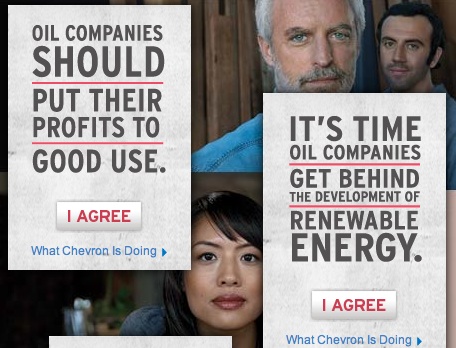 Chevron has just announced a new ad campaign to highlight the various ways in which the company and its critics actually agree on a number of ethically-important points. Things like:
- “Oil companies should put their profits to good use.”
- “It’s time oil companies get behind the development of renewable energy.”
- “Oil companies should support the communities they’re a part of.”
- etc.
Here’s the press release announcing the new campaign: Chevron Launches New Global Advertising Campaign: ‘We Agree’. There’s also a YouTube channel where you can see the TV ads.
Many people will detect a whiff of greenwashing, here. And you don’t have to be much of a cynic to be somewhat skeptical. Back in 2001, another oil company, British Petroleum, claimed to be turning over a new leaf when it branded itself as just BP, which it suggested stood for “Beyond Petroleum.” We all know how that turned out.
The We Agree website of course features all kinds of nifty-sounding illustrations of Chevron’s commitment to being socially responsible. It’s mostly the usual kinds of stuff. But what’s interesting here, philosophically, is the attempt to point to the underlying agreement on values. And (this campaign aside) I do think it’s important for people on different sides of any given debate to understand just how much they probably do agree on, at the level of basic values. Now, if we could just agree on how those shared values ought to be implemented, we would really be getting somewhere.
—–
(Note: as I blogged last night, this Chevron campaign got spoofed by pranksters who issued their own version of the Chevron press-release, pointing to a very-convincing-but-fake campaign website. I was temporarily fooled, myself. You can find out about the spoof via the NYT‘s Media Decoder blog: Pranksters Lampoon Chevron Ad Campaign.)
Finally: Why the “R” in “C.S.R.”?
 You probably saw this coming.
In mid-July, I asked Why the “C” in “CSR”?. Two weeks later I followed up with, Why the “S” in “CSR”? In both cases, my complaint was basically that the words the letters stand for (i.e., “Corporate” and “Social”) are too narrow to capture the topic at hand. So, am I now going to question the R-as-in-“Responsibility?” Yes, here endeth the trilogy.
The “R” in “CSR” is there because CSR grew out of an interest in the idea that companies, especially the biggest and most powerful ones, have some obligation, some responsibility, to do right by the communities they are part of. But the notion of “responsibility” is inadequate to capture the range of questions about which CSR advocates are typically (and ought to be) concerned. Such as:
- Questions about rights, such as “Is there a right to freedom of commercial speech? Does that right extend to corporations? Or does free speech only apply to individuals acting in their private capacity?”
- Questions about value, such as “Are there some things that ought not be market goods? Which ones? Why?”
- Questions about the virtues appropriate to the world of business.
- Questions about what kinds of actions are permissible, even if not morally praiseworthy.
- Questions about what kinds of actions are ethically desirable, even if they would not count as being a responsibility.
Now, each of those types of questions involves, at least tangentially, other questions that are about responsibility. But the questions above certainly cannot be reduced to questions of responsibility.
Of course, maybe people interested in CSR aren’t interested in those questions, or think such questions somehow are not central. But that just means that, whatever CSR is about, it isn’t about a whole range of the most interesting normative questions about business.
No Cake for Little Hitler: Ethics in the Bakery
Filed under: decision-making, discrimination, ethics, retail, values |
Comments (4)  Freedom is a wonderful thing; freedom of speech is particularly important. But speech can also be a potent weapon. Your way of expressing yourself might prove horrific to me. Given that lot of businesses make all or part of their livelihood from helping people express themselves, challenges are bound to arise. Case in point, from The Lehigh Valley Express-Times: Holland Township family angry that supermarket won’t personalize cake for their son
JoyceLynn Aryan Nation Campbell, Honszlynn Hinler Jeannie Campbell and Adolf Hitler Campbell.
Good names for a trio of toddlers? Heath and Deborah Campbell think so. The Holland Township couple has picked those names and the oldest child, Adolf Hitler Campbell, turns 3 today.
This has given rise to a problem, because the ShopRite supermarket in Greenwich Township has refused to make a cake for young Adolf’s birthday.
“We believe the request … to inscribe a birthday wish to Adolf Hitler is inappropriate,” said Karen Meleta, a ShopRite spokeswoman.
The Campbells turned down the market’s offer to make a cake with enough room for them to write their own inscription and can’t understand what all of the fuss is about.
Here’s an earlier, longer version of the story: Holland Township man names son after Adolf Hitler
ShopRite is within its rights to refuse to make the cake. They certainly have no obligation to help the Campbells live out their probably-hateful or at-least-misguided lifestyle. (Note: I’m willing to soften the case against these parents because, based on reading the longer version of the story — they seem dim-witted, not evil. Whatever.)
So, it was at least OK, and perhaps ethically a good thing, to refuse to make the cake. Of course, it’s easy to imagine all kinds of tacky, tasteless things someone would want to have written on a cake (“Happy Birthday, Assh*le!” or “Show Me Your T*ts!). I can imagine borderline cases that would give bakery managers headaches. But a cake paying apparent homage to the 20th Century’s literal poster boy for evil is probably not a borderline case.
Not surprisingly, different stores have different standards. Apparently the local Wal-Mart made little Adolf’s first two birthday cakes:
A spokeswoman for Wal-Mart said the store won’t put anything illegal or profane on a cake but thinks it’s important to respect the views of customers and employees.
The Wal-Mart spokesperson’s premise is a little off, here: you don’t need to respect all views of your customers and employees. A healthy degree of respect for cultural and religious differences is a good thing, but not all views are worthy of respect. So I don’t think a store needs to be willing to make Nazi cakes in order to show its support for diversity. But while I think what ShopRight did in refusing to make that cake was perfectly fine, I’m not sure there’s anything badly wrong with another store going ahead and making the cake. It is, after all, the kid’s name, and by making the cake the store would be pretty far from promoting Nazism. In a free society — and a free market — we probably want to allow merchants a reasonable degree of leeway in the customer preferences they are willing to tolerate.



 The Business Ethics Blog