Philip Morris: Endangering Kids and Academic Ethics
Filed under: accountability, children, ethics, health, law, marketing, product safety, rights |
 Comments (4)
 Tobacco giant Philip Morris is doing its best to get its hands on research about teen smoking, and encouraging some UK academics to violate ethical standards along the way.
Here’s the story, by Andrew Hough for the Telegraph: Philip Morris: tobacco firm using FOI laws to access secret academic data
Philip Morris International has tried to force the University of Stirling to hand over secret data into teenage smoking and cigarette packaging gathered over more than a decade.
The manufacturers behind the popular Marlboro brand, have used Freedom of Information laws to [attempt to] gain access [to] about 6000 confidential interviews undertaken with teenagers as young as 13, which discuss their views on smoking and tobacco….
The researchers are rightly fighting the request.
It’s a shocking move on Philip Morris’s part, even just from a PR point of view. To be seen seeking information that the company clearly hopes to use in marketing to children will do nothing to improve anyone’s opinion of the firm or the industry.
But there’s a second wrong, here, and that lies in the attempt to get the researchers in question to violate their obligations to the research subjects — the children and their parents — who participated in the research in question.
When university-based researchers conduct any kind of research on human beings, they are required to adhere to pretty strict standards for research ethics. The most fundamental of those standards has to do with obtaining informed consent from research subjects. Such consent may be obtained only after research subjects are fully informed about the goals of the research, as well as about what sorts of privacy protections they can expect. In the case described here, it is almost certainly the case that the children interviewed, and their parents, would have been assured that while the researchers would of course eventually make public the aggregate results of their research, the raw data — the interview transcripts that Philip Morris seems to be seeking — would of course be kept confidential.
So Philip Morris is asking these researchers to break their promise and to breach the trust placed in them by research subjects. The company is attempting to get the researchers to violate their duty. This puts the company’s behaviour into the same moral category as suborning perjury or intentionally putting another party into a conflict of interest. It’s a bad thing when a company violates its own duties; but it is especially corrosive to work so hard at encouraging other people to violate theirs.
The CSR Litmus Test
I wrote a short article for a forthcoming issue of Canadian Business, riffing on a recent Globe and Mail story about a South African winery that is working hard to face up to its slave-holding past. The Solms-Delta winery’s owners have done things like set up a museum in its wine cellar, and establish a trust for the benefit of workers. This is clearly admirable; other South African wineries generally prefer to sweep the past under a rug. But is highlighting the past this way an obligation owed to the winery’s current employees? If so, then Solms-Delta is simply meeting its ethical obligations. But if this is not something owed to current employees, it is better cast as a matter of social responsibility.
I’ve complained ad nauseum about the fact that there’s no clear, agreed-upon definition of CSR (Corporate Social Responsibility). Many definitions say something about “social contribution” or “giving back to the community.” But just what that amounts to is up for grabs. It might mean something trivial, or it might mean something unfairly burdensome.
Here’s a litmus test to help you figure out your own views in this regard, and what those views imply. Imagine a company that does all of the following, with reasonable consistency:
- Makes a decent product that people feel improves their lives in some small but meaningful way;
- Treats employees fairly;
- Deals honestly with suppliers;
- Tries to do a decent job of building long-term shareholder value;
- Cleans up their messes, environmental or otherwise;
- Does its best to follow all applicable laws, and trains and rewards employees suitably;
- Pay its taxes, making use of all relevant exemptions but not cynically seeking loopholes.
Next, if you consider yourself a fan of CSR, ask yourself this question: Would such a company count as a socially responsible company, in your books? Or is there something more they need to do in order to garner that designation? Are they ethically obligated to do something further?
If your answer is “Yes, that’s a socially responsible company!” then good for you. That’s a very reasonable answer. But then you should ask yourself two questions. One, why are you attached to the label “CSR”? Why not just call them a company that does right, or that acts ethically? Why try to shoehorn all the good stuff listed above into the little box of specifically social responsibility?
If your answer is “No, they’re still not giving back to the community!” then next you need to ask yourself what more and why. The company described above is engaging in voluntary, mutually-advantageous transactions with customers, making those customers better off (by their own lights). It is doing something good in the world, and being conscientious about how it does it. That seems pretty decent.
And whatever your answer is, taking this test should clarify both what your own views are, and perhaps why the term “CSR” is far less useful than it is popular. And whenever two people think they agree on the importance of CSR, each of them ought to doubt — or ask — whether they’re really agreeing on the same understanding of what social responsibility really means.
Business Ethics Around the Globe: Zimbabwe and Russia
 If you have an interest in business ethics, it’s worth keeping an eye on the international scene for commentary about the role that ethics plays in developing economies. Here are a couple of recent examples.
First, by Manson Mnaba, for the Zimbabwean publication NewsDay: “Corporate Zimbabwe should embrace business ethics”
Two things are worth remarking. The first has to do with Mnaba’s description of the state of his country’s economy:
We are a nation emerging from the woods and doldrums. The past decade was particularly painful, strange and unique in every aspect. Conventional economics failed. Strait-jacket business principles failed to offer corporate direction.
Executives had to think outside the box through creativity and innovation. But Creativity and innovation devoid of human conscience is disastrous….
Note that this sounds a lot like how many Americans would describe the US economy. The difference, of course, is that Zimbabwe is actually poor, with a per person GDP that is one one hundredth that of the US.
The other thing worth noting is that Mnaba sees clearly — perhaps painfully clearly — the necessity of ethics in building an economy:
A business landscape where there are no ethics is a gangster’s paradise. Business ethics and corporate governance workshops would help us to sharpen our business intelligence quotient.
Next, to Russia. Russia isn’t a developing nation like Zimbabwe, but it is an economy in transition, still struggling to come to grips with the mechanisms and traditions necessary to sustain a free market, after generations of suffering under oppressive government and a command economy.
See this story, by Andrew E Kramer for the NYT: At 35,000 Feet, a Russian Image Problem. The story recounts the trouble that Russian airline manufacturers, in particular, have faced in trying to build jets for the Western market. Just one stumbling block:
…Russian television station NTV reported that 70 engineers at the plant making the Superjet had obtained fake engineering diplomas by bribing a local technical college; Sukhoi said those employees were not directly involved in assembling the planes….
Unfortunately, this isn’t all that surprising, for a country that scores near the bottom of Transparency International’s corruption perception index. Not surprising, but unfortunate. As I’ve pointed out before, trust — and hence ethics — is absolutely essential to commerce. And if Russia wants to expand its market, and hence its economy, it’s going to need to figure out more consistent business ethics.
Post-Hurricane-Irene Business Ethics Roundup
Filed under: corporate citizenship, CSR, disaster, economics, pricing, profits |
Comments (2)  Natural disasters put all kinds of pressures on the behaviour of otherwise-civilized people, and they almost always raise business ethics issues. Here are a few little issues that popped up over the weekend, while hurricane Irene was wreaking havoc on the east coast of North America.
First, a bit of price gouging: Brooklyn’s posh Hotel Le Bleu squeezed Irene shelter seekers for $999 per room
A trendy Brooklyn hotel generated a flood of cash from Irene, jacking up the price of a room to $999 a night on Saturday as the powerful storm zeroed in on New York, employees said….
As I’ve written before, raising prices during a disaster isn’t always unethical — sometimes higher prices provide an incentive for others to rush to send resources to disaster-stricken areas, and sometimes higher prices give citizens an incentive to avoid overusing scarce resources. I’m pretty sure neither of those rationales applies here. [Update: see the hotel’s reaction, in the Comments section below.]
The flip-side of the price-gouging story is this one: “Generators, batteries big sellers ahead of Irene”. You can learn a lot about the ethics of pricing by contemplating why hardwares stores generally didn’t jack up their prices. (Yeah, there are anti-price-gouging laws in many jurisdictions, but that’s likely not enough to explain why prices stay stable.) Note that this story mentions that “…an Ace Hardware in Nags Head, N.C., the store sold out of portable generators.” The fact that the store sold out pretty certainly means that some customers went away disappointed. And it’s entirely possible that some of the disappointed needed the generators a lot more than the people who actually got them. Should Ace have found some way of asking customers how badly they needed a generator, or should they have raised the price a bit to make sure that people who bought one really needed one?
Next, from Katy Burne, blogging for the WSJ (just before the storm), “Hurricane Irene Whips Up Trading In ‘Catastrophe Bonds’”. Here’s the technical bit:
Catastrophe bonds, known in the insurance industry as “cat” bonds, are structured securities that allow reinsurers to transfer their own risks to capital-market investors. Investors in cat bonds earn regular payments in exchange for providing coverage on a predetermined range of natural disasters for a set period of time.
Note the similarity here to the controversial practice of short-selling stocks. In shorting stocks in a particular company, a trader is betting that the value of that stock is going to go down — that is, betting that the company will do poorly. Many people find that distasteful. Some have even called it unpatriotic. In buying (or in shorting) ‘cat bonds,’ an investor is wagering on human misery. But note that that’s what insurance companies do, too, and none of us wants to be without those.
Next, there have been a few stories about companies helping out by either donating goods or by fundraising for disaster relief (see here and here, for small examples). Many more such stories have no doubt gone unreported. It’s also been noted that some companies are going to benefit from the storm, especially if (like Home Depot) they sell goods that will be needed for reconstruction. Is there anything wrong with that? (See here for a previous blog entry on profiting from disaster relief.)
Finally, the key business-ethics stories to watch, over the next few days, are about insurance claims. Insurance firms are happy that losses look to be lower than expected. But stories will inevitably pop up about consumers having difficulty getting insurers to pay up. This will, again inevitably, be portrayed as heartless. And in some cases it may well be heartless. In other cases, we’ll simply see that people generally fail to understand the economics — and the ethics — of insurance.
Chasing Madoff (movie review)
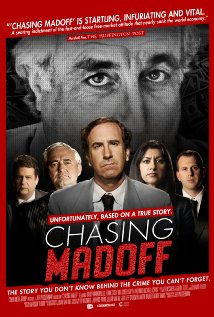 The documentary Chasing Madoff opens this week. I had a chance to attend a preview of the movie last night (courtesy of eOne Films).
The film is really the story of fraud investigator Harry Markopolos, the guy who, while working as an options trader at Rampart Investment Management, discovered Madoff’s scheme and worked valiantly to get the Securities and Exchange Commission to take notice.
It’s kind of a fun film, but not a great film. The film lacks a narrator, opting instead to tell the entire story through the first-hand accounts of a handful of people (primarily Markopolos and a couple of colleagues, along with a few of Madoff’s victims) and snippets from newscasts. The focus on first-person accounts gives the film a personal feel, but it also inevitably means a perspective that is slanted, though perhaps not fatally so.
There are a few laughs in the film. Markopolos is a bit of a strange cat. He’s a likeable guy, and apparently a man of integrity, but also a bit paranoid-sounding. On-screen, he tells us that he feared Madoff so much that he was ready to pre-emptively shoot the guy, if Madoff had discovered his investigation. He also describes what his strategy would be in the event of an armed standoff with the SEC, should they ever come to his home to get his files — files that included damning evidence of SEC complacency. Just for emphasis, one scene shows him leaning against his desk, brandishing a pump-action shotgun. These humourous parts are, I think, intentional, or at least surely the director (Jeff Prosserman) must have known they would spark laughter. And humour is fine, but it tends to undercut the filmmakers’ stated intention of generating outrage in their audience.
What’s most striking, perhaps, about Chasing Madoff is what it doesn’t tell us about the Madoff scandal. For example, it points fingers at the SEC, but tells us nothing about the agency’s funding levels, and whether it had the capacity to keep up with complaints like Markopolos’s as they flowed in. There are also allegations that “someone higher up” at the Wall Street Journal tried to stifle the story before it broke, but little evidence to back that up. And there are intriguing hints about the large number of individuals and organizations that must have been complicit in Madoff’s crimes, and hints at why they had no economic incentive not to keep putting faith in his results. There’s even a claim that Madoff “paid top dollar” to those that would bring him “new victims.” But the relevant parties are not named and the film makes little effort to explain the connections.
Bottom line: I’m a university professor — would I show this movie in my Business Ethics classroom? Probably not. It’s a fine portrayal of man of integrity fighting the good fight, but it teaches relatively little about how the financial crime of the century happened, or what if anything would prevent it from happening again.
PETA Promises Porn With a Purpose
Filed under: activism, advertising, entertainment, food, marketing, NGO, protest, sex, strategy |
Comments (1) Is it just me, or has PETA jumped the shark? The always-provocative animal-rights organization is at it again, this time announcing that it’s planning on starting its own porn site to draw attention to the plight of animals. And once again it’s alienating groups that it ought to consider allies.
See this version of the story, by Madeleine White, for the Globe and Mail: PETA to launch porn website: Is this still about animal rights?
The animal rights group, known for its naturalist ways, has registered the domain name peta.xxx and plans to launch a pornography website in December that “draws attention to the plight of animals….”
Not surprisingly, many feminists (in the broadest sense of the term) have objected. The general line of argument is that you’re not really accomplishing anything if you’re raising awareness for one cause (say, animal suffering) by doing damage to another cause (say, sexual equality). When PETA uses naked bodies, they are almost always female bodies, portrayed and instrumentalized as sex objects. Porn, in other words, is pretty problematic as a consciousness-raising tool.
Now none of this assumes that all porn is automatically a bad thing. It is, by definition, naughty, and certainly controversial, but there’s little reasoned objection against portrayals of nudity or sexuality per se. Any sane objection has to be rooted in things like objectification, which is not a necessary ingredient of porn, though it is certainly a common one. Of course, no one knows yet just what kind of porn PETA has in mind, but the group’s history suggests that we shouldn’t expect anything terribly progressive.
Why does the group use such tactics in the first place? PETA claims that they have no choice:
Unlike our opposition, which is mostly composed of wealthy industries and corporations, PETA must rely on getting free “advertising” through media coverage.
But that’s not exactly true. According to PETA’s financial report, the organization has about a $36 million budget, overall, out of which it spends about $11 million on “Public Outreach and Education.”
It perhaps goes without saying that any for-profit corporation that tried to set up such a website to draw attention to its product would draw fire, too. But of course it is utterly unthinkable that Coca-Cola or Microsoft would set up an entire porn site just to draw attention to their products. That’s not to say that lots of companies don’t use sex in their advertising, but no mainstream company would ever go so far as to use actual porn to reach an audience. But then, PETA isn’t a for-profit corporation, but rather a not-for-profit corporation, one that exists to promote animal rights. But is objectification of female bodies for a cause different than objectification of female bodies for money, ethically speaking? PETA will surely say “yes.” After all, this is porn for a good cause, not just for its own sake, and not just to generate filthy profits. But it’s worth remembering that PETA’s values, and the goals it seeks, are far from universal. We’re not talking about, say, world hunger or literacy. And there are all kinds of for-profit companies that produce products that make the world a better place in tangible, agreed-upon ways.
Maybe the problem with PETA isn’t (just) that their campaigns objectify women, but that they are cavalier about doing so. They’re single-minded in pursuit of their objectives, and sex is just one more tool for them to use in pursuing it. An organization that’s supposedly committed to getting us to think about the plight of animals can’t afford to be seen as clueless about other ethical issues.
Jack Layton and Adversarial Ethics
Filed under: adversarial ethics, government, leadership, politics |
Leave a Comment Today Canada mourns the loss of Jack Layton, a politician beloved by his allies on the left and grudgingly respected, I sense, by a great many opponents on the right. Layton was, for most of the last decade, the tireless leader of the New Democratic Party (traditionally Canada’s “third” party), and eventually led the party during its historical first turn as the Official Opposition in the House of Commons.
Layton has left behind a considerable legacy of public service, but his career also holds lessons for how we think about business ethics.
One of the things that the market and the realm of electoral politics have in common is that they are both deliberately adversarial. In both politics and business, we want participants (political parties, in one case, and business firms in the other) to compete vigorously with each other, rather than cooperating. The idea is that when participants compete, third parties (voters in one case, and consumers in the other) reap the benefits. Such systems are interesting, and ethically complex. Competitive behaviour is often considered anti-social, and so it requires careful thought to figure out just what the boundaries of competitive behaviour are, when we actually encourage people to act that way.
Here are two facts about Layton that serve as perfect illustrations.
First is that he spearheaded an effort to bring greater civility to debates in the House of Commons. This is not surprising, coming from the Federal politician voted to be the one that Canadians were most likely to want to have a beer with. But that sort of effort is also absolutely essential to any adversarial system. Just as norms of good sportsmanship keep violent games like football and hockey within reasonable boundaries, norms of civility in politics keep that game from devolving into something intolerable.
But some may also recall that Layton was declared (by impartial academic researchers) the “least civil” participant in recent Canadian parliamentary debates. Critics were quick to use that story as ammunition against the affable politician. But the authors of that study rightly pointed out a structural reason for Layton’s place in the ranking: Layton was leader of one of the opposition parties, and zealous debate in Parliament is one of the opposition’s few tools in Canada’s parliamentary system. Canadians would have been worse-off if Layton, in his role as leader of an opposition party (and later as Leader of the Official Opposition), had been more polite.
Clearly the challenge Layton faced — by all accounts met admirably — is the same one faced by business leaders everywhere. And that is how to compete zealously in order indirectly to promote the common good, while at the same time resisting the entirely-natural temptation to behave in such a way as to bring the entire endeavour into disrepute. Competing in a zealous but civil way is a crucial part of Jack Layton’s legacy, and a crucial challenge for all leaders in the worlds of both politics and commerce.
——-
Correction: the original version of this blog entry claimed that Layton was Leader of the Official Opposition during the time-frame of the academic study mentioned. That was incorrect, and has been fixed above.
Winning the Hearts and Minds of Organic Consumers
Filed under: food, health, product safety, risk, science, standards |
Comments (1) The agri-food business has rapidly become one of the most ethically-controversial on the planet. Vicious cultural battles are being fought over what constitutes an ethically-decent way to raise various food products. And marketers are fighting tooth-and-claw to develop and market food products that meet the increasingly diverse desires of consumers — including consumers who may want food that is not just low-fat, low-salt, and low-cal, but organic, free-range, local, low-carbon, cruelty-free, fair-trade and/or free of genetically-modified ingredients. Winning the hearts and minds of a public with such varied preferences and interests is no easy task.
For a peek at the cultural and ethical complexity of the agri-food industry, check out this story, by Louise Gray, writing for The Telegraph: Soil Association ditches rockstars to go back to its roots. The story is really a profile of Helen Browning, the new director of the UK’s Soil Association, which is the nation’s most significant pro-organic charity, as well as the organization responsible for the world’s very first certification system for organic food back in the 60’s.
Two key points are worth making, here:
1) Browning displays an unusual degree of common sense in avoiding an “us vs. them” attitude towards non-organic farmers:
Much to the dismay of the more ‘fundamentalist’ wing of the organic movement she is also relaxed about letting non-organic farmers join the organisation and sharing information with intensive agriculture….
This is essential, if advocates of organic farming really are concerned with the health of consumers and the planet, rather than merely being concerned with promoting the organic ‘brand.’ Turning organic agriculture into an all-or-nothing category makes it too much like a cult, alienating non-organic farmers and giving them little reason to try to learn about alternatives or to reduce the amount of pesticides they use.
2) On the other hand, Browning’s hit-and-miss attention to science is are sure to do damage to her cause.
The former chair of the food ethics council argues that large scale units are overusing antibiotics and creating MRSA strains that are a danger to humans as well as animals.
She uses homeopathy to keep her herd healthy, but mostly it is being outdoors on a mixture of grass and clover that makes happy cows and tasty beef….
This is rather alarming. While Browning is right to worry about overuse of antibiotics in agriculture — that’s a serious public-health risk — opting for homeopathy as an alternative is utter lunacy, roughly equivalent to relying on witchcraft. (The Soil Association’s standards for organic livestock do permit standard vaccination, but also promotes the use of homeopathy.) Where the health of food animals is concerned, we need proven methods, not dis-proven ones. Consider: any food-processing plant that relied exclusively on, say, prayer or the blessings of a priest to eliminate germs, instead of thoroughly cleaning their machines, would face the wrath of regulators, not to mention public outrage. If organic agri-business is to win not just hearts, but also minds, it needs to do a better job of relying on science, and not just wishful thinking.
Pipeline Leaks and Stakeholder Theory
Filed under: accountability, corporate citizenship, corporations, CSR, management, pollution, shareholders, stakeholders |
Comments (2) When oil spills in a forest, does everybody matter? That’s the question posed by the events recounted in this recent CBC story: Wrigley residents voice pipeline spill concerns.
The story is about an Enbridge pipeline that sprung a leak in a tiny, remote town in Canada’s Northwest Territories. Not surprisingly, residents of tiny Wrigley are unhappy about the spill, and so Enbridge has to figure out not just what to do about the spill (i.e., how to clean it up) but what to do about the people of Wrigley. More generally, managers at Enbridge have got to figure out, on an ongoing basis, what their obligations are, and to whom those obligations are owed.
There’s an older school of thought (or more likely a caricature of an older school of thought) according to which shareholders are the only ones whose interests really need to be taken seriously. According to this view, an oil company’s managers’ only real obligations are owed to shareholders. After all, says this view, shareholders own the company, and they’re the ones who (indirectly) hired these managers to make money on their behalf. If anyone else matters, they matter in a strictly instrumental way. Don’t treat your customers badly, for example, because they’re the key to making a profit. Or, in the present case, don’t irritate the people of Wrigley, because if you do they might do something inconvenient, like protesting.
A leading modern alternative to the only-shareholders-matter view is sometimes called the “stakeholder” view (or sometimes, in academic circles, “stakeholder theory.”) The core of the stakeholder view is the idea that the real ethical task of corporate managers is to balance the interests of various stakeholders — various individuals and groups whose interests intersect with those of the corporation. After all, many people contribute to the success of a firm, from customers to suppliers to members of local communities. And if they all contribute, they all have the right to ask for something in return. (You can read a summary of my review of a recent book on the topic, here: Managing for Stakeholders.)
The pipeline story is an excellent example of both the strengths and the limits of the stakeholder perspective. It’s surely useful for executives at Enbridge (or any other company, in the midst of an environmental crisis) to survey the situation and ask, “Who do we need to talk to? Who has a stake in this?” So, are the people of Wrigley stakeholders in Enbridge? Pretty clearly, yes. But after that, things get complicated. Does the environment itself automatically count as a stakeholder of some sort, or does it only count if the well-being of the people of Wrigley is jeopardized? What about the residents of Zama, Alberta? That’s the little town, 850 km away from Wrigley, to which Enbridge is planning to ship the contaminated soil. What about me? Like most people, I’m a consumer of oil. I clearly have a stake, here, don’t I? Pretty clearly, there are stakeholders and then there are stakeholders.
But anyway, once you’ve figured out who the stakeholders are, then what? Let’s take the easy one, a group that’s directly affected, namely the people of Wrigley. What are they owed? Are they owed the cleanup? Are they owed a speedy one? At what cost? Do they have a right to participate in the decision-making, or just to be kept informed? Or are they owed, as one resident of Enbridge suggested, a “swimming pool or a hockey arena or something for the kids”?
As you can see, one problem with the stakeholder view is that the word “stakeholder”, itself, doesn’t actually clarify much. Yet some people tend to sprinkle it on like fairy dust, as if simply anointing someone a Stakeholder™ clarifies what is owed to them, ethically. Life in the little town of Wrigley should be so simple.
Managing for Stakeholders (Book Review)
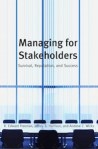 A couple of years ago, the editors of Business Ethics Quarterly asked me to write a feature-length review of Managing for Stakeholders: Survival, Reputation, Success (2007), by R. Edward Freeman, Jeffrey S. Harrison, and Andrew C. Wicks. It was a daunting task. The book was a highly anticipated one — the lead author of the book, Ed Freeman, is the man who imported the term “stakeholder” into the world of business ethics back in 1984, in his much-cited (and recently re-issued) book Strategic Management: A Stakeholder Approach. Further, Managing for Stakeholders is a book aimed specifically at a non-academic audience, and yet I was being hasked to review it for a scholarly journal. The 4500-word result appeared in the October, 2009 issue of BEQ (Vol. 19, No. 4).
For anyone unfamiliar with the term, a stakeholder in a company is roughly any person or group that can affect, or be affected by, that company’s operations. It’s a useful concept, though its real contribution to business ethics is up for debate. Freeman’s key insight, nearly 30 years ago, was that business managers have obligations to a range of stakeholders (rather than just to shareholders), and that hence the manager’s job is to balance the interests of various stakeholders. But identifying someone as a stakeholder just means, ethically, that they matter — somehow. That still leaves unanswered a whole range of harder questions about how to balance the interests of various stakeholder groups when those interests conflict.
So, here’s a brief summary of my review of Managing for Stakeholders:
On the plus side:
1) The book’s authors express their intention to tell “a new narrative” about business, one according to which a manager’s legitimate social role goes beyond short-term profit-making. They’re right. We desperately need such a narrative.
2) The authors of Managing for Stakeholders aim their message directly at managers, rather than at other scholars, and they try hard to make it a narrative that managers, themselves, can take up and consider their own. In other words, their book isn’t just about managers, it is for managers.
3) The book wisely encourages managers to seek out what might colloquially be referred to as “win-win” solutions. Creating value for all, when possible, is both wise and ethically good.
On the minus side:
1) The authors of Managing for Stakeholders portray, as the “standard” view to which their view is intended to be an alternative, a view of managerial capitalism that I doubt anyone actually holds. According to them, the “standard” view (held by managers and scholars) is that the goal of capitalism is only to generate value for shareholders, and that other stakeholders need not even be considered. This is of course false.
2) The authors of Managing for Stakeholders try very hard to deny that there is any real conflict between the interests of different stakeholders. They’re right to point out that commerce is a cooperative game from which all voluntary participants ought to benefit; what’s in the interest of one stakeholder needn’t automatically be against the interests of another. But that’s not to say that there’s never any conflict at all.
3) Managing for Stakeholders also seems to assume that the mindset of managers is all that matters — it contains no discussion of corporate culture, and no discussion of the requirements of good corporate governance or the dictates of corporate law.
4) The authors slide from the very reasonable claim that managers ought to manage stakeholder relationships to the the much-less-plausible claim that managers ought to manage the corporation for stakeholders. The latter claim is one that many others believe, but it needs support, and it certainly shouldn’t be confused with the former claim.
5) The book also make a faulty leap of logic in jumping from the very sane claim that business is in some sense about creating value for all to the much-less reasonable claim that it is the role of individual managers to ensure value for all concerned. The latter claim puts a lot of pressure on the very managers these authors seek to help, as well as implying what is likely a violation of employment contracts and committing the fallacy of division.
But the biggest problem with Managing for Stakeholders, I argue in my review, was that it was unlikely to serve well its intended audience, namely managers. For example, the authors of the book steadfastly refuse to cite any social science (including economic) literature to back up their many empirical claims. This is surely a result of their well-intentioned populist approach, but the result is that many claims go unsupported, and managers who want to learn more are left with nowhere to turn. And by telling managers that a “simple” change of mind-set is all that is needed, the book fails to make good on the now decades-old promise to turn the term “stakeholder” from a mere category word into a useful tool for ethical decision-making.


 The Business Ethics Blog