Highest Standards Aren’t Always Best in Ethics
Filed under: accountability, character, conflict of interest, decision-making, ethics, government, regulations, standards, trust, values |
 Leave a Comment
 No one wants low ethical standards, but it’s also a mistake to aim at the highest possible standards — at least it can be, depending on what you mean by “highest.”
See, for example, this useful piece on defence contractors, by Noah Shachtman for Wired: Pentagon Probe Will Review Every Darpa Contract
Since Regina Dugan became the director of Darpa [Defense Advanced Research Projects Agency], the Pentagon’s top research division has signed millions of dollars’ worth of contracts with her family firm, which in turn owes her at least a quarter-million dollars. It’s an arrangement that has raised eyebrows in the research community, and has now drawn the attention of the Defense Department’s internal auditors and investigators…
The story usefully points out that aiming for the highest possible standards of integrity can also cause trouble:
[A former director’s] bright ethical guidelines had unintended consequences. If a company allowed an employee to take a sabbatical to join Darpa, the firm was essentially blocking itself from millions of dollars in agency research projects.
The result, of course, is that under the old rules the agency risked cutting off useful sources of expertise. That’s not to say that the old rules were worse. It’s just to point out that there’s a legitimate trade-off here.
There’s a very general lesson to be drawn from this. When thinking about ethics, the goal isn’t always to be squeaky-clean. The goal is to find standards that are high enough to merit the trust of relevant stakeholders, and to do so without sacrificing other, possibly-equally important, values.
Consider this graphic, which illustrates the challenge of choosing experts to make decisions. On one hand, we want people with real expertise. On the other hand, we want to avoid conflict of interest. That is, we want maximum expertise and minimal risk of bias. So the upper-left quadrant of this graphic is the sweet spot:
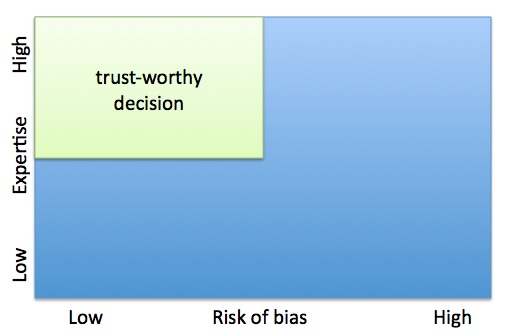
Note that what we’re looking for here is not the “highest possible” standard of integrity (i.e., the standard that implies the lowest possible risk of bias among decision-makers), but a system that makes the optimal tradeoff between risk of bias, on one hand, and relevant expertise, on the other. The point here is not that we’re trading off ethics and expediency. The point is that we’re trading off competing, ethically-significant values.
The point in thinking about ethics is not to aim at the highest standards, but at the best standards. We do enormous damage both to the functioning of organizations and to people’s willingness to talk openly about ethics when we talk about “high standards” in a way that comes off as unthinkingly pious.
Academic Business Ethics and the Corporation as Political Actor
Filed under: corporate citizenship, corporations, CSR, ethics, governance, government, law, personhood, politics, regulations, rights |
Comments (1) I’m returning home today after spending the weekend at the Annual Meeting of the Society for Business Ethics, the world’s foremost association for academics engaged in the study and teaching of issues related to business ethics, corporate social responsibility, and so on. (It was a fantastic meeting and anyone with a professional interest in these issues should consider joining SBE.)
One of the dominant themes of this year’s meeting was the role of the corporation in the political realm. It’s an old topic, one revitalized by the US Supreme Court’s decision last year in the Citizens United case. Corporate involvement in the political sphere takes many forms (from lobbying to campaign donations to participation in collaborative approaches to regulation). Such involvement is probably inevitable, but definitely controversial, and so there’s lots to sort out regarding how we should understand corporations in the political realm, and what rights and responsibilities they should have in that world. Among several dozen scholars presenting their research at the SBE meeting, a striking proportion of them presented work related to this set of topics.
David Ronnegard and Craig Smith, for example, presented work that elucidated the connection between competing theories of business ethics, on one hand, and competing theories from political philosophy, on the other.
Anselm Schneider and Andreas Scherer presented their work on the changes in corporate governance necessitated by (what I would call) the quasi-governmental responsibilities that corporations sometimes take on in the international sphere.
Pierre-Yves Néron presented work arguing that the way we think of corporations in the public sphere ought to be strongly influenced by thinking about the kinds of corporate behaviours (including regulatory lobbying, for example) that can either improve or frustrate market efficiency.
Waheed Hussain presented his work on what it might look like to “civilize” the corporation to make its participation in the political realm less worrisome — essentially, by fostering among corporations a “public interest” ethos, and insisting that lobbying etc be framed in terms of the public good.
Wayne Norman encouraged his fellow business ethicists to pay more attention to regulation, rather than focusing (as the typically do) on the corporate ethical obligations that go “beyond mere compliance”.
I myself presented some of my current thinking on the various ways we might think of corporations in their interactions with government. In particular, I argued that while, in some cases, it makes sense to conceptualize the corporation as an agent in its own right, there are other cases (perhaps many more cases) in which it makes sense to think of the corporation as a tool or technology used by citizens to advance their goals. (This is something I’ve touched on before, informally, in a blog entry.)
Although I don’t want to speak for my colleagues, it seems safe to say that the scholars whose work is noted above share an interest in better understanding what it means, and what it should mean, for corporations to be political agents. They are part of a trend — I don’t yet want to say movement — that sees scholars attempting to take seriously the complexity of the practical and philosophical problems raised by having limited-liability, joint-stock corporations participate in a realm that is generally thought of as being rightfully the place of flesh-and-blood citizens.
Deaf Nudists, Rights, and the Responsibilities of Business
Filed under: corporate citizenship, discrimination, law, rights, values |
Leave a Comment Here’s another “tempest in a teapot” story with much larger implications.
By Daniel Wiessner, for Reuters: Deaf man complains nudists would not provide interpreter
A deaf man has accused a nudist park in upstate New York of violating federal law by refusing to provide him with a sign-language interpreter at an annual festival.
Tom Willard, 53, of Rochester, filed a complaint with the U.S. Justice Department claiming Empire Haven Nudist Park violated the Americans with Disabilities Act (ADA) by refusing his requests for an interpreter.
“I am fed up with being turned away every time I try to do something, by idiots who somehow feel the ADA does not apply to them,” Willard wrote in the complaint….
Now it’s true that the ADA‘s “Public Accommodations” does require businesses and nonprofits to take reasonable steps to reduce barriers for the disabled. But according to this page explaining the application of the ADA, Willard is probably out of luck, legally speaking:
Q. Will a bookstore be required to maintain a sign language interpreter on its staff in order to communicate with deaf customers?
A. No, not if employees communicate by pen and notepad when necessary.
In other words, a business doesn’t have to provide a customer’s chosen accommodation, as long as they do something to achieve a fair outcome. (If someone reading this understands the application of the ADA better, please comment!) At a bookstore, you don’t need a translator as long as you’ve got a pen and paper. The same would pretty clearly apply at a nudist park.
Now all that is about the law, not about ethics per se. Ethics and the law are two different things, and that goes for the legal and ethical responsibilities of business, too. But that doesn’t mean that legal issues are “merely” legal issues. The legislation with regard to how businesses need to accomodate disabilities is right there, in black and white. But such legislation is must be interpreted, and interpretation inevitably involves the application of ethical principles, and the relevant ethical principles here include not just the principle that we ought to do more to lower barriers, but also a principle of reasonableness that says that the needs of the disabled have to be balanced against the legitimate interests of businesses and other organizations (and of their other stakeholders). Judges and juries end up having to apply such principles, among others, when discrimination cases reach court. In the 99.999% of cases that never end up near a courtroom, it’s up to businesses — and the people who work for them — to do their best to apply those principles too.
Topless in Not-Quite-“Public”
According to a CBC story, a Toronto woman was chastised by security guards after taking her shirt off (leaving only her rather modest black bra) at Toronto’s Festival of Beer.
Here’s the story: Toronto woman told to put her top on
…Jeanette Martin was at the annual Toronto beer gathering on Sunday when she took up a dare from one of her friends and took off her shirt. She was wearing a bra but apparently that wasn’t enough for organizers.
“Within 10 seconds flat I had a security guard telling me to put my top back on or else I’d be escorted out of the grounds,” Martin told CBC News….
The CBC story rightly points out that, 20 years ago, a young Canadian woman named Gwen Jacobs fought and won a legal battle for the right to go topless — entirely topless — in public.
What the CBC story misses, however, is that the Festival of Beer is not a public place. It’s a business venue. As we all know, there are plenty of business establishments with a policy: “No shirt, no shoes …no service!” The basic ethical principle here is that private establishments get to make their own rules about the tone they want to set.
In fact, the Beer Festival’s rules aren’t limited to proper attire. According to the Festival’s FAQ, there are plenty of rules, including for example:
What can’t I bring with me?
No pets
No children
No opened water
No food
No chairs
No coolers
No large video cameras
No cameras other than for personal use
Of course, these rules aren’t all about attire, but you see the point. A private business gets to set rules, including ones that set the tone for their events, and attire is a significant part of that. Bars and nightclubs in particular very often have dress codes — many forbid ripped jeans, for example, or require that men wear shirts with collars. (For interesting reading, see the rules for attire for customers of Harrod’s department store.) Now pointing out that companies generally have the right to make their own rules for decorum doesn’t mean that there are not ethical limits on such rules. It’s not hard to imagine truly morally obnoxious rules they could impose. For example, if a company imposed Victorian standards on women but put no limits at all on what men could wear, that would be unfairly discriminatory. But requiring shirts is far from that.
Unfortunately, while the Beer Festival’s organizers may have been within their rights to establish rules of decorum for their event, the reasons offered by the event’s organizers were weak ones. According to the CBC,
Martin was told that she would attract unwanted attention from men and her safety was at risk.
As Martin herself suggested (along with many who posted comments on the story), if men are behaving badly, then security should deal with them, rather than blaming Martin.
——–
Update (Aug. 12): I’ve learned through other news outlets that Martin says there were women wearing bikini tops at the Beer Fest on the day in question. That makes Security’s objections harder to understand. A business is still within its rights, but the distinction between a bra and a bikini top is, well, skimpy.
The “BlackBerry Riots” — What Should RIM Do?
Filed under: activism, corporate citizenship, CSR, privacy, protest, technology |
Comments (3) The intersection of social media with social unrest is a massive topic these days. Twitter has been credited with playing an important role in coordinating the pro-democracy protests in Egypt, and Facebook played a role in helping police track down culprits after the Vancouver hockey riots.
But the mostly-unstated truth behind these “technologies of the people” is that they are corporate technologies, ones developed, fostered, and controlled by companies. That means power for those companies. And, as the saying goes, with great power comes great responsibility.
Fast-forward to early August 2011. London is burning, and the riots have spread to a couple other major UK cities. The British government has called in a few thousand extra cops. And again, social media is playing a role. But this time the focus is specifically on Research in Motion’s (RIM’s) BlackBerry, and its use as a social networking tool. There have been all kinds of reports that the BlackBerry’s “BBM” messaging has been the tool of choice for coordination among London’s rioters. RIM is probably asking itself right now whether it’s really true that ‘there’s no such thing as bad publicity.’
Distancing itself from its role in the “BlackBerry Riots,” RIM issued (via Twitter) the following:
We feel for those impacted by the riots in London. We have engaged with the authorities to assist in any way we can.
The “in any way we can” part is intriguing. So, what can, and what should, RIM do? One thing they can do is to help authorities identify those inciting violence by breaking through the security of the BBM messages. But as reported here, “RIM refused to say exactly how much information it would be sharing with police.” The other, much more dramatic, thing that RIM could do would be to temporarily shut down all or part of its network. Whether that would be at all useful is open to question. It would certainly make a lot of people angry, including millions of people who are not involved in the riots, or who are relying on their BlackBerries to keep in touch with loved ones during this crisis. But I point out this option just to illustrate the breadth of options open to RIM.
The question is complicated by questions of precedence. Tech companies have come under fire for assisting governments in, for example, China, to crack down on dissidents. Of course, the UK government isn’t anything like China’s repressive regime. But at least some people are pointing to underlying social unrest, unemployment etc., in the UK as part of the reason — if not justification — for the riots. And besides, even if it’s clear that the UK riots are unjustifiable and that the UK government is a decent one, companies like RIM are global companies, engaged in a whole spectrum of social and political settings, ones that will stubbornly refuse to be categorized. Should a tech company help a repressive regime stifle peaceful protest? No. Should a tech company help a good and just government fight crime? Yes. But with regard to governments, as with regard to social unrest, there’s much more grey in the world than black and white.
Two Problems With CSR
There’s plenty of confusion about what CSR is. Indeed most of the definitions you’ll find online don’t even read like definitions. They’ll tell you what CSR (Corporate Social Responsibility) is “about,” or what it “relates to,” but they won’t tell you what it is. Any definition worth its salt ought to take the words in the term seriously, and note that the term “CSR” refers to some kind of responsibility, and then explain just what kind of responsibility it is. But good luck finding such a definition. And this failure of definition isn’t just a matter of semantics. It’s critically important, because a sloppy understanding of the term gives the appearance of unifying under a single banner people who actually hold vastly different views of what a corporation’s responsibilities are.
Various definitions out there seem to coalesce around the idea that business should be “giving back” to the community — and typically not via antiquated methods like corporate philanthropy. The goal, generally, is to make sure that a company’s net impact on society is positive. Let’s take that as our point of departure.
The following two problems form the Scylla and Charybdis of CSR. If you avoid one, you run right into the other. Both spell doom.
Problem #1: CSR is too easy, if taken literally. If all that’s at stake is making sure your net impact is positive, wow, that’s pretty easy: just sell a decent product that people want, and don’t hurt any bystanders. It’s a fundamental principle of commerce. Start with individual transactions. Those, if voluntary and well-informed, always have a positive impact. A customer gives you $1.00, and you give them a pound of bananas. They’re happy, and you’re happy. Don’t step on any bystanders’ toes, and there you go: positive net impact. In fact, as long as your customers are happy enough, you can afford to hurt people along the way (e.g., by mistreating employee) and your net impact will still be positive. (And of course, claiming to adhere to CSR is even easier if you use a mushier definition, one that only asks that you “manage” your social impact, rather than aiming at any particular objective.)
Problem #2: On the other hand, CSR is unfairly burdensome, if really taken to heart — that is, if you really think that the pursuit of social contribution ought to take over a manager’s entire way of thinking. It means that a company that makes a good product, treats employees well, deals fairly with suppliers, etc., still has to ask itself, “yes, but how are we giving back to the community?” Look in the mirror. What’s your net impact on society? What good are you — other than the fact that you put in an honest day’s work, take care of your kids, and given a few bucks to charity now and then? (Hint: that’s a rhetorical question.) The joint-stock corporation, on the other hand, is arguably one of the most welfare-enhancing inventions of all time. For such organizations, failure to have a positive impact is the exception, rather than the rule. Asking one to risk its productivity by obsessing over something it’s already doing is silly.
Now, there’s absolutely nothing wrong with the idea that companies are responsible for their behaviour (and that the individuals who work for companies are responsible for their behaviour, too). And for some people, that’s all that CSR means. That’s just fine. In fact, such responsibility is absolutely morally fundamental. Companies should try to make an honest living, just like individuals like you do. They should avoid hurting people, just like you do. They should clean up their messes, just like you do. That’s basic ethics. And if they’re doing those things, calling it something as mushy as “CSR” adds absolutely nothing to the equation.
Are they Competing, or Just Trying to Sell You Something?
Filed under: competition, complexity, corporate citizenship, CSR, definitions, sustainability, values |
Comments (2) Peaceful coexistence isn’t always a good thing. In the marketplace, competition is what drives different producers of a good to improve their wares, and having one producer explain the superiority of his or her product is — embellishment and puffery aside — how consumers learn to differentiate among products. When different suppliers fail to engage in competition, the consumer is left in the dark. Let me give you two examples.
Here’s the first example. One of the problems — or rather, one of the warning signs — about so-called “alternative” medicine is that there are dozens of different kinds of alt-med, all making different and presumably conflicting assumptions about how the human body works, and yet they all get along cozily together. Nowhere do you find homeopaths, for example, explaining why their methods are superior to those of acupuncturists. Nor do you find Reiki therapists dissing Ayurveda. Crystal therapy gurus are unlikely to tell you about the problems with Traditional Chinese Medicine. And so on. As Robert Park wrote with reference to alt-med, in his book, Voodoo Science (p. 65), “there is no internal dissent in a community that feels itself besieged from the outside.” Of course, the existence of different alt-med treatments isn’t in itself surprising or problematic. Mainstream medicine too uses different treatments for different illnesses. But the different treatments offered by mainstream medicine are all, without exception, underpinned by a single coherent body of theory: the heart circulates blood, germs cause infection, physiological effect varies according to drug dosage, and so on.
So the fact that various systems of alternative therapy, underpinned by very different understandings of the human body (and indeed of metaphysics), can get along so chummily is a huge red flag. It suggests that purveyors of alt-med either a) aren’t thinking critically, or b) are more interested in sales than in healing.
Roughly the same concern arises with regard to different perspectives on how businesses should behave. Some will tell you that the obligations of business are all rooted in the notion of sustainability, with its indelible environmental overtones. Others will say no, it’s a matter of CSR — Corporate Social Responsibility. Still others say it’s all about values. Or leadership. Or citizenship. Or the (ug!) Triple Bottom Line. And each of those seems, at least, to be underpinned by a different understanding of the nature of the firm, its role in society, and what it is that makes an action right or wrong. And yet all kinds of folks seem to want to cleave to all of the above, or to glom onto one of them seemingly at random, as if it doesn’t matter which one you choose.
Again, this should be a big red flag.
I’m sure I’m going to be told that these different schools of thought don’t need to compete with each other — what’s really important, they’ll say, is that, you know, we focus on fixing the way business is done. But again, as with the case of alternative medicines, if someone tries to sell you some and isn’t willing to even try to explain why theirs is better than the other stuff, you should at least wonder whether they aren’t thinking critically, or are merely trying to sell you something.
Should Twitter Censor?
Filed under: accountability, corporate citizenship, CSR, internet, protest, standards, technology, values |
Comments (2) Last weekend, a despicable “hashtag” trended* on Twitter, one promoting the idea that violence against women is OK. By Sunday morning, tweets using that hashtag were mostly critical ones, expressing outrage at any non-critical use of the hashtag. One prominent twitterer, Peter Daou, (@peterdaou) asked why Twitter wasn’t preventing that hashtag from trending. He tweeted:
“Unbelievable: Is Twitter REALLY allowing #reasonstobeatyourgirlfriend to be a trending topic??!”
The outrage expressed by Daou and others is entirely appropriate. The hashtag in question is utterly contemptible. But the question of whether Twitter should censor it and prevent it from trending is another question altogether.
The central argument in favour of censorship is that the idea being broadcast is an evil one, and decision-makers at Twitter are in a clear position to stifle the spread of that evil idea, or instead to allow its proliferation. With great power comes great responsibility.
The most obvious reason against censorship is freedom of speech, combined with the slippery slope argument: if Twitter is going to start censoring ideas, where will it end? Freedom of speech is an important right, and that right includes the right to speak immoral ideas. Limits should only be imposed with great caution.
Now, it’s worth noting that the hashtag trending isn’t actually anyone’s speech: it’s the aggregate result of thousands of individual decisions to tweet using that hashtag. So if Twitter were, hypothetically, to censor the results of their trending-detection algorithm, they wouldn’t actually be censoring anyone, just preventing the automated publicizing of a statistic. But perhaps that’s a philosophical nicety, one obscuring the basic point that there is danger anytime the powerful act to prevent a message from being heard.
More importantly, perhaps, Twitter isn’t a government, it’s a company, and it doesn’t owe anyone the use of its technology to broadcast stupid ideas (or any other ideas, for that matter). We insist that governments carefully avoid censorship because governments are powerful and because for all intents and purposes we cannot opt out of their services as a whole. If a company doesn’t want to broadcast your idea, it’s not morally required to. Your local paper, for instance, isn’t obligated to publish your Letter to the Editor. The right to free speech isn’t the right to be handed a megaphone.
But then the challenging question arises: is Twitter a tool or a social institution? Just how much like a government is Twitter, in the relevant sense? It is, after all, in control of what many of us regard as a kind of critical infrastructure. This is a challenge faced by many ubiquitous info-tech companies, including Twitter, Facebook and Google. While their services are, in principle, strictly optional — no one is forced to use them — for many of us going without them is very nearly unthinkable. We are not just users of Twitter, but citizens. That perspective doesn’t tell us whether it’s OK for Twitter to engage in censorship, but it does put a different spin on the question.
—–
*The fact that it was “trending” on Twitter means that Twitter’s algorithm had identified it as, roughly, a “novel and popular” topic in recent tweets. Trending topics are featured prominently on Twitter’s main page.
Surfing Porn at Work
Filed under: employees, internet, privacy, productivity, scandal, sex |
Comments (4) As someone once said, ‘let he among you who has a free hand cast the first stone.’
Canadian Business recently reported that the head of Houston’s public transit agency has been suspended (for a week) for using the agency’s internet connection to look at porn.
This sort of conflict is likely to become increasingly common, since the only thing more ubiquitous in office settings than boredom are high-quality internet connections. And I suspect that under-prepared employers are likely to continue overreact, for no particularly good reason.
It seems to me that the point here should not be about porn; the point should be whether personal web-surfing at the office is allowed at all. There’s all kinds of deviant, transgressive, and socially controversial stuff on the web. Porn, per se, is far from the worst. So surfing the web for non-business purposes should either be allowed, or not. Either could well be a reasonable policy. A company can reasonably forbid use of company internet for personal purposes, just as most forbid use of corporate stationary or corporate premises by employees who are moonlighting. On the other hand, a company might reasonably allow a certain amount of personal usage as akin to making the occasional personal call on a company phone. But if employees are not allowed to use company internet for personal (including entertainment) purposes, that should be a clearly-stated policy.
There are of course a couple of circumstances in which an employer would have a legitimate interest in limiting the kind of stuff employees access online. One is size. If the employee is downloading large porn files (say, entire movies), that kind of thing could have an impact on the firm’s bandwidth usage, something that could cost money or just slow down internet access for employees engaged in legitimate work. Of course, the same would go for employees downloading the latest episode of Breaking Bad on iTunes. The second circumstance would be if there is a chance that the download would be visible and reflect badly on the company. If for some reason the fact that you’re surfing porn at work is liable to come to the attention of people outside the company, then, reactions to porn being as variable as they are, you should avoid drawing potentially unwanted attention to your company that way.
But in general, at least, the fact that it’s porn you’re looking at on your break, behind a closed office door, shouldn’t much matter to your employer.
None of this is to say, of course, that surfing porn at work is a good idea. It’s generally pretty dumb, especially if there’s any chance at all that co-workers are going to see and be offended. After all, we’re talking about the office, not your own living room. And so while employers have reason to allow their employees a certain amount of latitude, employees have reason to exercise a certain amount of discretion.
Yes, there is such a thing as business ethics
Filed under: accountability, blogs, character, codes of ethics, corporations, critical thinking, definitions, ethics, values |
Comments (10) Marketing guru (blogger, author, etc.) Seth Godin posted a provocative blog entry called, “No such thing as business ethics”, in which he worries that the focus on “business ethics and corporate social responsibility” is distracting us from questions of personal responsibility:
It comes down to this: only people can have ethics. Ethics, as in, doing the right thing for the community even though it might not benefit you or your company financially….
Now I could quibble with Godin’s definition of ethics, which is actually a particular controversial view about what ethics requires, rather than a definition. But instead I’m going to take issue with Godin’s claim that all that matters in business is personal ethics, rather than organizational ethics. Godin writes:
I worry that we absolve ourselves of responsibility when we talk about business ethics and corporate social responsibility. Corporations are collections of people, and we ought to insist that those people (that would be us) do the right thing. Business is too powerful for us to leave our humanity at the door of the office. It’s not business, it’s personal.
Godin’s claim that “it’s not business, it’s personal” is problematic in two ways. First, it wrongly implies that business ethics somehow misses out on the whole personal integrity thing. That’s entirely false. Both the academic literature on business ethics and the “ethics and values” programs set up by individual companies put a lot of emphasis on individuals adopting the right values and making good decisions. Secondly, contrary to what Godin implies, individual ethics clearly is not enough. For one thing, people embedded in organizations have obligations that are role-specific. Just as lawyers and doctors have special duties that go along with their roles — they have to follow not just their own consciences, but also highly specific professional codes — so do people in the world of business. And for another thing, organizations can be set up badly such that all kinds of “good” individual decisions can still lead to problematic outcomes. The ethics of the organization, per se, matters a lot.
Interestingly, Godin tells us that he learned about all this from his dad. Unfortunately, while the homely lessons we learned at our parents’ knees tend to give us a good start in life, complex institutional settings tend to bring more complex duties, and hence require more complex principles.



 The Business Ethics Blog