Author Archive
Is a Board Position a Conflict of Interest?
Filed under: accountability, boards, conflict of interest, corporations, employees, governance, professionalism |
 Comments (2)
 Here’s an story (in which I was quoted) by Paul Turenne, in the Winnipeg Sun: Gerrard slams WRHA manager’s ‘moonlighting’.
The story is basically about a senior executive (Brock Wright) at the Winnipeg Regional Health Authority (the public body responsible for administering hospitals in and around that city) who took a position on the Board of Directors of a small American medical technology company. Critics (like Opposition leader Gerard, named in the headline) called that a Conflict of Interest.
Now, a conflict of interest is basically any situation in which a person has a private or personal interest sufficient to appear to influence the objective exercise of judgment in his or her official duties.
So, to figure out whether there’s a problem here, a few elements need to be considered.
1) Does taking a Board position constitute an “personal interest” in the relevant sense? The one that’s usually (but not always) at stake is an interest in money. Well, And corporate board membership isn’t typically volunteer work. It involves a significant stipend, along with a good deal of personal prestige.
2) What bits of judgment might Wright need to exercise on behalf of WRHA that might be jeopardized by his board membership? The most obvious one is his involvement in purchasing decisions for the WRHA. In that regard, a spokesperson for the WRHA says:
This is a company the WRHA has no business relationship with. We have not purchased anything from them. If at any time they were to try to sell us something, Dr. Wright would of course remind us of his relationship with them and recuse himself from any discussions. Having said that, he’s not in a position to make decisions like that. We have a very strict policy about the tendering process
The bigger issue (though perhaps not insurmountable) is the judgment that Wright (or any employee) needs to exercise with regard to his own time management. Being a member of a corporate board isn’t an honourary thing: it comes with real responsibilities, and can take considerable time. So the question I would want to ask, if I where the WRHA, is how Wright plans to satisfy his duties as a member of the TearLab board (including possibly several trips a year to attend meetings in California) without diminishing the quality of his work in Winnipeg. If there’s reasonable plan to make that happen,
3) Finally, it’s worth noting (again and again) that being in a Conflict of Interest isn’t automatically unethical. (So it’s not, contrary to the headline used in another newspaper’s story about this issue, an accusation.) It is possible to end up in a Conflict of Interest through no fault of your own. And, finding yourself in a COI, what matters is what you do about it. Disclosing the COI to the person or organization relying on your judgment is usually considered step 1, and removing yourself from key decisions, if possible, is another standard move. But COI is at least sometimes worth tolerating, if managed appropriately. That does mean, though, that we should all be expected to think carefully, before putting ourselves into a Conflict of Interest, whether the risks are manageable, and whether in the end those risks are sufficient to constitute a disservice to those who rely upon our judgment.
Corporate Governance and Ethics
Filed under: accountability, boards, corporations, CSR, governance, shareholders |
Comments (10)  “Corporate governance” is the term used to refer to the policies and processes by which a corporation (or other large, complex institution) is controlled and directed. It refers especially to the way power and accountability flow between shareholders, boards of directors, CEOs, and senior managers.
For most corporations, the basic governance structure is this: shareholders vote for, and hence empower, a board of directors, who then have a fiduciary responsibility to look out for shareholders’ interests. The board hires a CEO, who is accountable to the board. The CEO (sometimes with input from the board) hires a management team, and so on. At each step, there is a flow of power down the chain (from shareholders through to front-line employees), and a flow of accountability back up that chain. And there are all sorts of rules — including various policies and principles of good governance — that establish how that power and accountability is to be implemented. There will be internal rules, for example (partly determined by relevant corporate law), about how board elections are to be carried out. There are also governance principles that apply to things like the inclusion of external, “independent” directors on the board.
In case it’s not obvious, I’ll say it explicitly: corporate governance is out-and-out a matter of ethics. It is about who is responsible to whom, and for what, and under what conditions.
Now, to an investor, governance might look first and foremost like a matter of economics: no one particularly wants to invest in a poorly-governed company. And governance is also legal matter (for example, the Sarbanes-Oxley Act of 2002 includes a number of requirements about corporate governance). Governance is properly a legal matter because (at least arguably) shareholders need protection from unscrupulous or merely lazy boards of directors and executives, and because the public interest is at stake when large companies are mis-governed. Enron used to be the prime example of poor governance practices having a devastating effect on shareholders and the broader public. These days we could probably look to a few major financial institutions for object lessons in the ill effects of bad governance.
But even where the law is silent, governance remains important: regardless of whether you think in terms of a narrow, shareholder-driven, profits-first perspective, or instead in terms of a broader ‘stakeholder’ approach, you simply have to agree that the way decisions get made, and the interests that corporate policies tell decision-makers to serve, are ethically important matters.
My mind is on governance a lot lately, not least because I’m currently a Visiting Scholar at the Clarkson Centre for Business Ethics and Board Effectiveness (at the University of Toronto’s Rotman School of Management).
While I’m at Clarkson, I’m helping out with the CCBE blog. The blog is focused primarily on governance and board effectiveness, but in most cases the ethical implications of those issues are pretty clear. Today, for instance, the blog features a posting about changes in the way boards of directors are elected — and how at last some companies (including one Canadian company, Linamar Corp.) have been slow to catch on. Here’s the blog entry: Trend Watch: How are Directors Elected?
See also: the entry on Corporate Governance in the Concise Encyclopedia of Business Ethics.
- What Directors Need to Know: Corporate Governance, by Carol Hansell (the focus of this book is on Canada, but much of it is generally applicable)
- Harvard Business Review on Corporate Governance
Chevron Agrees
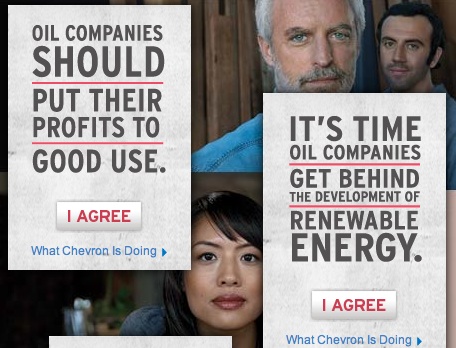 Chevron has just announced a new ad campaign to highlight the various ways in which the company and its critics actually agree on a number of ethically-important points. Things like:
- “Oil companies should put their profits to good use.”
- “It’s time oil companies get behind the development of renewable energy.”
- “Oil companies should support the communities they’re a part of.”
- etc.
Here’s the press release announcing the new campaign: Chevron Launches New Global Advertising Campaign: ‘We Agree’. There’s also a YouTube channel where you can see the TV ads.
Many people will detect a whiff of greenwashing, here. And you don’t have to be much of a cynic to be somewhat skeptical. Back in 2001, another oil company, British Petroleum, claimed to be turning over a new leaf when it branded itself as just BP, which it suggested stood for “Beyond Petroleum.” We all know how that turned out.
The We Agree website of course features all kinds of nifty-sounding illustrations of Chevron’s commitment to being socially responsible. It’s mostly the usual kinds of stuff. But what’s interesting here, philosophically, is the attempt to point to the underlying agreement on values. And (this campaign aside) I do think it’s important for people on different sides of any given debate to understand just how much they probably do agree on, at the level of basic values. Now, if we could just agree on how those shared values ought to be implemented, we would really be getting somewhere.
—–
(Note: as I blogged last night, this Chevron campaign got spoofed by pranksters who issued their own version of the Chevron press-release, pointing to a very-convincing-but-fake campaign website. I was temporarily fooled, myself. You can find out about the spoof via the NYT‘s Media Decoder blog: Pranksters Lampoon Chevron Ad Campaign.)
Spoof Chevron Ad Campaign: Too Dumb to be True
Filed under: activism, advertising, corporations, CSR, energy, protest |
Comments (2)  I should have known.
Earlier this evening, I briefly posted a blog entry about a too-dumb-to-be-true ad campaign, supposedly by Chevron. The spoof ad campaign made Chevron look very dumb. And say what you will about the oil giant: it ain’t dumb.
I won’t say who is (apparently) behind the spoof, because a) that’s exactly the kind of publicity this stunt was intended to generate, and b) from what I can tell (from this and previous stunds) this gang is only good at media manipulation, and does nothing to promote smart solutions.
Tomorrow, I’ll post about the real Chevron ad campaign. (And yes, the image above is real, from the Chevron “We Agree” website.)
Ethics and Economics (And Coffee Too)
A bit of economics can go a long ways in helping understand a range of issues in business ethics. I’m not an economist myself, but I’ve read a fair bit of economics here & there. And I want to read more. In order to arrive at sound ethical conclusions, you need more than just ethical beliefs: you need some understanding of how the world works. For many issues in business ethics, economics provides relevant facts.
For example, consider ethical issues related to price. Prices are clearly important to all of us: the price of a thing tells us how much we would have to pay to get it. But economists recognize that prices play two other very important social roles, roles that are important to the way the economy as a whole operates.
First, a price conveys information. When something is expensive, that tends to convey the fact that it is scarce — scarce enough that buyers are willing to pay a lot for it, and are perhaps even competing with each other and hence bidding up the price. Likewise, when something is cheap, that generally conveys the fact that it is plentiful. (Note that scarcity can be either natural, a straightforward matter of the amount of a thing in existence, or artificial, as when some person or company gains monopoly control over the supply of a thing.)
Second, a price provides motivation. People are generally (though unevenly) motivated by money, and by money-making and money-saving opportunities. (If you really don’t care about money, you should send me all of yours. Thanks.) Among those who want to buy a good, high prices tend to lower demand, and low prices tend to increase it. Price also affects suppliers. The fact that the price for a given good or service is high is going to tend to motivate people to want to get into that line of business. A low price is going to tend to deter people from making that their line of work.
Now, how does that understanding of the social role of prices affect a real-life issue in business ethics? Here’s a simple example of the social function of prices at work, and why economics matters for ethics. It’s an example I learned from the book, The Undercover Economist, written by economist Tim Harford.
Consider coffee. Coffee is a hugely important commodity — second only to oil on the world market. Most people know they now have the option of buying ‘fair trade’ coffee, the aim of which is to make sure that the people who grow coffee get a fair deal for what they produce. (October is “Fair Trade Month,” by the way.)
Hartord’s argument is this. Coffee farmers are poor, and will generally remain poor, because the thing they produce isn’t scarce. Coffee is relatively easy to grow, and can be grown in relatively many (hot) places. Buying fair trade coffee (at a premium price) means paying coffee farmers more. Now, recall what I said above about the role of prices in motivating people. Paying more for coffee is likely to draw more growers into the business. And drawing more growers into the business will increase the supply of coffee. And if you increase the supply of coffee, you inevitably depress its market price — and along with it the wages of those who labour on coffee plantations. So it’s hard to make coffee growers alone better off, until workers in other industries (like the garment industry) are well-enough off that they can’t be attracted into the coffee industry by (for example) fair-trade-driven higher wages. According to Harford (p. 229):
High coffee prices will always collapse, until workers in sweatshops become well-paid blue collar workers in skilled manufacturing jobs, who don’t find the idea of being even a prosperous coffee farmer attractive.
That makes it awfully hard, if not impossible, to boost net wages in the coffee industry, in the long run. Now, that by itself is nothing like a conclusive argument against fair trade coffee. But a sound understanding of the economic role of prices does give reason to pause before we accept the notion that we can make people better off simply by voluntarily paying more for a non-scarce commodity. (I’ve blogged before about other problems with the fair trade notion. See: What’s so Fair About Fairtrade?)
As I noted above, I’m not an economist — so if someone reading this can help by correcting anything I’ve written here, or add any further detail, I’d be grateful.
—-
Here are a few books about economics that I recommend (not all equally good, and I recommend them for different reasons). All of them are aimed at non-economists, and 2 of the 4 are even written by non-economists.
- Economics Without Illusions: Debunking the Myths of Modern Capitalism, by Joseph Heath
- The Undercover Economist, Tim Harford
- The Rational Optimist, by Matt Ridley
- Predictably Irrational: The Hidden Forces That Shape Our Decisions, by Dan Ariely
Ethical Issues for the Chilean Miners
Filed under: contract, disaster, employees, entrepreneur, sponsorship, workplace safety |
Comments (2) On August 5, 33 miners went down into the San José copper-gold mine; over two months later, 33 entrepreneurs emerged from the mine. They were labourers once. Now they’re businessmen, and celebrities.
Their fame is already being used by major corporations for public relations purposes. The New York Times reported, for instance, that Apple has sent each of the miners a brand new iPod.
But the miners themselves will have decisions to make, about how (and indeed whether) to make use of their new fame. Hollywood will surely come knocking, for instance. Book deals have already been announced. How will they (and how should they) handle fame and fortune? And the miners have already made a good start on their entrepreneurial careers. While still down in the mine, they drew up a contract “ensuring they will equally profit from the lucrative media deals they expect to secure for sharing the story of their two month survival in the hope that they never have to work again.”
But a question arises about such a contract. Is it, in fact, legally binding? To get an indication of why that’s a real question, see this piece by Andrew Potter: Chilean miners: That far down, who decides what’s law?
What is striking about the situation in Chile is how much it resembles one of the most famous thought experiments in the philosophy of law, known as “The Case of the Speluncean Explorers.” Written by the Harvard law professor Lon Fuller and published in 1949, the paper explores the fictional case of five men who embarked on the exploration of a system of caves in a country known as the Commonwealth of Newgarth. When a landslide covers the entrance and traps the men, they sit down to await rescue….
In Fuller’s thought experiment, the miners are eventually driven to cannibalism, in order to survive. Fuller’s article is about whether such cannibalism would rightly be considered illegal, under those circumstances. Fuller makes the case that it is (at very least) possible to argue that it would not be. Laws are social artefacts, and miners trapped underground for an extended period are effectively cut off from, and hence no longer part of, any particular society. Andrew notes:
…trapped miners are living in what amounts to a mini society of their own. All sorts of problems could arise in such a cramped space, from disputes over the allocation of food and medical supplies to rules over respect for privacy to procedures for dealing with crimes like theft or assault. If sovereignty is defined by the ability to exercise a monopoly over the use of force, then whatever legal authority currently exists in the San Jose mine, it is not the Chilean government.
Now, Andrew’s hypothetical is about the reach of Chilean criminal law. As it turns out (as far as we know) no significant violence erupted among the 33, so that question remains hypothetical. But, as I noted above, other kinds of legal questions arise, including the bindingness of the contract the men made while down there.
I won’t speculate further on the question of legality, but even if the legality of the contract were to be successfully challenged, the question of whether the contract is morally binding would remain a live one. After all, 33 men gave their word, and honourable men should want to keep their promise. On the other hand, if we consider the circumstances under which the contract was arrived at, we quickly see that those circumstances were very far from the ideal circumstances for giving free and informed consent. Many things can render a contract both legally and morally suspect, including such things as undue influence and duress. It’s easy to imagine that men trapped, in close quarters, half a mile underground being subject to both of those.
At any rate, my aim here is not to cast a pall over what seems, so far, to be a happy ending to the miners’ ordeal. My aim is simply to point out that, as newly-minted celebrity-entrepreneurs, “los 33” will face a range of ethical issues. What they have to learn, and what we have to learn from them, did not end when the last man finally saw the light of day.
Wall Street (1987) — “Greed is Good”
Filed under: boards, competition, corporations, finance, governance, management, pay, profits, shareholders, stakeholders |
Comments (13)  I just re-watched the original 1987 film, Wall Street. (The sequel, Wall Street: Money Never Sleeps, is in theatres now, and apparently doing very well.)
In the original Wall Street, Michael Douglas’s character, Gordon Gekko, is a corporate raider — essentially, he buys up underperforming companies, breaks them up and sells their parts at a healthy profit. What drives him? Greed, pure and simple. In one scene, Gekko appears at the annual shareholders’ meeting being held by Teldar Paper. Gekko owns shares, but wants more. He wants control of the company, though his motives for doing so are hidden. It is there that he delivers the speech that includes the movie’s most famous line. “Greed,” he tells the shareholders of Teldar, “is good.”
That line is the only thing a lot of people alive in the 80’s remember about Wall Street. And that’s a shame.
Here’s Gordon Gekko’s famous “Greed is good” speech, in its entirety:
Teldar Paper, Mr. Cromwell, Teldar Paper has 33 different vice presidents each earning over 200 thousand dollars a year. Now, I have spent the last two months analyzing what all these guys do, and I still can’t figure it out. One thing I do know is that our paper company lost 110 million dollars last year, and I’ll bet that half of that was spent in all the paperwork going back and forth between all these vice presidents. The new law of evolution in corporate America seems to be survival of the unfittest. Well, in my book you either do it right or you get eliminated. In the last seven deals that I’ve been involved with, there were 2.5 million stockholders who have made a pretax profit of 12 billion dollars. Thank you. I am not a destroyer of companies. I am a liberator of them! The point is, ladies and gentleman, that greed, for lack of a better word, is good. Greed is right, greed works. Greed clarifies, cuts through, and captures the essence of the evolutionary spirit. Greed, in all of its forms; greed for life, for money, for love, knowledge has marked the upward surge of mankind. And greed, you mark my words, will not only save Teldar Paper, but that other malfunctioning corporation called the USA. Thank you very much.
The first thing to note about this speech is how little of it is actually about greed — roughly the last third of the speech. The first two thirds is a critique (disingenuous, as it happens, but not therefore off-target) of the complacency of overpaid corporate executives. Gekko is advising Teldar’s shareholders that the people responsible for protecting their interests — Teldar’s executives and Board — have been doing a bad job.
How does that first part relate to the final third of the speech, the part about greed being good? Well, it’s worth noting that when Gekko first uses the word “greed,” he does so “for lack of a better word.” And Gekko, one-dimensional character that he is, probably does lack a better word for it. For him, it really is greed — the unseemly and excessive love of money. But Teldar’s shareholders don’t need personally to embrace greed in the Gordon Gekko sense. All they need to do is to see that their interests are not being served well, and to understand that Gekko’s own greed is likely to serve them better: he wants to make a killing on the Teldar deal, and if they let him do so, they’ll all make a little money themselves, along the way. His greed is good for them.
Is Gekko’s greed a good thing over all? Well, Gekko says nothing, in his speech, about the interests of other stakeholders in Teldar Paper, stakeholders such as the company’s employees for example. If Gekko breaks up the company, shareholders may benefit but employees will lose jobs. That’s a bad thing, but it’s also sometimes inevitable. Not all companies should stay in business.
No, greed is not good. But the point — the grain of truth in Gordon Gekko’s Machiavellian speech — is that if shareholders allow executives and Boards to operate inefficiently, rather than using what little power they have to improve their lot, then they are suckers, being taken for a ride. And there’s no particular virtue in that.
Chilean Miners: What is Rescue Worth?
Filed under: aid, CSR, disaster, employees, government, pricing, risk, workplace safety |
Comments (8)  Happily, rescue crews seem to have made better progress than anticipated toward rescuing 33 Chilean miners trapped deep underground since August.
Here’s a recent story giving details, by Alexei Barrionuevo and Christine Hauser writing for the NYT: Drill Reaches Miners in Chile, but Risks Remain
As the rescue proceeds, most of us will (rightly) be focused on the human side of this story, the ordeal those 33 men have gone through. But this story also has an important business- and economic component. Last month, I blogged about whether the trapped miners ought to be paid, and by whom. But another issue is that the rescue effort itself is likely to be exceptionally expensive. What should the companies doing the drilling be paid? Back in April, after a mine collapse in West Virginia, I blogged about the Ethical Obligation to Save Trapped Miners, and pondered the extent of the financial obligations of the mining company and the government in the face of such a disaster. Today, I’d like to look at the question from a different angle. How much should drilling companies involved in such a rescue be charging for their work?
Now, just to be clear, I’m not talking about the actual companies involved.
Brandon Fisher, founder & president of US-based Center Rock Inc., the company that made the drill used, is reported to have nobler motives:
He says the Chilean government is paying for his time and equipment — “that’s the plan anyway.” But he is not at the Mina San Jose for the money. He is there for the miners.
“I don’t know that there’s 10 minutes that you’re out here that you don’t look down there and think, ‘There’s 33 guys 600 feet below our feet,’ ” he said. “Whenever you’re tired, it’s real easy to think, ‘Hey, I’m out here seeing sunlight and breathing fresh air. It’s time to suck it up and get these guys out of here.’ ”
It’s also worth noting that, in fact, this is a competitive arena — there are apparently quite a few companies with relevant capacities, and they’re likely competing with each other to bid for the work. Perhaps they’re even charging less for this high-profile job than they normally would, because it’s good advertising. But let’s set that complication aside for the moment.
So, a thought experiment: what if there were only one company qualified to do the rescue work, or only one company available locally? What should that company charge?
A few quick options:
1. They should charge whatever the market will bear, which would essentially amount to charging the most the Chilean government and/or the mining company involved are willing to pay.
2. They should charge nothing. They should be happy to be involved, and to charge anything would be to put a price on human lives, which is unacceptably exploitative.
3. They should charge just enough to cover their own costs — machinery, fuel, and maybe their own workers’ wages.
4. They should charge exactly the same to drill this hole as they would to drill any other hole of similar size, depth, and complexity. No more (that would be exploitative), and no less (that would be foolish).
Do you favour one of those four? On what grounds? Or can you suggest another principled answer?
—–
Addendum: I found a story that offers the following relevant detail: “Local newspaper La Tercera reported that the rescue efforts, expected to last three to four months, will cost anywhere from $10 million to $20 million.”
Ethics & Foreclosures
Filed under: banking, consumers, finance, government, politics, risk |
Comments (7)  The number one business story of the week is surely the foreclosure story. A number of U.S. banks, including most notably Bank of America, have suspended mortgage foreclosures for the time being due to worries over flawed paperwork.
Here’s just one of many news items on the topic, by David Streitfeld and Nelson D. Schwartz writing for the NYT: Largest U.S. Bank Halts Foreclosures in All States
…Bank of America instituted a partial freeze last week in those 23 states, and three other major mortgage lenders have done the same. The bank’s decision on Friday increased pressure on other lenders to extend their moratoriums nationwide as well.
An immediate effect of the action will be a temporary stay of execution for hundreds of thousands of borrowers in default. The bank said it would be brief, a mere pause while it made sure its methods were in order….
As the NYT story points out, there is considerable pressure on lenders to put the brakes on. Members of Congress and various attorneys general are suggesting that it would be wise to do so.
A few quick points about ethics:
1) In case it’s not obvious, the freeze on foreclosures is an ethical issue, in addition to being a legal one. It involves shifting benefits, burdens, and risks among groups, including homeowners, banks’ shareholders, and taxpayers. (In this regard, it’s worth remembering that the banks are middlemen, essentially mediating a transaction between their shareholders, who have money to lend, and homeowners, who need to borrow. If there has indeed been any fraud or even lack of diligence on the part of the banks, it is an offence not just against homeowners, but against shareholders.)
2) Mortgages are not just like any other product. For starters, a home is by far the biggest purchase most of us will make in our lifetimes. Scale alone makes this an important issue. Further, home ownership is for most people laden with emotion. When foreclosures happen, people aren’t just losing a product; in most cases they lose a home. This is both morally significant, and accounts for at least some of the political attention being paid to the issue.
3) It’s not at all clear that a freeze on foreclosures is good for home-owners (or rather would-be home owners) over all. The ability to foreclose in the event of default is part of what makes it worthwhile for lenders to take a risk in lending money to buy a home in the first place. Also, foreclosures put houses on the market, helping to keep prices down. Fewer foreclosures may mean a rise in prices. (See CNN-Money: Foreclosure freeze shakes battered home market). Since ethics is, in part, about evaluating outcomes, recognizing the effects of the freeze on the full range of stakeholders is ethically important.
When Personal Problems Become Business Problems
Filed under: employees, management, privacy, shareholders, stakeholders |
Comments (3) 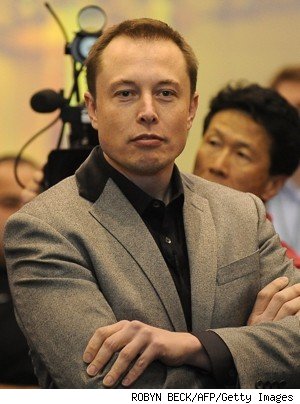 A divorce is a very private thing, except of course when it isn’t. And an employee’s (or executive’s) private struggles are, well, private — except when various kinds of business analysts start taking notice of those struggles.
Case in point: the bitter lawsuit over the terms of the difficult divorce of Elon Musk, one of the co-founders of PayPal and current CEO of Tesla Motors. For an outline of why the divorce resulted in a lawsuit, see this blog entry, by Jeanette Bicknell: Challenge to Confidentiality in Mediation? Basically, Musk’s ex-wife, Justine, is challenging the terms of the divorce settlement, and it looks likely to be a long, drawn out court battle.
The whole thing is a sad event for the former couple (and their 5 children) but it is also presenting problems for at least one of Mr. Musk’s companies, Tesla. See this piece from auto-industry website FutureCars: Could Elon Musk’s Divorce Affect Tesla’s IPO?
Sources are saying that the upcoming Tesla Initial Public Offering will be for between $1 and $1.5 billion or $10-$12/share, but all of this could be in jeopardy because of CEO Elon Musk’s pending divorce.
So the problem here is more than just the worry that an ugly personal battle is. And it’s not just the worry that Musk’s personal issues are a distraction from his management duties, though that has been suggested. No, according to the FutureCars story, Musk’s bitter divorce could have very serious implications for Tesla Motors, particularly if the court decides that Mr. Musk has to give some of his stock portfolio to his ex-wife:
If [Musk] did lose a large shareholding, that would default Tesla’s recent Department of Energy loan and could cause the S-1 filing for IPO to go in the round file….
So, the question for discussion: do investors in Tesla have the right to tell Mr. Musk to get on with it and settle the lawsuit with his ex-wife? Are investors (or employees, for that matter) essentially stakeholders in the Musk vs Musk court battle? Or is that an entirely personal matter, and none of investors’ business?
—
p.s., for those of you worried more about Mr. Musk’s emotional state than the financial well-being of his companies, fear not: he just recently celebrated his marriage to Hollywood starlet Talulah Riley.