Author Archive
Rising Above Sweatshops
 Leave a comment
Day 3 of my blogaversary celebration brings me to a double-barrelled success story. Story #1 is the story of a significant shift in practices in the international garment industry. Story #2 is the story of a book about story #1. I’ll tell both stories very briefly, and then move onto the 3rd contest of the week.
Story #1
Workers in the international garment industry could be the poster-children (sometimes literally children) for modern business ethics. Stories about sweatshops in Haiti and China and other places have made headlines many times over the last 2 decades. Brand-name manufacturers (e.g., Nike) and retailers (e.g., the Gap) have been boycotted. Celebrities (e.g., Kathy Lee Gifford) have been publicly ridiculed for endorsing or lending their names to products that turned out to have been manufactured under delporable conditions. But it’s also quite a complicated problem: in some cases, labour practices (low pay, few safety measures) that would never be tolerated in Canada are used by developing nations as a means of attracting crucial foreign investment. Nobody reasonable thinks that garment factories in Vietnam or Thailand are going to pay Canadian wages any time soon; but neither does anybody reasonable think that “anything goes.” The hard part lies somewhere in between: setting reasonable standards and then getting far-flung and hard-to-monitor factories, often run by profit-hungry middle-men, to comply. But progress has been made, at least among industry leaders. Indeed one industry leader, Nike — once criticized for the deplorable working conditions at factories in its supply chain — now ranks highly on corporate citizenship rankings.
Now by calling this a “success story” I don’t mean to say that all is rosy in the world of the international garment industry. Far from it. But it seems that significant progress has been made over the last few years, in a domain where corporate professions of good intentions generated little but skepticism and cynicism just 10 years ago.
Story #2
A story as interesting as the changes in the garment industry over the last decade cries out to be told in rich detail. This was the task set for themselves by the authors whose work is featured in Review of Rising Above Sweatshops: Innovative Approaches to Global Labor Challenges, edited by Laura P. Hartman, Denis G. Arnold, and Richard E. Wokutch. It’s an ambitious book, one that covers a lot of ground. It’s laid out in two main sections. The first section includes six chapters by various authors exploring a range of substantive issues related to global labour practices. The second half of the book is dedicated to case studies; in particular, the authors and editors state that their goal is to provide positive case studies, ones that provide detailed descriptions of companies that have been successful responding to global labor challenges.
Melissa Whellams and I reviewed Rising in the October issue of Business Ethics Quarterly. And while we generally liked the book (we called it “a good book, and a valuable contribution to the literature on this important topic”), one of our criticisms of the book looks unfair in retrospect. The criticism was that some of the cases featured in the books are about companies — companies such as Nike and Levi Strauss — that have already been talked about a lot. We wondered, in print, whether some newer cases might be more useful. Of course, this was entirely unfair: we were reviewing in 2006 a book published in 2003 and likely submitted for publication in 2002, for starters. So the authors can hardly be blamed for attention given to those companies in the intervening 4 years. And furthermore, part of the reason that the Nike and Levi Strauss cases are so familiar to us at this point is precisely that the authors of Rising have spent the last several years presenting those case at academic conferences.
So, our apologies to the authors, and congratulations again on a very valuable contribution.
Which brings us to…
Contest #3
The third contest in my blogaversary extravaganza is this: which company should get an award for the year’s worst instance of “greenwashing?” (If you don’t know what greenwashing is, see the explanation here.)
Email me your submission. Best submission — as judged by me — wins the prize.
The prize is a hardcover copy of Rising Above Sweatshops, courtesy of the nice folks at Greenwood Publishing. The contest will stay open for 48 hours; I’ll judge entries & post the winner on Friday.
[Full disclosure: 2 of the editors of Rising Above Sweatshops (Hartman & Arnold) are friends of mine, though I knew them less well when I agreed to review their book for BEQ.]
[UPDATE: Several people have told me the contest deadline is too short. So, I’m going to keep the contest open until I have a critical mass of entries to sift through.]
Blogaversary Retrospective Summary, Plus 2nd Contest
Welcome to Day 2 of the Business Ethics Blog Blogaversary celebration. Yesterday – in true egocentric blogger form – I summarized what regular readers have learned about me over the last year. But enough about me: what about the blog? What topics have dominated this space over the last 12 months?
Retrospective Summary (Nov. 2005-Nov.2006):
16 entries on Wal-Mart
16 on Pharma
10 about Corporate Social Responsibility
9 about Enron
7 on charity/philanthropy
6 on biotech
5 on measuring and/or awards for ethics
4 on organic foods
4 on SUV’s & the swell folks who make ‘em
3 on the “Triple Bottom Line”
3 on Coca Cola
(if you’re curious, the complete list of all blog entries is here)
What does this list tell us? Well, probably not much. It tells us that Wal-Mart and Pharma are in the news a lot (but note that it takes the entire pharmaceutical industry to keep up with Wal-Mart in this regard!), and that I find both interesting.
OK, that list brings me to the second contest of the week (still 2 more to go after this). What issue isn’t on that list, but should be? More specifically, what is the most neglected business ethics issue you can name?
To be eligible, submissions should:
– name the issue
– explain why it’s important (in case it’s not obvious), and
– illustrate the neglect (“no Google news hits,” “no books on the topic,” “lack of media attention,” whatever)
Email me your submission. Best submission — as judged by me — wins the prize.
The prize again is a copy of John Roberts’ book, The Modern Firm, courtesy of Oxford University Press Canada. (FYI, the book isn’t about ethics, but I assign it in my Business Ethics course. Or, as I tell my students, it IS a book about ethics — really rich in normative content — it’s just that Roberts doesn’t happen to use the word ethics.)
The contest will stay open for 48 hours; I’ll judge entries & post the winner on Thursday.
[UPDATE: Several people have told me the contest deadline is too short. So, I’m going to keep the contest open until I have a critical mass of entries to sift through.]
Business Ethics Blog Celebrates Blogaversary!
Today is the Business Ethics Blog’s 1-year Blogaversary. Yes, I posted my first entry on this date in 2005.
Over the next 5 days, I’ll be celebrating this Blogaversary here on-line. You’ll see:
- Retrospection;
- More retrospection;
- Contests;
- More contests (yes, there will be fabulous prizes to win! So visit often, & send your friends).
Blogs are intrinsically egocentric devices. My blog (just like most other blogs) is about what I want to say, on topics that I see fit to expound upon (note that – and several of you have written to complain about this – this blog doesn’t have a “Comment” feature. Sorry!) So, given that the BEB is sort of a diary of my thoughts on issues that I find interesting, inevitably if you’ve reading this Blog, you’ll have learned a bit about me (eek!) along the way to (hopefully) learning something about business ethics. So, what have y’all learned about me over the last year?
1) I dislike SUVs, and the companies that make them.
2) I think Wal-Mart is not so bad (mostly), and is the most intellectually stimulating company on the planet.
3) I think people who assume all corporations are evil, or that all corporations are saints, are themselves morons.
4) I think the pharmaceutical industry deserves serious criticism, but not always for the things they actually get criticized for.
5) I thought The Corporation (which lots of folks loved) was an awful, awful movie, and I thought The Smartest Guys in the Room (which most people haven’t seen) should have won the Academy Award it was nominated for. (Stupid penguins!)
OK, enough about me. On to contest #1. Here goes:
The prize goes to the reader who can answer this trivia question: what famous person did I facetiously claim (in a blog entry earlier this year) was sponsoring an ethics prize? Email me your answer. First correct answer wins the prize.
The prize is: a copy of John Roberts’ excellent book, The Modern Firm, courtesy of Oxford University Press Canada. The winner will also naturally gain the fame that goes with being publicly recognized on this blog. 🙂
[Update! The contest is over. The winner was Fahir Zulfikar, a Ph.D. student who lives in North Carolina. Congratulations Fahir, your book is on its way!]
Britney Spears & Business Ethics
When I heard that Milton Friedman had died, I wondered how I’d explain the significance of this to my Business Ethics class. My first thought was to tell them that the Nobel Prize-winning economist was like the Britney Spears of economics.
But probably more accurate to paraphrase my friend Wayne’s comment about the place of John Rawls in the world of political philosophy, and say that Friedman was “as important to Economics as the Beatles were to Rock & Roll.” I just wish I was sure that all my undergrads know who the Beatles are.
It’s tempting to post something more about Friedman (whose famous article, “The Social Responsibility of Business is to Increase its Profits”, is the most widely-anthologized article in the world of business ethics.) I’ll take a few days or maybe a week to gather my thoughts before I do that.
Tim Horton’s: Honey-Glazed Competition
 Here’s an little story, from my local newspaper, with a nifty little message about fair play in business:
Tim Hortons founder still loyal to the brand
The story is an interview with Ron Joyce, the now-retired founder of Canada’s much-beloved, and ubiquitous, coffee-and-donut chain, “Tim Horton’s”. (How ubiquitous? It’s got more than 2,500 outlets in Canada, twice as many as McDonald’s does. And it accounts for over 60% of the Canadian coffee market, compared to Starbucks’ measly 7%.) The chain is referred to colloquially as “Tim’s” or “Timmy’s,” and as coffee chains go, Tim’s is the anti-Starbucks. Plain decor; few specialty drinks; and they still call a large coffee “a large coffee.” No half-decaf grande mochas at Tim’s.
(Personal note: their coffee is actually awful, but folks swear by it. Their maple glazed donuts and apple fritters kick butt, though.)
The interesting part of the story, from a business ethics point of view, is this snippet, about a franchise that didn’t open in one small Nova Scotia town:
…there was a local man who applied for a Tim’s franchise several times but was repeatedly turned down by the company.
In frustration, he went to the competition and won a Robin’s Donuts franchise and set up shop just outside the village.
Business boomed.
It was shortly after that Joyce heard Tim Hortons became interested in the location and actually acquired property for a store in the centre of the village. Although he was no longer with the company, having sold out to Wendy’s for $250 million years earlier, he made a call to friends still inside the business and got the location killed.
He said it would be really unfair for the chain to open a store and take business away from a guy who had tried so hard to be part of the Tim Hortons family.
So — for you skeptics — here is one instance, at least, in which a huge chain, a multi-million dollar corporation, consciously chose not to pursue a profitable business opportunity, on grounds of fairness. (Note: though there’s no date attached to this anecdote, it’s almost certainly from the time when Tim’s was privately owned, and didn’t have shareholders to answer to: it was just this year that the company sold shares publicly for the first time.)
Not that Tim Horton’s hasn’t done the usual big-chain thing, driving lots of independent coffee/donut shops out of business. Tim’s was, and is, a tough competitor:
Joyce quickly adds that it is his belief that Tim’s has never actually put anyone out of business. Businesses only go bankrupt when owners don’t give the customer what they want, he said. And that message applies to businesses competing with Wal-Mart as much as it does for people competing against Tim Hortons.
Fair enough!
(Thanks to Nicole for passing this story along.)
Are Pictures Worth A Thousand Words?
While yesterday’s topic (Triple Bottom Line) is still fresh in your mind, I thought I’d heap on a little fresh criticism.
This time, let’s take a look at some of the images that folks use to represent this otherwise rather unclear concept.
Here’s the graphic that Novo Ordisk (the pharmaceutical company) uses to explain 3BL: This is from Novo’s document, Novo Nordisk: Transparency Champion. They actually refer to it as “Triple Bottom Line Accounting.” Does that triangle look like an accounting method to you?
Here’s another triangle. This one’s from the Center for Sustainability at Aquinas College:
Not big on triangles? How about circles?
That’s from DNV Software. [Link repaired Nov. ’08]
How about something that shows, you know, the flow of it all?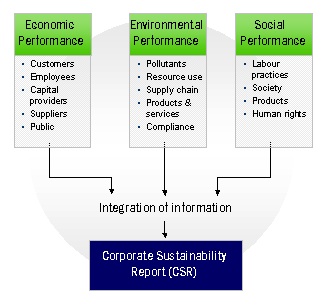 That’s from Ernst & Young. (From their page on Sustainability Management and Reporting.) Yup, Ernst & Young. Those guys are accountants. Surely they wouldn’t advocate a form of “accounting” where the items being counted don’t come in a common unit of measure…would they?
But really, it’s hard to beat this representation of 3BL: This “Triple Bottom Line Visual Framework” is from the Australian Government’s Department of the Environment & Heritage.
So, is a picture worth a thousand words? More like, how many thousand words would it take to begin to make sense out of these nonsense pictures?
Business Ethics Blogaversary Soon
A special note for all you loyal readers out there…
Monday (Nov. 20) is my blogaversary, i.e., the one-year anniversary of the Business Ethics Blog.
I’m going to spend the week celebrating (on-line) in various ways, including:
- A heart-felt retrospective;
- The awarding of a News-Maker of the Year award;
- Contests & give-aways (including a couple of fabulous books as prizes).
So, make sure to tune in often next week & join in the fun. And tell all your friends! It’s going to be an action-packed week on the ol’ Business Ethics Blog.
Triple Bottom Line: Still Crazy After All These Years
Regular readers my recall previous rants about the ubiquitous, and misleading, “Triple Bottom Line” (3BL). For those of you who are blissfully unaware of that concept, the 3BL is the idea that, in addition to the good old-fasioned financial bottom line (you know, the one at the bottom of an income statement), there are 2 further ‘bottom lines’ (viz. the social & environmental bottom lines) that businesses ought to attend to. In particular, adherents of the 3BL notion argue that business managers can and ought to monitor, measure, and report the social and environmental performance of their companies.
Wayne Norman and I published what we thought, modestly, was a devastating critique of the concept in the April 2004 issue of Business Ethics Quarterly. More recently, we’ve written a rebuttal (forthcoming in BEQ, January 2007) of the only scholarly response (written by Moses Pava) to our original 2004 article (you can see the abstract of our rebuttal here). Briefly, Wayne and I argue that while there’s nothing wrong with the idea of tracking and reporting social and environmental performance, there’s something very wrong — misleading, incoherent, etc. — about thinking that you can sum up social and environmental performance “just like” you do with financial performance, so that you can arrive at a clear & defensible “bottom line.” (You can find more info about our critique here.).
Despite our best efforts, the 3BL remains frighteningly popular. For a while, we tracked the popularity of 3BL, by the crude but useful measure of Google hits. Here’s the early data.
August, 2002: 15,600 Google hits
January, 2003: 22,900
September, 2004: 69,500
January, 2005: 187,000
We stopped keeping track, but as of today, Google registers about 726,000 hits. (Get the latest figure by here.)
Needless to say, I was curious when I saw that a new book on 3BL had been published. Curious, and hopeful that perhaps this book would mention that the 3BL concept is not without its critics (critics like Wayne & me). The book is called The Triple Bottom Line: How Today’s Best-Run Companies Are Achieving Economic, Social, and Environmental Success — and How You Can Too, and it was written by Andrew Savitz (with Karl Weber).
I was disappointed (but I guess not surprised) to find that the bibliography contains no reference at all to our criticism of the 3BL. That’s unfortunate, and not just because I’ve got a vested interest in my work being recognized. It’s unfortunate because people who buy Savitz’s book (or otherwise swallow the 3BL line) ought at least to know that there’s reason to be wary of the concept. Now, to be fair, our BEQ article came out in 2004, and Savitz’ book came out in 2006, and given how long the publishing process takes, Savitz might simply have submitted his manuscript before becoming aware of our work.
OK, enough about me. What about the book?
Well, to be honest I haven’t read it all yet. But early signs have me worried. My hope had been that, though this book has the 3BL idea in its title, maybe it wouldn’t really take the idea seriously. Maybe “triple bottom line” is just a catchy phrase, one the author would use without implying that, you know, there really are 3 “bottom lines.” Alas, no. All you need to see is this figure, from the book’s introduction, to see that Savitz is very committed to taking this awful metaphor seriously:
This table clearly implies that performance on areas as diverse as “Human Rights” and “Community Impacts” can be summed to provide a TOTAL. In other words, it makes a promise that it can’t possibly deliver on. And in doing so, it likely does damage to the very idea of managing social and environmental performance.
Coke, CSR, and Water

Here’s a story from the Environmental news Network: Coca-Cola Undertaking Africa Water Project, CEO Says
Coca-Cola Co. said Wednesday it would help to bring clean drinking water to parts of Africa in a plan to work with local communities on environmental issues like water management. “We’re focusing on water because we’re a hydration company,” Neville Isdell, chief executive of the world’s largest beverage company, said at a Business for Social Responsibility conference here.
“We’re focusing on water because it’s the main ingredient in every product we make…the success of our business depends on the availability of local water resources.”
OK, so the first comment to make is that, on the surface at least, this is a relatively progressive approach to Corporate Social Responsibility (CSR). It involves a company working in a field it actually knows about — in Coke’s case, treatment & transport of drinkable liquids — on projects that hold the possibility of not merely providing band-aid solutions, but instead contributing to the long-term development needs of communities.
Secondly, it’s worth noting that Coke is quite open about the fact that this is CSR of the “win-win” kind: it’s not philanthropy (i.e., it’s not Coke giving something away out of the goodness of its heart). Establishing a stable water supply is both good for local communities and helps Coke meet the needs of its bottling plants.
Now the cynical counter-spin: in helping bring water to more African communities, Coca-Cola is also helping bring its product, Coke, to more African communities. That is, Coca-Cola is expanding its market. As the ENN story notes,
International markets are becoming more important to Coca-Cola…as consumers in developed markets choose drinks like bottled water and tea over soft drinks.
OK, well I already noted that this isn’t philanthropy, it’s CSR of the win-win variety, which necessarily involves an upside for the corporation involved. So, what’s the problem? Well, the worry, anyway, is that Coca-Cola isn’t just expanding its market, it’s expanding the market for what is generally a pretty unhealthy product. Enjoyed in moderation, Coke is surely far from lethal. But better access to high-sugar, low-nutrient beverages is pretty much the last thing Africa’s poor need. I don’t want to ‘look a gift-horse in the mouth,’ — after all, lots of parts of Africa clearly are in desperate need of better supplies of water — but this particular example strikes me as being only slightly different than a tobacco company subsidizing the construction of roads to isolated towns so that they can more easily distribute their deadly product.
But if I lived in one of those African villages (or if I were a local politician), I guess I’d see this as good news. I’d accept the gift of clean water, even if it meant that kids would also now have easier access to some pretty unhealthy food choices. Not a pretty choice to have to make. But the fact that it’s offering something that desperate people would gladly accept is perhaps not the highest praise we can imagine for a company.
(Thanks once again to Melissa for alerting me to this story.)
Advertisers Create Own Shows
Some ethical issues in business aren’t about specific instances of right- or wrong-doing, involving specific customers (or other stakeholders) on specific days. Some of the most interesting and complicated issues are about the large-scale social effects of various business practices, and whether companies have an obligation to moderate their behaviour in recognition of such effects.
One common issue of this type is the effect of commercial advertising. Advertising is becoming more pervasive, often more intrusive and (according to some) more manipulative.
In that vein, here’s an interesting story from the New York Times: Brands Produce Their Own Shows
Marketers have found a new way to try to keep viewers from tuning out: offer them TV shows, movies and online programming created by the marketers themselves, often with help from their advertising agencies.
These new offerings, the marketers hope, will be entertaining enough to endear viewers to the brands behind them.
Burger King, for example, is making a feature-length film that may star — no surprise here — the “King” character of its ad campaign. Office Max recently created a show on the ABC Family channel. Anheuser-Busch plans to start a seven-channel TV network online, called BudTV.
Interestingly, the NYT story avoided citing the obvious (perhaps too obvious? or too silly?) worries. The story managed to avoid quoting the usual media critics about how moves like this spell the end of civilization, etc. No mention of the idea that it’s bad to blur the distinction between entertainment & advertising (as if that distinction weren’t pretty much gone already.) Are we, collectively, just sort of over it? Is this a non-issue these days?
(Hopefully Andrew over at Rebel Sell will have something to say on this.)



 The Business Ethics Blog