Archive for the ‘accountability’ Category
Bullying in Pursuit of the Public Good
Filed under: accountability, activism, corporations, government, international, NGO |
 Comments (5)
 Should we celebrate when a powerful NGO convinces a powerful corporation to change its mind on something?
Here’s an example. Greenpeace recently… um, persuaded Mattel to stop using packaging sourced from companies that contribute to deforestation in Indonesia. (See the story by Angelina Chapin: Greenpeace wins battle with Mattel.) Mattel is a major toymaker, selling millions of products wrapped in cardboard, so the company’s decisions on where to get that cardboard stand to have a significant environmental impact. And Greenpeace managed to get the company to change its ways.
I suspect — but only suspect — that this is a good thing. I don’t know much about the facts of this particular case, but I think generally it’s good that there are well-intentioned nongovernmental organizations (NGOs) like Greenpeace working hard to get companies to think twice about the environmental impact of their business practices.
But it’s not always a good thing when NGOs badger and cajole a big company. Consider, for example, another case involving Greenpeace, namely the battle over the dismantling and disposal of the massive Brent Spar oil-storage buoy in the mid-90s. In that case, Greepeace launched a global campaign to pressure Shell, owner of the Brent Spar, to dispose of the floating oil-storage facility in a way that contradicted the company’s own environmental impact assessment. Greenpeace later changed its mind and apologized, but it was too late: Shell’s original disposal plan had already been scrapped, and the company’s share price damaged. In other words, Greenpeace had bullied Shell into doing the wrong thing.
Now most people are generally not very worried about major corporations, or large institutions of any kind, being bullied. And it’s easy enough to understand why. We’re usually more worried about corporations having too much power, rather than too little. But to uniformly celebrate victories of NGOs over corporations is to assume that NGOs are always right. And that’s a mistake. It’s also a mistake to assume that NGOs are in any important sense democratic, or automatically representative of the public interest.
Now this point must not be mistaken for a general critique of NGOs. There are many good NGOs out there, doing invaluable work. It’s just a reminder that the leaders of NGOs are not elected representatives, but rather self-appointed defenders of what they see as the public good. (I’ve written about how to assess NGO legitimacy before.)
Think of it this way. Companies sometimes do dumb things, and sometimes they do unethical things. There are lots of ways that can happen. Sometimes it’s due to flawed internal decision-making processes. Sometimes it’s a blind focus on profits or on expanding market share. Sometimes they do bad things in response to poorly-constructed regulations, or pressure from governments. And sometimes they’re bullied by other organizations, including NGOs.
And when a major corporation is bullied into making a bad decision, that bad decision can have enormous implications. So we should all watch with a careful eye when lobby groups, whether corporate or populist, attempt to use powerful non-democratic means to get their way.
Ethical Investing and Values-Based Investing
Filed under: accountability, certification, experts, film, investing, values |
Comments (9) If you’re an investor, and if you want your money invested in companies that will not just bring you a return on investment, but will also some good in the world, that means you’re interested in what is variously called “responsible investing” or “ethical investing” or “values-based investing.”
I was recently interviewed for a documentary on the topic. Here it is: “Responsible Investing: An Evolving Story.” The 20-minute video was produced by the Ontario Teachers’ Pension Plan (OTPP). OTPP (colloquially known as “Teachers”) is one of the biggest institutional investors in Canada, managing a fund of just over a hundred billion dollars.
One of the main points I tried to make in the segments I’m in is that the key to thinking about values-based investing is to think of it as a mechanism for value-alignment. That is, it’s a way for investors to invest in companies whose values are like their own. It allows pacifists to avoid investing in arms manufacturers, and allows anyone who is stridently anti-tobacco to avoid investing in that industry. It’s not about all of us investing in products or industries that are “more ethical”, overall. Such global judgments are difficult to arrive at, and even harder to find consensus on.
That is, it’s best not to think of values-based investing as “ethical” investing, as if in contrast to all that other, unethical, investing. Indeed, referring to it as “ethical” investing probably makes the same mistake as references to “ethical oil” or “ethical food” does: it confuses the fact that there is ethical reasoning involved in such investing with a much grander claim that your investments are the only (or most) ethical ones.
Wall Street Needs to be Fixed, Not Occupied
Filed under: accountability, activism, corporations, corruption, finance, government, protest |
Comments (16) Issues of corporate ethics are too important to leave to the Occupy Wall Street gang. The principles the group is fighting for are noble ones, but the tools they employ leave much to be desired. It’s up to the rest of us to use better tools.
Those currently camped out in New York, and other cities across the US, are right to want better corporate ethics, including a big dose of accountability and transparency. And they’re right to want to live in a just and equitable society. And they’re right to want certain kinds of electoral reform: finding ways to limit the influence of corporations (without stomping on free speech) would be a very good thing. But occupying Wall St. isn’t going to do it.
Don’t get me wrong: I’m there, in spirit. Well, not there there. I’m not likely to join the sit-in anytime soon; those methods aren’t my methods. But I sympathize with the frustration manifested by the passionate, non-partisan cabal of well-intentioned folks who make up the Occupy Wall Street movement. Indeed, though our methods are radically different, I’ve dedicated my career to some of the same ideals. I’m committed to the project of figuring out the best possible standards for corporate structures and behaviours, and I hope that better understanding will lead, indirectly, to better outcomes. The folks of the “Occupy Wall Street” movement likely think my way won’t won’t have much impact. Don’t worry, I’m not taking it personally.
The Occupy Wall Street movement has substantial symbolic significance, but we all know, I think, that nothing concrete is going to come of it. To start with, the mechanism is all wrong — it’s not like corporate and political elites are going to see a sit-in, and suddenly going to smack their foreheads and say, “Oh, ok! Let’s make changes!” And then there’s the movement itself. It’s pretty clear by now that the loosely-organized movement doesn’t have much in the way of concrete goals. And its spokespeople can barely open their mouths on topics related to business and economics without saying things that are grossly mistaken. Their values are right, but the mechanisms they envision to implement those values — things like repealing corporate personhood — are deeply misguided. But then, to look for direct impact is, as others have observed, likely a mistake, and misses the real significance of the movement.
So it would be easy — too easy ‐ to dismiss Occupy Wall Street as a bunch of well-intentioned young people tilting at windmills. But that would be a mistake. The windmills they’re tilting at are important ones.
The real value of the Occupy Wall Street movement is that it ought to serve as a kick in the pants to the rest of us, an inspiration to make use of tools that will do some real good. Let’s leverage their energy into effective methods. So think. Learn about the issues. Learn about corporate governance. Advocate reform. Organize. Get out the vote. If Occupying Wall Street is to have any real impact, it won’t be by motivating a few hundred more people to camp out in the street.
Conflict of Interest: the SEC Doesn’t Get It
Filed under: accountability, character, codes of ethics, conflict of interest, government, regulations |
Comments (1) There are a few ways to interpret how the Securities and Exchange Commission handled a blatant conflict of interest on the part of one of its own lawyers, and none of them is particularly flattering.
If you don’t already know the story, see this Wall St. Journal editorial: The SEC’s Ethics: Washington’s double standard on conflicts of interest
…this week’s remarkable report from SEC Inspector General David Kotz disclosing how the SEC’s former top lawyer, David Becker, directly handled matters relating to the Madoff fraud case despite his mother’s $2 million investment with the firm, to which he and his brothers were heirs….
Despite a clear conflict, Mr. Becker didn’t recuse himself. He did (properly) report the conflict to his superior, Mary Schapiro, but she didn’t take the appropriate action in response.
How do we explain this failure? One possibility is that leadership of the Commission is clueless about what conflict of interest is. That seems unlikely; watching for conflict of interest at regulated companies is an important part of the Commission’s mandate.
Alternatively, it could be that this is a case of actual corruption (something not intrinsic to the notion of conflict of interest). That is, it’s possible that Becker was intentionally acting in a genuinely self-serving way, and that Schapiro was facilitating his attempt to do so. But there’s no evidence of that as far as I can see, and making that assumption is neither charitable nor consistent with our best understanding of what motivates wrongdoing. Self-serving rationalizations are much more commonly the mechanism behind wrongdoing than is actual pursuit of personal gain. So I’m willing to assume that Becker and Schapiro genuinely thought there was no real problem, that Becker was technically in a conflict, but that that conflict wouldn’t actually affect his ability to make the right decisions.
More likely, it seems to me, is that Becker and Schapiro, while understanding what conflict of interest is, how it is defined, etc., don’t really get the moral significance of the concept. They don’t see that conflict of interest isn’t about some personal interest actually having an influence on the integrity of the decision-maker. They don’t see that avoiding conflict of interest is about avoiding the shadow of doubt, a shadow that reduces people’s trust in the organization as a whole.
This sort of misunderstanding is alarmingly common in institutions that treat ethics as an administrative function. They focus on the rules, and on the processes and procedures that need to be built in order to enforce the rules. But too often, then forget why the rules are there in the first place.
——
Notice / Correction: The first version of this blog entry had a serious, repeat typo, wrongly implying that Mr Kotz, rather than Mr. Becker, was the one in the conflict. I’ve fixed that sloppy error above. My apologies for any confusion.
Ethical Oil: Choose Your Poison
Filed under: accountability, activism, advertising, boycott, brands, consumers, critical thinking, energy, human rights, markets, pollution |
Comments (3) There’s oil, and then there’s oil. Right? Or is there only, you know, oil? Does it matter, ethically, where the oil we consume comes from?
That issue has arisen very recently and caused a minor diplomatic dust-storm: a Canadian ad offering a moral critique of Saudi Arabian oil specifically has apparently offended the Saudis, who have asked that the ads be taken off the air.
See this summary, by John Terauds for the Toronto Star: Canadian ethical oil ad stirs Saudi ire
A Canadian-made television ad that speaks out against oil imported from Saudi Arabia has raised the ire of the Middle Eastern nation, prompting it to send a threatening legal notice to broadcaster CTV.
The 30-second ad, produced by Toronto-based ethicaloil.org, focuses on discrimination against women in the conservative Muslim country….
But the ad in question isn’t just anti-Saudi oil; it’s a defence, by means of contrast, of good ol’ Canadian oil, derived primarily from the oilands (a.k.a. tarsands) of Alberta. Yes, the same oilsands that have themselves generated so much criticism on environmental grounds. Now it’s certainly not the first time someone has been accused of greenwashing the tarsands. But to slam Saudi oil as unethical in order to proclaim tarsands the ‘ethical alternative’ really does strain credulity.
Now the critique of Saudi oil isn’t entirely without merit. Saudi cultural standards for the status and treatment of women are ethically indefensible. But the “ethical oil” claim for the oilsands is a serious stretch, at least if it’s supposed to point to a bright and clear difference not just in particular ethically-salient characteristics, but in overall ethical goodness.
In principle, we could look at this as a matter of “choose your poison.” Do you want the oil that’s associated with human rights violations, or the oil that’s associated with environmental destruction? Interesting dilemma, in principle. But for most of us, it’s a moot point: oil (and the gas that comes from it) is an undifferentiated commodity, and we don’t get to choose based on nation-of-origin. So it’s not like the ad in question is really intended to help consumers make more ethical consumption choices.
More likely, what the group behind the ad is doing is the rhetorical equivalent of fracking, injecting the novel term “ethical oil” into existing debates over the oilsands, not because the term actually makes any sense, but simply in the hopes of stirring something up.
—–
Update: Take a hew poll on this topic, here: Oil Poll: Human Rights or Environment?
Philip Morris: Endangering Kids and Academic Ethics
Filed under: accountability, children, ethics, health, law, marketing, product safety, rights |
Comments (4) Tobacco giant Philip Morris is doing its best to get its hands on research about teen smoking, and encouraging some UK academics to violate ethical standards along the way.
Here’s the story, by Andrew Hough for the Telegraph: Philip Morris: tobacco firm using FOI laws to access secret academic data
Philip Morris International has tried to force the University of Stirling to hand over secret data into teenage smoking and cigarette packaging gathered over more than a decade.
The manufacturers behind the popular Marlboro brand, have used Freedom of Information laws to [attempt to] gain access [to] about 6000 confidential interviews undertaken with teenagers as young as 13, which discuss their views on smoking and tobacco….
The researchers are rightly fighting the request.
It’s a shocking move on Philip Morris’s part, even just from a PR point of view. To be seen seeking information that the company clearly hopes to use in marketing to children will do nothing to improve anyone’s opinion of the firm or the industry.
But there’s a second wrong, here, and that lies in the attempt to get the researchers in question to violate their obligations to the research subjects — the children and their parents — who participated in the research in question.
When university-based researchers conduct any kind of research on human beings, they are required to adhere to pretty strict standards for research ethics. The most fundamental of those standards has to do with obtaining informed consent from research subjects. Such consent may be obtained only after research subjects are fully informed about the goals of the research, as well as about what sorts of privacy protections they can expect. In the case described here, it is almost certainly the case that the children interviewed, and their parents, would have been assured that while the researchers would of course eventually make public the aggregate results of their research, the raw data — the interview transcripts that Philip Morris seems to be seeking — would of course be kept confidential.
So Philip Morris is asking these researchers to break their promise and to breach the trust placed in them by research subjects. The company is attempting to get the researchers to violate their duty. This puts the company’s behaviour into the same moral category as suborning perjury or intentionally putting another party into a conflict of interest. It’s a bad thing when a company violates its own duties; but it is especially corrosive to work so hard at encouraging other people to violate theirs.
Pipeline Leaks and Stakeholder Theory
Filed under: accountability, corporate citizenship, corporations, CSR, management, pollution, shareholders, stakeholders |
Comments (2) When oil spills in a forest, does everybody matter? That’s the question posed by the events recounted in this recent CBC story: Wrigley residents voice pipeline spill concerns.
The story is about an Enbridge pipeline that sprung a leak in a tiny, remote town in Canada’s Northwest Territories. Not surprisingly, residents of tiny Wrigley are unhappy about the spill, and so Enbridge has to figure out not just what to do about the spill (i.e., how to clean it up) but what to do about the people of Wrigley. More generally, managers at Enbridge have got to figure out, on an ongoing basis, what their obligations are, and to whom those obligations are owed.
There’s an older school of thought (or more likely a caricature of an older school of thought) according to which shareholders are the only ones whose interests really need to be taken seriously. According to this view, an oil company’s managers’ only real obligations are owed to shareholders. After all, says this view, shareholders own the company, and they’re the ones who (indirectly) hired these managers to make money on their behalf. If anyone else matters, they matter in a strictly instrumental way. Don’t treat your customers badly, for example, because they’re the key to making a profit. Or, in the present case, don’t irritate the people of Wrigley, because if you do they might do something inconvenient, like protesting.
A leading modern alternative to the only-shareholders-matter view is sometimes called the “stakeholder” view (or sometimes, in academic circles, “stakeholder theory.”) The core of the stakeholder view is the idea that the real ethical task of corporate managers is to balance the interests of various stakeholders — various individuals and groups whose interests intersect with those of the corporation. After all, many people contribute to the success of a firm, from customers to suppliers to members of local communities. And if they all contribute, they all have the right to ask for something in return. (You can read a summary of my review of a recent book on the topic, here: Managing for Stakeholders.)
The pipeline story is an excellent example of both the strengths and the limits of the stakeholder perspective. It’s surely useful for executives at Enbridge (or any other company, in the midst of an environmental crisis) to survey the situation and ask, “Who do we need to talk to? Who has a stake in this?” So, are the people of Wrigley stakeholders in Enbridge? Pretty clearly, yes. But after that, things get complicated. Does the environment itself automatically count as a stakeholder of some sort, or does it only count if the well-being of the people of Wrigley is jeopardized? What about the residents of Zama, Alberta? That’s the little town, 850 km away from Wrigley, to which Enbridge is planning to ship the contaminated soil. What about me? Like most people, I’m a consumer of oil. I clearly have a stake, here, don’t I? Pretty clearly, there are stakeholders and then there are stakeholders.
But anyway, once you’ve figured out who the stakeholders are, then what? Let’s take the easy one, a group that’s directly affected, namely the people of Wrigley. What are they owed? Are they owed the cleanup? Are they owed a speedy one? At what cost? Do they have a right to participate in the decision-making, or just to be kept informed? Or are they owed, as one resident of Enbridge suggested, a “swimming pool or a hockey arena or something for the kids”?
As you can see, one problem with the stakeholder view is that the word “stakeholder”, itself, doesn’t actually clarify much. Yet some people tend to sprinkle it on like fairy dust, as if simply anointing someone a Stakeholder™ clarifies what is owed to them, ethically. Life in the little town of Wrigley should be so simple.
Highest Standards Aren’t Always Best in Ethics
Filed under: accountability, character, conflict of interest, decision-making, ethics, government, regulations, standards, trust, values |
Leave a comment No one wants low ethical standards, but it’s also a mistake to aim at the highest possible standards — at least it can be, depending on what you mean by “highest.”
See, for example, this useful piece on defence contractors, by Noah Shachtman for Wired: Pentagon Probe Will Review Every Darpa Contract
Since Regina Dugan became the director of Darpa [Defense Advanced Research Projects Agency], the Pentagon’s top research division has signed millions of dollars’ worth of contracts with her family firm, which in turn owes her at least a quarter-million dollars. It’s an arrangement that has raised eyebrows in the research community, and has now drawn the attention of the Defense Department’s internal auditors and investigators…
The story usefully points out that aiming for the highest possible standards of integrity can also cause trouble:
[A former director’s] bright ethical guidelines had unintended consequences. If a company allowed an employee to take a sabbatical to join Darpa, the firm was essentially blocking itself from millions of dollars in agency research projects.
The result, of course, is that under the old rules the agency risked cutting off useful sources of expertise. That’s not to say that the old rules were worse. It’s just to point out that there’s a legitimate trade-off here.
There’s a very general lesson to be drawn from this. When thinking about ethics, the goal isn’t always to be squeaky-clean. The goal is to find standards that are high enough to merit the trust of relevant stakeholders, and to do so without sacrificing other, possibly-equally important, values.
Consider this graphic, which illustrates the challenge of choosing experts to make decisions. On one hand, we want people with real expertise. On the other hand, we want to avoid conflict of interest. That is, we want maximum expertise and minimal risk of bias. So the upper-left quadrant of this graphic is the sweet spot:
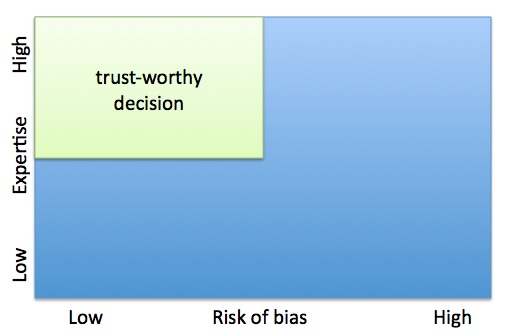
Note that what we’re looking for here is not the “highest possible” standard of integrity (i.e., the standard that implies the lowest possible risk of bias among decision-makers), but a system that makes the optimal tradeoff between risk of bias, on one hand, and relevant expertise, on the other. The point here is not that we’re trading off ethics and expediency. The point is that we’re trading off competing, ethically-significant values.
The point in thinking about ethics is not to aim at the highest standards, but at the best standards. We do enormous damage both to the functioning of organizations and to people’s willingness to talk openly about ethics when we talk about “high standards” in a way that comes off as unthinkingly pious.
Two Problems With CSR
There’s plenty of confusion about what CSR is. Indeed most of the definitions you’ll find online don’t even read like definitions. They’ll tell you what CSR (Corporate Social Responsibility) is “about,” or what it “relates to,” but they won’t tell you what it is. Any definition worth its salt ought to take the words in the term seriously, and note that the term “CSR” refers to some kind of responsibility, and then explain just what kind of responsibility it is. But good luck finding such a definition. And this failure of definition isn’t just a matter of semantics. It’s critically important, because a sloppy understanding of the term gives the appearance of unifying under a single banner people who actually hold vastly different views of what a corporation’s responsibilities are.
Various definitions out there seem to coalesce around the idea that business should be “giving back” to the community — and typically not via antiquated methods like corporate philanthropy. The goal, generally, is to make sure that a company’s net impact on society is positive. Let’s take that as our point of departure.
The following two problems form the Scylla and Charybdis of CSR. If you avoid one, you run right into the other. Both spell doom.
Problem #1: CSR is too easy, if taken literally. If all that’s at stake is making sure your net impact is positive, wow, that’s pretty easy: just sell a decent product that people want, and don’t hurt any bystanders. It’s a fundamental principle of commerce. Start with individual transactions. Those, if voluntary and well-informed, always have a positive impact. A customer gives you $1.00, and you give them a pound of bananas. They’re happy, and you’re happy. Don’t step on any bystanders’ toes, and there you go: positive net impact. In fact, as long as your customers are happy enough, you can afford to hurt people along the way (e.g., by mistreating employee) and your net impact will still be positive. (And of course, claiming to adhere to CSR is even easier if you use a mushier definition, one that only asks that you “manage” your social impact, rather than aiming at any particular objective.)
Problem #2: On the other hand, CSR is unfairly burdensome, if really taken to heart — that is, if you really think that the pursuit of social contribution ought to take over a manager’s entire way of thinking. It means that a company that makes a good product, treats employees well, deals fairly with suppliers, etc., still has to ask itself, “yes, but how are we giving back to the community?” Look in the mirror. What’s your net impact on society? What good are you — other than the fact that you put in an honest day’s work, take care of your kids, and given a few bucks to charity now and then? (Hint: that’s a rhetorical question.) The joint-stock corporation, on the other hand, is arguably one of the most welfare-enhancing inventions of all time. For such organizations, failure to have a positive impact is the exception, rather than the rule. Asking one to risk its productivity by obsessing over something it’s already doing is silly.
Now, there’s absolutely nothing wrong with the idea that companies are responsible for their behaviour (and that the individuals who work for companies are responsible for their behaviour, too). And for some people, that’s all that CSR means. That’s just fine. In fact, such responsibility is absolutely morally fundamental. Companies should try to make an honest living, just like individuals like you do. They should avoid hurting people, just like you do. They should clean up their messes, just like you do. That’s basic ethics. And if they’re doing those things, calling it something as mushy as “CSR” adds absolutely nothing to the equation.
Should Twitter Censor?
Filed under: accountability, corporate citizenship, CSR, internet, protest, standards, technology, values |
Comments (2) Last weekend, a despicable “hashtag” trended* on Twitter, one promoting the idea that violence against women is OK. By Sunday morning, tweets using that hashtag were mostly critical ones, expressing outrage at any non-critical use of the hashtag. One prominent twitterer, Peter Daou, (@peterdaou) asked why Twitter wasn’t preventing that hashtag from trending. He tweeted:
“Unbelievable: Is Twitter REALLY allowing #reasonstobeatyourgirlfriend to be a trending topic??!”
The outrage expressed by Daou and others is entirely appropriate. The hashtag in question is utterly contemptible. But the question of whether Twitter should censor it and prevent it from trending is another question altogether.
The central argument in favour of censorship is that the idea being broadcast is an evil one, and decision-makers at Twitter are in a clear position to stifle the spread of that evil idea, or instead to allow its proliferation. With great power comes great responsibility.
The most obvious reason against censorship is freedom of speech, combined with the slippery slope argument: if Twitter is going to start censoring ideas, where will it end? Freedom of speech is an important right, and that right includes the right to speak immoral ideas. Limits should only be imposed with great caution.
Now, it’s worth noting that the hashtag trending isn’t actually anyone’s speech: it’s the aggregate result of thousands of individual decisions to tweet using that hashtag. So if Twitter were, hypothetically, to censor the results of their trending-detection algorithm, they wouldn’t actually be censoring anyone, just preventing the automated publicizing of a statistic. But perhaps that’s a philosophical nicety, one obscuring the basic point that there is danger anytime the powerful act to prevent a message from being heard.
More importantly, perhaps, Twitter isn’t a government, it’s a company, and it doesn’t owe anyone the use of its technology to broadcast stupid ideas (or any other ideas, for that matter). We insist that governments carefully avoid censorship because governments are powerful and because for all intents and purposes we cannot opt out of their services as a whole. If a company doesn’t want to broadcast your idea, it’s not morally required to. Your local paper, for instance, isn’t obligated to publish your Letter to the Editor. The right to free speech isn’t the right to be handed a megaphone.
But then the challenging question arises: is Twitter a tool or a social institution? Just how much like a government is Twitter, in the relevant sense? It is, after all, in control of what many of us regard as a kind of critical infrastructure. This is a challenge faced by many ubiquitous info-tech companies, including Twitter, Facebook and Google. While their services are, in principle, strictly optional — no one is forced to use them — for many of us going without them is very nearly unthinkable. We are not just users of Twitter, but citizens. That perspective doesn’t tell us whether it’s OK for Twitter to engage in censorship, but it does put a different spin on the question.
—–
*The fact that it was “trending” on Twitter means that Twitter’s algorithm had identified it as, roughly, a “novel and popular” topic in recent tweets. Trending topics are featured prominently on Twitter’s main page.



 The Business Ethics Blog