Archive for the ‘crime’ Category
Chasing Madoff (movie review)
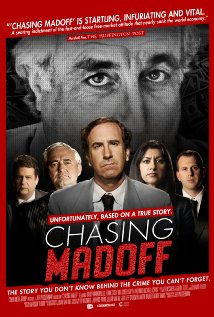 The documentary Chasing Madoff opens this week. I had a chance to attend a preview of the movie last night (courtesy of eOne Films).
The film is really the story of fraud investigator Harry Markopolos, the guy who, while working as an options trader at Rampart Investment Management, discovered Madoff’s scheme and worked valiantly to get the Securities and Exchange Commission to take notice.
It’s kind of a fun film, but not a great film. The film lacks a narrator, opting instead to tell the entire story through the first-hand accounts of a handful of people (primarily Markopolos and a couple of colleagues, along with a few of Madoff’s victims) and snippets from newscasts. The focus on first-person accounts gives the film a personal feel, but it also inevitably means a perspective that is slanted, though perhaps not fatally so.
There are a few laughs in the film. Markopolos is a bit of a strange cat. He’s a likeable guy, and apparently a man of integrity, but also a bit paranoid-sounding. On-screen, he tells us that he feared Madoff so much that he was ready to pre-emptively shoot the guy, if Madoff had discovered his investigation. He also describes what his strategy would be in the event of an armed standoff with the SEC, should they ever come to his home to get his files — files that included damning evidence of SEC complacency. Just for emphasis, one scene shows him leaning against his desk, brandishing a pump-action shotgun. These humourous parts are, I think, intentional, or at least surely the director (Jeff Prosserman) must have known they would spark laughter. And humour is fine, but it tends to undercut the filmmakers’ stated intention of generating outrage in their audience.
What’s most striking, perhaps, about Chasing Madoff is what it doesn’t tell us about the Madoff scandal. For example, it points fingers at the SEC, but tells us nothing about the agency’s funding levels, and whether it had the capacity to keep up with complaints like Markopolos’s as they flowed in. There are also allegations that “someone higher up” at the Wall Street Journal tried to stifle the story before it broke, but little evidence to back that up. And there are intriguing hints about the large number of individuals and organizations that must have been complicit in Madoff’s crimes, and hints at why they had no economic incentive not to keep putting faith in his results. There’s even a claim that Madoff “paid top dollar” to those that would bring him “new victims.” But the relevant parties are not named and the film makes little effort to explain the connections.
Bottom line: I’m a university professor — would I show this movie in my Business Ethics classroom? Probably not. It’s a fine portrayal of man of integrity fighting the good fight, but it teaches relatively little about how the financial crime of the century happened, or what if anything would prevent it from happening again.
Should Rioters be Fired?
Filed under: crime, employees, law, privacy, risk, scandal, trust |
 Comments (5)
 The post-Stanley Cup riots in Vancouver last week have generated a minor landslide of commentary. Much of it has focused on just who the malefactors were. In an age of social media, this has amounted to more than mere speculation: the identities of quite a few of the trouble-makers have come to light. Those who participated in the riots have thus brought very public shame upon themselves and their city. But what about the shame brought upon their employers?
Over at the “Double Hearsay” law blog, the question is asked from a legal point of view: Can employers fire Vancouver rioters? The short version of the legal analysis there is this. Any employer can fire an employee “without cause” as long as they give proper notice. In order to fire without giving a couple weeks’ notice, an employer has to have “cause:”
Generally speaking, an employee can be fired for his private conduct if that conduct is “wholly incompatible” with the proper discharge of his employment duties, or if it would tend to prejudice the employer….
The latter possibility is the relevant one here. If an employee participates in a riot and is widely known a) to have participated in shameful behaviour and b) to be your employee, then the employee has effectively done something “prejudicial” (i.e., likely to negatively effect your business).
OK, so that’s the legal side. Labour law draws a reasonably clear line around what you as an employer can do, and what the court will support your having done. But that still leaves open the question, should you even attempt to fire an employee who you know to have participated in a riot, say like the recent one in Vancouver or last year’s at the G20 in Toronto?
Here are a few quick considerations:
1) The legal issue of an employee behaving in a way that is “prejudicial” to the employer is also of course a very reasonable ethical consideration. A riot like the one in Vancouver is accompanied by significant public outrage, and guilt by association is a very real problem. In many industries, a business lives or dies by its reputation. As Warren Buffett has said, “Lose money for the firm, and I will be understanding. Lose a shred of reputation for the firm, and I will be ruthless.”
2) By participating — even somewhat passively, let’s say — in a riot, an employee reveals quite a lot about his own character and judgment. Do you really want someone with that little judgment working for you? Your company, no matter how laid back its corporate culture, has some sort of authority structure. It’s fair to ask just how suitable an employee is to work within any authority structure when they’ve publicly egged on another human being in burning cop cars or assaulting firefighters.
3) Even from an ethical point of view, the legal notion of “due process” is relevant. So if you’re considering firing someone for taking part in a riot, you can’t in all fairness do so based on mere hearsay, or without giving him a chance to defend himself. The right process is at least as important as the right outcome.
4) Finally, it is worth considering whether there are alternatives to firing. Maybe being laid off for a few weeks is sufficient. Or perhaps the employee can demonstrate his contrition by doing volunteer work. But it should be remembered that the solution has to fit the reason for firing in the first place. If your worry is that participation in a riot demonstrates a fundamental lack of judgment, then volunteer work isn’t going to erase that worry.
As a lawyer friend of mine put it, “rioting seems to strike at the core of social order.” And social order is at the core of business. It’s not unreasonable to think that participation in a riot is a disqualification for employment — but such a conclusion still has to be implemented prudently and fairly.
—-
Thanks to Dan Michaluk for tweeting this story and bringing it to my attention.
Business Ethics Lessons from G20 Cop’s Arrest
Filed under: crime, government, protest, trust, Uncategorized |
Leave a comment What lessons can we take from a story about police brutality and apply to the world of business?
As many readers will know, the meeting of the G20 here in Toronto last summer was not, on the whole, a happy experience. Protestors, both peaceful and otherwise, were plentiful, and there were serious questions about the way the Government, and in particular the Toronto Police Service, conducted themselves. No one came out looking very good. Protestors torched cop cars and broke shop windows. Some of the tactics used to quell the riot resulted in accusations of police brutality.
Nearly a year later, after a fraught investigation by Toronto Police’s Special Investigations Unit, one police officer has been charged with assault. See this story by Jennifer Yang, for the Toronto Star: Toronto police officer charged in G20 assault:
After nearly one year, two closed investigations, and a public squabbling match between Toronto police and the agency tasked with investigating them, criminal charges have finally been laid in the case of Dorian Barton.
On Friday, the Special Investigations Unit charged Toronto police Const. Glenn Weddell with assault causing bodily harm in connection with Barton’s arrest during the G20 summit last June. The charge came on the same day the Toronto Star publicly revealed Weddell was the previous unnamed officer photographed during Barton’s violent arrest….
Strictly speaking, this isn’t a story about business ethics, but still it provides plenty of fodder for discussion of issues that are centrally important to business ethics. Issues such as:
- Who watches the watchers? Any regulatory system — whether a system of policing criminality or a system of vetting new pharmaceuticals — requires safeguards to make sure that those who wield regulatory power wield it wisely. That’s why police forces have systems for hearing complaints from citizens and for investigating wrongdoing by their own officers. And it’s also why regulatory decisions are typically subject to parliamentary oversight and judicial review.
- With great power comes great responsibility. Self-regulation is crucial for those given the power to enforce rules. Such self-regulation can take many forms. First and foremost, it needs to include individual self-regulation and the adoption of principles of integrity and good conduct. But individual ethics needs to be bolstered by an informal system of peers reminding each other of their obligations. When one regulatory bureaucrat or police officer edges too close to crossing a line, it is essential that colleagues be ready to point out that “That’s not how we do things around here.”
- What are the limits of team loyalty? It is no exaggeration to say that modern civilization is built on something akin to teamwork. And the number one challenge in literally every organization involves getting a number of people with different personalities, talents, and points of view, to work together effectively. Fostering loyalty is a key part of that. But loyalty must have limits. Lawyers are supposed to act as zealous advocates, but are not allowed to suborn perjury. Police and soldiers and firefighters often depend on teamwork for their very lives, but they jeopardize their social value if they put fraternal loyalty above the public good. And corporate employees are expected to help build shareholder value, but not to break the law in doing so.
One of the worst mental habits that can be adopted by people who proclaim an interest in business ethics is that of thinking that the ethical issues found in business are categorically different from those found in other walks of life. Commercial contexts do raise a number of special issues, but we can learn a lot about those issues by thinking about the ethical issues that arise in seemingly quite different domains.
Should Boards Monitor CEO Morality?
Filed under: accountability, boards, CEOs, character, crime, decision-making, employees, governance, leadership, privacy |
Leave a comment A Board of Directors is responsible for overseeing the management and direction of a company, and that task includes monitoring the full range of risks to which a company might be subject. But what if the company’s CEO is one of those risks? What should a board do when a CEO’s off-the-job behaviour raises concerns? The IMF’s Dominique Strauss-Kahn is a case in point. Long before his recent arrest, Strauss-Kahn’s behaviour towards women raised eyebrows. Should it also have spurred the IMF’s Board to act?
See this story, by Janet McFarland, in the Globe and Mail: When and how to confront a wayward leader
Most corporate directors find it hard enough to confront a respected CEO about work-related poor performance, but it is even harder to tip-toe into the minefield of rumours about problems in an executive’s personal life.
(I’ve blogged before about whether ‘private’ vice is a business issue. I’ve also written about whether a CEO’s divorce is a purely personal matter or not.)
McFarland quotes me in her story, but let me give a slightly fuller version of my comments here.
To start, it’s worth making a distinction. There are personal vices that are strictly personal (including most of what goes on between consenting adults behind closed doors.) And there are personal vices that are very likely to impinge upon the workplace or on performance at work. A tendency to engage in sexual harassment is an obvious example, as is heavy drug use.) But, when you’re a CEO of a name-brand organization, that distinction tends to break down. High profile means that personal vices can turn public very quickly, and affect the organization.
Also, bad behaviour on the part of those in the public eye can easily lead to blackmail, which can result in misuse of position and other kinds of bad decision-making. This is another example of why great power brings great responsibility.
On the other hand, there are lines boards should be hesitant to cross, on principled grounds. A CEO’s sexual orientation, for example, should be off-limits. This is obviously less of an issue in 2011 than it would have been in 1951, but even today a gay CEO might be seen as a risk factor (especially for an organization with a conservative customer base) but boards should take a principled stand against taking an interest in their CEO’s sexuality. The board has fiduciary duties to protect the company, but even fiduciary duties have their limits.
The last point I want to make here is that, when faced with a CEO’s bad behaviour, a Board faces more than a yes-or-no question. The ethical question here is not just a matter of whether to confront the CEO, but how to do it. A Board in such a situation needs to formulate a plan — a method of proceeding, including answers to questions like:
- Will the Chair of the Board approach the CEO solo, or should an ad hoc committee do it?
- Should they raise the issue explicitly, or obliquely?
- Should they give the CEO an ultimatum, or ask his or her suggestions for how things might improve?
- Given various anticipated responses by the CEO, how will the Board/Chair plan to react in turn?
Are the Unethical in Business Also Untalented?
If disgraced hedge-fund manager Raj Rajaratnam were good at his job, couldn’t he have done well without insider trading?
Unethical (and illegal) behaviour in business is often compared to breaking the rules in sports. And it has always seemed to me that the sportsman who cheats is basically admitting he’s not good enough to win any other way. Same goes for the student who cheats on a test — she cheats because she knows she hasn’t got what it takes to get a passing grade any other way.
Too often, in the world of business, those caught doing something unethical end up being regarded as “great but flawed.” The story that gets told is usually a Shakespearean one of a talented business mind driven to the dark side by greed, ambition, etc. So Rajaratnam gets described as “brilliant”. And Enron’s Jeff Skilling was, after all, “the smartest guy in the room.”
Now, this line of thinking has occurred to me before, namely that if you have to do something unethical to make a profit, then you’re just not very good at your job. But I was reminded of it by Andrew Potter’s recent blog entry on countersignalling, and how refusal to use modern, high-powered hunting bows might be a way of signalling the hunter’s true skill, and consequent refusal to ‘cheat’.
I sense there’s an opening for a potent new narrative here. When someone is caught doing something unethical in business, we should, in addition to criticizing their lack of character, and perhaps worrying about the institutional structures that facilitated their wrongdoing, also mock their lack of business acumen. Yes, mock. We should mock them the same way we might mock the hunter who uses a sniper rifle to take out a deer. Or maybe the guy who shoots fish in a barrel. Oh, congratulations, tough guy. And we should reserve our praise not for the shrewdness of the Rajaratnams and Skillings and Madoffs of the world, but for the quiet sagacity of the other guy, the truly talented one who quietly goes about building and maintaining a thriving business without having to resort to cheating.
Laptop Thefts: Starbucks Scandal?
Filed under: accountability, consumers, corporate citizenship, crime | Tags: crime
Comments (9)  Just whose fault is it if your laptop gets stolen at Starbucks? Do coffee shops (and other similar businesses) have a responsibility to help curb such crimes? If so, how far does that responsibility go?
To kick the topic off, here’s a story by Michael Wilson, for the NY Times: As the Careless Order a Latte, Thieves Grab Something to Go
Starbucks shops are ubiquitous in New York, a respite for tourists and professionals young and old, and while the city’s criminal trends come and go and ebb and flow, there remains a steady march of handbags from those shops in someone else’s hands….
Apparently, Starbucks’ customers are pretty common targets. Starbucks, Wilson notes, pop up “again and again on police blotters.” That makes the iconic coffee chain sound like a pretty dangerous hangout. But Wilson rightly acknowledges that the rate of thefts at Starbucks (of which there are 298 in New York alone) needs to be put into context, and compared to the rate of thefts at other establishments:
Not to pick on the chain, based in Seattle. No one has tallied the number of Starbucks thefts, and purses and bags walk out of any number of restaurants and bars day and night. Grand larcenies — the theft of anything over $1,000, which is almost every purse with a credit card inside — remain the Police Department’s most vexing crime, as preventable as it is commonplace.
The focus on how common such crimes are in all kinds of public and semi-public spaces is right on target. To me, this is all reminiscent of the part in the movie, “Wal-mart: The High Cost of Low Price,” in which the film-makers — incredibly — blame Walmart for thefts, rapes, and murders that happen in the retailer’s parking lots. It’s a crazy accusation, of course: Walmart has nearly 9000 locations. If you looked at the stats for any 9000 parking lots, I’m willing to bet you’d find a fair bit of crime.
But back to coffee shops, and the rate of laptop and purse theft on their premises. What are companies like Starbucks to do in light of this? Clearly it’s not their fault that people are leaving their laptops unattended — I guess except to the extent that they’ve carefully engineered a warm and welcoming environment, one pretty much designed to encourage people to let their guard down. What might the company do, in principle, to reduce the amount of theft on their premises? Vigilant security guards would be one possibility, though that would surely do something to detract from the Starbucks ambiance. Security cameras are another, less intrusive, option. (But then there might be privacy concerns related to constant surveillance: do you really want the Starbucks-Cam watching over your shoulder while you read The Onion?) They could also install laptop locks on the tables in their shops (since most laptops have a universal lock slot). A different tack would be to eliminate free Wi-Fi, which would give people less reason to bring their laptops to Starbucks in the first place. Of course, lots of us like the free Wi-Fi, but if it’s encouraging us to engage in risky behaviours, I can at least see an argument for hitting the ‘off’ switch.
Warning signs are another option: signs could remind unwary customers of the dangers, and recommend that they carry their laptops with them at all times when on the premises. Apparently, one police commander thought that was a good idea:
[The officer] asked one branch to put up a sign warning customers; the manager demurred, saying such a sign required corporate approval.
But what is Starbucks (or any other coffee shop) obligated to do to reduce crime? Or at least, what would it be ethically-very-good of them to do? I don’t see a clear answer, though it’s easy enough to argue that they ought, at least, to grab some of the ‘low-hanging fruit.’ If there are simple and cheap things they can do to make customers safer, those things could arguably be considered obligatory, and besides, such moves might even attract customers, giving them a genuine sense of security, rather than a false one. But laptop theft at Starbucks will never, never be zero, and it’s unreasonable to think that the company has an obligation to drive the on-site crime rate anywhere near that.



 The Business Ethics Blog