Archive for the ‘decision-making’ Category
If You Can’t Take the Heat, Get Out of the Banana Republic
Filed under: corporations, corruption, decision-making, energy, government, international, risk |
 Comments (2)
 Some neighbourhoods simply are not worth the trouble, and the entire nation of Ecuador may be one of them. Ecuador is a significant producer and exporter of oil (ranked 30th in the world), but it is also a place where effective rule of law is being called into question.
See this story, from Americas Forum: Chevron says rule of law no longer exists in Ecuador
James Craig, Chevron’s spokesman for Latin America, said in a recent statement that Ecuador, in the past seven years, has seen a deterioration in the administration of justice, which in his opinion began with the removal of judges of the Supreme Court in 2004….
Of course, this statement is from a corporate spokesman, so we’ll surely take it with a grain of salt. But those claims are not unsupported. See for instance this report (only slightly dated) on Ecuador from Global Integrity Report: Ecuador, 2008. Ecuador ranked 127th on Transparency International’s Corruption Perceptions Index for 2010.
So, what should Chevron do? The short, harsh answer: get out of Ecuador. Multinational companies all need to acknowledge that there are some places where they simply cannot — should not — do business. For most kinds of companies, that includes war zones. But it also includes places where the kind of background conditions that make a market economy possible, including stable rule of law, do not exist. Naturally, corporate risk managers keep a close eye on such things. The risk that some cowboy government official is going to appropriate your earnings or toss managers into jail on trumped-up charges is not one to take lightly. But there’s also an ethical risk, here. The standard, conservative ethical rule for companies is that they should go about their business without force, fraud, or deception, and within the boundaries of the law. But that rule of thumb only makes sense — even a little bit of sense — where a reliable legal system exists. When the rule of law is in serious doubt, the preconditions for the ethical conduct of business simply do not obtain. Not only do such situations jeopardize the interests of a whole range of stakeholders; they eliminate the crucial fulcrum of ethical corporate decisions.
—-
Hat tip to legal scholar Errol Mendes (a.k.a. @3mendous on Twitter) for pointing me to this story.
Highest Standards Aren’t Always Best in Ethics
Filed under: accountability, character, conflict of interest, decision-making, ethics, government, regulations, standards, trust, values |
Leave a comment No one wants low ethical standards, but it’s also a mistake to aim at the highest possible standards — at least it can be, depending on what you mean by “highest.”
See, for example, this useful piece on defence contractors, by Noah Shachtman for Wired: Pentagon Probe Will Review Every Darpa Contract
Since Regina Dugan became the director of Darpa [Defense Advanced Research Projects Agency], the Pentagon’s top research division has signed millions of dollars’ worth of contracts with her family firm, which in turn owes her at least a quarter-million dollars. It’s an arrangement that has raised eyebrows in the research community, and has now drawn the attention of the Defense Department’s internal auditors and investigators…
The story usefully points out that aiming for the highest possible standards of integrity can also cause trouble:
[A former director’s] bright ethical guidelines had unintended consequences. If a company allowed an employee to take a sabbatical to join Darpa, the firm was essentially blocking itself from millions of dollars in agency research projects.
The result, of course, is that under the old rules the agency risked cutting off useful sources of expertise. That’s not to say that the old rules were worse. It’s just to point out that there’s a legitimate trade-off here.
There’s a very general lesson to be drawn from this. When thinking about ethics, the goal isn’t always to be squeaky-clean. The goal is to find standards that are high enough to merit the trust of relevant stakeholders, and to do so without sacrificing other, possibly-equally important, values.
Consider this graphic, which illustrates the challenge of choosing experts to make decisions. On one hand, we want people with real expertise. On the other hand, we want to avoid conflict of interest. That is, we want maximum expertise and minimal risk of bias. So the upper-left quadrant of this graphic is the sweet spot:
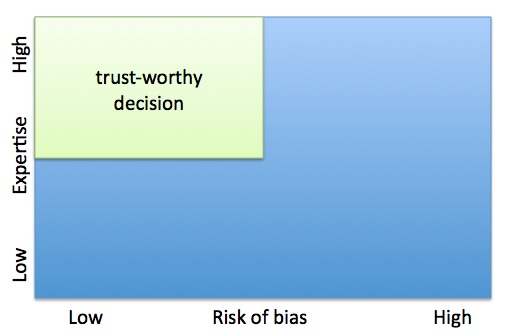
Note that what we’re looking for here is not the “highest possible” standard of integrity (i.e., the standard that implies the lowest possible risk of bias among decision-makers), but a system that makes the optimal tradeoff between risk of bias, on one hand, and relevant expertise, on the other. The point here is not that we’re trading off ethics and expediency. The point is that we’re trading off competing, ethically-significant values.
The point in thinking about ethics is not to aim at the highest standards, but at the best standards. We do enormous damage both to the functioning of organizations and to people’s willingness to talk openly about ethics when we talk about “high standards” in a way that comes off as unthinkingly pious.
The Ethics of Closing Up Shop
Filed under: accountability, corporate citizenship, decision-making, employees, ethics, management, values |
Comments (1)  At what point are a company’s misdeeds sufficiently grave that the right thing to do is simply to shut the doors, permanently?
As was widely reported yesterday, the printing presses at News of the World (part of Rupert Murdoch’s News Corp.) will be grinding to a stop after this Sunday’s edition. The paper’s shameful history of phone-hacking and other scuzzy “journalistic” practices has finally caught up with it.
Under what conditions is such a move the right one? When is a company obligated to commit the corporate equivalent of the ancient Japanese tradition of seppuku (a.k.a. harakiri), or even just to sacrifice a corporate “limb”?
Some people might say, “when doing so best serves the interests of your shareholders.” Others might say, “when doing so best serves the interests of the full range of stakeholders.” Still others might say that it has nothing to do with anybody’s interests, but rather with what’s in the the interest of justice. “Let justice be done,” as the ancient legal saying goes, “though the heavens fall.” So it may be thought that the organization, as a whole, needs to pay a penalty for its wrongdoing.
But there are of course counter-arguments that could apply, even where the corporate wrong is significant. For one, in shutting down an entire corporation for the wrongdoing of a few, you are effectively punishing a large number of innocent employees. And in some cases, that might be justified. Sometimes there is collateral damage along the road to justice. But surely that damage is not irrelevant.
In other cases, shutting a company down may amount to a cynical attempt to insulate sister companies or a parent company from fallout. Or to protect a favoured employee. In such cases, shutting the company is likely blameworthy, rather than worthy of praise. In such cases, surely the honourable thing to do is not to perform seppuku, but rather to stand to face the music. Accept the scrutiny, pay the price, and then rebuild under new management.
But all such considerations presume that the initial crime is sufficiently grave to make such an extreme solution plausible in the first place. In the News of the World case, the offence is serious and multi-faceted. Individual rights were violated; law enforcement officials were bribed; and the journalistic profession was arguably sullied. And all of that was perpetrated in pursuit of an utterly trivial objective, namely the production of yet more trashy tabloid “news.” Compare: there were few serious calls for BP to be dismantled after the Deepwater Horizon spill, despite that spill’s very serious human and environmental impact. But then, unlike News of the World, BP actually produces a socially valuable product.
Ethics of Golden Handshakes
Filed under: boards, decision-making, employees, governance, leadership, pay, stakeholders |
Comments (2) When an executive leaves in disgrace, what does the organization owe him or her? How should a Board handle such situations? In some cases, contractual obligations may seem to settle the matter, but contracts can be contested. Should they be? Does the IMF’s Dominique Strauss-Kahn deserve a quarter million dollars?
For further food for thought, see this story, by Tom Hals and Dena Aubin, for Reuters: Strauss-Kahn severance revisits CEO pay dilemma
The IMF now faces a challenge that keeps members of corporate compensation committees up at night: explaining why they may have to pay a handsome severance package to an indicted executive.
…
Former International Monetary Fund managing director Dominique Strauss-Kahn, facing charges of attempted rape in New York, resigned his post from the global lender on Wednesday.Strauss-Kahn’s contract entitles him to a one-time severance payment of $250,000, the IMF said on Friday….
Whether a Board of Directors should attempt to fight in order not to pay severance to an executive who has brought disgrace upon the organization is clearly going to depend on the circumstances. But it serves as a good example of the conflict between two different styles of moral reasoning. On one hand, a Board thinking primarily in terms of consequences might well reason this way: “Look, we need to get past this unfortunate incident. Let’s pay this guy the money his contract says he is owed, and be done with it. It’s better for the firm, overall, if we pay and get this finished.” On the other hand, a Board might think primarily in terms of justice: “This guy has brought shame (or at least notoriety) upon the organization. He doesn’t deserve a dime. We should fight for what’s fair.”
The tension between these two styles of moral reasoning is an ancient one, and it’s perfectly reasonable to find something attractive in both styles of reasoning. But the fact that both kinds of reasons might occur to a single group of people — a Board of Directors — in a single situation implies an interesting question. Even if we were to agree (even for sake of argument) that a Board of Directors’ main obligation is to serve the interests of the organization and its shareholders, that still leaves open this important question: should a Board of Directors seek the best outcomes for the organization and its shareholders, or should it seek justice for it and for them?
Should Boards Monitor CEO Morality?
Filed under: accountability, boards, CEOs, character, crime, decision-making, employees, governance, leadership, privacy |
Leave a comment A Board of Directors is responsible for overseeing the management and direction of a company, and that task includes monitoring the full range of risks to which a company might be subject. But what if the company’s CEO is one of those risks? What should a board do when a CEO’s off-the-job behaviour raises concerns? The IMF’s Dominique Strauss-Kahn is a case in point. Long before his recent arrest, Strauss-Kahn’s behaviour towards women raised eyebrows. Should it also have spurred the IMF’s Board to act?
See this story, by Janet McFarland, in the Globe and Mail: When and how to confront a wayward leader
Most corporate directors find it hard enough to confront a respected CEO about work-related poor performance, but it is even harder to tip-toe into the minefield of rumours about problems in an executive’s personal life.
(I’ve blogged before about whether ‘private’ vice is a business issue. I’ve also written about whether a CEO’s divorce is a purely personal matter or not.)
McFarland quotes me in her story, but let me give a slightly fuller version of my comments here.
To start, it’s worth making a distinction. There are personal vices that are strictly personal (including most of what goes on between consenting adults behind closed doors.) And there are personal vices that are very likely to impinge upon the workplace or on performance at work. A tendency to engage in sexual harassment is an obvious example, as is heavy drug use.) But, when you’re a CEO of a name-brand organization, that distinction tends to break down. High profile means that personal vices can turn public very quickly, and affect the organization.
Also, bad behaviour on the part of those in the public eye can easily lead to blackmail, which can result in misuse of position and other kinds of bad decision-making. This is another example of why great power brings great responsibility.
On the other hand, there are lines boards should be hesitant to cross, on principled grounds. A CEO’s sexual orientation, for example, should be off-limits. This is obviously less of an issue in 2011 than it would have been in 1951, but even today a gay CEO might be seen as a risk factor (especially for an organization with a conservative customer base) but boards should take a principled stand against taking an interest in their CEO’s sexuality. The board has fiduciary duties to protect the company, but even fiduciary duties have their limits.
The last point I want to make here is that, when faced with a CEO’s bad behaviour, a Board faces more than a yes-or-no question. The ethical question here is not just a matter of whether to confront the CEO, but how to do it. A Board in such a situation needs to formulate a plan — a method of proceeding, including answers to questions like:
- Will the Chair of the Board approach the CEO solo, or should an ad hoc committee do it?
- Should they raise the issue explicitly, or obliquely?
- Should they give the CEO an ultimatum, or ask his or her suggestions for how things might improve?
- Given various anticipated responses by the CEO, how will the Board/Chair plan to react in turn?
L.I.F.E. Lessons (A Short Guide to Ethics)
In this blog, I spend a lot of time talking about particular ethical issues in the world of commerce. “What are the limits on honesty in business?” “How should we handle conflicts of interest?” And so on. But one of the questions I get asked most frequently, as a professor and as a consultant, is about how to go about making ethical decisions, quite generally. It’s not an easy question. There have been many, many attempts to sum up our ethical obligations, none of them fully satisfactory. Naturally, you’re never going to find a brief summary — let alone a slogan or single word — that captures everything about how we ought to think about complex issues involving a range of values, virtues, and principles. But it can be useful to think in terms of a brief acronym that serves to jog the memory, to remind us of the major elements that make up our ethical responsibilities.
One way to think of ethics is in terms of what I call “L.I.F.E. Lessons.” Each of the letters in “L.I.F.E.” stands for a word that should play a crucial role in our moral reasoning:
L is for Loyalty. The “L” in “L.I.F.E.” reminds us that loyalty is in many ways the first virtue of organizational life. Loyalty, of course, should never be absolute: being loyal to your company or to your friends doesn’t imply that your company or your friends can do no wrong. Loyalty doesn’t mean being morally agnostic or refusing to take action when you see wrong being done. The focus on loyalty here is just to remind us that in various roles — as employee, as trustee, as leader — you have been entrusted by others to do your job and to do it right. When we voluntarily associate ourselves with particular people and organizations, the default setting is that they deserve our loyalty.
I is for Integrity. The “I” in “L.I.F.E.” reminds us that each of us should aim at integrity. Each of us is responsible for our own actions, and those actions should add up to a clear and consistent pattern of honest and trustworthy behaviour.
F is for Fairness. The “F” in “L.I.F.E.” reminds us of the importance of treating each other fairly. We should treat like cases alike, and give people what they are owed. Fairness is a value that has to do with the fact that we want not just to do good in the world, but to make sure that that good is distributed justly — whatever justice demands in particular cases.
E is for Empathy. Finally, the “E” in “L.I.F.E.” reminds us of the importance of figuring out how other people feel, in ethically-contentious situations, and what their point of view is. We need empathy in order a) to understand the impact that our actions really have on others, as well as b) to understand other people’s reasons, when our ethical judgment differs from theirs.
Again, there’s nothing magical about this way of thinking about ethics. It’s just a mnemonic, a kind of memory-jogger. Acting appropriately requires much more than this, especially on complex organizational contexts involving special role-specific obligations.
But still, I think the idea of “L.I.F.E. Lessons” amounts to a pretty good heuristic. We all know that loyalty, integrity, fairness, and empathy are crucial ingredients to leading an ethically-sound life, but it’s good to be reminded. And if life hasn’t taught you these lessons yet, those around you can only hope that it eventually will.
Ethics of Profit, Part 3: The Profit Motive
Filed under: character, competition, corporations, decision-making, ethics, finance, profits, white collar crime |
Comments (7)  This is the third in a 3-part series on the ethics of profit. (See also Part 1 and Part 2.) As mentioned in previous postings, we should distinguish between our ethical evaluation of profit per se (which, after all, just means financial “gain”), and our ethical evaluation of the profit motive. After all, I don’t worry at all that Big Pharma makes big profits — that just means that they make products that lots of people think are worth paying for — but I do have serious worries about what people inside the pharmaceutical industry are willing to do to maintain those profits.
But we should be cautious about jumping too quickly to criticize the profit motive, either in particular cases or as a force in the economy as a whole. Here are just a few points:
1) People often suspect the profit motive — or at least, excessive focus on the profit motive, in the form of greed — of being responsible for a lot of corporate wrong-doing. But, anecdotes aside, that intuitive hypothesis isn’t necessarily well-supported by the facts. I’ve mentioned previously a paper by philosopher Joseph Heath* that points out that there are problems with the theory that greed is the root cause of a lot of wrongdoing. Corporate crime is actually more often aimed at loss-avoidance than at profit-making. And it’s also worth noting that we see lots of white-collar crime occurring at the top of organizations, committed by people who are already rich and who hence have relatively little to gain in financial terms. As Joe points out, the criminological literature has long since discarded the notion that greed is the root of all (or even most) evil.
2) Despite the fact that the traditional corporate (and anti-corporate) rhetoric has focused on the significance of profits, it’s probably much more likely that corporations and the key decision-makers within them are moved by a much broader range of motives, including things like:
- A desire to increase market share;
- The desire to innovate;
- The desire to create cool products;
- Basic competitive drives to be (and prove yourself to be) bigger, stronger, faster, smarter, etc.;
- The CEO’s desire to build his or her personal legacy;
- etc.
Of course, each of those motives can almost certainly result in wrongdoing too. But that just reinforces the point that even if the profit motive causes trouble, it isn’t unique in that regard.
3) The profit motive, whatever else it may do, plays 2 absolutely essential roles in any modern economy. Economist Steven Horwitz points this out in his “Profit: Not Just a Motive”. One role (as Adam Smith pointed out) is the basic one of motivating productive activity. Now, Smith never said that the profit motive is the only thing that motivates people to engage in production and trade. But what he did say is that even someone who doesn’t happen to have much love for his or her fellow human being is liable to end up doing something productive, even if only because he or she wants to earn a living. The other role for the profit motive is more subtle, and has to do with information. As Horowitz puts it:
What critics of the profit motive almost never ask is how, in the absence of prices, profits, and other market institutions, producers will be able to know what to produce and how to produce it. The profit motive is a crucial part of a broader system that enables producers and consumers to share knowledge in ways that other systems do not.
4) The profit motive also plays an essential role in modern corporate governance. Most large corporations are “owned” (in a very loose sense) by shareholders, to whom corporate managers and directors owe a fiduciary duty. In particular, managers and directors are obligated to try to make a profit. (Note that, contrary to what many seem to think, there is no obligation to actually make a profit, and the need to make a profit is not, in fact, legally binding or overriding. Shareholders only ever get a profit after a number of other, legally-binding, obligations — such as the obligation to pay workers, to pay suppliers, to provide refunds for consumers who bought faulty products, etc. — are met.) The strong obligation to try to make a profit for shareholders provides focus for managers. Rather than being pulled in 20 different directions by 20 different stakeholders, corporate managers have in mind that, yes, they need to keep in mind various stakeholder obligations, but all of that has to be part of an overall plan aimed at shareholder profits. Many people believe that this imposes a kind of discipline on corporate executives, without which those executives would be free to feather their own beds, throw lavish parties for their favourite charities (not necessarily the most needy ones), hire under-qualified siblings for key roles, etc.
5) Getting rid of the profit motive would essentially mean abolishing private ownership. When we talk about “profit”, we’re typically talking about the money that flows from owning something. It might be the landlord’s profit (i.e., whatever’s left after costs are subtracted from rent) or the shareholder’s profit (i.e., the dividend that might be paid out on the shares he or she owns, if the corporation happens to make a profit). Abolishing the profit motive basically means and end to permitting individuals to own things. So why do critics of the profit motive so seldom (in the last, say, 4 decades) propose ending private ownership? Hmmm. As Joseph Heath put it in “Learning to love the Psychopath” [PDF] (a review of the movie, The Corporation), “If public ownership is not the solution, then private ownership cannot be the problem.”
6) Even if we could keep our attachment to private ownership and wish into existence more “positive” motives than the profit motive, it’s not clear that we would be better off. Even if large numbers of executives (and shareholders) could be convinced not to aim at profit, but instead to aim at things like charitable deeds or the public good or world peace, it’s not clear that that would solve the problems we are most worried about. Does anyone really think that fraud couldn’t be, or indeed hasn’t been, committed in the name of charity? Does anyone believe that lies haven’t been told and thefts committed in the name of the public good?
None of this is intended as a blanket endorsement of profit-seeking. It’s just a reminder that in our haste to criticize the profit motive, we ought not ignore important questions about just what role the profit motive plays, what current institutions do to transform a range of motives into a range of outcomes, and what alternative motives and institutions are available to us.
———
*Joseph Heath, “Business Ethics & Moral Motivation: a Criminological Perspective,” Journal of Business Ethics 83:4, 2008. Here’s the abstract.
Ethics of Shoe-Shine Pricing
Filed under: decision-making, employees, marketing, pay, pricing, profits, wages |
Comments (6)  A few days ago at the airport I stopped to have my shoes shined professionally, something I rarely do. The service was excellent. The guy doing the work was pleasant and knowledgeable, and the results were beautiful. The price, revealed at the end of the process: $6.75. I gave the guy a ten, and told him to keep the change. Now, that’s not exactly enough to make me think I’m a big spender, but it’s pretty good, percentage-wise (nearly a 50% tip). The guy sitting next to me did the same thing, by the way, and I’m betting that’s actually a pretty common pattern.
This got me thinking about the relationship between pricing, tipping, and currency denominations. If the price of the shoe-shine were $8.00, most people likely would still give the guy the same $10, resulting in a substantially smaller tip. But if the price were closer to $5, I bet most people would pull out a $5 bill and then looked for some change to add as a tip. So whoever sets the basic price for the shoe-shine has enormous power to influence the size of tips.
Now, the guy who shined my shoes was wearing a shirt bearing the logo of a chain of shoe care-and-repair stores, so I’m guessing he wasn’t setting his own prices. This implies that the company he works for, in addition to making a decision about his base pay, is also, through its pricing policies, making a decision that likely has an even bigger impact on his income. Of course, that decision is not entirely unrestricted. The company in question has to cover its costs. But presumably it has different pricing strategies open to it. Crudely, it can set prices high, which will likely keep demand down but will result in a big per-sale profit margin; or the company can set its prices low, and rely on volume. Either strategy might make economic sense. If (and that might be a big “if”) both strategies have the potential to work out equally well for the company, that means the choice is open, and the potential is there to base pricing on whichever strategy will do the most for employees in terms of providing customers an incentive for large tips.
(Another example: any bar manager that sets the price of a beer at $4.50 is pretty much ensuring that wait-staff are going to get lousy tips — the temptation for many people is going to be to plunk $5 onto the bar, resulting in a tip of 50 cents or 11%.)
But the factual foundation of this question, beyond my own anecdote, is all speculation on my part. I’ve never had a job where I relied on tips. Can anyone shed any light on the relevant facts, here? And does anyone know whether incentivizing tipping is something companies ever take into consideration in their pricing decisions?
Corporate Motives and Discrimination
Filed under: corporations, culture, decision-making, discrimination, employees, management, values |
Comments (1) Motives, especially corporate ones, are hard to figure. Some people, of course, are skeptical about the notion that an abstract entity like a corporation can have motives (or intentions or beliefs of attitudes or any of those sorts of things), even though we all have a tendency to talk about corporations as if they are capable of having them. It’s pretty common to talk about a company “expecting” profits to rise next year, or “wanting” to increase its market share, and so on. But even if we’re not so skeptical about attributing motives (etc.) to companies, their motives can be pretty elusive. We may not be ready to believe corporate spokespersons when they tell us what their company’s motives are, and besides, even if everyone within a company agrees that a certain course of action is the right one to take, it’s entirely possible that different parties within the company all have different motives for doing so.
But sometimes it’s good to at least try to understand what motivates companies, particularly when we want to diagnose a widespread and/or persistent problem, in order to suggest changes.
This question of determining motives came to mind when I read a story about an age discrimination case at 3M: “3M settles age-discrimination suit for up to $12M”.
3M Co. has agreed to pay up to $12 million to settle an age-discrimination lawsuit with as many as 7,000 current and former employees.
The 2004 lawsuit targeted the company’s performance-review system, alleging that older workers were disproportionately downgraded. It also accused the company of favoring younger employees for certain training opportunities that could fast-track them for promotions….
If we accept for the sake of argument that some sort of systemic discrimination took place at 3M, what on earth might have motivated such behaviour?
Here are a few possibilities:
- Profits. Maybe the discriminatory practices and policies were an attempt to increase efficiency in order to boost profits. This of course is the go-to assumption for most corporate critics.
- Energy. Maybe those who engaged in age discrimination weren’t thinking specifically about the end goal of profits, but merely had a certain vision in mind of the kind of company they ought to have, and the kind of youthful energy that makes a company vibrant.
- Recruitment. Maybe 3M wanted to give younger employees lots of opportunities so that they could brag about opportunities for young employees when recruiting new talent. Most recruits, after all, are likely to be young, and ambitious young people are likely to be drawn to a company that holds the promise of great opportunities.
- Bias. It could be that various key decision-makers inside 3M were simply personally biased, as many (most? all?) of us are, against older employees.
- Justice It’s at least possible that key decision-makers within 3M actually thought that giving preferential treatment to younger employees was the morally-right thing to do. Quick, ask yourself this: if 2 patients each need a heart transplant, and you’ve got just one donor heart, and one patient is 15 and the other is 55, who would you give the heart to? Surely all of us are tempted, from time to time, to think that the young are particularly deserving of opportunities. Note that I’m not defending such a view, here.
What do you think? Note that the point here is not about the 3M case, but about what could motivate a company, any company, to engage in discriminatory behaviour. And again, I think it’s worth contemplating the possibility that there simply was no corporate motive (nor maybe even a truly corporate “cause”).
Critical Thinking in Business Ethics, Part 3: Fallacies
Filed under: complexity, critical thinking, decision-making, definitions, ethics, excuses |
Comments (2)  This is the 3rd in a series of occasional postings on the role of critical thinking in business ethics.Critical thinking is about a) how to construct good arguments, and b) how to spot and avoid bad ones. The focus of this posting will be on the latter. Bad arguments come in many forms, in many shapes and sizes. But some faulty arguments follow patterns of reasoning that are so common that they’ve acquired names. The general term for such named patterns of faulty argumentation is “fallacy”. There are many known fallacies, and textbooks on critical thinking typically devote a chapter to discussing a dozen or more of the most common ones.
Here are just a few examples of fallacies that could hinder good reasoning about Business Ethics.
One common fallacy is known as “the fallacy of composition.” We commit the fallacy of composition any time we assume, without justification, that the characteristics of the parts of a thing are automatically shared by the thing as a whole. A silly example: the fact that each piece of a motorcycle is light enough to lift doesn’t mean that the motorcycle as a whole is light enough to lift. Likewise, the fact that each member of a committee is talented and effective does not mean that the committee as a whole will be talented and effective — group dynamics matter. A business-ethics example follows pretty quickly from that one: from the fact that each member of your organization is ethical and well-intentioned, it does not follow that your organization, as a whole, will always act ethically. Team dynamics and institutional structure matter. That’s not to say that having ethical employees isn’t important. It obviously is. The point is just that you can’t automatically assume that, because you’ve got good employees, the net result of their behaviour will always be ethical. Another important example: from the fact that individual ethical acts don’t always pay, it doesn’t follow that an ethical pattern of behaviour won’t pay off in the long run.
Here are some other standard fallacies with clear relevance to business ethics. I’ll leave it to the reader to think up examples.
- “Appeal to the Person” (a.k.a. ad hominem attack), which generally involves attacking the person putting forward a point of view, rather than examining the strengths and weaknesses of that person’s argument. It’s important to keep in mind that a well-reasoned argument from someone you don’t like is still a well-reasoned argument.
- “Appeal to Tradition“, which typically means using the fact that “we’ve always done things this way” as a reason for continuing to do things that way. Clearly a recipe for disaster.
- “Appeal to Popularity“, which involves appealing to the fact that a particular point of view or practice is popular as a reason in favour of that view or practice. But being widely-believed is of course a very poor indicator of whether or not a claim is actually true.
- “Straw man” argument, which involves setting up, and then knocking down, a weak or foolish-looking “dummy” version of your opponent’s argument. This is a common rhetorical device. Whenever someone criticizes a particular bit of regulation, for example, it’s easy (but wrong) to paint them as a “rabid free-market neoliberal,” and then to attack that ideology, rather than looking at the substance of their argument.
One of the reasons such fallacies are so dangerous is that they tend to be psychologically appealing. Sometimes they’re appealing because they play to our biases. And sometimes they’re appealing just because they act as short-cuts, letting us take the easy (i.e., lazy) route straight to a simple conclusion, without doing the hard work of actually looking critically at the case at hand. But in business ethics, what we really need are the best answers, not the easiest ones.
——–
See also Part 1 and Part 2 in this series.



 The Business Ethics Blog