Financial Advice, Competency, and Consent
Filed under: consumers, decision-making, ethics, finance, investing, professionalism, trust |
 Comments (1)
 I blogged recently on a California case about an insurance agent who was sentenced to jail for selling an Indexed Annuity — a complex investment instrument — to an elderly woman who may have been showing signs of dementia. I argued that giving investment advice is just the sort of situation in which we should expect professionals to live up the standard of ‘fiduciary’, or trust-based duty. An investment advisor is not — cannot be — just a salesperson.
But asserting that investment advisors have fiduciary duties doesn’t settle all relevant ethical questions. It settles how strong or how extensive the advisor’s obligation is; but it doesn’t settle just how the financial advisor should go about living up to it.
The story alluded to above again serves as a good example of that complexity. How should a financial advisor, in his or her role as fiduciary, handle a situation in which the client shows signs of a lack of decision-making competency? Sure, the advisor needs to give good advice, but in the end the decision is still the client’s. How can an advisor know whether a client is competent to make such a decision?
In the field of healthcare ethics, there is an enormous literature on the question of ‘informed consent,’ including the conditions under which consent may not be fully valid, and the steps health professionals should take to safeguard the interests of patients in such cases.
The way the concept is explained in the world of healthcare ethics, informed consent has three components, namely disclosure, capacity and voluntariness. Before a health professional can treat you, he or she needs to disclose the relevant facts to you, make sure you have the mental and emotional capacity to make a decision, and then make sure your decision is voluntary and uncoerced. And the onus is on the professional to ensure that those three conditions are met. But there’s really nothing very special about healthcare in this regard. Selling someone an Indexed Annuity isn’t as invasive, perhaps, as sticking a needle in them, but it often has much more serious implications.
Of the three conditions cited above — disclosure, capacity and voluntariness — disclosure is of course the easiest for those in the investment professions to agree to. Of course you need to tell your client the risks and benefits of the product you’re suggesting to them. But of course, many financial products have an enormous range of obscure and relatively small risks — must the client be told about those, too? There’s only so much time in a day, and most clients won’t care about — or be able to evaluate — those tiny details.
Voluntariness might also be thought of as pretty straightforward. A client who shows up alone and who doesn’t seem distressed is probably acting voluntarily, and it’s unlikely that we want investment professionals poking around our personal lives to find out if there’s a greedy nephew lurking in the background and badgering Aunt Florence to invest in penny stocks.
What about capacity? That’s the tough one, the one implicated in the court decision alluded to above. Notice that in most areas of the market, no one tries to assess your capacity before selling to you. I bought a car recently, and all the salesperson cared about was a driver’s licence and my ability to pay. No one tried very hard to figure out if I was of sound mind — beyond immediate appearances — and hence able to make a rational purchase.
Investment professionals do typically recognize a duty to ensure the “suitability” of an investment, and presumably whether an investment is suitable depends on more than just the client’s financial status. It also depends in part upon whether the client is capable of understanding the relevant risks. Being a true professional and earning the social respect that goes with that designation is going to require that financial advisors of all sorts adopt a fiduciary view of their role. That means learning at least a bit about the signs of dementia and other forms of diminished capacity. It also means knowing how and when to refer a client to a relevant health professional. Finally and most crucially, it means putting the client first — solidly and entirely first — and hence being willing to forego a sale when that is clearly the right thing to do.
Investment Advice and Fiduciary Duties
Filed under: complexity, consumers, ethics, finance, honesty, investing, law, professionalism, trust |
Comments (6) Most of us rely on accredited professionals for a range of services. Doctors, lawyers, accountants and so on play a huge role in our lives, giving us advice and rendering services that we would be foolish to provide for ourselves. Some topics, in other words, are beyond the ken of even the dedicated do-it-yourselfer. Financial planning is in that category. If you plan to do anything much beyond storing your money in a mattress, you probably want help from a professional. And you hope — really, really hope — that that professional is on the ball and has your best interests at heart.
A recent story highlights some of the difficulties in this regard. The story is about an independent insurance agent facing jail time for selling a particular kind of investment — an indexed annuity — to an 83-year-old woman. The catch: prosecutors say the woman showed signs of dementia, and the implication is that the agent took advantage of the fact that the buyer may not have understood the limits and disadvantages of the investment instrument she was buying.
Even minus the question of the buyer’s competency, there are worries here. For perspective on this story, I talked to Prof. John Boatright, who literally wrote the book on ethics in finance. He pointed out to me that Equity-Indexed Annuities are so complex that they’re a dubious product quite generally. He also pointed out that such annuities are investment instruments sold by people in the insurance industry who are not truly investment specialists. Most investment instruments are regulated such that they can only be sold by investment professionals with suitable training and credentials.
But regardless of the kind of professional you go to for investment advice, the underlying ethical question is whether that professional is going to have your best interests at heart. When the thing you’re buying is too complex to understand, you have to put your trust in the seller. Such trust is best underpinned by what are called fiduciary duties. A fiduciary, roughly speaking, is someone to whom something of value is entrusted. And a professional who bears a fiduciary duty has a stronger obligation than a mere salesman. Someone out to sell you something — a car, a stereo, whatever — has a plain obligation not to deceive you, but generally isn’t obligated to make sure that the product is right for you. Whether the product is right for you is up to you to decide. But a fiduciary is held to a higher standard. As Alexei Marcoux points out, we are vulnerable in various ways to professionals of various kinds, and that vulnerability generates duties on the part of those professionals, not just to be honest to us but to put our interests first. The transaction between a professional and a client is not a regular market transaction; rather, it is (or ought to be) governed by the higher standard implied by a fiduciary relationship.
Whether financial advisors and financial planners proclaim and live up to such a high standard is another matter. It certainly seems they should. In some places, financial professionals are explicitly expected to live up to the standard applied by a fiduciary duty, and other jurisdictions are moving in that direction. If ever there were a circumstance in which we were vulnerable, a situation in which we are trusting a stranger to tell us what to do with our life’s savings seems to fit the bill.
What Determines Consumer Value?
 Is it ethically OK for a manufacturer to reduce the amount of product in a package, but to keep charging the same for it?
Here’s an interesting example. The image shown here shows three varieties of Kraft Peanut Butter — Smooth, Extra Creamy, and Whipped. Notice that all three varieties are in jars of the same size, and all three cost the same. The ingredients are also virtually the same. But notice also that the one on the right — the Whipped peanut butter — includes one special ingredient not listed on the label. That ingredient also happens to be one that is free to the manufacturer, and that takes up a lot of space in the jar. That ingredient is air.
Yes, whipping peanut butter (like whipping cream or anything other liquid or paste) adds air to it. It fluffs it up. So if you look closely you’ll see that the label on the jar of Smooth peanut butter indicates that its contents weigh 1 kilogram (1000 grams). But the label on the jar of Whipped peanut butter indicates that its contents weigh just three quarters of a kilo, or 750 grams. The result is that when you buy a jar of whipped peanut butter, you’re getting 25% less peanut butter, or a jar that is effectively 1/4 full of air.
From a manufacturer’s point of view, this is wonderful. Being able to charge just as much while reducing the amount, and cost, of ingredients by a quarter is something of a coup.
Is it fair to the consumer? Or is the consumer being ripped off, getting less peanut butter for the same price? Is the consumer getting less value?
Well, no, I don’t think the consumer is being ripped off, though I suspect some will disagree with me. The 750g jar of Whipped peanut butter contains no less value than the 1000g jar of Smooth peanut butter precisely because there’s nothing to say that 750g of the one is less valuable than 1000g of the other. They’re different products, despite having the same ingredients. The value of a thing is absolutely not determined by its ingredients; all that its ingredients (or rather their cost) determines is the lowest level at which the product could be sold without the seller suffering a loss. A thing’s ingredients no more determine its value than does the amount of labour that went into it.
Or rather, no one can say that 750g of one thing is worth less than 1000g of the other, other than the customer. What matters is how the customer values those two things. If the customer finds 750g of Whipped PB to be as useful to them as 1000g of Creamy, then charging the same price seems perfectly fair. Consumers who disagree are naturally free to object — that is, to refuse to make a purchase. But that, I’m afraid, would be akin to cutting off their noses to spite their faces.
McDonald’s and the Ethics of Olympic Sponsorship
Filed under: advertising, brands, food, health, marketing, protest, sponsorship, sports |
Comments (2) McDonald’s has been taking some heat over its continuing sponsorship of the Olympics. The fast-food chain recently announced that it would remain a top sponsor of the Olympic games through 2020.
The main charge here seems to be some form of hypocrisy. Critics suppose that there’s some sort of contradiction involved in a sporting event being sponsored by a fast-food chain. But there is, of course, no contradiction at all — at least not for those of use who take both our sports and our junk food in moderation. True, a diet that includes frequent trips to McDonald’s (or Burger King or Wendy’s, etc. etc.) seems inconsistent with a lifestyle aimed at maximal athletic output. There’s a real conflict there. But few of us are aiming at elite sporting status, and relatively few of us (thankfully) make Big Macs a staple. Most of us enjoy both sport and junk food in moderation. For us, the occasional serving of greasy fries does absolutely no harm at all to our athletic aspirations. There’s no contradiction in loving, say, both a Quarter Pounder With Cheese and training for a Half Marathon. So there’s no inherent contradiction involved in McD’s sponsoring the Olympics.
And really, if anyone is to blame, it’s not McDonald’s but the International Olympic Committee, and/or whatever subcommittees or functionaries are assigned the task of signing sponsors. After all, it’s their supposed values, not the fast-food chain’s, that this sponsorship deal presumably violates.
But supposed value-conflicts aside: what about the effect of such the McDonalds/Olympics alliance on, for example, kids? Well, note to start that kids don’t watch the olympics much. As for the rest of us, well we need to come to grips with the fact that our economic system features certain warts. And one of those warts is that the freedom to buy-and-sell means the freedom to sell things the over-consumption of which is harmful. And the freedom to sell such things implies the freedom to advertise them. Is affiliation with McDonald’s jeopardizing the positive impact of the Olympics? So be it. Our system of free commerce is a system that brings with it enormous benefits, far more benefits than will ever be derived from one hypertrophied sporting event.
The Right Amount of Waste
Filed under: crime, efficiency, energy, environment, markets, pollution, values |
Comments (2)  A recent story in the NY Times provides some encouraging anecdotes about companies that are moving to take greater responsibility for recycling. Companies like Starbucks and Coca-Cola, for instance, are finding new — and in some cases profitable — ways to take responsibility for the waste that their product packaging generally becomes. More recycling generally means less waste, less energy used, and less pollution.
Waste and pollution are business-ethics topics about which there is some room for agreement between the moralist and the economist. The moralist points out that it’s unfair to make innocent bystanders suffer the ill effects of your factory’s pollution. The economist points out that market inefficiency can result when costs, financial or otherwise, are not internalized (i.e., when costs are instead imposed on innocent third parties).
But an economically-savvy point of view must also recognize that there is in fact a socially-efficient level of waste and pollution, and that that level is not zero. Waste and pollution could only be driven to zero by shutting down industry (of all kinds) altogether, and that would have disastrous effects. In other words, we would have to sacrifice things we care about, like the ability to raise world-wide standards of living, in order to reduce pollution and waste to zero.
Consider this analogy: economists likewise sometimes argue, rightly I think, that there is an efficient level of crime. The methods by which crime could be driven to zero are both enormously invasive and enormously costly. It is not efficient — not a good use of resources — to drive crime to zero, even if we think it technically possible.
So waste and pollution, we might say, are always bad, but not always wrong. They are features of a system the overall productivity of which is an enormous boon to humankind. It would be crazy to say that gains in productivity must be sought at any cost, but it is likewise crazy to value anything else (e.g., the environment) so highly that it drowns out all considerations of efficiency.
Now none of this tells us about whether particular efforts at waste reduction or pollution abatement are good or bad. But it helps frame the issue. What we’re looking for is the right level of pollution and waste, and that level is not zero. It is also likely to shift over time, as affluence grows and technology evolves, and as companies like Coke and Starbucks and a thousand anonymous start-ups find new ways to make environmental protection efficient, in the broadest, most ethically-significant sense of the word.
The True Cost of Conflict of Interest
Filed under: accountability, conflict of interest, education, employees, lobbying, marketing, scandal, taxpayers, trust |
Comments (3) What does conflict of interest cost?
It was recently reported that certain employees of the Chicago Public Schools food services department were going to be required to undergo ethics training, after it was revealed that they had accepted improper gifts from contractors.
The worry, naturally, is that accepting gifts put those CPS employees into a conflict of interest, a situation in which they were trusted to make good decisions on behalf of CPS, but in which they had an ‘outside’ interest — in this case, gratitude to the gift-givers — that might reasonably be thought likely to warp their judgment. The behaviour here was more specifically a violation of the section of the CPS Code of Ethics that specifically forbids accepting gifts, but the moral root of the problem is conflict of interest.
Now, in addition to the trouble the employees are in, it’s been reported that Chicago Mayor Rahm Emanuel wants to go after two food services companies that had given improper gifts.
Just what have those companies done wrong? What’s wrong with putting someone else in a conflict of interest? I’ve argued before that we might think of this as analogous to suborning perjury. When you intentionally put someone else in a conflict of interest, it means that even if you’re not violating any duties yourself, you’re encouraging other people to violate their duties.
And the companies’ bad behaviour, here, is going to cost them. It may well cost them future contracts, but it may cost them (and other companies that want to compete for CPS contracts) more than that. It’s been reported that they may be required to provide ethics training for their employees, and hire an independent auditor to make sure they’re complying with CPS ethics standards. Neither of those things is likely to be cheap. In an industry with narrow profit margins, such additional costs could well mean the difference between black ink and red.
But the most important “cost” in this case is, of course, the loss of confidence in the CPS and its purchasing procedures. That is always the risk with conflict of interest, namely that when conflicts are accepted and fostered, rather avoided or remedied, they erode confidence in the judgment not just of individuals, but of entire institutions.
Apple: The Ethics of Spending $100 Billion
Filed under: accountability, boards, charity, decision-making, economics, environment, governance, shareholders |
Comments (4) What’s the best thing to do with a hundred billion dollars? Apple — the world’s richest company — gave its answer to just that question, when it announced yesterday how it will spend some of the massive cash reserve the company has accumulated.
Of course, spending the whole $100 billion was never on the agenda. The company needs to keep a good chunk of that money on-hand, for various purposes. Then there’s the fact that a big chunk of it is currently held by foreign subsidiaries, and bringing it back to the US to spend it would require Apple to pay hefty repatriation taxes. But any way you slice it, Apple has a big chunk of cash to spend, and so its Board faces some choices.
In the abstract, there are lots of things one could do with that much money. Financial analysts had rightly predicted that Apple company would decide to pay out a dividend (for the first time since 1995). Some were predicting bolder moves, like buying Twitter (which would use up a mere $12 billion). But what could Apple have done with that much money, aside from narrow strategic moves?
The money could have, in principle, been spent on various charitable projects. That amount of money could also do a lot towards helping developing countries combat and adapt to climate change. Or it could revolutionize the American education system. Closer to home, the company could spend a bunch on improving working conditions at its factories in China, conditions for which the company has been widely criticized. All of these, and many more, are (or rather were) among the possibilities.
But business ethics isn’t abstract; Apple’s Board faced a concrete question. And the Board has ethical and legal obligations to shareholders. Those aren’t its only obligations, but once workers are paid, warranties are honoured, expenses are covered, and relevant regulations are adhered to, the main remaining obligation is to shareholders.
Now, there’s a significant strain of thought that says that a company’s managers (and its Board) are not there just to serve the interests of shareholders, but also to carry out shareholders’ obligations. So, if you believe that Apple shareholders have an obligation to fight climate change or to promote education or to improve conditions for workers, then maybe it makes sense to think that the company ought to help shareholders to act on that obligation. But keep in mind that Apple’s shareholders are a rather amorphous group. Shares in corporations change hands incredibly frequently, and the interests and obligations of shareholders vary significantly, so a Board ‘represents’ shareholders (or acts as their agent) only in a rather abstract sense.
The alternative, of course, is for Apple’s Board to give itself some leeway, forget about what shareholders’ collective obligations might be, and go back to thinking abstractly about what to do with that big pile of cash. They can simply decide whether the shareholders’ financial interests outweigh their collective obligation to do some good with that money, and simply decide which of the various worthy causes it should go to. But of course, lots of people are rightly uncomfortable with the idea of well-heeled corporate boards arrogating to themselves that kind of power. The question for discussion, then, is this. Which is the greater evil? For corporations not to step up to the plate and contribute to social objectives, or for corporate leaders to presume to spend vast sums of money as if it were their own?
Greg Smith, Goldman Sachs, and Corporate Culture
Filed under: banking, corporations, culture, employees, ethics, governance, trust |
Comments (6) By now everyone has heard that a guy named Greg Smith wrote a letter this week. Who is Greg Smith and why does anyone care? Why is Greg Smith’s letter getting attention from anyone who isn’t a Goldman Sachs employee, customer, or shareholder? Sure, he’s a mid-level executive at one of the world’s most powerful financial institutions. So he’s certainly not a nobody. And sure, Goldman, like other big financial institutions today, is seen by many as the corporate embodiment of evil, and so people are bound to be fascinated by an insider’s repudiation of the firm — especially accompanied, as it was, by a good dollop of juicy details. But there’s more to it than that, and the “more” here is instructive.
I think the key to understanding why Smith’s letter caused such an uproar is the fact that Greg Smith’s letter taps into the deep, dark fear that every consumer has, namely the fear that, somewhere out there, someone who is supposed to be looking out for us is instead trying to screw us. Smith’s letter basically said that that is exactly what is going on at Goldman, these days: the employees charged with advising clients about an array of complex financial decisions are, according to Smith, generally more focused on making money than they are on serving clients.
Now, first a couple of words about the letter. It goes without saying that we should take such a letter with a grain of salt. It’s just one man’s word, after all. Now that doesn’t make Smith’s account of the tone at Goldman implausible. He’s not the first to suggest that there’s something wonky at Goldman. It just means that we should balance his testimony against other evidence, including for example the kinds of large-scale surveys of Goldman employees that the company’s own response to Smith’s letter cites. Then again, such surveys are themselves highly imperfect devices. Either way: buyer beware.
(Note: one group that must take this stuff seriously is Goldman’s Board of Directors. A loyal employee taking a risk like Smith has is not a good sign, and his story deserves to be investigated thoroughly by the Board.)
OK, so let’s bracket the reliability of Smith’s account, and ask — if it accurately reflects the tone at Goldman — why that matters.
It matters because of this awkward fact: in many cases, in business, all that stands between you the customer and getting ripped off is that amorphous something called “corporate culture.” Most of us are susceptible to being ripped off in all kinds of ways by the businesses we interact with. That’s true whether the business in question is my local coffee shop (is that coffee really Fair Trade?) or a financial institution trying to get me to invest in some new-fangled asset-backed security. My best hope in such cases is that the business in question fosters a culture within which employees are expected to tell me the truth and help me get the products I really want.
Now culture is a notoriously hard thing to define, and harder still to manage. Culture is sometimes explained as “a shared set of practices” or “the way things are done” or “the glue that holds a company together.”
Why does culture matter? It matters because, other things being equal, the people who work for a company won’t automatically feel inspired to spend their day doing things that benefit either the company or the company’s clients. People need to be convinced to provide loyal service. In part, such loyalty can be had through a combination of rewards and penalties and surveillance. Work hard, and you’ll earn a bonus. And, Treat our customers well, or your fired. And so on.
But sticks and carrots will only get you so far. Far better if you can get employees to adopt the right behaviours voluntarily, to internalize a set of rules about loyal service and fair treatment. An employee who thinks that diligence and fair treatment just go with the turf is a lot more valuable than one who needs constantly to be cajoled. And, humans being the social animals that we are, getting employees to adopt and internalize a set of rules is a lot easier if you make it part of the ethos of a group of comrades. Once you’ve got the group ethos right, employees don’t act badly because, well, that’s just not the sort of thing we do around here! In the terminology used by economists and management theorists, culture helps solve ‘agency problems.’ Whatever it is that you want employees to be focusing their energies on, corporate culture is the key.
Of course, there’s still the problem of what exactly employees should be focusing their energies on. Should they be taking direct aim at maximizing profit? Or should they be serving customers well, on the assumption that good service will result in profits in the long run? In any reasonably sane market — one without ‘TBTF‘ financial institutions — the latter strategy would be the way to go, practically every time. And that fact is precisely what makes large-scale commerce practical. Consumers enjoy an enormous amount of protection from everyday wrongdoing due to the simple fact that most businesses promote basic honesty and decency on the part of their employees.
Unfortunately, it’s far from clear that Goldman operates in a sane market. So it is entirely plausible that the company could have allowed its corporate culture to drift away from seeing customers as partners in long-term value creation, toward seeing them as sources of short-term revenue. I don’t know whether Greg Smith’s tale is true, and representative of the culture at Goldman Sachs. But if it is, that means not just that Goldman isn’t serving its clients well. It means that Goldman embodies a set of values with the potential to undermine the market itself.
Tourism as Foreign Aid
Filed under: aid, consumers, profits, supply chain, tourism, trade |
Comments (2)  A couple of weeks ago, I spent 5 days contributing to the economic wellbeing of a developing nation. To be more specific, I spent 5 days in Mexico, at an all-inclusive resort on the Mayan Riviera. I’m a lucky, lucky man, no doubt. So in what sense does my vacation count as “contributing to the economic wellbeing of a developing nation”?
Now, to be clear, this is a personal example, and so there’s reason for me to worry about the clarity of my own thinking (even now that the margaritas have long-since worn off.) Am I just congratulating myself in order to get past the uncomfortable feeling that many people from affluent nations feel at enjoying luxury while visiting a nation rife with poverty? After all, the tourism industry is often portrayed as one that helps mostly-white Northerners visit places where they pay mostly-brown inhabitants of southern climes to call them “sir” or “ma’am” — with the profits going largely to the mostly-wealthy shareholders of the cruise-line or resort chain.
But is that portrayal of the industry accurate? Let’s take a very rough look at the economics, here.
Let’s say a vacation package — flight plus accommodations at an all-inclusive resort — costs something like $1500 per person, just to pick a round number. Where does the money actually go? Who does it help? By vacationing in Mexico, am I helping Mexicans, or just the shareholders of some American or Canadian corporation?
A big chunk of that $1500, maybe a little less than half, goes to the airline. Aha! Profits for the airlines!
But wait a minute. Profit margins in that industry are razor-thin — in some years, negative! So most of the airline’s half of that $1500 isn’t actually going to shareholders in the form of profits, but is instead going to cover the airline’s costs, including fuel, salaries, etc.
The other half ($750) of the total price goes to the resort. How much of that is profit? One source (a few years old) puts profit margins in the resort industry at about 8%. Let’s be generous and round up to 10%. That means $75 profit, which leaves $675 for various costs — including the cost of food, labour, alcohol, maintenance of buildings, and so on. And it’s a truism of economics that $675 in costs for them is $675 in income for someone else.
And so, overall, only a tiny sliver of the money paid for such a vacation goes to the shareholders of the airline and of the company that owns the resort. Most goes to employees, and suppliers, and employees of suppliers, and so on. About half of that stays in Canada (home of the airline) and almost half stays in Mexico (where the employees and key suppliers of the resort are). By my very rough math, I contributed nearly $700 to the Mexican economy, and more specifically to the income of low-wage Mexicans. And it’s a kind of help I’m very happy to give.
So the questions for discussion: “Is my math at least roughly right?” and “Is this the sort of math those of us who aspire to ethical tourism ought to be doing?” Of course, I’m setting aside for now the environmental impact of such a trip. I’ll leave that for a future blog entry. But at very least, it seems to me that a rough assessment of the economic impact of a vacation is a pretty good starting point.
Insider Trading and Market Integrity
Filed under: accountability, conflict of interest, consultants, insider trading, law, regulations, risk, white collar crime |
Comments (2) 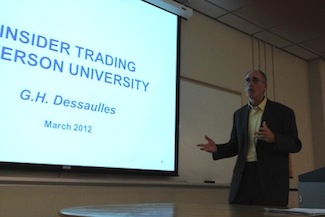 Cheng Yi Liang, a chemist for the US Food and Drug Administration, has been found guilty of Insider Trading and sentenced to 5 years in prison. (I first blogged about this case back in March, when Liang was arrested.)
As it happens, the Liang verdict dovetailed nicely with the topic covered yesterday in the Management Ethics class I teach at the Ted Rogers School of Management. The class was led by a terrific guest speaker, compliance consultant and retired RBC compliance officer Georges Dessaulles.
The Liang case serves as a great example of one of the points Georges emphasized in his presentation, namely that when it comes to Insider Trading, highly-placed executives are far from the only concern. In the Freeport McMoran case in the mid-90’s, for example, the central figure was a consulting geologist, not an employee of the mining company itself. In the 2001 case related to Nortel’s acquisition of Clarify, the central figure was an executive working at a public relations firm that had a contract with Clarify. And now, in the Liang case, the guilty party not only didn’t work for the company in question, he didn’t have any contractual or other financial relationship with the company. Instead, he was a scientist at a regulatory agency. Other cases have involved administrative assistants, or even employees at companies printing corporate reports.
This highlights an important point about the ethics of insider trading. The stereotypical cases of insider trading involve executives, making use of undisclosed knowledge to gain an unfair advantage over outsiders in buying or selling stock. In taking unfair advantage, executives not only perpetrate a basic injustice, but also violate their duties to shareholders. But the kinds of cases cited above point to a different reason for the wrongness of insider trading. In the Freeport and Nortel cases, and now in the FDA case, the central figure wasn’t someone with direct obligations to corporate shareholders. There was thus no breach of fiduciary duty (at least not in the usual sense). What’s really at stake, in such cases, is the undermining of the basic principle of free-and-voluntary exchange on which the a free-market economy is based.
The challenge for organizations is to make sure that employees and contractors with access to sensitive information understand the definition of — and penalties for — insider trading. But that’s a serious challenge, especially at big companies. Better still would be for more people to understand the moral underpinnings of free markets quite generally, and to have the moral reasoning skills to figure out the rest from there.



 The Business Ethics Blog