Want to Avoid Scandal at the Top? Hire a Woman!
Filed under: boards, CEOs, character, discrimination, scandal, sex |
 Comments (1)
 There’s an antiquated quip / greeting-card slogan / bumper sticker that says, “Sometimes the best man for the job is a woman.” I say “antiquated” because in 2011, we all know that very often — let’s say half the time — the best person for the job is a woman. That’s far beyond “sometimes.” But there’s one job-related talent that seems to make women especially qualified for positions of senior leadership, and that is their apparent ability to avoid bringing themselves, and their organizations, into disrepute by involving themselves scandals.
See this story by Sheryl Gay Stolberg, for the NY Times: When it Comes to Scandal, Girls Won’t Be Boys
Female politicians rarely get caught up in sex scandals. Women in elective office have not, for instance, blubbered about Argentine soul mates (see: Sanford, Mark); been captured on federal wiretaps arranging to meet high-priced call girls (Spitzer, Eliot); resigned in disgrace after their parents paid $96,000 to a paramour’s spouse (Ensign, John) or, as in the case of Mr. Weiner, blasted lewd self-portraits into cyberspace….
Now, Stolberg’s piece is about male vs female political leadership. But the same point can be made in the corporate world. What do the names Skilling, Madoff, Boesky, and Hurd all have in common? Well in addition to referring to persons implicated in major scandals, they all have the title “Mr” in front of them. Indeed, it’s relatively hard to name a female CEO or other senior executive who was culpable in a headline-making scandal. Martha Stewart’s name comes to mind, but her insider trading had nothing to do with her executive position. (And sure, Oprah Winfrey, CEO of Harpo Productions, gave Jenny McCarthy her own TV show, but that’s a different kind of scandal.)
Of course, we have to be careful with letting anecdotes stand in for stats, here. The first and most obvious reason why my male CEOs are involved in more scandals is because there are more CEOs. According to the Globe and Mail, “Only 17 per cent of corporate officers and 13 per cent of directors at Canada’s top 500 private and public sector companies are female.” According to Catalyst (a nonprofit aimed at expanding business opportunities for women), only 30 of The Financial Post 500 companies are headed by women. In the US, the numbers seem even lower: as of 2009, there were just 13 female CEOs in the Fortune 500.
Still, it does seem that males are liable to be involved in scandals out of proportion to their statistical dominance in the C-suite. Male CEOs seem more likely to behave badly than female ones. Does this have anything to do with the documented correlation between testosterone and financial risk-taking? Hard to say. But it wouldn’t be that surprising if a tendency toward risky behaviour in one domain were correlated with a tendency toward risky behaviour in another.
So should boards of directors actually discriminate against men, given the male tendency to become embroiled in scandals? No. For one thing, the fact that “more” male CEOs than female CEOs seem to get into hot water has to be put into context: very few CEOs of either sex get themselves into the kind of trouble that makes headlines. So to say that men are more likely to get into trouble is like saying that the risk of getting hit by lightning is higher than the risk of shark attack: both risks are in fact tiny. And besides, we probably don’t want to advocate discrimination against individuals based on their membership in a group that merely has a statistical tendency towards a particular weakness. But then again, such a statistically-driven hiring bias might well be better than the entirely baseless bias that results in their being so few female CEOs in the first place.
Ethics on Business Magazine Websites
I’ll start by highlighting the obvious conflict of interest, here: my blog is carried on the website of Canadian Business magazine. In this blog entry, I effectively congratulate CB for highlighting ethics. So this is not an unbiased blog entry, but hopefully the facts I present here speak for themselves and stand on their own.
Ethics in business is clearly a hot topic these days, whether discussed using the word “ethics” itself or one of the mushier terms like “CSR” or “sustainability” or “corporate citizenship.” Even those who are cynical about the topic cannot deny that it is an important topic.
But here’s an interesting fact. At time of writing, only two major business magazines (Canadian Business and Fast Company) feature ethics and/or CSR on the front page of their websites. The Economist, Forbes, Fortune, and Business Week do not.
Here’s slightly more detail:
- Canadian Business has both Ethics and CSR listed on the front page.
- Fast Company has a link called Ethonomics on its front page (right at the top), which leads to a section featuring a pretty steady stream of social responsibility blog postings.
- Forbes has a CSR blog but it is very hard to find if you start from the site’s main page. You need to click on “Leadership” (not at all obvious) and then you’ll see the link in the lower-right of the Leadership page.
- The Economist has nothing ethics- or CSR-related on its main page, though to its credit The Economist does tackle relevant topics pretty frequently. (For an older example, see The Good Company.)
- Fortune likewise has nothing on their main page (though if you click on the “Leadership” link, you get taken — oddly — to their Management page, which currently features a piece on philanthropy.)
- Business Week likewise does nothing to feature CSR or ethics.
So, what do you think? Why are business magazines, and in particular their websites, so slow on the uptake? Is it lack of interest, lack of access to good content, or both, or something else?
Beer, Burgers, and Pretty Girls
As business models go, it’s all pretty straightforward: beer, fried food, and pretty girls who smile a lot and show some skin. And it’s successful, too. The ‘Hooters’ chain has made a lot of money that way, but so have a number of other chains. For evidence, see this story by Jason Daley, for Entrepreneur: ‘Breastaurants’ Ring Up Big Profits.
Franchises inspired by the Hooters model–such as Celtic-themed sports bar chain Tilted Kilt Pub & Eatery and faux mountain sports lodge chain Twin Peaks–have expanded rapidly over the last half decade, while corporate-owned chains like Brick House Tavern + Tap and Bone Daddy’s House of Smoke are picking up steam regionally. In fact, for the next couple of years, this segment (often referred to as “breastaurants”) is poised to be one of the fastest-growing restaurant categories….
OK, so it works. But it is also a business model that draws its share of criticism. A man doesn’t have to be a total prude to find himself thinking, “hmm…would I want my daughter / girlfriend / sister working there?” And if not, “why am I so comfortable with other people’s daughters / girlfriends / sisters working there?”
And being vaguely “uncomfortable” with such restaurants (if that’s your reaction) is a perfectly reasonable moral position. This is just the kind of case to use to illustrate the point that ethics doesn’t have to be done in terms of binary, go-or-no-go, ethical-or-unethical evaluation. The ethics of a business model that uses sex (or at least the idea of sex) to sell food is pretty grey. It’s easy to sketch a very rough kind of ethical justification of that business model, cast in terms of a commercial transaction between consenting adults, etc. It’s also easy to prejudge the situations, intentions, and attitudes of the women who work at a place like Hooters, and to cry out “exploitation” without truly understanding, say, the point of view of an actual Hooters Girl. But both of those options are too quick, and neither does much to increase our understanding. But it’s also worth seeing that refusal to opt for either extreme is not the same as shrugging your shoulders — it can be a principled point of view.
Besides, restaurants like Hooters or Tilted Kilt are part of a much larger spectrum, along which various restaurants and chains locate themselves. You certainly don’t have to go to a “mancave” restaurant of that sort in order to see either short shorts or low-cut tops on the waitresses and bartenders. That’s not justification for any particular business practice, but it is reason to question singling out particular chains for especially harsh criticism. And it’s also worth noting that in many cases, outside of these chains, it’s individual waitresses who make their own wardrobe decisions. Again, that fact doesn’t obviate the option of (or indeed the need for) social critique; it just means that we can’t reasonably roll our eyes at the very notion of a place like Hooters, and then merrily skip down to the neighbourhood bar where the waitresses wear short skirts and tube tops all summer.
Finally, it’s tempting to think there’s a sort of arms race going on here: that restaurants in this category (and some individual waitresses) will compete by having skimpier and skimpier outfits. But that seems unlikely. For one thing, the picture painted in the Entrepreneur piece is much more complicated than the ‘beer-and-boobs’ stereotype. Cleavage and short skirts may get men (in particular) through the door, but any restaurant that wants return business is going to have to do more than that. After all, if it were just about the boobs, then the “businessman’s lunch” offered by many strip clubs would be a lot more popular.
Naomi vs Cadbury
Filed under: advertising, brands, discrimination, food, marketing, protest, snacks |
Comments (3) Racism is one of the last things any company wants to be accused of. Of all the kinds of corporate wrongdoing, racism is one of the hardest to defend against. For one thing, there’s not much “on the other hand.” It’s not like child labour, where you can say yeah, it’s unfortunate, but on the other hand these kids really do need the income. Racism is just bad, with no upside. The other problem is that racism (or at least accusations of same) can arise without anyone having racist intentions, let alone racist corporate policies.
See, for example, this story, by Mark Sweney for The Guardian: Cadbury apologises to Naomi Campbell over ‘racist’ ad:
Confectionery giant Cadbury has apologised to Naomi Campbell after the supermodel claimed an advert comparing her to one of its chocolate bars was racist.
The advert for Cadbury’s Bliss range of Dairy Milk chocolate bars used the strapline “Move over Naomi, there’s a new diva in town”….
Now, the ad isn’t necessarily racist. Campbell certainly is a diva (in the negative sense of that word) regardless of her skin colour. The word carries connotations of success, popularity, and glamour, as well as (more recently, I think) more than a touch of spoiled brattiness. Campbell certainly fits the bill, and so it wouldn’t be surprising if any ad using the word “diva”, regardless of what it is advertising, referred to her. And, as a matter of logic, to say that both Campbell and a chocolate bar are in the same category (i.e., “diva”) is not to say that Campbell herself is a chocolate bar. So I suspect the intention probably wasn’t racist, even in a passive, thoughtless way. But who knows what the ad’s makers were thinking? Maybe it really was a reference to ‘chocolatey skin,’ the kind of reference that, like many other racial terms or allusions, is probably best left for self-referential use by members of the relevant groups. Anyway, the perception that the ad was racist is there, and that’s enough: enough both to result in genuinely hurt feelings and to generate a serious PR problem. So yes, it’s good that Cadbury retracted the ads.
You’ve got to wonder how it is that all the smart people at Cadbury (including their PR department) and at their ad agency (Fallon), didn’t see this coming. Surely someone there must have realized that this is dangerous turf. Why didn’t someone raise a red flag? Is the “can-do” attitude there so strong that no one had the sense to say “wait a minute”? One way or the other, this case raises issues about corporate culture, whether in terms empowering employees to speak up, or, as Campbell herself rightly suggests, in terms of fostering diversity (of all kinds) at the level of senior management.
Finally, it must be somewhat galling for Cabury to be lectured to by Naomi Campbell, queen of disreputable behaviour. Ms Campbell’s own history of questionable behaviour doesn’t rob her critique of its force, but I guess it does make her something of an expert on the offering and timing of public apologies.
Organizational Diversity in a Capitalist Society
Today is the 2nd day of a 2-day workshop I’m attending on Regulatory Design, hosted by Duke University’s Kenan Institute for Ethics. I posted yesterday about the difficulty of developing and implementing effective regulations.
Day 2 of the workshop begain with a discussion of a stimulating paper by sociologist Marc Schneiberg, called “Toward an Organizationally Diverse American Capitalism? Cooperative, Mutual, and Local, State-Owned Enterprise”. Marc’s paper is about alternatives to the shareholder-driven corporation that currently dominates industrialized economies. He basically argues that, in the wake of economic crisis, we should at least have a renewed discussion of alternative models of economic organization. To be clear, Marc isn’t suggesting alternatives to capitalism, but rather promoting the idea of experimenting (further) with different ways of organizing business within a capitalist framework. In most jurisdictions, business law makes available plenty of non-corporate options for organizing business. But shareholder-driven firms dominate. So there are interesting empirical and normative questions about the balance between various forms.
Here are some interesting questions to ponder, with regard to this issue in general:
- Why do cooperatives of various kinds, and other non-shareholder-driven businesses, seem to thrive in some industries but not in others?
- If in fact shareholder-driven corporations are particularly conducive to instability and crisis, how common do alternative forms need to be in order to have an appreciable effect on the stability of the economy as a whole?
- From a public-policy point of view, what can (or should) governments do to encourage alternative business forms? (Note that in some places, alternative forms already receive, for example, favourable tax treatment.)
- Which particular problems (of governance or of ethics) are solved by non-corporate ways of organizing business?
- What are the costs (socially and individually) of various forms of organization?
- The profit motive (taken as driving shareholder-controlled corporations) is often singled out for criticism. But all organizations are, by definition, driven by some combination of motives. To what extent, and under what circumstances, are those motives more, or less, likely to encourage anti-social behaviour?
Essential reading for those interested in the empirical side of this topic is a book I’ve recommended here before, and which Marc cites in his paper, namely The Ownership of Enterprise by Henry Hansmann. It’s a dense scholarly book, written by a prominent scholar of corporate law. But for anyone with a serious interest in these topics, it’s well worth the effort. Hansmann’s basic argument (derived from an examination of various case-studies as well as international patterns) is that ownership patterns are best explained by things like a) homogeneity of interests among a group of stakeholders (whether they be shareholders or customers or employees or whatever) and b) the extent to which that group of stakeholders find it reasonably easy to monitor the behaviour of the organization’s managers. In other words, for any organization, some stakeholders want (and are willing to bargain for) control, whereas other stakeholders merely want (and are only willing to “pay” for) a thinner kind of interaction with the organization. The implication is that, if Hansmann is right, any thought that there could be a “better” or even “best” mix of organizational structures, from a social point of view, is going to run up against the fact that the actual mixture is being driven by the desires and capacities of millions of individual market participants, and changing the mix will require changing some of those desires, some of those capacities, or both.
The Earth is Flat (and Regulation is Easy)
I’m currently attending a workshop on Regulatory Design, hosted by Duke University’s Kenan Institute for Ethics.
As a philosopher, I’m often at pains to remind people of the distinction between ethics and law. But there’s also no denying that there are important interrelationships between ethics, on one hand, hand law (and the regulations pursuant to various laws) on the other. When done well, regulations are shaped by good ethical reasoning, aimed at promoting the public good while at the same time respecting individual and collective rights. And it’s very likely that ethical standards are, in turn, influenced by existing legal/regulatory standards.
Regulation of course attracts a lot of attention — arguably a lot more than ethics does — both from industry and from critics, as well as from all points on the political spectrum. It’s a frustrating topic for just about everyone. Just about everyone can name regulations or regulatory agencies that they think are dumb or ineffectual or too powerful or not powerful enough.
The problem — and the reason that makes knee-jerk criticism of particular regulations or regulators perilous — is that regulation is in fact incredibly difficult. Here are just a handful of complicating factors that have arisen during our workshop discussions, so far this morning:
- People generally don’t like to be regulated. That means that people (and the organizations they populate) tend to push back when you try to regulate them.
- Regulated industries have the capacity to push back, not just by means of political contributions and advertising campaigns, but also by means of court challenges that can be costly and time-consuming for regulators. This means that the regulatory process must very often be a process of negotiation.
- Good regulations should be based on evidence, but that poses problems when what you’re trying to regulate is a danger that is very large in scope or severity but that is either unprecedented or that cannot be measured in advance.
- Regulatory agencies face challenges in attracting and retaining smart people. This is true for two reasons. First, it’s hard for public-sector organizations to compete with the private sector in terms of salaries. Secondly, in order to take seriously the idea of a career at a regulatory agency, young people need to have the sense that they are going to be able to make a difference, which is not always the case.
- Perceptions of new regulatory efforts, even when those efforts originate with experts within regulatory agencies, can be coloured by perceptions of the government of the day. Those who are critical of the government of the day are likely to be skeptical of regulatory efforts that come about during that government’s reign, regardless of whether it is actually driven by the government’s policy platform or not.
- Effective regulation requires detailed understanding of the thing being regulated. Very often that means that regulators must rely upon those being regulated as a key source of information. The conflict of interest there is clear.
- There are genuine and sincerely-held ideological differences about the desirability of regulation, both regulation in general and particular kinds of regulation. Crudely, effective regulation means finding the right balance between the beliefs of the tree hugger and the beliefs of the free-market ideologue.
- There is a fundamental strategic challenge involved in designing regulatory frameworks. In the abstract, one option is for the legislature to pass highly specific legislation that puts in place detailed regulations governing the minutiae of, for example, the operation of some industry. This can result in concrete results very quickly, but it can limit the ability of regulatory agencies to adapt to changing circumstances and to new technologies. The other option is to pass very broad legislation that merely sets rough objectives and empowers regulators to figure out how to achieve those objectives. This approach has the advantage of flexibility, but also puts a lot of power into the hands of unelected bureaucrats.
- Nothing is free. All regulation involves trade-offs. Tighter environmental regulations can cost jobs. Gathering the data needed for effective consumer protection regulations can have implications for consumer privacy. Win-wins are few, and certainly not automatic.
- Regulation is part of a political process. Regulators are part of the executive branch of government, and the executive branch relies upon the cooperation of the legislature (both to pass the relevant legislation and to provide regulators with funding). And even if we are optimistic about the dedication of our legislators to the public good, we have to remember that the key goal of politicians is to get and keep power. That inevitably has an impact on the way they facilitate, or frustrate, efforts at passing and enforcing regulations.
So, think about your favourite regulatory issue. Now re-read the list above. If you can think through each of those problems and solve them, well, after that getting the right regulation should be easy.
(Thanks to Duke’s Edward Balleisen for the invitation to attend this workshop.)
Shoe Shine Ethics, Again
 Two months ago I blogged about the Ethics of Shoe-Shine Pricing, based on my experience at an airport shoe-shine stand. I was particularly interested in the relationship between base price and tipping behaviour. I noted that pricing decisions by businesses might well have a substantial impact on customers’ tipping behaviour, by making it more or less convenient, for example, simply to “round up” to the nearest dollar (or currency denomination). Case in point: I was charged $6.75 to have my shoes shined, and gave the guy a ten. It occurred to me that, had the price been $8.00 instead, I would have given the guy the same ten, but the resulting tip would have been substantially smaller.
Well, I’m back at the airport, and just had my shoes shined. And guess what: the price has gone up. I was charged $8.00, and, yes, as predicted I gave the guy a ten-dollar bill and told him to keep the change. In other words, rather than tipping on any principled basis, I did what was convenient. I suspect the vast majority of customers do the same.
Whoever decided to raise the price from $6.75 to $8.00 may not have thought about a couple of secondary effects of that decision (not that consciousness of these effects would necessarily have altered the decision). One secondary effect is that he or she reduced employees’ tips by $1.25 per shine (assuming most people tip roughly the way I do). That’s a big cut, big enough that it probably ought not to be made thoughtlessly.
The other effect of this pricing decision is of course the effect on the customer. The obvious effect is that a shoe-shine now puts a slightly larger dent in the customer’s wallet. But then, an airport shoe-shine is pretty clearly a luxury good (if a very minor one), and so it’s pretty easy to avoid the price change simply by forgoing the service. But less obviously, the customer now finds it slightly less easy to engage in a minor act of beneficence, namely the act of overtipping. Note that, back when the price was $6.75, my $10 payment amounted to nearly a 50% tip, which is crazy when compared to the 15-20% that most people aim at in response to good service at a restaurant. But shoe-shine customers who are anything like me are still going to do the easy thing (i.e., give the guy $10), even after the change in price. My evidence here is purely anecdotal, but I suspect that people generally value being handed the opportunity to engage in small, reasonably pain-free acts of kindness or generosity. I must admit that, back when I was charged just $6.75, I felt kind of good about having given the guy a “big” tip (percentage-wise) and it made me feel good about the whole shoe-shine experience. Today, the $8 shoe-shine cost me exactly the same (after tip), and the service was just as good, but I went away without that warm-and-fuzzy feeling, having given the guy a “mere” 25% tip.
It’s interesting to note that the ethics of pricing is virtually virgin territory, from an academic point of view. There’s practically nothing on the topic in the scholarly literature on business ethics, aside from a few journal articles on price gouging, a some stuff on price fixing in textbooks, and of course a bit of work on the pricing of executive talent. I’ve always assumed that the paucity of work on the topic has something to do with the fact that pricing is seldom seen (from the outside, at least) as a choice. In theory, at least, companies charge “what the market will bear,” and that tends to mean a number dictated by a combination of consumer demand and the availability of competing products. But for many products, pricing is in fact a choice, and I think the ethics of pricing is far more complex and interesting than most people realize.
Corruption and Ethics in the Russian Economy
Filed under: culture, economics, fraud, international, investing, transparency, white collar crime |
Comments (2) Back in February I blogged about Russian Business Ethics, and about the way that watching a developing economy helps us see the significance of ethics in the functioning of any economy. If you want to understand the role of honesty, trust, and transparency in a market, you just need to look at a society experiencing a severe deficit of those things.
Here’s more in a similar vein, by Sergei L. Loiko, for the LA Times: Taking on Russian corruption
Moscow lawyer and blogger Alexei Navalny has been singlehandedly taking on Russia’s state-controlled energy giants, accusing them of large-scale embezzlement and corruption….
(See also this piece on fighting corruption in India: Wake-up call on anti-graft laws, from The Hindu Business Line. I also blogged last year about Business Ethics in China.)
It’s perhaps worth pointing out that there really is no ethical debate over corruption: there is no pro-corruption case to be made. No one is in favour of corruption, generally — though of course the corrupt are in favour of those instances of corruption that help them. There just is no systemic upside to bribery, embezzlement, and unremediated conflict of interest. But this fact sometimes go unnoticed when people lump bribery, for example, in with various other dubious practices that North American companies might engage in overseas. I recently had a senior academic suggest to me, in the context of a discussion of labour standards, that third-world sweatshops are just another money-grubbing technique that corporations use whenever they can get away with it — just like, you know, bribery. But there is an important distinction to be made there: sweatshops may sometimes play the role of unfortunate-but-necessary engine of economic growth. Bribery is just a drag on an economy. As seen by competing businesses, it’s a zero-sum game: either my bribe works or yours does. From a social point of view, it results in misallocation of resources: contracts go not to the most efficient producer, but to the producer that excels at the bribery game. This is another example of why it’s so important, in our normative evaluation of business practices, to maintain a mental distinction between things that are unfortunate, and things that are wrong.
Bragging About Not Recycling
Filed under: environment, honesty, marketing, quality, transparency, values |
Comments (4) 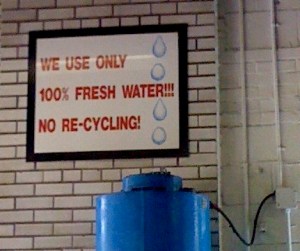 Recycling is cool, right? It’s hip to be green, right? Well, apparently that’s not always the case.
I spotted this sign at a carwash here in Toronto yesterday. This carwash (the labour-intensive handwash kind) is proud of the fact that its water is always fresh, never recycled. In 2011, it’s a striking way of bragging.
Two points worth making:
First, any business that brags about using a resource in the least frugal way possible is perhaps, just perhaps, paying too little for it. Now, from what I understand, water usage by businesses in Toronto is metered, though I don’t know just how expensive the water is for businesses. But it’s at least worth contemplating that, for a sometimes-scarce resource (and water counts as one of those, even in Canada) a business can only brag about maximal usage if it’s not paying very much for it in the first place. If we want to encourage people (and businesses) to use less water, the first step is to make sure usage is metered, and the second step is to make sure that prices are sufficient to discourage waste. Water is a public utility, and pricing is often subsidized in ways that encourages waste. Notice there are precisely zero airlines bragging about how much fuel they use.
The second thing worth noting is the basic value conflict here. Why is it that this company is bragging about using only fresh water? Presumably it’s because they or their customers associate fresh water with a better product, i.e., a better wash. Now, that belief might be mistaken. In fact, I strongly suspect it is mistaken. I suspect that recycling and filtering can easily get water clean enough to get your car 100% sparkly clean. But the perception that recycled water is inferior is out there, and it may be difficult to change. In the meantime, this remains an example of what many will experience as a difficult values-based choice: do you want the best product, or the greenest one? Sometimes, the greenest choice is also the best product, and when that’s true it’s either a happy coincidence or the result of really smart product development. But we must not allow clever marketing to convince us that that will automatically be the case, that green = ethical = happy = socially progressive. Life is full of choices, and that truth is one that we cannot afford to water down.
Ethics of Golden Handshakes
Filed under: boards, decision-making, employees, governance, leadership, pay, stakeholders |
Comments (2) When an executive leaves in disgrace, what does the organization owe him or her? How should a Board handle such situations? In some cases, contractual obligations may seem to settle the matter, but contracts can be contested. Should they be? Does the IMF’s Dominique Strauss-Kahn deserve a quarter million dollars?
For further food for thought, see this story, by Tom Hals and Dena Aubin, for Reuters: Strauss-Kahn severance revisits CEO pay dilemma
The IMF now faces a challenge that keeps members of corporate compensation committees up at night: explaining why they may have to pay a handsome severance package to an indicted executive.
…
Former International Monetary Fund managing director Dominique Strauss-Kahn, facing charges of attempted rape in New York, resigned his post from the global lender on Wednesday.Strauss-Kahn’s contract entitles him to a one-time severance payment of $250,000, the IMF said on Friday….
Whether a Board of Directors should attempt to fight in order not to pay severance to an executive who has brought disgrace upon the organization is clearly going to depend on the circumstances. But it serves as a good example of the conflict between two different styles of moral reasoning. On one hand, a Board thinking primarily in terms of consequences might well reason this way: “Look, we need to get past this unfortunate incident. Let’s pay this guy the money his contract says he is owed, and be done with it. It’s better for the firm, overall, if we pay and get this finished.” On the other hand, a Board might think primarily in terms of justice: “This guy has brought shame (or at least notoriety) upon the organization. He doesn’t deserve a dime. We should fight for what’s fair.”
The tension between these two styles of moral reasoning is an ancient one, and it’s perfectly reasonable to find something attractive in both styles of reasoning. But the fact that both kinds of reasons might occur to a single group of people — a Board of Directors — in a single situation implies an interesting question. Even if we were to agree (even for sake of argument) that a Board of Directors’ main obligation is to serve the interests of the organization and its shareholders, that still leaves open this important question: should a Board of Directors seek the best outcomes for the organization and its shareholders, or should it seek justice for it and for them?



 The Business Ethics Blog