Archive for the ‘retail’ Category
Pennies-Be-Gone: The Ethics of Rounding
 The always-useful Consumerist brings us this story, with a self-explanatory title: A Lone Dunkin’ Donuts Sort Of Abolishes Pennies
One donut shop is taking a stand against the bacteria-ridden zinc disks of suck that are pennies. Reader Tom sent us [a photo of a sign] from a store he recently visited. In a policy change that was probably born during an 8 AM rush, this franchise appears to be are rounding customer totals up or down to the nearest five cents, and only providing pennies to those annoying people who actually want them….
Setting aside paranoia about pennies causing germs, what should we say about this policy, from an ethical point of view?
First, the efficiency argument is worth noting. Lines are annoying. Lining up (i.e., standing behind other people) to get something you’re anxious for (like coffee) is doubly annoying. Speeding things up is good. So, improving the efficiency of the payment system is good.
Second, it’s worth pointing out that the system intends to treat everyone equally. Every customer is subject to the same system of rounding. In principle, no customer is disadvantaged relative to any other customer, and indeed (importantly) the customer is not disadvantaged relative to the coffee shop. Round up or round down — it’s all just a matter of math.
Third, in practice, this system may not actually end up treating everyone equally. As one person (with the pseudonym “Pecan”) who commented on the Consumerist piece pointed out, regulars who buy the exact same thing every day are going to be either systematically advantaged or systematically disadvantaged. If their change is “supposed” to be 27 cents, they’re only going to get 25 cents — every time. If they don’t realize that, then they’re going to lose money, time after time, in a way that will add up. Clearly, it would take a long time to add up to an amount that most of us might care about, but it’s still worth noting.
Finally, it’s worth pointing out that such a system allows the coffee shop a new way of acting unethically. Not that the rounding is itself unethical — it’s not. But if accepted by customers, the rounding offers the shop the opportunity to set its prices so that, on average, it ends up rounding in its own favour more often than it rounds in customers’ favour. Prices that end in “8”, for example (such as $1.38) will always result in exact change ending in “2”. For example, a price of $1.38 results in 62 cents expected back from two dollars. When the exact change is an amount ending in “2”, that will always be rounded down to zero, resulting in 2 cents’ extra profit on every transaction. On low-priced items like coffee and donuts, that could mean a significant increase in the store’s profit margin.
California’s Marijuana Industry: Ethical Issues
Filed under: competition, consumers, CSR, employees, health, law, natural, pharma, politics, product safety, profits, regulations, retail, snacks, wages |
 Comments (4)
 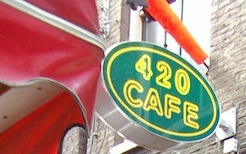 I’ve blogged about the insurance industry, the mining industry, the auto industry, even the donut industry. But the pot industry? Yes, it’s time.
From the Sacramento Bee: Growth of California’s Pot Industry is Good News for Unions
As Californians prepare to vote on a November ballot initiative that would expand legalization to recreational pot use, labor groups see the potential for perhaps tens of thousands of unionized jobs.
United Food and Commercial Workers Union, Local 5, which has 32,000 members in California working in trades including the grocery and food processing industries, began organizing marijuana “bud tenders,” greenhouse workers, packagers and laboratory technicians last spring….
So, here a budding industry, built around a controversial product that is illegal in most jurisdictions. There’s plenty of grass-root support for broader legalization (both for medicinal and recreational use). But there may be enough opposition to blunt the enthusiasm of law-makers about sudden moves. The support of politically-powerful unions is another ethically-significant factor — as is the potential capture of this new industry by unions.
This is such a rich and interesting story that there’s too much in it for me to try to hash it out by myself without resorting to quick, potted answers. So here are a handful of questions to seed the discussion. I’ll let you weed the good from the bad.
- Ryan Grim reports that “The teachers union, citing the revenue that could be raised for the state, is also backing the initiative.” Is that sufficient reason? You don’t have to be an anti-pot puritan to worry about anything that might (inadvertently) encourage use of pot by school-age kids.
- What business ethics issues are faced by producers and sellers of pot in the illegitimate parts of the drug industry? What new issues will the newly-legitimized industry face?
- What CSR-type responsibilities does the (expanding) legal marijuana industry have?
- Why are California Beer & Beverage Distributors lobbying against the proposed change? (See useful discussion over at Marginal Revolution).
- What sorts of regulations should the industry seek? What motives will be foremost in industry’s mind in his regard — protecting revenues? protecting its image? protecting consumers?
- Will the other drug industry — the pharmaceutical industry — move into this line of business? Why or why not?
- Is the unionization of this industry generally a good or bad thing? Unionization improves the lot of workers, but also tends to raise prices. Since unionization itself is controversial, let’s ask it this way: is the case for unionization stronger or weaker, with regards to the marijuana industry?
I’ll open the floor for discussion.
Back to Playboy…errrr School
 Marketing to kids is always a touchy subject. But even worse is when a company accidentally markets to kids. And when you accidentally market to kids something that is seriously adult-oriented…watch out!
Check out this story, from the Globe & Mail‘s Business section: Firm regrets back-to-school ad for Playboy thongs, bras
Giant Tiger, a discount retailer with outlets across Canada, says it made a big mistake when it marketed Playboy-branded underwear in a back-to-school flyer. Many parents complained to the retailer over the ads for bras, thongs and other items with Playboy’s logo.
…
Giant Tiger has apologized to the parents, and Playboy, according to the news agency, is working with the retailer to ensure that such items are aimed at women over 18. Playboy, the spokeswoman said, has strict rules that prohibit marketing to minors….
Now, the actual offense here is pretty modest (no pun intended). And there’s every reason to believe both companies when they say it was all a mistake.
I wonder if this is another, quite different, kind of example of the little ethical lapses (or lapses in quality more generally) that can occur when things are done cheaply. (For those of you not familiar with the chain, Giant Tiger stores are a couple of notches down-scale from Walmart, in most regards. Discount products, cheaply displayed.) Without casting aspersions on the skill or judgment of the workers who put together Giant Tiger’s flyers, I have to wonder whether slips of this kind aren’t more likely at bargain-basement retailers. If you shop at GT, you’re either shopping there because you can’t afford to shop somewhere more fancy, or you’re choosing to in order to save money to spend on other things. And, at risk of overgeneralizing, if you want stuff cheap, you’re going to get things done cheaply. Sweatshop labour may be the most high-profile result, but you’re also going to get things like shoddy marketing. On the other hand, I wonder if this could have happened at that most famous of discount retailers, Walmart? They’re famous for cutting costs, but they’re also famous for efficiency.
When Companies “Play Games” With Prices
Filed under: advertising, consumers, food, pricing, profits, retail |
Comments (10)  Is it ethical for companies — without deception — to make use of well-documented human tendencies and weaknesses in order to get us to buy more? Social scientists have long been aware that humans are subject to a range of cognitive biases that affect the way they think in fairly predictable ways. And, apparently, smart marketers know it, too.
For instance, check out this critique of Apple’s pricing, by Ben Kunz: “How Apple plays the pricing game”
Economist Dan Ariely, author of Predictably Irrational, gives the classic example of a Realtor who shows you a home that needs a new roof, right before taking you to a higher-priced house she really wants to sell. It’s hard to tell if a $400,000 colonial is a good deal – but compared with a $380,000 home that needs work, it looks quite good. Now consider, $499 for an iPad? Well, compared with a smaller one with fewer features, it suddenly looks great.
Decoys explain why Apple often sells each gadget in a pricing series, such as the new iPod Touch’s $229, $299, and $399 price points for different storage capacities. You may gladly spend $229 to get a hot media player, thinking it’s a deal compared with the highest-priced version and not blink that you could instead buy an iPhone 4 at the lower price of $199 with more features.
(Don’t put too much stock in the details of the prices quoted — as one of the comments under the article points out, Kunz may be comparing apples & oranges by comparing retail prices for iPod Touch to the discounted iPhone price that you get when you sign a 3-year contract with a phone company.)
At any rate, practices like the ones Kunz describes are by no means unique to Apple. Many restaurants, for example, will include one or two high-priced entrees. I’ve heard it said that those, too, are “decoys.” The restaurant doesn’t expect to sell much of the $35 Surf’n’Turf, but the fact that there is a $35 entree makes the $25 entrees look very reasonably-priced. Now notice that there’s no actual deception, here…just a reliance on the fact that most people will have their choices swayed by such pricing.
Here’s the short version of the case for such practices: Look, there’s no deception here. And consumers still have free will. And there’s no clear difference between using this kind of so-called “trick” and the “trick”, known by salesmen since time immemorial, that people will buy more stuff if you smile and are polite to them. The relationship between buyer and seller is an adversarial one, so buyer beware. (Notice also that a company can accidentally, unintentionally engage in such pricing. Maybe the restaurant really thought the #35 Surf’n’Turf would sell well. But it didn’t, and so the net effect is that the dish ends up acting as a decoy, but it’s hardly something you can blame the restaurant for.)
Here’s the short version of the case against such practices: The cognitive biases that such pricing preys upon are so strong that they effectively limit consumer autonomy. Preying upon them is therefore wrong. We put limits on marketing to young children, because we realize that young children aren’t fully capable of filtering messages, evaluating options, and choosing rationally. But the (sad) news from the psychological literature is that adults are likewise limited. We just aren’t as rational or autonomous as we think we are. Selling crack to a crack addict is unethical in part because the addict has no choice but to buy. She doesn’t rationally choose to buy the crack: her addiction ensures the sale. Now, cognitive biases of the kind describe above aren’t quite like addictions. But if a given cognitive bias is only effective “most” of the time (as opposed to an addiction’s near certainty) doesn’t the fact remain that the person doing the selling is relying on a kind of human compulsion, rather than on a rational choice that is likely to satisfy the consumer’s needs?
—
If you’re interested in this stuff, I highly recommend Dan Ariely’s book, Predictably Irrational. See also Judgment under Uncertainty: Heuristics and Biases, by they guys who basically invented the field, Daniel Kahneman, Paul Slovic, and Amos Tversky.)
Tip the Farmer?
Filed under: charity, consumers, food, international, quality, retail |
Comments (10)  In much of the world, patrons of restaurants and bars tip their waiters, waitresses, and bartenders, in recognition of a job well-done (and in recognition that, in some jurisdictions at least, such jobs are exempted from minimum wage requirements). More recently, tip jars have shown up at places featuring counter service only, like coffee shops. But if you’re going to tip your barista, why stop there? Why not show your appreciation to, say, the farmer who grew and harvested the coffee?
That’s precisely the idea behind this interesting project: TraceableCoffee.org
“We’re using technology to put a human face on a commodity product that Americans savor every day. Coffee lovers don’t think twice about providing a well-deserved tip to a barista, so why not use your smart phone or computer to tip the actual farmers who grew your coffee,” said Thaleon Tremain, General Manager, Pachamama Coffee Cooperative. “This isn’t charity, but a chance at a more direct and meaningful relationship with your coffee farmer.”
[That’s from this press release.]
Interesting idea. And far be it from me to object to a voluntary transfer of wealth. But I wonder about just why farmers are being chosen as the beneficiaries. The most straightforward answer, of course, is that the project is the brainchild of the coffee growers cooperative. It’s entirely (and not unreasonably) self-serving. But from a consumer’s point of view, why tip farmers, in particular? If you appreciate your coffee, and want to improve the lives of the underprivileged people who made it possible, why single out farmers? Why the farmer, and not the truck driver who brought the coffee beans to the processing plant? Or the longshoreman who loaded the coffee onto or off of the ship that carried it from Guatemala or Ethiopia? Or the shipping clerk who made sure that the paperwork got done? Chances are, none of these people is well paid.
My guess is that our continuing romanticization of farming makes it easier to be sympathetic to the plight of a (poor) farmer than it is to be sympathetic to the plight of a (poor) shipping clerk. But from an ethical point of view, the choice seems entirely arbitrary.
(For a recent blog entry about a project with similar intentions, see “Progressive Garment Factory, or Charity?”).
Business Ethics & Alternative Medicine
Filed under: health, natural, pharma, product safety, regulations, retail, Uncategorized |
Comments (2)  This is a “meta” blog posting, bringing together the various blog entries of mine over the last couple of years on the single topic of business ethics and alternative medicine.
Alternative medicine (includes things like homeopathy, herbal supplements, Traditional Chinese Medicine, acupuncture, therapeutic touch, and so on) raises some interesting ethical issues. On one hand, most of it doesn’t work (or to be more accurate, most of it is unproven, and much of it is disproven), and we tend to think people should only sell products that work as advertised. But on the other hand, alternative medicine has many fans, and we generally think consumers ought to be able to choose for themselves what products are good for them.
Two other factors make alternative medicine interesting, from a business-ethics point of view.
One factor is that both the safety and efficacy of alternative therapies varies. Some therapies (e.g., homeopathy) are entirely implausible, whereas others such as some herbal therapies probably are effective. Not surprisingly, the pattern is reversed for safety: homeopathy is entirely safe (unless the consumer does something foolish like forgoing real medicine in favour of homeopathic remedies for the treatment of a serious illness), while on the other hand some herbal remedies pose significant dangers.
The second important factor is that alternative medicine is generally under-regulated. In Canada, for example, herbal supplements are categorized as “natural health products” and subject to only minimal oversight. The result is that neither consumers nor companies can assume that the law is providing significant oversight. In the absence of strong consumer-protection legislation, there’s a particularly strong obligation for companies to act ethically.
Here are my blog postings on this topic, in reverse-chronological order:
- Pharmacists and Candour About Homeopathy (May 2, 2010)
- Consumer Protection & Homeopathy (April 12, 2010)
- Which Alternative Therapies is it Ethical To Sell? (March 8, 2010)
- Charities, Stakeholders, and Guilt By Association (August 28, 2009)
- Ethical to Teach a Bogus Therapy? (August 25, 2009)
- Second Plea to Alternative Health Practitioners: Help With Health Reform! (June 17, 2009)
- British Chiropractors Retreating from Publicity (June 10, 2009)
- I Need A Homeopath or Naturopath (May 17, 2009)
- Marketing Useless (Magnetic) Products (October 21, 2008)
By the way, to the best of my knowledge, there is not a single scholarly paper that looks at the selling of alternative medicines from a business-ethics point of view. If you know of one, please let me know!
Authenticity in Advertising
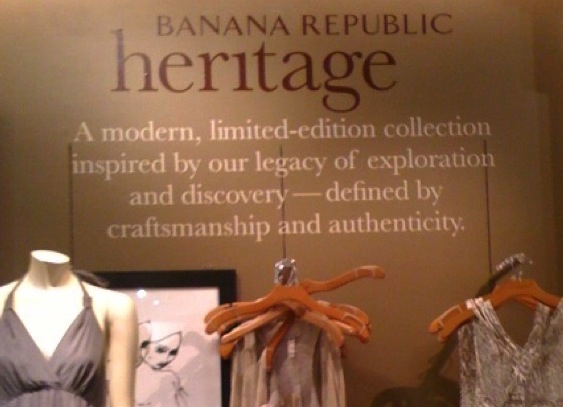 I took this picture in a Banana Republic store in Toronto this morning. This sign on the wall caught my eye, mostly because I’ve been reading my pal Andrew Potter’s wonderful new book, The Authenticity Hoax.
Note the explicit claim of authenticity, in this ad. As Andrew’s book points out, the language of authenticity is increasingly common in advertising today. It’s interesting to ask just what the claim to “authenticity” means in an ad like this, or in any other ad. Here, does it mean these dresses are historical reproductions? Surely not. So there’s no question of interrogating Banana Republic on the accuracy of either their styles or the accuracy of their claims. So what does “authenticity” refer to, here? It seems to be a straightforward attempt to tap into the widely-shared (but, as Andrew argues, ultimately misguided) desire to flee all that is superficial and phony, and get “back” to something more “real.”
Two further things are worth pointing out. One is that here, as is so often the case, finding authenticity seems to require buying something that is a self-proclaimed rip-off from fashions of days gone by. You get “real” through imitation. The other is that Banana Republic (among many others) recognizes that they can’t get away with simply doing something authentic…consumers actually need to be told these clothes are authentic, in order to recognize them as such.
(Watch here for an interview with Andrew Potter, about authenticity and business ethics, coming soon.)
No Cake for Little Hitler: Ethics in the Bakery
Filed under: decision-making, discrimination, ethics, retail, values |
Comments (4)  Freedom is a wonderful thing; freedom of speech is particularly important. But speech can also be a potent weapon. Your way of expressing yourself might prove horrific to me. Given that lot of businesses make all or part of their livelihood from helping people express themselves, challenges are bound to arise. Case in point, from The Lehigh Valley Express-Times: Holland Township family angry that supermarket won’t personalize cake for their son
JoyceLynn Aryan Nation Campbell, Honszlynn Hinler Jeannie Campbell and Adolf Hitler Campbell.
Good names for a trio of toddlers? Heath and Deborah Campbell think so. The Holland Township couple has picked those names and the oldest child, Adolf Hitler Campbell, turns 3 today.
This has given rise to a problem, because the ShopRite supermarket in Greenwich Township has refused to make a cake for young Adolf’s birthday.
“We believe the request … to inscribe a birthday wish to Adolf Hitler is inappropriate,” said Karen Meleta, a ShopRite spokeswoman.
The Campbells turned down the market’s offer to make a cake with enough room for them to write their own inscription and can’t understand what all of the fuss is about.
Here’s an earlier, longer version of the story: Holland Township man names son after Adolf Hitler
ShopRite is within its rights to refuse to make the cake. They certainly have no obligation to help the Campbells live out their probably-hateful or at-least-misguided lifestyle. (Note: I’m willing to soften the case against these parents because, based on reading the longer version of the story — they seem dim-witted, not evil. Whatever.)
So, it was at least OK, and perhaps ethically a good thing, to refuse to make the cake. Of course, it’s easy to imagine all kinds of tacky, tasteless things someone would want to have written on a cake (“Happy Birthday, Assh*le!” or “Show Me Your T*ts!). I can imagine borderline cases that would give bakery managers headaches. But a cake paying apparent homage to the 20th Century’s literal poster boy for evil is probably not a borderline case.
Not surprisingly, different stores have different standards. Apparently the local Wal-Mart made little Adolf’s first two birthday cakes:
A spokeswoman for Wal-Mart said the store won’t put anything illegal or profane on a cake but thinks it’s important to respect the views of customers and employees.
The Wal-Mart spokesperson’s premise is a little off, here: you don’t need to respect all views of your customers and employees. A healthy degree of respect for cultural and religious differences is a good thing, but not all views are worthy of respect. So I don’t think a store needs to be willing to make Nazi cakes in order to show its support for diversity. But while I think what ShopRight did in refusing to make that cake was perfectly fine, I’m not sure there’s anything badly wrong with another store going ahead and making the cake. It is, after all, the kid’s name, and by making the cake the store would be pretty far from promoting Nazism. In a free society — and a free market — we probably want to allow merchants a reasonable degree of leeway in the customer preferences they are willing to tolerate.


 The Business Ethics Blog