Archive for the ‘employees’ Category
Employment, Smokers, and Fundamental Ethical Conflicts
Filed under: employees, health, productivity, risk, values, workplace safety |
 Comments (2)
  I’ve seen two interesting stories recently about smokers — of various kinds — facing trouble with their employers. Both stories raise difficult, perhaps intractable, ethical difficulties, because in both cases the objectives sought by employers are, on the face of things, entirely reasonable; and yet the freedoms sought by employees in these cases are also, I think, very reasonable ones to seek.
First, this piece by A.G. Sulzberger for the NY Times: Hospitals Shift Smoking Bans to Smoker Ban
…More hospitals and medical businesses in many states are adopting strict policies that make smoking a reason to turn away job applicants, saying they want to increase worker productivity, reduce health care costs and encourage healthier living….
I’ve blogged about this issue before. (See: “Smokers Need Not Apply”, from January of 2009.) My conclusion back then was that an employer, no matter how well-intentioned, has no right to tell employees what to do on their own time. They have a right to demand a certain level of performance on the job, and that might have implications for what employees do at home. But what employers have a right to is performance, rather than to a particular lifestyle in pursuit of that performance. Besides, there are lots (and lots and lots) of things employees can do at home that will limit their performance at work. I don’t see smoking as being unique among those, and letting employers screen for (and monitor?) all such behaviours would obviously constitute a massive invasion of privacy.
And then there’s this Reuters piece, reported by Clare Baldwin: Wal-Mart employee fired for medical pot loses case
A federal judge in Michigan on Friday upheld Wal-Mart Stores Inc’s dismissal of an employee for testing positive for marijuana, even though he was using the drug under the state’s medical marijuana law.
…
Former Wal-Mart employee Joseph Casias said he was using the marijuana to treat pain from an inoperable brain tumor and sinus cancer, and was doing so legally, with a medical marijuana registry card…
This one is trickier because the implications of marijuana — cannabis — for workplace performance are much clearer. Pot (even pot prescribed for very good reasons by a physician) is very likely to affect judgment. And the effects of smoking it can last 2-3 hours — so smoking just before work, or during a break, could reasonably be expected to have a negative impact on performance. But in the case above, the employee involved had what sound like very good reasons, if ever there were any. Wal-Mart is a company that is trying hard to polish its image, and firing people for trying to deal with the pain from their inoperable brain tumor seems inconsistent with that objective.
For me, this is one of those short news stories that immediately makes me wonder what’s really going on here. Is the employee one of “those” employees that a company looks for reasons to fire? Or was his manager an unsympathetic jerk? Or what? Because surely this is an issue that could have been sorted out among reasonable adults, without resorting to lawyers. Could the worker be moved to a position where the possible effects of at-home cannabis use would not be as problematic? Could the employee agree to limit the hours during which he would use cannabis, in return for an exemption from the company’s testing regimen? I don’t know the answer. But living and working together means that we find ways of getting along together, even when we cannot find ways of agreeing.
HuffPo, AOL and the Ethics of Unpaid Labour
Filed under: activism, advertising, blogs, brands, employees, intellectual property, pay, profits, protest, technology |
Leave a comment  AOL bought the Huffington Post this week. Now, many of HuffPo’s volunteer bloggers are up in arms, accusing the left-leaning news-and-aggregation site of two related crimes: selling out to a (presumably) evil corporate media giant, and failing to share the wealth with thousands of volunteer bloggers who, over the years, have contributed probably millions of words to HuffPo’s archive of content.
But criticism was not limited to the volunteer bloggers themselves. Tim Rutton, of the LA Times, wrote:
To grasp its business model, though, you need to picture a galley rowed by slaves and commanded by pirates….
Adbusters — the slightly-past-its-best-before-date organization whose sole purpose is to bash capitalism and consumerism — put it this way:
Socialite Arianna Huffington built a blog-empire on the backs of thousands of citizen journalists. She exploited our idealism and let us labor under the illusion that the Huffington Post was different, independent and leftist. Now she’s cashed in and three thousand indie bloggers find themselves working for a megacorp….
On the face of it, this sounds like a strong criticism. Use unpaid labour to build a truly massive (and profitable) online presence. Keep that unpaid labour in the fold by espousing values they believe in. And then sell out for hundreds of millions to a corporation that almost certainly could not care less about the aforementioned values. It really does sound tantamount to slavery, with a touch of ideological treason thrown in for good measure. But to understand this better, we need to know a little more about the economics of blogging. As a good starting point, see this piece by stats guru Nate Silver: The Economics of Blogging and The Huffington Post
The fact is, however, that sentiments like [the LA Times’s] Mr. Rutten’s reflect a misunderstanding of The Huffington Post’s business model. Although The Huffington Post does not pay those who volunteer to write blogs for it, this content represents only a small share of its traffic. And, to put it bluntly, many of those blog posts aren’t worth very much….
Silver goes on to be much more specific, calculating the likely dollar value of the contribution of the average volunteer HuffPo Blogger.
The point is that for something over 99% of bloggers, blogging is a hobby. The contribution of most HuffPo bloggers to the website’s success is minimal. Those thousands of volunteer bloggers on whose “backs” HuffPo was supposedly built were likely more important as audience than as generators of content. Should the volunteer bloggers feel jilted? I’m reminded of a commercial from a few years back, in which a mom consoles her 8-year-old boy whose team just lost a game of soccer or hockey or something. “Did you try your hardest?”, asks the mom. “And did you have a good time? That’s all that really matters.”
Of course, if the volunteer bloggers are worried about the integrity of HuffPo’s editorial voice, you would think they would be somewhat consoled by the fact that Arianna Huffington is retaining the reins in that regard, and in fact will be gaining the key editorial role at AOL as a whole. But then, that’s reason why the rest of us should be deeply concerned, given Huffington’s penchant for featuring dangerously bad pieces related to things like healthcare, including some that are the intellectual equivalent of evolution denial.
Death by Pizza Delivery: Domino’s Korea
Filed under: brands, employees, food, international, marketing, pay, pricing, workplace safety |
Leave a comment  During most of the 80’s (starting in 1984), customers of Domino’s Pizza in the U.S. enjoyed the benefits of a catchy promise of speedy delivery: Domino’s promised to deliver your pizza in “30 Minutes Or It’s Free.” The only problem: soon after the slogan was introduced, a rise in deaths due to accidents involving Domino’s drivers was noted. The assumption was that drivers were facing pressure to make good on the promise, and were therefore driving faster, which meant they were more likely to have accidents, some of which were fatal. Lawsuits ensued. Big ones. As a result, the “30 Minute” delivery promise ended back in 1991, in the U.S. But apparently the same can’t be said for Domino’s Korea.
Here’s the story, by blogger Lee Yoo Eun, blogging at Global Voices: South Korea: Backlash After ‘30 Minute’ Pizza Delivery Death
A popular Domino’s Pizza marketing strategy promising pizza delivery within 30 minutes of an order has met with a public backlash in South Korea, following the deaths of several young delivery personnel.
The Young Union, the union For Occupational and Environmental Health (FOEC) and several labor unions held a press conference on 8 February, 2011, in front of Domino’s Pizza’s headquarters in South Korean capital Seoul, pressuring the company to abolish the ‘30 Minute’ delivery system….
Here’s another version of the story, from the Korea Times: Quick delivery jeopardizes drivers.
In often discuss the story of “30 Minutes or It’s Free,” as it played out in the U.S., in my business ethics class. I use the case to illustrate 3 key points:
- A simple business decision can have large and unforeseen consequences, ones that result in a major ethical challenge for a company. In this case, a simple (and frankly brilliant) marketing slogan resulted in Domino’s executives being called killers and the company facing multi-million dollar lawsuits.
- The ethical thing to do is not always obvious. We spend a lot of time chastising companies for bad behaviour, but in at least some cases it is genuinely difficult to know what to do. In the Domino’s case, my students are typically unified in the opinion that something had to be done to reduce the rate of accident-related deaths involving Domino’s drivers, but they’re typically deeply divided on a) how far the company needs to go and b) just what strategy they should adopt.
- Putting an ethical decision into action can be very difficult. Back in the late 80’s, there were several thousand Domino’s pizza franchises in the U.S., and tens of thousands of drivers. Any decision made by Head Office was going to have to be implemented by all those franchisees and acted on by all those drivers. Making that sort of thing happen is anything but straightforward.
As for Domino’s Korea — frankly I’m stunned to find out that the people in charge of the Domino’s brand haven’t done more to make sure that a lesson learned 20 years ago, at great expense, is reflected in their international operations.
MTV’s “Skins”: The Ethics of Profiting from Teen Sexuality
Filed under: accountability, advertising, children, CSR, employees, ethics, marketing, media, sex, stakeholders, values |
Comments (5) There’s been a lot of chatter in the last few days about MTV’s teensploitation show, “Skins.” Of course, one theory says that that’s just what MTV has been hoping for — a lot of free advertizing.
I’m quoted giving a business-ethics perspective on the show in this story, by the NYT’s David Carr: “A Naked Calculation Gone Bad.”
What if one day you went to work and there was a meeting to discuss whether the project you were working on crossed the line into child pornography? You’d probably think you had ended up in the wrong room.
And you’d be right.
Last week, my colleague Brian Stelter reported that on Tuesday, the day after the pilot episode of “Skins” was shown on MTV, executives at the cable channel were frantically meeting to discuss whether the salacious teenage drama starring actors as young as 15 might violate federal child pornography statutes.
Since I’m quoted in that story, I’ll just cut to my own conclusion:
“Even if you decide that this show is not out-and-out evil and that the show is legal from a technical perspective, that doesn’t really eliminate the significant social and ethical issues it raises,” said Chris MacDonald, a visiting scholar at the University of Toronto’s Clarkson Center for Business Ethics and author of the Business Ethics Blog. “Teenagers are both sexual beings and highly impressionable, and because of that, they’re vulnerable to just these kinds of messages. You have to wonder if there isn’t a better way to make a living.”
I wouldn’t bet one way or the other on how this will turn out — in particular on whether pressure from advocacy groups and advertisers will convince MTV to can the show. If it does, then this controversy turns into a nice example of how just the wrong kind of corporate culture can produce bad results. Consider: there are an awful lot of people involved in conceiving and producing, and airing a TV drama. In order for Skins to make it to air, a lot of people had to spend months and months going with the flow, basically saying to themselves and each other “Yes, it is a really good idea to show teens this way, to use teen actors this way, and to market this kind of show to teens.” Hundreds of people involved in the production must have either thought it was a good idea, or thought otherwise but decided they couldn’t speak up. If this turns out badly, MTV will have provided yet another example of how things can go badly when employees aren’t encouraged and empowered to speak up and to voice dissent.
Steve Jobs’ Health & a CEO’s Privacy
Filed under: accountability, employees, health, management, privacy, risk, transparency |
Comments (5) How much privacy does a CEO deserve? Is his or her health a private matter, or a matter that should be open to the scrutiny of the public (and, in particular, of the investing public)?
See, for example, this piece by Miguel Helft, at the NYT: Jobs Takes Sick Leave at Apple Again, Stirring Questions
Steven P. Jobs, the visionary co-founder and chief executive of Apple, is taking a medical leave of absence, a year and a half after his return following a liver transplant. The leave raises questions about both his long-term prognosis and the leadership of the world’s most valuable technology company….
So, should Jobs tell all, letting shareholders and potential shareholders (and other stakeholders?) just what’s up with his health, so that everyone can adjust their decision-making accordingly? Some say a CEO has as might right to privacy as anyone else. Others say a CEO’s obligation to be transparency overrides that.
As Slate’s Annie Lowrey tells us:
While publicly traded corporations need to disclose events and changes that might “materially” affect the company, the Securities and Exchange Commission does not specifically require disclosures about CEO health. That vagueness in the law means that Apple has remained within the letter of the law with its disclosures….
I don’t have a strong view on this, but here are some thoughts:
1) Information is good; it’s what lets markets operate more rather than less efficiently. But a big part of what matters most is equal access to information, and so far there’s no worry about that here, as far as I can see. (It may be that some are worried that top insiders will trade Apple’s stock based on their insider knowledge. Doing so would probably be illegal, and hence very dangerous.)
2) Health is a spectrum. There are people in the pink of health, and people on death’s doorstep, and everything in between. All CEOs are somewhere on that spectrum, and there’s simply no clear line beyond which a CEO’s health becomes a worry. So if Steve Jobs needs to disclose his diagnosis, the same likely goes for all CEOs (and other senior executives?) Note also that medical prognosis is as much art as science. So even if, say, Jobs were to reveal that his doctors were giving him a year to live — well, frankly, that could mean he’d be dead in a month or in 5 years. We have good evidence that doctors just aren’t good at making those estimates.
3) The basic, crucial info — that Jobs has ongoing health problems, likely quite serious ones — is already out there. As a former SEC chair Arthur Levitt says,
Jobs going on medical leave sends a message to the market,” Levitt continues. “An intelligent investor should know the risks of Jobs having a relapse. For the board to opine on what the extent of the illness is right now I don’t think is really necessary.”
In the end, I guess I’m most worried about the slippery slope, here. There are lots of things investors could want to know, and lots of things they could argue they need to know. But that doesn’t mean we want to push on down that road.
Most Hated American Companies Of 2010
Filed under: consumers, corporations, employees, rankings, virtue |
Leave a comment  The corporate world is certainly subject to plenty of criticism, and even hatred. But which companies are hated most?
Here’s one look at that question, from 24/7 Wall St.: The Fifteen Most Hated American Companies Of 2010
Customers, employees, shareholders and taxpayers hate large corporations for many reasons. 24/7 Wall St. reviewed many of these to choose the 15 most hated companies in America.
We examined each company based on six criteria….
(Note that the title “Most Hated” actually understates the sophistication of the ranking method used here, which includes measures of employee satisfaction, media coverage, total return to shareholders, and more.)
Interestingly, several of the companies on this “most hated” list have appeared on the Business Ethics Blog before.
- Dell (#9 on the un-ordered list) appeared here several times in 2006 and 2007, in blog entries about the ethics of poor customer service.
- Nokia (#2 on the list) appeared here as the subject of a movie I reviewed, called A Decent Factory. The movie was about Nokia’s attempt to manage things like labour standards in its supply chain.
- Toyota (#3) appeared in a blog entry on whether a company’s shareholders really “own” the company, as well as in an older blog entry about “Patriotism vs. Globalization in the Auto Industry”.
- Citigroup (#6) appeared in a blog entry called “Ethics in Banking: Best Practices”, as well as in a more recent one called “The Pay Czar’s Ethical Dilemma”.
- McDonald’s (#12), not surprisingly, has made a couple of appearances. It appeared in a blog entry on “Trans-fats vs. Genetically Modified Foods”, as well as “Saving the Earth, One Big Mac at a Time”.
- Last, but not least, British Petroleum (BP) is #14 on the list (and labelled “the most obvious choice to be on a list of hated companies”) has of course appeared here several times this year, including in “BP and Corporate Social Responsibility”, and “Boycotting BP is Futile and Unethical”, and “Ethics, BP, & Decision-Making Under Pressure”.
As you read through the whole list, it’s worth noting more generally the role that unethical (or at least ethically controversial) behaviour plays in generating hatred.
Should Workplaces Ban Lotteries?
Filed under: employees, honesty, pay, pricing, profits, values |
Comments (10) Should workplaces ban lottery pools? Lots of offices feature “pools” of various kinds, with groups of employees joining together collaboratively or competitively to speculate on, e.g., the outcome of the NFL playoffs. Very likely lots of managers regard it all as harmless fun, boosting morale by giving employees a break from the tedium of their cubicle farms. But a lottery pool is unlike, say, a hockey or football pool. In a hockey or football pool, there are winners and losers, but typically the dollar amounts are pretty small. But when employees band together to buy lottery tickets, the possibility is there for all hell to break loose.
To see what I mean, take a look at this story, from the CBC: More claiming share of $50M lottery prize
Some of the claimants to the disputed $50-million Lotto Max jackpot were at the Ontario Lottery and Gaming prize centre on Wednesday being questioned about the win.
The original claimants — 19 Bell Canada call centre workers from east Toronto — validated the winning ticket on Monday, said OLG spokeswoman Sarah Kiriliuk.
But since then, several more people have come forward to say they should have a share of the prize, said Kiriliuk, although she refused to say exactly how many….
Clearly, this is an anxious moment for the winners. But it’s also surely a rather anxious moment for their employer, telecommunications giant Bell Canada.
My friend Andrew Potter (author of The Authenticity Hoax) suggested to me that there are at least a couple of reasons reasons why employers might legitimately choose to ban lottery pools.
The first reason Andrew suggests is the potential for a highly disruptive exodus of an entire group of employees in the event of a lottery win. Most people, when asked, say that the first thing they would do if they won the lottery is quit their jobs. Losing a good employee can be a bad thing. So what happens when a dozen or 20 employees win together, and very likely depart en mass? Clearly, employers have a significant interest in avoiding such an outcome. Of course, the odds against such a thing happening are, well, tiny…one in many millions. How tiny do they have to be for us to say that the employer would be out of line to try to prevent it?
Second, and I think more significantly, Andrew suggests that employers might have a strong interest in avoiding the possible legal troubles that could result from a group of employees winning a lottery. Even for a win much smaller than the $50 million win in the story above, there’s the chance that employees will come forward who say they were unfairly excluded for one reason or another. And with money on the line, lawsuits are far from unlikely. And when lawsuits happen, chances are that everyone is going to get sued, including the employer. After all, an excluded employee can reasonably claim that the employer was effectively hosting the lottery pool, and hence bears some responsibility for making sure that it is run fairly. Even if the dollar amounts are too small to result in lawsuits, I can imagine considerable disruption of the working environment when there’s disagreement over a lottery win. Just take the usual petty office grievances and multiply them by a few tens of thousands of dollars, and then a win for employees equals trouble for their employer.
Now, I’m not sure there’s a huge risk here, but I think it’s an interesting question. Obviously, it behooves employers to allow employees a little breathing room when it comes to lunch-break entertainment. In general, it’s good for employers to respect employees’ privacy and autonomy, and that might include the freedom to engage in things like office pools. For most of us, our employers already dominate our lives in ways that are at least sometimes regrettable, so employers should be cautious about imposing unnecessary constraints. But given that lotteries are already widely-criticized as a regressive form of taxation (or, more bluntly, as a ‘tax on the inability to do math’), it might well be that eliminating office lottery pools would be a reasonable move.
——
Addendum: it’s a little-known and sad fact that a relatively high proportion of lottery winners eventually file for bankruptcy. [URL updated Aug. 2011]
Greenpeace, Tar Sands and “Fighting Fire With Fire”
Filed under: activism, advertising, CSR, employees, energy, environment, ethics, greenwashing, NGO, pollution, sustainability |
Comments (4) 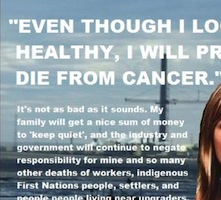 Do higher standards apply to advertising by industry than apply to advertising by nonprofits? Is it fair to fight fire with fire? Do two wrongs make a right?
See this item, by Kevin Libin, writing for National Post: Yogourt fuels oil-sands war.
Here’s what is apparently intolerable to certain environmental groups opposed to Alberta’s oil sands industry: an advertisement that compares the consistency of tailings ponds to yogourt.
Here’s what is evidently acceptable to certain environmental groups opposed to Alberta’s oil sands industry: an advertisement warning that a young biologist working for Devon Energy named Megan Blampin will “probably die from cancer” from her work, and that her family will be paid hush money to keep silent about it….
It’s worth reading the rest of the story to get the details. Basically, the question is about the standards that apply to advertising by nonprofit or activist groups like the Sierra Club and Greenpeace. But it’s also more specifically about whether it’s OK for such groups to get personal by including in their ads individual employees of the companies they are targeting.
A few quick points:
- Many people think companies deserve few or no protections against attacks. Some people, for example, think companies should not even be able to sue for slander or libel. Likewise, corporations (and other organizations) do not enjoy the same regulatory protections and ethical standards that protect individual humans when they are the subjects of university-based research. Corporations may have, of necessity, certain legal rights, but not the same list (and not as extensive a list) as the list of rights enjoyed by human persons. So people are bound to react differently when activist groups attack (or at least name) individual human persons, as opposed to “merely” attacking corporations.
- Complicating matters is the fact that the original ads (by Canadian Association of Petroleum Producers, or CAPP) themselves featured those same individual employees. So the employees had presumably already volunteered to be put in the spotlight. But of course, they volunteered to be put in the spotlight in a particular way.
- For many people, the goals of the organizations in question will matter. So the fact that Greenpeace and the Sierra Club are trying literally to save the world (rather than aiming at something more base, like filthy lucre) might be taken as earning them a little slack. In other words, some will say that the ends justify the means. On the other hand, the particular near-term goals of those organizations are not shared by everyone. And not everyone thinks that alternative goals (like making a profit, or like keeping Canadians from freezing to death in winter) are all that bad.
- Others might say that, being organizations explicitly committed to doing good, Greenpeace and the Sierra Club ought to be entirely squeaky-clean. If they can’t be expected to keep their noses clean, who can? On the other hand, some might find that just a bit precious. Getting the job done is what matters, and it’s not clear that an organization with noble goals wins many extra points for conducting itself in a saintly manner along the way.
(I’ve blogged about the tar sands and accusations of greenwashing, here: Greenwashing the Tar Sands.)
—
Thanks to LW for sending me this story.
Ethics and Stupidity
Filed under: complexity, corporations, decision-making, employees, ethics, excuses, values, virtue |
Comments (9)  Why do people do bad things? It’s an ancient question. Certainly, some people do bad things simply because they are bad people. Psychopaths and sociopaths exist, though thankfully they are very few. Whether those few should be classified as “evil,” or as “mentally ill,” or both, is not clear to me. Either way, they certainly have the capacity to do evil. But sometimes, surely — maybe quite often — people do bad things stupidly, rather than out of evil intent. Sometimes, as I’ve blogged before, people do bad things because they allow themselves to use invalid excuses. It’s likely that some people know (in their heart of hearts) that they’re using lame excuses. But probably some people sincerely believe those excuses, and simply don’t understand that their reasoning is flawed.
“Hanlon’s Razor” is the name for an adage attributed to one Robert J. Hanlon. It says the following:
Never attribute to malice that which is adequately explained by stupidity.
It’s a good rule of thumb, not least because it is so often true that bad outcomes owe more to poor decision-making than they do to evil intent.
Of course, if what we’re really interested in is why bad things happen, attributing it to stupidity rather than malice just pushes the question down one level. If so many people act stupidly, why?
There are at least 3 kinds of situations in which dumb things happen:
- Some dumb moves are made by people who, well, are not that bright. The truth is that people have different levels of ability. We don’t all have equally-good judgment, and we’re not all equally good at foreseeing the consequences of our actions. In a corporate context, good hiring practices are supposed to weed out the untalented. But talent pools are always limited. And remember: screwups can in principle occur anywhere within a corporate hierarchy, so there’s no position so unimportant that a company can simply afford to fill it poorly.
- Some dumb moves are made by people — maybe even smart people — who lack the relevant skills. In some cases, that may mean they lack the relevant technical skills. If you’re not an accountant, for example, you simply may not understand the consequences of certain kinds of bookkeeping decisions. But people can also lack the skills to assess, for example, the quality of their own arguments and thought processes. I teach a course on Critical Thinking, and believe me, people are not all equally good at spotting fallacious arguments or flawed patterns of thought. But it’s a skill-set that can be taught, and learned.
- Some “dumb” decisions get made as a result of one or another of a bunch of well-studied cognitive biases. Those biases — the subject of an enormous body of psychological literature — go by names like “anchoring,” and “confirmation bias” and “the framing effect,”. (Confirmation bias, for example, essentially means that we have a tendency to accept new evidence when it confirms what we already believe, and to reject new data that challenges our beliefs. It’s dangerous, and we all do it.) Basically, cognitive biases are a bunch of persistent, and generally faulty, trends in the way humans think. They are ways in which we are pretty consistently subject to patterns of error in our thinking. Alarmingly, these cognitive biases tend to apply to smart people, too, as well as to people with the kind of technical training that you might hope would help them avoid such biases.
(For a bit more on why individuals do dumb things, see this Wired piece on Why Do Smart People Do Stupid Things?)
So, there are lots of reasons why people — even smart people — end up doing dumb things. And sometimes those dumb things will have evil (or just bad) consequences. It’s worth understanding the difference between bad things that happen because someone did something bad, and bad things that happen because someone did something dumb, though in some cases the line will be pretty fuzzy.
And I suspect Hanlon’s Razor holds true of organizations just as it does for individuals, and maybe more so. So really, we need to distinguish between why individuals act stupidly, and why organizations do. That’s a topic for another day.
Deadly Crashes, “Agency Theory” & the Challenges of Management
Filed under: accountability, complexity, corporations, decision-making, employees, ethics, excuses, governance, management, product safety, quality, risk, technology |
Leave a comment  Sometimes for a corporation to “do the right thing” requires excellent execution of millions of tasks by thousands of employees. It thus requires not just good intentions, but good management skills, too.
For an example, consider the story of the crash of a Concorde supersonic jet a decade ago. The conditions leading up to the crash were complex, but one factor (according to the court) was negligence on the part of an aircraft mechanic. Whether (or to what extent) that mechanic’s employer is responsible for that negligence, and hence at least partly responsible for the crash, is a difficult matter.
Here’s the story Saskya Vandoorne, for CNN: Continental Airlines and mechanic guilty in deadly Concorde crash
The fiery crash that brought down a Concorde supersonic jet in 2000, killing 113 people, was caused partially by the criminal negligence of Continental Airlines and a mechanic who works for the company, a French court ruled Monday.
Continental Airlines was fined 202,000 euros ($268,400) and ordered to pay 1 million euros to Air France, which operated the doomed flight.
Mechanic John Taylor received a fine of 2,000 euros ($2,656) and a 15-month suspended prison sentence for involuntary manslaughter….
I don’t know the details of this story well enough to have any sense of whether the mechanic in this case really did act negligently. But what intrigues me, here, is the issue of corporate culpability. Note the difficulty faced by airline executives who (for the sake of argument) want desperately to achieve 100% efficiency and never, ever to risk anyone’s life. In order to achieve those goals, executives have to organize and motivate hundreds or perhaps thousands of employees. They need to design and administer a chain of command and a set of working conditions (including a system of pay) that is as likely as possible to result in all those employees diligently doing their very best, all of the time. That challenge is the subject of an entire body of political & economic theory known as “agency theory.”
Agency theory and the various mechanisms available to motivate employees in the right direction are things that every well-trained business student knows about, because those are central challenges of managing any corporation, or even any small team. What is recognized too seldom, I think, is just how central a role agency problems play in assessing and responding to ethical challenges in particular.



 The Business Ethics Blog