Archive for the ‘ethics’ Category
Should Celebrities Regret Singing for Gadhafi’s Family?
Filed under: accountability, boycott, brands, charity, entertainment, ethics, excuses, international, profits |
 Leave a comment
 I blogged nearly two weeks ago about the Ethics of Doing Business in Libya. The concern there was about the ethics of involvement in Libya by, well, “businesses” in the traditional, i.e., corporate, sense of that word. But the controversy that emerged short after that, and that continues still, concerns high-profile members of the entertainment business — celebrities like Usher, 50 Cent, and Mariah Carey. Basically, it has come to light that a whole fistful of such stars have, at various times, done private concerts for members of the Gadhafi family. And now, in light of the continuing violence in Libya, most of those stars are expressing regret and doing things like donating the money to charity. (For details, see Public consequences of pop stars’ private gigs, by By Reed Johnson and Rick Rojas for the Los Angeles Times.)
A few people have pointed out that the timing of the celebs’ crisis of conscience is just a little bit off. Libya has been a dictatorship for decades, and its leader has been a vicious madman just as long. As Tim Cavanaugh wrote on his blog at Reason, “Even assuming Qaddafi is so toxic you can’t with sound conscience take his dinars, that didn’t just become the case a few weeks ago.” If it’s right to give the money back now, it was likely wrong to take it in the first place.
But we can also question whether anyone does, or should, give much of a hoot over where these celebs sing, or for whom. The LA Times quotes Sting — a star with a reputation for charity work and activism — as defending having sung for the daughter of Uzbekistan dictator Islam Karimov:
Sting addressed criticism saying he was “well aware of the Uzbek president’s appalling reputation in the field of human rights as well as the environment. I made the decision to play there in spite of that.” He added, “I have come to believe that cultural boycotts are not only pointless gestures, they are counterproductive, where proscribed states are further robbed of the open commerce of ideas and art and as a result become even more closed, paranoid and insular.”
The man has a point. Though it may sound like a self-interested argument, that doesn’t mean it’s a bad one.
(Cavanaugh’s blog entry has a wonderful quote from, of all people, Adolf Hitler, who shrugged off artists behaving in ways that might have taken by him to be treasonous: “I don’t take any of that seriously. We should never judge artists by their political views. The imagination they need for their work deprives them of the ability to think in realistic terms.”)
But this leads me wonder: just what is the objection to singers singing for dictators? Is the money the problem, or is it having sung for (or more generally having done business with, or having provided a service for) an evil man’s family? Consider: if the money really is the problem — i.e., if this really is a case of filthy lucre — then donating the money to charity really does utterly absolve the stars in question of any blame. Or at least it would if the timing weren’t so questionable. Singing for free would also be OK. Indeed, if the money is all that matters, then stars might have a positive obligation to sing for wealthy tyrants and give the money to charity. After all, what could be better than squeezing a few million out of a mad dictator’s family in order to do something good with it? And if singing for free (or singing for money and donating it to charity) isn’t OK, then that seems to imply that the money isn’t the problem either.
Critical Thinking in Business Ethics, Part 3: Fallacies
Filed under: complexity, critical thinking, decision-making, definitions, ethics, excuses |
Comments (2)  This is the 3rd in a series of occasional postings on the role of critical thinking in business ethics.Critical thinking is about a) how to construct good arguments, and b) how to spot and avoid bad ones. The focus of this posting will be on the latter. Bad arguments come in many forms, in many shapes and sizes. But some faulty arguments follow patterns of reasoning that are so common that they’ve acquired names. The general term for such named patterns of faulty argumentation is “fallacy”. There are many known fallacies, and textbooks on critical thinking typically devote a chapter to discussing a dozen or more of the most common ones.
Here are just a few examples of fallacies that could hinder good reasoning about Business Ethics.
One common fallacy is known as “the fallacy of composition.” We commit the fallacy of composition any time we assume, without justification, that the characteristics of the parts of a thing are automatically shared by the thing as a whole. A silly example: the fact that each piece of a motorcycle is light enough to lift doesn’t mean that the motorcycle as a whole is light enough to lift. Likewise, the fact that each member of a committee is talented and effective does not mean that the committee as a whole will be talented and effective — group dynamics matter. A business-ethics example follows pretty quickly from that one: from the fact that each member of your organization is ethical and well-intentioned, it does not follow that your organization, as a whole, will always act ethically. Team dynamics and institutional structure matter. That’s not to say that having ethical employees isn’t important. It obviously is. The point is just that you can’t automatically assume that, because you’ve got good employees, the net result of their behaviour will always be ethical. Another important example: from the fact that individual ethical acts don’t always pay, it doesn’t follow that an ethical pattern of behaviour won’t pay off in the long run.
Here are some other standard fallacies with clear relevance to business ethics. I’ll leave it to the reader to think up examples.
- “Appeal to the Person” (a.k.a. ad hominem attack), which generally involves attacking the person putting forward a point of view, rather than examining the strengths and weaknesses of that person’s argument. It’s important to keep in mind that a well-reasoned argument from someone you don’t like is still a well-reasoned argument.
- “Appeal to Tradition“, which typically means using the fact that “we’ve always done things this way” as a reason for continuing to do things that way. Clearly a recipe for disaster.
- “Appeal to Popularity“, which involves appealing to the fact that a particular point of view or practice is popular as a reason in favour of that view or practice. But being widely-believed is of course a very poor indicator of whether or not a claim is actually true.
- “Straw man” argument, which involves setting up, and then knocking down, a weak or foolish-looking “dummy” version of your opponent’s argument. This is a common rhetorical device. Whenever someone criticizes a particular bit of regulation, for example, it’s easy (but wrong) to paint them as a “rabid free-market neoliberal,” and then to attack that ideology, rather than looking at the substance of their argument.
One of the reasons such fallacies are so dangerous is that they tend to be psychologically appealing. Sometimes they’re appealing because they play to our biases. And sometimes they’re appealing just because they act as short-cuts, letting us take the easy (i.e., lazy) route straight to a simple conclusion, without doing the hard work of actually looking critically at the case at hand. But in business ethics, what we really need are the best answers, not the easiest ones.
——–
See also Part 1 and Part 2 in this series.
Ethics of Doing Business in Libya
Filed under: corporate citizenship, ethics, government, international, risk, trade, workplace safety |
Comments (1)  Amidst the upheaval in Libya, questions arise about foreign companies doing business there. Many firms, of course, are pulling out and evacuating any employees currently on the ground, for obvious reasons related to safety. But there are apparently still a few reasonably safe places in Libya, places far from the major cities that are the focus on the current fighting. And certainly business done from afar is still an option. So, that leaves companies with choices. Should Libya be considered entirely off-limits? At this point in the conflict, various governments have issued orders that put restrictions in place. But that doesn’t mean that Libya is, from a legal point of view at least, a no-go zone. (Canada’s government, for example, has clarified that Canadian firms are still allowed to do business in Libya, generally, but not with the Libyan government or with the Libyan Central Bank.)
I’m sure many will be tempted to say that foreign companies should pull out entirely. But then, it’s not clear that such a blanket prohibition does much good for the people of Libya as a whole. Note, for example, that Libya currently imports about 75% of its food. Stopping doing business with Libya would mean starving its population.
Of course, even before the current crisis, Libya was a dubious place to do business — at least some kinds of business. Note, for example, that a Canadian company has faced questions about its role in building a fancy new prison for the Gadhafi government. (From the Globe & Mail, see: SNC-Lavalin defends Libyan prison project.)
(An interesting side-note: SNC-Lavalin was recently ranked as one of the best-governed corporations in Canada. Note also that the companies shares are down, apparently because of worries not just about Libya, but about the entire region. About a quarter of the country’s income comes from the Middle East and Africa.)
Building a prison for use by a dictatorship is exactly the kind of project that is likely to draw fire. But that’s not entirely fair, either. As the G&M notes, Libya has been under international pressure to modernize its prisons. And if it is a legitimately good thing for a dictator to upgrade his prisons, then it’s hard to claim that it’s unethical for a company to make a profit by helping him do so.
Utility Monopolies: Who Pays for Mistakes?
Filed under: consumers, corporations, energy, ethics, excuses, government, pricing, profits, shareholders, stakeholders |
Comments (3) Naturally, when any organization suffers unanticipated expenses, it’s going to have to find ways to make up the shortfall in its budget. That’s exactly what happened to Ontario Power Generation (OPG), the provincially-owned power company responsible for generating about 70% of all the power consumed in the Canadian province of Ontario. A legal battle with customers ended up costing the company nearly $20 million. So, where did the company turn to recoup that amount? Well, to its customers, of course.
Here’s the story, via the CBC: Ont. electricity rates expected to rise next week
Electricity ratepayers in Ontario, already reeling from soaring prices, should brace for more increases.
The Ontario Energy Board agreed Tuesday to let utilities raise rates to recover $18 million they paid in fines and legal costs after charging consumers excessive interest on late payments….
Now most companies could only dream of passing along such costs to their customers. Some might even succeed. But most wouldn’t. Most would be hindered by the fact that, if they raise the prices they charge to customers, customers would simply buy from someone else. But electricity in Ontario (as in most places) is a monopoly: an organization called Hydro One has a monopoly on distribution of electricity throughout Ontario, and the power it distributes is produced by a small handful of organizations, the most significant of which by far is OPG. So, with the consent of the Ontario Energy Board (the relevant regulatory agency) all OPG has to do is raise its prices, and the company’s customers end up paying for the consequences of its legal tussle with…the company’s customers.
I don’t know much about the original lawsuit, but I do know that this was a predictable result of it. And that puts customers of utilities in a strange position. Sure, customers can sue the a utility when they screw up, but all the utility is going to do is turn around and raise your rates to get the money back out of you.
Now, just to be clear, I generally have nothing against this sort of monopoly. Electricity distribution is what economists call a “natural monopoly.” It’s crazy to have multiple competing sets of power lines running down to street. And, for that matter, it might well be crazy to let many multiple competing companies all run nuclear power plants (OPG runs several of those). But at any rate, it’s worth recognizing the effect that this monopoly (or quasi-monopoly) situation has in the event that the company screws up (say, by overcharging customers). The expenses incurred are entirely likely simply to be passed along to their captive customers.
By the way, Ontario Power Generation (whose only shareholder is the government of Ontario) had a profit of $333 million for the 4th quarter of 2010.
—-
Thanks to NW for the story.
Russian Business Ethics
Filed under: accountability, corporations, economics, ethics, international, transparency, trust |
Comments (3)  We can learn a lot about the fundamental nature of business ethics by looking at its operation in various countries at different levels of economic development and with very different histories. Former members of the USSR are a good place to start. Russia, for example, was once at the heart of the Soviet empire, yet today — 20 years after the fall of that empire — Russia continues to struggle. The country’s per capita GDP is middling (i.e., about 1/3 of American GDP), and the economy has been growing steadily for years, but it’s far from free of problems. Law and order (including the functioning of its basic democratic institutions) continues to be a challenge there. Note also that Russia fares very badly on Transparency International’s Corruption Index.
So what about the role of business ethics in civilizing (and hopefully growing) the Russian economy?
See this story by Khristina Narizhnaya, for the Moscow Times: Business Ethics Get Codified
Business ethics are improving in Russia, on paper at least.
More local companies are emulating Western standards and adopting ethics codes to help them operate in a corrupt environment and create the appearance of trustworthiness.
Such codes regulate everything a company’s employees do, from how they dress to how they act in case a bribe is offered….
In the last three years, state companies, including Sberbank and Rosneft, have established codes for their workers as part of President Dmitry Medvedev’s initiative to increase transparency. Gazprom has begun putting together its ethics guidelines, which could take more than a year to deploy. Private companies have followed suit….
The entire piece is interesting and well worth reading, but I think couple of issues in particular are worth thinking about. First, what is the point of all this explicit attention to ethics? Interestingly, at least some Russian business people seem to be aware that ethics is a fundamental building block for real success in business:
“It is good for the image — and clients, investors and partners respond with trust,” said Econika chief executive Andrei Iliopulo.
(The reference to “image” is a distraction, there. Iliopulo’s main point is about trust.)
Others see ethics as an absolute necessity on a macro scale, for the Russian economy as a whole:
Some experts see the ethics code trend as an example of transforming the economic model from wild capitalism to socially responsible business.
“Business feels this need and tries to fulfill it,” said Alexander Sergeyev, a professor at the School of Higher Economics. “It might seem strange, but people like to live by the rules….”
And then there’s the question of scope, and focus. What are the key issues to focus on? As the story notes, ethics codes can cover everything from conflict of interest to social responsibility:
[British-Russian conglomerate] TNK-BP’s code outlines a set of principles covering ethical conduct, employee behavior, external relationships, health, safety, security and environmental performance, control and finance.
That’s quite a range of issues. And when thinking about a country still struggling to “find its feet” in terms of business ethics, we might well want to ask about priority-setting. So, question for discussion: of the various issues mentioned above, which one should Russian businesses be focusing on? I’m not suggesting single-mindedness. But for the good of the Russian population as a whole, which business ethics issues is likely to be the most important?
——
(For more on the importance of business ethics for economic development, see Nobel Prize-winning economist Amartya Sen’s “Does Business Ethics Make Economic Sense?”)
Credit Card Laws & Ethics
Filed under: banking, complexity, consumers, ethics, honesty, regulations, transparency |
Comments (4) Credit cards: we love them, and we hate them. We love the convenience, but we hate the high interest rates. But really, based on our patterns of usage, it seems like the love/hate relationship is tilted in favour of love; it looks like our fondness for those super-convenient pieces of plastic is getting the better of us. The result: many North Americans are utterly buried under credit card debt. The natural temptation is to blame the banks, and certainly many financial institutions have preyed upon both our fondness of convenient purchasing, and our lack of attention to fine print, to turn credit cards into a cash cow.
But see this story, by Jennifer Liberto, for CNN Money: Credit card laws working, says bank critic
A year after new credit card laws curbed interest rate hikes and forced new disclosures, consumers are paying fewer late fees and have a better understanding of what their cards cost, according to a federal study released Tuesday.
White House official Elizabeth Warren, best known for her outspoken criticism of the banking industry, is expected to praise that same group during a Tuesday conference on the one-year anniversary of the credit card laws….
Now unless I’m mistaken, what banks are being force to disclose is stuff that would previously likely have been buried in the notorious ‘fine print’ of credit card agreements. And fine print is a hard problem, ethically. We all know that consumers should read the fine print; there can be important information there. But we also all know that almost nobody does read the fine print. Fairness requires at least some attention to what we can reasonably expect consumers to do. But on the other hand, is it really a bank’s fault if they disclose something important and you simply don’t bother to read it? While you could argue the fairness point back and forth, it’s also worth pointing out that there’s an economic efficiency argument here, too. Information asymmetries are the enemy of economic efficiency. (An “information situation” is any situations in which one party to a transaction understands that transaction much better than the other.) So we have here the foundation for an argument that says that, even if it is fair to expect consumers to read all the fine print, the fact that they do not do so is resulting in socially sub-optimal patterns of purchasing. This means a social reason, not just a paternalistic reason, to want to help consumers by forcing banks to change how it is that they disclose information.
The other interesting aspect of this story has to do with the persuasive force of law. According to Warren, “much of the industry has gone further than the law requires in curbing repricing and overlimit fees.” In other words, this may be a case in which the law not only prescribed a certain set of behaviours, but also set the tone for the industry. I think this aspect of law is too often overlooked. This suggests that even when we are skeptical about a new law because, for instance, we are skeptical about the potential for strict enforcement, we ought to consider the possibility that an industry will take the passage of a law as sending a signal about the overall tenor of society’s perspective on their business. We also ought to consider also the possibility that the law will give those subject to it an excuse to do what they thought they ought to be doing in the first place.
Most Ethically-Significant Consumer Decision?
OK, this is one where I pose a question.
What is the most ethically-significant purchasing decision a consumer can make?
Most consumer choices make very little difference in the world, taken on a purchase-by-purchase decision. In the aggregate, of course, consumer decisions are enormously important. But I’m thinking today about individual decisions.
Take the decision to buy a low-energy lightbulbs for your house. The net impact on the environment will be roughly zero. Same goes for, e.g., not eating certain kinds of tuna that are on the verge of being listed as endangered. Whether you buy tuna or not really isn’t going to make any difference to the fate of the species.
On the other hand, if you decide not to buy meat this week, the net impact is that a bunch of critters get to live (and if you think animals matter, ethically, then that’s a good thing). Of course, even that is questionable, because in most cases it’s not as if those animals were going to be killed just for you. If you don’t eat them, they’re still going to be killed, and it’s only long-term trends in consumer demand that will make a difference.
Another kind of example might include the decision to purchase, for example, a piece of art from a homeless person. In that case, a single purchase (say, for $20) might make the difference between that person eating and not eating for a couple of days — something clearly ethically significant. But those kinds of opportunities are relatively rare.
So what are the best examples of purchase decisions that individual consumers can make that will have a real, concrete impact on the world?
100 Most Influential People in Business Ethics, 2010
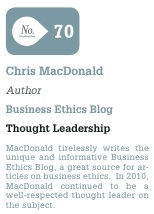 For the third year in a row, I’ve been honoured by Ethisphere Magazine as one of the “100 Most Influential People in Business Ethics.” I was recognized in the category of “Thought Leadership.”
Once again, I’m humbled but also encouraged that my 5 years’ worth of blogging is seen as having some impact on the world, however indirect.
MBA Ethics Education Roundup
Back in November I did a 4-part series on ethics education for MBA students. I thought it might be a good idea to collect all of them, plus a couple other relevant blog entries, on a single blog entry. So here they are:
- MBA Ethics Education: Designing the Designers (…whether we are thinking about training MBAs to make particular decisions, or training them to build the contexts in which particular decisions are to be made, business schools are in the business of designing designers….)
- MBA Ethics Education: Avoiding Excuses (…Sometimes, doing the right thing simply requires that we avoid the temptation to do the wrong thing. Positive role models are definitely a good thing, but we also need to understand why things sometimes go wrong…)
- MBA Ethics Education: All Decisions are Ethics Decisions (…there really is no clear distinction between “ethical” decisions in business and straightforward business decisions…)
- MBA Ethics Education: Speaking Up (…too often, bad things happen because good people don’t speak up….)
And see also these earlier blog entries by me:
Socially Responsible Investing & Value Alignment
Filed under: corporate citizenship, CSR, ethics, finance, investing, stakeholders, sustainability, trust |
Comments (11) Socially responsible investing (SRI) is a big topic, and a complex issue, one about which I cannot claim to know a lot. The basic concept is clear enough: when people make investments, they send their money out into the world to work for them. People engaged in SRI are trying to make sure that their money is, in addition to earning them a profit, doing some good in the world, rather than evil.
There are a number of kinds of SRI. For example, there are investment funds that use “negative screens” (to filter out harmful industries like tobacco), and there are “positive investment” (in which funds focus on investing in companies that are seen as producing positive social impact). We can also distinguish socially-responsible mutual funds from government-controlled funds, such as pension funds.
(For other examples, check out the Wikipedia page on the topic, here.)
Setting aside the kinds of distinctions mentioned above, I think we can usefully divide socially responsible investments into two categories, from an ethical point of view, rooted in 2 different kinds of objectives.
On one hand, there’s the kind of investment that seeks to avoid participating in what are relatively clear-cut, ethically bad practices. For example, child slavery. Trafficking in blood diamonds might be another good example. Responsible investment in this sense means not allowing your money to be used for what are clearly bad purposes. In this sense, we all ought to engage in socially-responsible investment.
(Notice that investments avoiding all child labour do not fall into the above category, because child labour, while always unfortunate, is not always evil. There are cases in which child labour is a sad necessity for poor families.)
On the other hand, there’s what we might call “ethical alignment” investments, in which a particular investor (small or large) attempts to make sure their money is invested only in companies or categories of companies that are consistent with their own values. Imagine, for example, a hard-core pacifist refusing to invest in companies that produce weapons even for peace-keeping purposes. Or picture a labour union investing only in companies with an excellent track-record in terms of labour relations. In such cases, the point is not that the corporate behaviour in question is categorically good or bad; the point is that they align (or fail to align) with the investor’s own core values.
I’m sure someone reading this will know much more about SRI than I do. Is the above distinction one already found in that world?



 The Business Ethics Blog