Archive for the ‘values’ Category
The Ethics of Closing Up Shop
Filed under: accountability, corporate citizenship, decision-making, employees, ethics, management, values |
 Comments (1)
  At what point are a company’s misdeeds sufficiently grave that the right thing to do is simply to shut the doors, permanently?
As was widely reported yesterday, the printing presses at News of the World (part of Rupert Murdoch’s News Corp.) will be grinding to a stop after this Sunday’s edition. The paper’s shameful history of phone-hacking and other scuzzy “journalistic” practices has finally caught up with it.
Under what conditions is such a move the right one? When is a company obligated to commit the corporate equivalent of the ancient Japanese tradition of seppuku (a.k.a. harakiri), or even just to sacrifice a corporate “limb”?
Some people might say, “when doing so best serves the interests of your shareholders.” Others might say, “when doing so best serves the interests of the full range of stakeholders.” Still others might say that it has nothing to do with anybody’s interests, but rather with what’s in the the interest of justice. “Let justice be done,” as the ancient legal saying goes, “though the heavens fall.” So it may be thought that the organization, as a whole, needs to pay a penalty for its wrongdoing.
But there are of course counter-arguments that could apply, even where the corporate wrong is significant. For one, in shutting down an entire corporation for the wrongdoing of a few, you are effectively punishing a large number of innocent employees. And in some cases, that might be justified. Sometimes there is collateral damage along the road to justice. But surely that damage is not irrelevant.
In other cases, shutting a company down may amount to a cynical attempt to insulate sister companies or a parent company from fallout. Or to protect a favoured employee. In such cases, shutting the company is likely blameworthy, rather than worthy of praise. In such cases, surely the honourable thing to do is not to perform seppuku, but rather to stand to face the music. Accept the scrutiny, pay the price, and then rebuild under new management.
But all such considerations presume that the initial crime is sufficiently grave to make such an extreme solution plausible in the first place. In the News of the World case, the offence is serious and multi-faceted. Individual rights were violated; law enforcement officials were bribed; and the journalistic profession was arguably sullied. And all of that was perpetrated in pursuit of an utterly trivial objective, namely the production of yet more trashy tabloid “news.” Compare: there were few serious calls for BP to be dismantled after the Deepwater Horizon spill, despite that spill’s very serious human and environmental impact. But then, unlike News of the World, BP actually produces a socially valuable product.
Ethics & Economics, Part 2: The Market
Filed under: competition, consumers, economics, markets, trade, values |
Comments (5) This is the second in an occasional series on the relationship between ethics and economics.
Today’s topic is the market. ‘The market’ isn’t anything magical. It’s just the term we use for the abstract entity that is the aggregate of all actual markets for particular goods — the sum total of the market for cars plus the market for poetry plus the market for pedicures and so on. Seen another way, the market is just a whole bunch of people (and organizations) buying and selling stuff from and to each other.
The market is ethically significant. And in general, that significance is positive: markets are generally morally good. There is an ethical justification for markets, such that, with some exceptions for particular goods, where markets do not exist we wish they did.
Reasonably-free markets have three basic moral virtues. One is freedom. In a free market, each of us is free to buy whatever we want, within the limits of our ability to pay. That’s not the only kind of freedom anyone could hope for. The sense in which everyone is “free” to buy whatever model of car they want is not very compelling for those who cannot afford a car at all. But scarcity is a basic fact about the world, and the freedom to make one’s own choices within the confines of such scarcity is hardly trivial.
The second virtue of free markets is efficiency. For very many goods, reasonably-free markets are not just one way to provide those goods: a reasonably-free market is the most efficient way to provide those goods. I’ll have more to say about efficiency in a later instalment in this series. But very briefly, we can begin to understand efficiency as a moral value if we consider its opposite, namely inefficiency. Inefficiency means wastefulness, or getting fewer outputs from more inputs. Almost no one is in favour of inefficiency. And in a world where many people see their basic needs go unmet, inefficiency is a great evil.
The third great virtue of the market is its ability, famously described by Adam Smith, to turn self-interested behaviour on the part of one person into (reasonably) good outcomes for others. Smith’s point wasn’t that people are selfish, nor that they should be. His point was that everything you own, everything around you, exists because someone made it. And chances are that — hand-made gifts aside — they made it for you not because they love you, but because they needed to make a living. The market turns my needs into a way of satisfying yours, and vice versa. And it generally happens without someone putting a gun to our heads to make it happen.
But markets also have moral failings. One is the very lack of coordination that I referred to as “freedom” above. That lack of coordination means that markets are notoriously bad at providing for the production of genuinely useful public goods, like highways and lighthouses and police forces and so on. For such goods, it’s much more effective to have some central authority, preferably with coercive powers, collect taxes in order to build them.
Markets are also much better at providing what people want than it is at providing what they genuinely need. So markets produce junk food and video games and porn in abundance, but relatively little delicious health-food and educational games and poetry. Of course, in casting the former as “bad” products and the latter as “good” ones, I’m merely appealing to popular stereotypes. In reality, there’s very little rationale for thinking video games are better than poetry. That’s just an elitist bias. But still, it probably is fair to say that there are products that are out-and-out socially bad: it’s no great bragging point for the market that it has brought us so many brands of cigarettes, for example. So if — and this is a very big if — we were much more certain, and much more unanimous, than we are about what things are genuinely good in life, then it might make a lot more sense just to have governments direct the making and provision of those things.
One of the key starting points for any sane consideration of issues in business ethics is the realization that the market serves a moral purpose. It’s an imperfect mechanism, to be sure, but its value for promoting human freedom and wellbeing is such that what we ought to think in terms of balancing various market virtues and vices against each other, rather than thinking in terms of the market as an alternative to important human values.
Beer, Burgers, and Pretty Girls
As business models go, it’s all pretty straightforward: beer, fried food, and pretty girls who smile a lot and show some skin. And it’s successful, too. The ‘Hooters’ chain has made a lot of money that way, but so have a number of other chains. For evidence, see this story by Jason Daley, for Entrepreneur: ‘Breastaurants’ Ring Up Big Profits.
Franchises inspired by the Hooters model–such as Celtic-themed sports bar chain Tilted Kilt Pub & Eatery and faux mountain sports lodge chain Twin Peaks–have expanded rapidly over the last half decade, while corporate-owned chains like Brick House Tavern + Tap and Bone Daddy’s House of Smoke are picking up steam regionally. In fact, for the next couple of years, this segment (often referred to as “breastaurants”) is poised to be one of the fastest-growing restaurant categories….
OK, so it works. But it is also a business model that draws its share of criticism. A man doesn’t have to be a total prude to find himself thinking, “hmm…would I want my daughter / girlfriend / sister working there?” And if not, “why am I so comfortable with other people’s daughters / girlfriends / sisters working there?”
And being vaguely “uncomfortable” with such restaurants (if that’s your reaction) is a perfectly reasonable moral position. This is just the kind of case to use to illustrate the point that ethics doesn’t have to be done in terms of binary, go-or-no-go, ethical-or-unethical evaluation. The ethics of a business model that uses sex (or at least the idea of sex) to sell food is pretty grey. It’s easy to sketch a very rough kind of ethical justification of that business model, cast in terms of a commercial transaction between consenting adults, etc. It’s also easy to prejudge the situations, intentions, and attitudes of the women who work at a place like Hooters, and to cry out “exploitation” without truly understanding, say, the point of view of an actual Hooters Girl. But both of those options are too quick, and neither does much to increase our understanding. But it’s also worth seeing that refusal to opt for either extreme is not the same as shrugging your shoulders — it can be a principled point of view.
Besides, restaurants like Hooters or Tilted Kilt are part of a much larger spectrum, along which various restaurants and chains locate themselves. You certainly don’t have to go to a “mancave” restaurant of that sort in order to see either short shorts or low-cut tops on the waitresses and bartenders. That’s not justification for any particular business practice, but it is reason to question singling out particular chains for especially harsh criticism. And it’s also worth noting that in many cases, outside of these chains, it’s individual waitresses who make their own wardrobe decisions. Again, that fact doesn’t obviate the option of (or indeed the need for) social critique; it just means that we can’t reasonably roll our eyes at the very notion of a place like Hooters, and then merrily skip down to the neighbourhood bar where the waitresses wear short skirts and tube tops all summer.
Finally, it’s tempting to think there’s a sort of arms race going on here: that restaurants in this category (and some individual waitresses) will compete by having skimpier and skimpier outfits. But that seems unlikely. For one thing, the picture painted in the Entrepreneur piece is much more complicated than the ‘beer-and-boobs’ stereotype. Cleavage and short skirts may get men (in particular) through the door, but any restaurant that wants return business is going to have to do more than that. After all, if it were just about the boobs, then the “businessman’s lunch” offered by many strip clubs would be a lot more popular.
Bragging About Not Recycling
Filed under: environment, honesty, marketing, quality, transparency, values |
Comments (4) 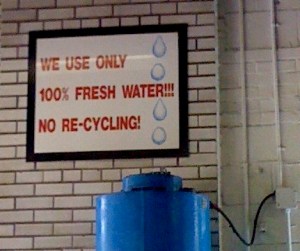 Recycling is cool, right? It’s hip to be green, right? Well, apparently that’s not always the case.
I spotted this sign at a carwash here in Toronto yesterday. This carwash (the labour-intensive handwash kind) is proud of the fact that its water is always fresh, never recycled. In 2011, it’s a striking way of bragging.
Two points worth making:
First, any business that brags about using a resource in the least frugal way possible is perhaps, just perhaps, paying too little for it. Now, from what I understand, water usage by businesses in Toronto is metered, though I don’t know just how expensive the water is for businesses. But it’s at least worth contemplating that, for a sometimes-scarce resource (and water counts as one of those, even in Canada) a business can only brag about maximal usage if it’s not paying very much for it in the first place. If we want to encourage people (and businesses) to use less water, the first step is to make sure usage is metered, and the second step is to make sure that prices are sufficient to discourage waste. Water is a public utility, and pricing is often subsidized in ways that encourages waste. Notice there are precisely zero airlines bragging about how much fuel they use.
The second thing worth noting is the basic value conflict here. Why is it that this company is bragging about using only fresh water? Presumably it’s because they or their customers associate fresh water with a better product, i.e., a better wash. Now, that belief might be mistaken. In fact, I strongly suspect it is mistaken. I suspect that recycling and filtering can easily get water clean enough to get your car 100% sparkly clean. But the perception that recycled water is inferior is out there, and it may be difficult to change. In the meantime, this remains an example of what many will experience as a difficult values-based choice: do you want the best product, or the greenest one? Sometimes, the greenest choice is also the best product, and when that’s true it’s either a happy coincidence or the result of really smart product development. But we must not allow clever marketing to convince us that that will automatically be the case, that green = ethical = happy = socially progressive. Life is full of choices, and that truth is one that we cannot afford to water down.
Are Girl Scout Cookies Evil?
Filed under: activism, boycott, environment, food, health, protest, snacks, sustainability, values |
Comments (4)  Is nothing sacred? What could be more pure and innocent and hard-to-object-to than delicious bite-sized cookies sold, door-to-door, by happy-faced young girls trying to raise money to support a wonderful not-for-profit organization?
Well, apparently nothing is safe from criticism. Girl Guide cookies, as it turns out, are under attack for being made with palm oil, a tropical oil the production of which has been blamed for deforestation and for endangering the habitat of orangutans. Girl Scout cookies, in their current form, are apparently evil.
Dammit.
Here’s the story as reported by Tara Kelly, blogging for Time: Do Girl Scout Cookies Harm the Environment? Renegade Scouts Fight Against Palm Oil Ingredient
…now two renegade girl scouts are lobbying the Girl Scouts of America to remove the ingredient from the cookies.
Rhiannon Tomtishen and Madison Vorva, who are high school sophomores, stopped selling Girl Scout cookies in 2007 after they began working on a public service project to bring attention to the plight of endangered orangutans in Borneo. To ramp up their efforts, Rhiannon Tomtishen and Madison Vorva, natives of Ann Arbor, Michigan, have teamed up with Rainforest Action Network (RAN) to make the change a reality….
OK, OK. So I’ve long realized that Girl Scout Cookies (a.k.a. “Girl Guide Cookies,” here in Canada) are evil, but only in roughly the same way that any addict realizes that the object of his desire is evil. Every year I buy quite a few boxes of GG Cookies (the mint wafer kind, thank you very much) and hoard them, hiding them from family and friends, to enjoy them one-by-delicious-one.
A few random thoughts about the ethical issues here:
1) This is a lovely example of why not-for-profit organizations fall squarely within the bailiwick of business ethics, even if they’re not “businesses” as that term is traditionally conceived. (According to Time, by the way, the Girl Scouts annually sell nearly three quarters of a billion dollars worth of their delicious baked goods.) I suspect that Kathy Cloninger, CEO of Girl Scouts USA, is finding out that even a not-for-profit cannot hide its head in the sand when faced with criticism of its supply chain.
2) Sometimes (but only sometimes) evil comes from trying to do good. Time notes the reason for the existence of palm oil in the cookies:
In 2006, the U.S. Food and Drug Administration began requiring unhealthy trans-fats to be listed on the Nutrition Facts labels on food products. Two official Girl Scouts bakers worked to make its cookies healthier in light of the changes, said Tomkins. “In order to rid cookies of trans-fats, you had to find another alternative.” That alternative is palm oil.
So, the cookies are less-environmentally-friendly because of efforts to make them better for your arteries. Is there a win-win alternative out there? Maybe, but that cannot be assumed. It may well be that some sort of tradeoff is going to be required. So, ask yourself: which do you care about more…your arteries or the orangutans? (“Pssst! You’ve got cookie crumbs on your tie!”)
3) The main reason that Girl Scouts USA makes such a good target for criticism (in addition to its prominence) is of course precisely the organization’s clean-cut, do-gooding image. In other words, the organization is vulnerable to criticisms that would simply be shrugged off by whatever anonymous company makes the cookies sold in the bulk-food aisle of the grocery store. The Girl Scouts have an image to protect, and, other things being equal, this means they are more likely to be responsive to pressure. But then, that image has been earned, and critics may well find that the public would rather continue to support a favourite charitable organization than learn about a new set of ethical issues focused on the effects such support could have in far-away lands. That doesn’t mean that the anti-cookie campaign can’t get traction. It just means that when the battle is good cause versus good cause, the outcome is hard to predict, and it’s not clear whether there can even be winners.
—–
Hat tip to NW, for pointing me to this excellent story.
Buffett, Sokol, and Virtue Ethics
Filed under: character, conflict of interest, employees, ethics, finance, honesty, trust, values, virtue, white collar crime |
Comments (8) 
Warren Buffett (photo by Mark Hirschey)
The world’s most successful investor, Warren Buffett, was recently caught up in a scandal. He himself is not accused of any wrongdoing, though some have accused him of responding to the scandal — one involving a senior employee of his, one David Sokol — in a lackadaisical manner.
For the basics of the story, see here:
Berkshire doesn’t plan big changes after scandal (by Josh Funk, for the AP)
Berkshire Hathaway CEO Warren Buffett says he doesn’t think his reputation has been hurt much by a former top executive’s questionable investment in Lubrizol shortly before Berkshire announced plans to buy the chemical company….
Sokol is accused of a form of insider trading, essentially a kind of betrayal that is unethical at best, and illegal at worst. Now, Sokol himself is, not surprisingly, keeping pretty quiet, and speaking only through his lawyer. I’m more interested, at this point, in Buffett’s response, and what it says about his character. I’m not the first person to suggest that you can learn a lot about a person by the way he or she responds to a crisis. But when the man in the spotlight happens to be one of the world’s most successful businessmen, there’s some reason to think that the lessons learned might just be more interesting than most.
For more about Buffett’s response, see here: Buffett Takes Sharper Tone in Sokol Affair (by Michael J. De La Merced, for the NYT.)
Despite the critics, I think Buffett comes out of this looking pretty good. To begin, Buffett gets points for demonstrating his loyalty to a long-serving employee:
[Buffett] was harsh in his assessment of Mr. Sokol’s trading actions, he pointedly declined to personally attack Mr. Sokol, instead highlighting the executive’s years of service and good performance.
Buffett also has a sense of context and proportion. Not that the wrong of which Sokol is accused is small. But it is wise, and ethically correct I think, for Buffett to resist the urge to pounce on an employee who has, in Buffett’s own experience (up until the present crisis), been a diligent and morally-upstanding employee:
“What I think bothers some people is that there wasn’t some big sense of outrage” in the news release, Mr. Buffett said. “I plead guilty to that. But this fellow had done a lot of good.”
Buffett’s business partner, Charles Munger, likewise gets points for showing restraint:
“I feel like you don’t want to make important decisions in anger,” Mr. Munger said, defending Berkshire’s press release. “You can always tell a man to go to hell tomorrow.”
All of this is set against a background of Buffett insisting on the importance of having a reputation for integrity in business. Buffett is no slacker when it comes to ethical standards. The NYT piece quotes Buffett from 20 years ago, on the topic of the significance of reputation in business:
“Lose money for the firm, and I will be understanding. Lose a shred of reputation for the firm, and I will be ruthless.”
Finally, it’s worth pointing out that this focus on Buffett’s character, and on the example he sets, represents an importantly different approach to business ethics. The approach here is akin to what philosophers call “virtue ethics,” a stream of thought that goes back to Aristotle. The idea here is that, rather than focusing on principles (or, more cautiously, in addition to focusing on principles), what we really ought to do when thinking about ethics is to focus on character. Rather than asking, “what rules apply to this situation?” this way of thinking asks, “what would a good person do in a situation like this?” And in between crisis points, we should be asking, “when a crisis comes, what kind of person do I want to pattern my behaviour after?” I don’t know nearly enough about Mr Buffett to hold him up as a moral exemplar, but I think that the kind of character he has displayed in the Sokol affair is worthy of emulation.
Pink Toenails, Gender Identity and Social Responsibility
Filed under: activism, advertising, children, corporate citizenship, CSR, culture, ethics, marketing, protest, values |
Comments (21)  This one’s a real tempest in a teapot. Or rather, in a bottle of nail polish.
OK, so here’s the short version. Clothing chain J. Crew’s latest catalog includes a picture of president and creative director Jenna Lyons painting her young son’s toenails pink. Yes, pink — the colour most closely associated, in North American culture, at least, with traditional femininity. Criticism ensued, alleging that J. Crew was acting (intentionally!) to promote a gender-bending agenda. The calibre and cogency of the arguments in favour of that conclusion is about what you’d expect.
The main critic, Fox commentator and psychiatrist Dr Keith Ablow, provides an object lesson in how to cram as many argumentative fallacies as possible into a single piece of writing, in his oddly-titled editorial, “J. Crew Plants the Seeds for Gender Identity”. (I’ve blogged about the significance of logical fallacies before, here.) Among the good doctor’s fallacious arguments:
He alleges, without substantiation, that pink-toenail-painting is highly likely to result in gender confusion. In the absence of supporting evidence, we are expected to believe him because he’s got “Dr” in front of his name — essentially a form of illicit appeal to authority. He also engages in straw man argumentation (in which a critic attacks something his opponent never said nor implied), by suggesting that, via this ad, “our culture is being encouraged to abandon all trappings of gender identity” [my emphasis]. He also begs the question by assuming that pink is just for girls (and I’m wearing pink as I write this, by the way). He also has an unfortunate tendency to resort to rhetorical questions: “If you have no problem with the J. Crew ad, how about one in which a little boy models a sundress? What could possibly be the problem with that?” (What if my answer is “nothing”? Ablow provides nothing to help me, then.) Ablow also commits the fallacy known as appeal to ignorance when he points out that the effect of “homogenizing males and females … is not known” (i.e., we don’t know that it’s safe, so it is probably unsafe.) He also makes use of an illicit slippery slope argument, suggesting comically that ads such as this are somehow going to result in the end of all procreation, and, hence, of the human race. And Ablow’s argument as a whole amounts to one giant, fallacious, appeal to tradition. I could quite literally teach the entire Fallacies section of my Critical Thinking class just by having students pick apart Ablow’s critique of the J. Crew ad.
(Note that another critic, Erin Brown, over at the conservative Culture and Media Institute, commits fewer fallacies, but only because her article is shorter. But then she apparently doen’t even know what J. Crew is, referring to the men’s and women’s clothier as a “popular preppy woman’s clothing brand.” I happen to own two J. Crew ties. Men’s ties.)
Now, my response to the critics of J. Crew’s ad may seem flippant. So be it. Sometimes ridicule is the best response to something ridiculous. But there is a serious point to be made, here, about the social responsibility of business.
Ablow and Brown share one important view in common with many critics of modern capitalism, namely this: they all believe that businesses have an obligation to pursue certain social agendas. They merely disagree over what that agenda should be. For Ablow and Brown, the social obligation of business is to defend & promote good ol’-fashioned American values, including apparently carefully scripted gender roles. For critics of capitalism, the social obligation of business is to promote social justice, environmental values, gender equality, and so on. In either case, those who urge businesses to adopt social missions — as opposed to merely making and selling stuff that people want to buy, within the bounds of law and ethics — ought to be careful what they wish for. Because if and when businesses do take up social agendas, they may not be the agendas that those advocates prefer.
—-
Thanks to Laura for showing me this story.
Honesty, Reputation, and Ethics
Filed under: character, corporations, ethics, honesty, regulations, transparency, trust, values |
Comments (6) The connection between reputation and ethics is complex. A pattern of ethical behaviour is clearly essential to establishing a good reputation, which for a company means a reputation as the kind of company people want to do business with. But hold on. All that’s really essential, from a business point of view, is to be perceived as ethical. But there are two ways of reading that ancient point. The cynical way is to say that all that matters in business is to give people the impression that you’re ethical, and that can be done through good PR or even outright misrepresentation. The less cynical way of reading that is that you’ve got not just to be ethical, in the sense of doing what you think is the right thing to do; you’ve also got to convince key stakeholders that you’ve done the right thing.
Take honesty, for example. Honesty matters, but so do public perceptions of honesty. In that regard, see this useful piece on corporate disclosure, by Steven M Davidoff for the NY Times: In Corporate Disclosure, a Murky Definition of Material.
Most of the piece is an exploration of the legal standard of “materiality.” Materiality is essentially about relevance. Publicly-traded companies are obligated to reveal certain information to the investing public (typically through filings with the relevant regulatory agency). But not everything they do needs to be reported — not everything is sufficiently important — and there are lots of legitimate reasons why companies don’t want to reveal any- and everything. Figuring out just what needs to be disclosed is a difficult legal problem. But towards the end of the piece, Davidoff argues that companies should avoid focusing on mere legalities. As Davidoff points out:
Companies need to understand that information disclosure is not just a legal game. Failure to disclose important information on a timely basis can harm a company’s reputation.
So, it’s all about reputation, about ‘optics’? “What about ethics?” you ask. But consider: why would a failure of disclosure harm a company’s reputation? In part, it would do so because (or if) the failure harms people’s interests. But even then, harming someone’s interests won’t immediately harm reputation. If, for example, Ford designs a new SUV that’s so good that sales of GM’s SUV’s fall, putting thousands of GM employees out of work, well, that’s bad for GM’s employees, but the harm done to them by Ford is not going to damage Ford’s reputation. Because, after all, the harm done to the employees was the result of fair competitive practices on the part of Ford. A company’s behaviour is only going to hurt its reputation if some critical mass of people see that behaviour as unethical. So in the end, even a concern about “mere reputation” has to be grounded in ethical principles.
Corporate Motives and Discrimination
Filed under: corporations, culture, decision-making, discrimination, employees, management, values |
Comments (1) Motives, especially corporate ones, are hard to figure. Some people, of course, are skeptical about the notion that an abstract entity like a corporation can have motives (or intentions or beliefs of attitudes or any of those sorts of things), even though we all have a tendency to talk about corporations as if they are capable of having them. It’s pretty common to talk about a company “expecting” profits to rise next year, or “wanting” to increase its market share, and so on. But even if we’re not so skeptical about attributing motives (etc.) to companies, their motives can be pretty elusive. We may not be ready to believe corporate spokespersons when they tell us what their company’s motives are, and besides, even if everyone within a company agrees that a certain course of action is the right one to take, it’s entirely possible that different parties within the company all have different motives for doing so.
But sometimes it’s good to at least try to understand what motivates companies, particularly when we want to diagnose a widespread and/or persistent problem, in order to suggest changes.
This question of determining motives came to mind when I read a story about an age discrimination case at 3M: “3M settles age-discrimination suit for up to $12M”.
3M Co. has agreed to pay up to $12 million to settle an age-discrimination lawsuit with as many as 7,000 current and former employees.
The 2004 lawsuit targeted the company’s performance-review system, alleging that older workers were disproportionately downgraded. It also accused the company of favoring younger employees for certain training opportunities that could fast-track them for promotions….
If we accept for the sake of argument that some sort of systemic discrimination took place at 3M, what on earth might have motivated such behaviour?
Here are a few possibilities:
- Profits. Maybe the discriminatory practices and policies were an attempt to increase efficiency in order to boost profits. This of course is the go-to assumption for most corporate critics.
- Energy. Maybe those who engaged in age discrimination weren’t thinking specifically about the end goal of profits, but merely had a certain vision in mind of the kind of company they ought to have, and the kind of youthful energy that makes a company vibrant.
- Recruitment. Maybe 3M wanted to give younger employees lots of opportunities so that they could brag about opportunities for young employees when recruiting new talent. Most recruits, after all, are likely to be young, and ambitious young people are likely to be drawn to a company that holds the promise of great opportunities.
- Bias. It could be that various key decision-makers inside 3M were simply personally biased, as many (most? all?) of us are, against older employees.
- Justice It’s at least possible that key decision-makers within 3M actually thought that giving preferential treatment to younger employees was the morally-right thing to do. Quick, ask yourself this: if 2 patients each need a heart transplant, and you’ve got just one donor heart, and one patient is 15 and the other is 55, who would you give the heart to? Surely all of us are tempted, from time to time, to think that the young are particularly deserving of opportunities. Note that I’m not defending such a view, here.
What do you think? Note that the point here is not about the 3M case, but about what could motivate a company, any company, to engage in discriminatory behaviour. And again, I think it’s worth contemplating the possibility that there simply was no corporate motive (nor maybe even a truly corporate “cause”).
Charlie Sheen as Toxic Asset
Filed under: employees, entertainment, media, professionalism, risk, values |
Leave a comment  While actor Charlie Sheen may not be a ‘toxic asset’ in the technical sense, he’s clearly become too much of a liability for the companies who have thus far been profiting richly from his services.
In case you don’t already know all the gory details, here’s one version of the story, by Bill Carter, writing in the Business section the NY Times: Sheen Tantrum Likely to Cost in the Millions
Charlie Sheen’s latest antics may leave CBS and Warner Brothers with a quarter-billion-dollar headache.
The two companies decided on Thursday to halt production of the hit CBS comedy “Two and a Half Men” after Mr. Sheen, the star of the show, unleashed a barrage of vituperative comments about the sitcom’s creator, Chuck Lorre.
The loss of next season’s episodes would mean forgoing about $250 million in revenue between Warner Brothers, which produces the show, and CBS….
Sheen, of course, was already a famously problematic ‘talent’ long before his decision to publicly and viciously bite the hand that feeds him. Sheen has a long history of handing the tabloids easy headlines through his penchant for drugs and booze and prostitutes and property damage and domestic violence.
Several writers have already suggested that all of that should have been enough to make Sheen persona non grata, but it wasn’t. As the LA Times’ Mary McNamara put it,
If you are the star of a hit comedy on CBS, you can keep your job in spite of accusations of: threatening your pregnant second wife; holding a knife to your third wife’s throat on Christmas Day; and indulging in cocaine-fueled weekends during which your bizarre behavior causes your female companion to fear for her life.
I think from a Business Ethics point of view, we can look at this in two ways.
1) Employment. From an employment point of view, this is a question of CBS and Warner Brothers having an employee with serious behavioural problems, most of which have been after-hours problems rather than on-the-job problems. As McNamara reports, Sheen’s bosses referred to his domestic abuse troubles as “very personal and very private.” Of course, any employer needs to recognize that it will always be the case that at least some of their employees will have personal troubles, and it’s not entirely clear that such problems are grounds for dismissal. But what employers cannot ignore is insubordination, and that’s basically what Sheen’s recent outburst amounts to.
2) Production methods. In an age of conscious consumerism, people are paying a lot more attention to the way in which the products they enjoy are produced. The average consumer is more likely than ever to want to know whether their clothes were made in third-world sweatshops or whether coffee was made with beans that were traded fairly. For the bizarrely popular product that is “Two and a Half Men”, Charlie Sheen is a major part of the means of production. And all available evidence suggests that consumers of that product just don’t care that, in order to produce it, CBS and Warner Brothers had to turn a blind eye to behaviour that was by turns childish, unethical, and criminal.



 The Business Ethics Blog