Can SNC’s Reputation Recover?
Filed under: competition, compliance, corruption, crime, Uncategorized |
 Leave a Comment
 Canadian engineering giant SNC-Lavalin continues to provide plenty of fodder for ethics classroom discussion, and making news in all the wrong ways. Over just the last three days, the company has made headlines for making over $1 million in illegal political donations in Quebec, for disguising dodgy payments to an agent in Angola, and for police searching the home of a former executive as part of a prosecution involving more than a dozen criminal charges.
Against this backdrop, slightly less attention has been paid to an announcement last week that the company had hired a former Siemens executive to take over the role of Chief Compliance Officer, a portfolio that ostensibly puts him in charge of ethics, too.
I was interviewed about this recently on BNN, (see video here) and the key question not surprisingly was whether having hired a new Compliance Officer is going to be enough to turn the company around, either in terms of ethics or in terms of reputation. In this regard, I think three key points need to be made.
First, a word about the relationship between ethics and compliance. The new guy SNC has hired (Andreas Pohlmann) is first and foremost in charge of compliance. Compliance with the law will of course be a very good start for SNC, but it’s just a start. Ethics has to be part of the picture. For that matter, even if Pohlmann’s only goal is to get the company consistently onto the right side of the law, there’s good reason he should pay attention to ethics, so that employees at SCN understand the ethical underpinnings of the laws the company has been breaking.
Second, the company needs to see that its reputation has to be built on more than its ability to pull off big engineering projects. SNC needs to be a company all stakeholders – including investors – can trust, because trust is the foundation of business. Given its track record so far, if I were looking for a big engineering contractor I wouldn’t put much trust in SNC at all. If they play fast-and-loose with the rules as much as they seem to, what’s to say they aren’t going to play fast-and-loose with their obligations to me, too?
Finally, the company needs to get past its apparent belief that bribery is just part of doing business. Bribery isn’t just illegal — illegal pretty much everywhere, even in places where it’s tragically common — it’s also bad business. And by “bad business,” I mean it is bad capitalism. It’s the opposite of free and open competition.
If SNC is going to regain its place as a rockstar Canadian company, it needs to show that it can go out there and compete and win on quality, rather than on its ability to bend and break rules.
Business Ethics Journal Review: Month 1 Summary
A month ago, we launched the Business Ethics Journal Review (ISSN: 2326-7526), a venture in 21st century academic publishing, which I co-edit along with Alexei Marcoux (Loyola University Chicago).
The goal of BEJR is to publish short, peer-reviewed commentaries on recent business ethics articles published in the standard scholarly journals.
Since our launch, we’ve published the following six peer-reviewed Commentaries:
“Moving Beyond Market Failure: When the Failure is Government’s” by Peter Jaworski Bus Ethics J Rev 1(1) (2013): 1–6
“Corporate Human Rights Obligations: Moral or Political?” by Jeffery Smith Bus Ethics J Rev 1(2) (2013): 7–13
“Toward a Political Theory of the Business Firm? A Comment on ‘Political CSR’” by Pierre-Yves Néron Bus Ethics J Rev 1(3) (2013): 14–21
“Are Usurious? Another New Argument For the Prohibition of High Interest Loans?” by Matt Zwolinski Bus Ethics J Rev 1(4) (2013): 22–27
“The Unification Challenge” by Dominic Martin Bus Ethics J Rev 1(5) (2013): 28–35
“Proposition: Shared Value as an Incomplete Mental Model” by Laura P Hartman and Patricia H Werhane Bus Ethics J Rev 1(6) (2013): 36–43
We’ve also published the following three Responses, from the authors of the works at which some of the above Commentaries were aimed:
“The Cost of Usury” by Robert Mayer (a response to Zwolinski) Bus Ethics J Rev 1(7) (2013): 44–49
“Market Failure or Government Failure? A Response to Jaworski” by Joseph Heath Bus Ethics J Rev 1(8) (2013): 50–56
“Morality Meet Politics, Politics Meet Morality: Exploring the Political in Political Responsibility” by Florian Wettstein (a response to Smith) Bus Ethics J Rev 1(9) (2013): 57–62
You can see abstracts, and get free access to the full PDFs for each piece, by clicking on the links above.
For more information about BEJR, please see our instructions for authors.
Update: You can also follow the BEJR’s Facebook page, here: http://www.facebook.com/BusinessEthicsJournalReview
CEO Pay for Performance in Canada
CEO pay — in Canada, at least — is apparently more closely aligned with corporate performance than most people have suspected.
Last week I had the pleasure of hosting Matt Fullbrook, Manager of the Clarkson Centre for Business Ethics and Board Effectiveness, as part of my Business Ethics Speakers Series. Fullbrook’s presentation focused on an interesting study recently completed by the Clarkson Centre.
Much of the discussion focused on this provocative graph:
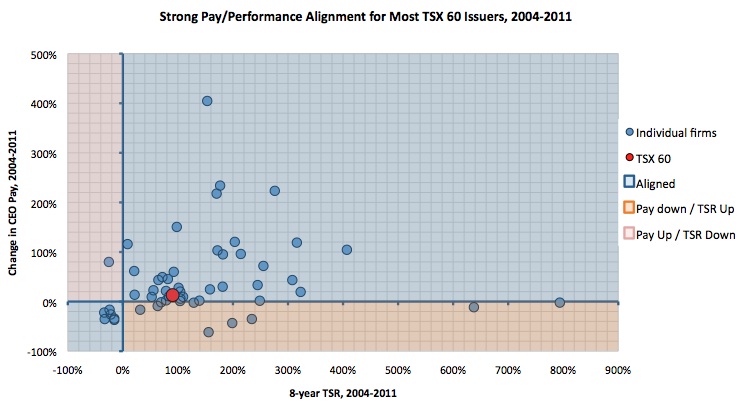
The graph plots change in CEO pay against total shareholder return (TRS). Each dot represents a company listed on the TSX 60. The red dot shows the average for all companies studied. The blue shaded areas indicate companies at which CEO pay and shareholder value have been headed in the same direction (up or down) over the 8 years under study (2004-2011). The other areas show misalignment. The vast majority of companies are in the blue regions. Only at one company did pay rise substantially without a commensurate rise in shareholder value, and several companies showed phenomenal growth in value with no change in CEO compensation.
After his presentation, Fullbrook summarized the study’s findings for me this way: “Our research shows that CEO pay and performance are largely in sync at Canada’s largest corporations, contrary to conventional wisdom. Despite the Financial Crisis, and a significant amount of CEO turnover, most issuers have successfully aligned executive compensation with shareholder returns, which is great news for investors.”
I’ll leave you with just a couple of comments on this.
First, it’s worth noting that the x-axis on the graph above shows change in CEO pay, rather than absolute level of CEO pay. So while we can see that not many Canadian companies provided their CEOs with big raises, that doesn’t mean that they weren’t overpaid to start with. They may or may not have been; that’s a different study. But the fact that pay and performance are heading in the same direction is still pretty significant, given that lots of criticism has been rooted in the perception that CEO pay was climbing while investors get shafted. This study shows that, in general, that’s not true in Canada.
Second, just what counts as “alignment” is itself a difficult question, and during his presentation Fullbrook was thoughtful in this regard. What we see in the red dot in the graph above is a kind of correlation. It suggests that the pattern in Canada is that a slight upward trend in CEO pay is accompanied by a bigger upward trend in shareholder value. But this leaves open questions such as whether TRS is the right measure of “performance” (even if we focus exclusively on the interests of shareholders).
And if we try looking at individual companies, at a particular moment in time, the question of alignment becomes even more difficult. The word “alignment” itself arguably suggests parallel trajectories. But where a CEO is overpaid, it makes sense for pay to go down even while (hopefully) value is going up. The attempt there is to make pay commensurate with value, not to push them in the same direction.
Executive compensation continues to be one of the hardest problems faced by corporate boards, as well as an absolutely key ethical obligation. Doing it well is difficult when we’re not even sure what doing it well looks like.
Food Labels that Matter
Filed under: capitalism, consumers, economics, efficiency, food, honesty, information, labelling, marketing |
Comments (13) Product labels are important, both practically and ethically. Reading the label is a key way to make sure the thing you’re buying meets your needs. Labels on products can help inform consumers about what they’re buying, reducing what economists call information asymmetries between buyer and seller. Where substantial information asymmetries exist, voluntary exchanges can fail to live up to the promise of mutual benefit, and society as a whole suffers from the resulting reduction in market efficiency.
Of course, not everything that could be said about a product could possibly be crammed onto a product’s label, so generally the information provided consists of what the maker of the product really wants to brag about, what consumers insist on knowing, and anything beyond that that regulators have seen fit to insist upon.
So precisely what gets labeled, and what form the labelling takes, matters a lot. Now while the moral significance of labels in general is not disputed, just what should be included on labels is hotly debated.
Take, for instance, the question of whether a food product has been genetically modified (GM). Or, more precisely, whether the ancestor of the organism from which a food product was derived was genetically modified by means of a particular set of laboratory procedures. It’s important to be precise, here, because there is virtually nothing that we eat today that hasn’t been ‘genetically modified’ by humans in some loose sense.
If you thought the question of GM labelling had gone away with the demise of California’s Proposition 37 this past November, think again. Washington State is apparently about to hold a vote on the issue, and there are reports that the anti-GM faction has been energized by the battle in California, and perhaps even galvanized by the massive sums of money that ‘big food’ and ‘big ag’ apparently spent to help defeat Prop 37. But as I’ve argued before, the demand for mandatory labelling of GM foods is misguided: the broad scientific consensus is that there’s no reason to worry about GM foods. Making such labelling mandatory, just because some people want to know if their food’s genes have been tweaked in certain ways, would be unjust.
Contrast this with the stunning report recently released by the ocean conservation group, Oceana. Nevermind subtle genetic modifications. Oceana found that a very high proportion of the fish sold in American retail outlets isn’t even from the species indicated on the label. So consumers are buying “snapper” that isn’t really snapper, and “tuna” that isn’t really tuna. Here, consumers are being lied to. Information isn’t just being omitted; the information being given is actually a lie, and so consumers are being cheated.
If the food companies of the world are going to expend money and effort to provide consumers with information, it’s pretty clear which kind of issue they should expend it on.
An Innovation in Business Ethics Scholarship
As of a couple of weeks ago, I’m now co-editor and co-publisher of an innovative new publication that aims to shake up the somewhat stodgy world of academic business-ethics publishing. The Business Ethics Journal Review (BEJR) is a cutting-edge online publication: it’s a free, open-access journal that publishes peer-reviewed commentaries on scholarly articles published in mainstream academic journals.
That may not sound all that exciting to those not firmly ensconced in the ivory tower, so let me explain why it’s worthy of note.
The business model of standard academic journals hasn’t changed in decades, perhaps centuries. The process goes like this. Scholars submit their research; editors vet it for basic adequacy, and then anonymize it and send it to other scholars for “blind review.” If the work passes muster (often after a round or two of revisions) it eventually gets published. If another scholar spots errors or confusions, he or she repeats the process, submitting a rebuttal that goes to an editor, then through the process of peer review, revision, and so on. It’s hardly a process that fosters discussion. A single back-and-forth can literally take years.
BEJR aims to change that formula radically, by leveraging the power of the internet and social media. We’re publishing online, and we’ve streamlined the review process so that we promise authors submission to publication in under 30 days. We also provide a “Comments” function on our website, so that literally anyone with an internet connection can participate in the discussion.
(An interesting aside: my co-Editor Alexei Marcoux and I have started BEJR using two laptops, some off-the-shelf software, and a consumer-grade web-hosting service. It’s taken plenty of work, but we’ve hardly broken the bank. A couple of decades ago, starting your own scholarly journal would have required taking out a second mortgage on your house.)
Broadening discussion in the realm of business ethics is no small feat. A lot of different people have an interest in business ethics, including business executives and other corporate employees, as well as consultants, activists, and academics. The problem is that although there is plenty of conversation about the topic, the conversation tends to be fragmented. Executives talk to executives and to their own employees. Activists chat amongst themselves and try to get the public interested. And academics most typically carry on isolated debates about esoteric considerations in scholarly journals that the uninitiated never dare to read. Bringing business ethics scholarship into a much more public forum holds the potential to foster real dialogue.
Of course, like anything really innovative, there’s a chance that the Business Ethics Journal Review will fall flat on its face. We’ve published half a dozen peer-reviewed commentaries so far, and our website has already seen some lively discussion, but it’s entirely possible that our initial momentum will wither, that the novelty will wear off, and that those who have expressed enthusiasm for this new format will go back to old, familiar ways.
And you know what? That’s OK. That’s what entrepreneurship is about: trying something cool, and living with the chance of failure. But for now, it’s great to be part of something that has other people saying, “Wow, what a great idea!” That’s something everyone should get the chance to experience, at least once in their lives.
Can Big Pharma Learn to Self-Regulate?
A new study suggests that the pharmaceutical industry’s attempt to regulate its own activities with regard to advertising erectile dysfunction drugs has fallen far short of the mark. According to the study, co-authored by US professors Denis Arnold and Jim Oakley, some of the industry’s biggest companies failed repeatedly, over a period of years, to live up to the standards they set for themselves. The companies studied had all committed to the 2005 PhRMA Guiding Principles, but didn’t come close to living up to that commitment.
I suspect few will be surprised by this result, though they may be surprised by the extent of of the violations documented by Arnold and Oakley. Eli Lily’s Cialis campaign, Pfizer’s Viagra campaign, and Bayer Healthcare, GlaxoSmithKline, and Merck’s Levitra campaign violated more principles than they adhered to.
The notion of businesses regulating themselves raises plenty of eyebrows. Skepticism about business is high, and many people will find it hard to believe that profit-oriented businesses will respond to any rules that aren’t backed by the force of law. And the idea of the pharmaceutical industry — an industry not exactly famous for its ethics — self-regulating with regard to marketing a cash-cow category of drugs is sure to garner even more skepticism. Did anyone expect it to work in the first place?
But we shouldn’t let an example like this cast a pall over the notion of self-regulation more generally.
Self-regulation can mean lots of things. It can mean the tacit evolution of norms within an industry, a shared sense that “this is how things should be done.” It can mean efforts to establish industry-wide standards (such as GAAP) that end up being woven into legislated regulatory requirements, and enforced by courts. It can also refer to the simple fact that thousands of basic ethical issues are left up to individual businesses and individual employees. Some of those mechanisms can reasonably be expected to work reasonably well, for some issues. And others, unfortunately, probably cannot.
Self-regulation by means of industry-wide standard-setting is in some sense a best-case scenario for self-regulation. Companies within a single industry have a shared set of interests, including an interest in forestalling intrusive government regulation. They also in many cases form a true community, and are hence able to exert peer pressure on each other to promote compliance. Of course, as the Arnold and Oakley study demonstrates, it doesn’t always work.
And there’s a powerful argument in favour of making use of self-regulation where feasible. After all, government can’t be everywhere, and if it could be we couldn’t want it to be. Having government pass rules about every aspect of business operations and then monitor compliance with those rules would be both terribly expensive and brutally intrusive. The question isn’t whether self-regulation is a good idea. The question is for which issues will self-regulation work, and under what conditions? We need as a society to be able to rely on a good deal of self-regulation, and business needs to figure out how to do it.
The Ethics of Innovation
Innovation is a hot topic these days. It’s been the subject of studies and reports and news reports. In fact, I spent the entire day this past Monday at the Conference Board of Canada’s “Business Innovation Summit,” listening to business leaders and civil servants talk about how Canada is lagging on innovation, and how much is left to be done to promote and manage innovation. And certainly technological innovations like Google’s new glasses and 3D printing make for compelling headlines.
So sure, hot topic. But how is it connected to ethics? What is an ethics professor like me doing at an event dedicated to innovation?
If you understand the domain of ethics properly, the connection is clear. In point of fact, innovation is an ethical matter through and through, because ethics is fundamentally concerned with anything that can promote or hinder human wellbeing. So ethics is relevant to assessing the goals of innovation, to the process by which it is carried out, and to evaluating its outcomes.
Let’s start with goals. Innovation is generally a good thing, ethically, because it is aimed at allowing us to do new and desirable things. Most typically, that gets expressed in the painfully vague ambition to ‘raise productivity.’ Accelerating our rate of innovation is a worthy policy objective because we want to be more productive as a society, to increase our social ‘wealth’ in the broadest sense. The 20th Century has seen a phenomenal burst of innovation and increases in wellbeing, exemplified not least by the fact that life expectancies in North American have risen by more than half over the last hundred years. The extension and enriching of human lives are good goals, which in turn makes innovation generally a good thing.
Indeed, when looked at that way, innovation isn’t just a ‘good,’ but a downright moral obligation. Yes, lives for (most) people in developed countries are pretty good. But many still don’t have happy and fulfilling lives; many children, even here, still go to bed hungry. Boosting productivity through innovation is a key ingredient for making progress in that regard. And if less developed nations are going to be raised up to even a minimally tolerable standard of living, we need innovations that will help them, and we need innovations that will make us wealthy enough that we can afford to be substantially more generous toward them than we currently are.
Which brings us to ethical evaluation of the specific fruits of innovation. Some innovations are plainly good: they make human lives better in concrete ways. Penicillin was a very good innovation. So was the birth control pill. So was the advent of the smartphone. Other innovations are less good: nuclear weapons are a clear candidate here, as perhaps are complex financial instruments such as derivatives, which Warren Buffet famously referred to as “financial weapons of mass destruction.”
The problem, of course, is that innovation brings risks. Some of those risks are of course borne by the innovator, by the entrepreneur. Others are borne by society. For one thing, we often don’t fully understand which category a particular innovation will end up in until years later. Is the net benefit of splitting the atom positive or negative? The jury is still out.
But ethical evaluation doesn’t just apply to individual innovations: systems of innovation bring a mix of risks and benefits. If we set ten thousand entrepreneurs loose on the world, and tell them (or incentivize them) to make something innovative that sells, some will bring us the proverbial ‘better mouse trap,’ and others will bring us video lottery terminals, biological weapons, and other bits of detritus that only serve to increase human suffering. If you give your tech company’s R&D department free reign, someone may invent the next ‘killer app,’ and someone else may simply crash your server. And the only way a system can preclude ‘negative’ innovation altogether is probably to discourage innovation altogether.
Hence the recent interest not just in innovation, but in managing innovation. The notion of managing innovation reflects the fact that innovation can be fostered — doing so is an obligation of ethical leadership — and is an activity rooted in creativity, not anarchy. So for practical purposes, the ethics of innovation ends up being a branch of the ethics of management and leadership. Organizations, from small teams to nations, face a range of ethical questions as a result. They need to figure out how much to spend on encouraging innovation, as compared to spending on existing programs. They need to figure out what combination of carrots and sticks to use to foster innovation. They need to figure out how much autonomy to give potential innovators, how much freedom to experiment. And finally, they need to figure out how to spread the risk of innovation, in order to make sure that risks and benefits are shared fairly, and to make sure that fear of risk doesn’t dampen our appetite for innovation. And all of those are fundamentally ethical questions.
Are Smaller Restaurant Portions Ethically Better?
Should restaurants aim at serving smaller portions? Many are doing so, these days, and it’s easy to see why. Some of this is motivated by calorie-labelling requirements that are now in force in some jurisdictions. But there are other reasons, too.
Regardless of regulations, smaller portions are appealing proposition, in many ways. Other things being equal, smaller portions mean fewer calories, which is good for customers’ waistlines. And, other things being equal, smaller portions means less money spent on ingredients, which is good for restaurants’ profits. Looked at that way, smaller portions look like a win-win.
But obviously there are limits to that argument. Some customers may appreciate smaller portions, just as some will choose ‘lite’ beer, child-size portions, and salad with dressing on the side. But plenty of other customers still appreciate bigger helpings, with extra cheese, please. So while offering choices in terms of serving size may be a no-brainer, smaller portions generally can’t be assumed to be a crowd-pleaser at all.
An argument could be made that there’s a social obligation here. Regardless of what individual customers want, it’s pretty clear that, as a society, we could all stand to eat less. North American waistlines keep expanding, and the effects that is having on our health and our healthcare costs are by now pretty familiar. Do restaurants have an obligation to help stem the tide of the obesity epidemic? Do they have such an obligation even if smaller portions drive customers to the restaurant down the street, the one that’s more than willing to supersize it?
This is a question that pits social obligation against a company’s interest in making a profit. But note, of course, that “profit” here is a misleading term; if it is to be used at all, we need to understand it broadly. Not all restaurants are mega-chains like McDonalds and Subway, and not everyone who benefits from restaurant profits is a stereotypical wealthy shareholder. For your average restaurant or even small chain, “profit” might really just mean “staying in business.” For a small business, staying in business can itself be an obligation; staying in business means fulfilling obligations to investors, to employees, to suppliers, and to creditors.
Add to that the limited impact of unilateral action. Few if any restaurants or even chains have the ability to make a dent in the obesity epidemic. Your typical restaurant owner is faced with the fact that downsizing portions just isn’t going to have any real effect. Only a collective effort can do that, and that can only really happen through regulation.
The other interesting, and perhaps counter-intuitive, route, is for restaurants to get creative. They can look for ways to reduce portion sizes — and hence calories — in ways that aren’t going to be noticed and resented by those customers who are accustomed to judging restaurant servings according to a ‘bigger is better’ mentality. I’m not suggesting anything deceptive here. But if there are differences in composition or process or plating that can leave customers feeling well-fed without dumping excess calories into their systems, that seems to be a good thing.
One last note. If you’re running a restaurant and the best way you can think of to bring in customers is to serve gut-busting portions, then shame on you. You’re just not as good at your job as you should be. The very best restaurants typically have very small — but incredibly satisfying — servings. Clearly there’s more than one way to make customers happy. So while it’s hard to defend an obligation to promote social welfare in a way that risks profits, it’s much easier to say that restaurants have obligation not to take the easy way out. After all, innovation, efficiency, and creativity are core market values, aren’t they?
Pope Shows Ethical Leadership Knowing When to Leave
More than a few leaders in the corporate world could learn a lesson from Pope Benedict XVI’s decision to step down. The 85-year-old leader of more than a billion Catholics is making a move that is nearly unprecedented, for a pope: he’s going to walk out of office, rather than being carried out. It’s a decision one that should give pause to some CEOs and senior members of corporate boards of directors.
The Pope’s stated reasons are simple: at his age, he simply doesn’t feel like he’s got the strength to do a good job. Assuming that’s really the reason — and there is always speculation at times like this — the pontiff has made the right move. Part of the ethics of leadership is knowing when to call it quits.
Of course, wise leaders and wise organizations don’t just make the right decision at the right time; they plan ahead for when the time comes. But too few organizations think far enough ahead, partly because a leader’s future departure is an awkward topic, and partly because when things are going well it just doesn’t seem like a pressing matter. But leadership is too important to be left to the last minute.
There can be lots of good reasons for an aging leader to step down. Sometimes it’s a matter of failing health, and the resulting inability to keep up with workload. Sometimes it’s simply a matter of having been at the helm too long. An organization that never changes leaders can grow set in its ways and resistent to change. For corporate boards, having a very senior member — statistically very likely to be a white male — step down can be an opportunity to increase diversity on your board. In other cases, when a team of leaders (such as a board of directors) ages together, with insufficient turnover, it simply fosters group-think and complacency.
None of this needs to be agist. The problem here is not with old leaders, but with leaders who stay later than they should, whether in terms of biological age or just length of tenure.
No, in the end, none of this is about age. It’s about understanding that leadership means knowing that it’s not about you. It’s about the organization, and what’s best for it. And sometimes, what’s best is for you to go.
The Value of Ethical Leadership
On the occasion of the launch of the Jim Pattison Ethical Leadership Program, a new effort for which I’m the director at the Ted Rogers School of Management, I want to take some time to talk a little bit about the program and ethical leadership.
At the program we’re aiming to go beyond the “mom and apple pie” aspects of ethical leadership, to look not just at the values and skills of ethical leaders, but also at the particular institutional mechanisms that ethical leaders use to shape institutional culture and to put their vision into practice throughout business organizations.
Leaders are by their very nature fascinating people. The news is replete with stories of the victories and foibles of leaders in the worlds of business and politics and entertainment. From an ethical point of view, the decisions they make and the values to which they subscribe are disproportionately important. Not only do they make crucial decisions, but they influence the decisions of others, both directly through the instructions they give and indirectly through the examples they set and the atmosphere they foster.
So ethical leadership is a compelling issue—even among those who don’t bother to think critically about the topic. It is all too tempting to think of ethical leadership as a question only for CEOs or for top-tier executives. And while I have high hopes and high expectations of my undergrad business students, not all of them will go on to leadership positions at that level. But what I’ve been teaching my students is this: leadership is an activity that goes on at all levels of a business organization. Whether you’re leading a publishing empire or a small sales team, you face the challenges implied by the term “ethical leadership.” You are faced with not just doing the right thing, but also with helping others to do the right thing and building organizational contexts that will foster people in doing the right thing.
The question, of course, is whether a program like ours can make a difference. And I think it can. And the reason has to do with how I understand the goal of ethics education itself.
I’ve long argued that an ethics course at a business school isn’t designed to make you into an ethical person, to teach you to be good. If making you ethical was the aim, then ethics education would be either redundant or hopeless: critics are probably right to think that a basic understanding of right and wrong is either there by the time kids enter university or it isn’t.
Ethics courses should assume a basic desire to do the right thing, and focus on giving students the ability to understand the special kinds of ethical issues that arise in business, along with the tools of teamwork and leadership that let them put their ethical understanding into action.
Students don’t come to business school to be educated on how to be employees. They come to learn how to be managers, and a manager with vision is what we call a leader.