Author Archive
Steve Jobs’ Health & a CEO’s Privacy
Filed under: accountability, employees, health, management, privacy, risk, transparency |
 Comments (5)
 How much privacy does a CEO deserve? Is his or her health a private matter, or a matter that should be open to the scrutiny of the public (and, in particular, of the investing public)?
See, for example, this piece by Miguel Helft, at the NYT: Jobs Takes Sick Leave at Apple Again, Stirring Questions
Steven P. Jobs, the visionary co-founder and chief executive of Apple, is taking a medical leave of absence, a year and a half after his return following a liver transplant. The leave raises questions about both his long-term prognosis and the leadership of the world’s most valuable technology company….
So, should Jobs tell all, letting shareholders and potential shareholders (and other stakeholders?) just what’s up with his health, so that everyone can adjust their decision-making accordingly? Some say a CEO has as might right to privacy as anyone else. Others say a CEO’s obligation to be transparency overrides that.
As Slate’s Annie Lowrey tells us:
While publicly traded corporations need to disclose events and changes that might “materially” affect the company, the Securities and Exchange Commission does not specifically require disclosures about CEO health. That vagueness in the law means that Apple has remained within the letter of the law with its disclosures….
I don’t have a strong view on this, but here are some thoughts:
1) Information is good; it’s what lets markets operate more rather than less efficiently. But a big part of what matters most is equal access to information, and so far there’s no worry about that here, as far as I can see. (It may be that some are worried that top insiders will trade Apple’s stock based on their insider knowledge. Doing so would probably be illegal, and hence very dangerous.)
2) Health is a spectrum. There are people in the pink of health, and people on death’s doorstep, and everything in between. All CEOs are somewhere on that spectrum, and there’s simply no clear line beyond which a CEO’s health becomes a worry. So if Steve Jobs needs to disclose his diagnosis, the same likely goes for all CEOs (and other senior executives?) Note also that medical prognosis is as much art as science. So even if, say, Jobs were to reveal that his doctors were giving him a year to live — well, frankly, that could mean he’d be dead in a month or in 5 years. We have good evidence that doctors just aren’t good at making those estimates.
3) The basic, crucial info — that Jobs has ongoing health problems, likely quite serious ones — is already out there. As a former SEC chair Arthur Levitt says,
Jobs going on medical leave sends a message to the market,” Levitt continues. “An intelligent investor should know the risks of Jobs having a relapse. For the board to opine on what the extent of the illness is right now I don’t think is really necessary.”
In the end, I guess I’m most worried about the slippery slope, here. There are lots of things investors could want to know, and lots of things they could argue they need to know. But that doesn’t mean we want to push on down that road.
Sustainability is Unsustainable
Filed under: accountability, complexity, CSR, definitions, energy, environment, greenwashing, labelling, natural, sustainability, values |
Comments (21) I was tempted to call this blog entry “Sustainability is Stupid,” but I changed my mind because that’s needlessly inflammatory. And really, the problem isn’t that the concept itself is stupid, though certainly I’ve seen some stupid uses of the term. But the real problem is that it’s too broad for some purposes, too narrow for others, and just can’t bear the weight that many people want to put on it. The current focus on sustainability as summing up everything we want to know about doing the right thing in business is, for lack of a better word, unsustainable.
Anyway, I am tired of sustainability. And not just because, as Ad Age recently declared, it’s one of the most jargon-y words of the year. Which it is. But the problems go beyond that.
Here are just a few of the problems with sustainability:
1) Contrary to what you may have been led to believe, not everything unsustainable is bad. Oil is unsustainable, technically speaking. It will eventually get scarce, and eventually run out, for all intents and purposes. But it’s also a pretty nifty product. It works. It’s cheap. And it’s not going away soon. So producing it isn’t evil, and using it isn’t evil, even if (yes, yes) it would be better if we used less. Don’t get me wrong: I’m no fan of oil. It would be great if cars could run on something more plentiful and less polluting, like sunshine or water or wind. But in the meantime, oil is an absolutely essential commodity. Unsustainable, but quite useful.
2) There are ways for things to be bad other than being unsustainable. Cigarettes are a stupid, bad product. They’re addictive. They kill people. But are they sustainable? You bet. The tobacco industry has been going strong for a few hundred years now. If that’s not sustainability, I don’t know what is. To say that the tobacco industry isn’t sustainable is like saying the dinosaur way of life wasn’t sustainable because dinosaurs only ruled the earth for, like, a mere 150 million years. So, it’s a highly sustainable industry, but a bad one.
3) There’s no such thing as “sustainable” fish or “sustainable” forests or “sustainable” widgets, if by “sustainable” you mean as opposed to the other, “totally unsustainable” kind of fish or forests or widgets. It’s not a binary concept, but it gets sold as one. A fishery (or a forest or whatever) is either more or less sustainable. So to label something “sustainable” is almost always greenwash. Feels nice, but meaningless.
4) We’re still wayyyy unclear on what the word “sustainable” means. And I’m not talking about fine academic distinctions, here. I’m talking big picture. As in, what is the topic of discussion? For some people, for example, “sustainability” is clearly an environmental concept. As in, can we sustain producing X at the current rate without running out of X or out of the raw materials we need to make X? Or can we continue producing Y like this, given the obvious and unacceptable environmental damage it does? For others, though — well, for others, “sustainability” is about something much broader: something economic, environmental, and social. This fundamental distinction reduces dramatically the chances of having a meaningful conversation about this topic.
5) Many broad uses of the term “sustainable” are based on highly questionable empirical hypotheses. For example, some people seem to think that “sustainable” isn’t just an environmental notion because, after all, how can your business be sustainable if you don’t treat your workers well? And how can you sustain your place in the market if you don’t produce a high-quality product? Etc., etc. But of course, there are lots of examples of companies treating employees and customers and communities badly, and doing so quite successfully, over time-scales that make any claim that such practices are “unsustainable” manifestly silly. (See #2 above re the tobacco industry for an example.)
6) We have very, very little idea what is actually sustainable, environmentally or otherwise. Sure, there are clear cases. But for plenty of cases, the correct response to a claim of sustainability is simply “How do you know?” We know a fair bit, I think, about what kinds of practices tend to be more, rather than less, environmentally sustainable. But given the complexities of ecosystems, and the complexities of production processes and business supply chains, tracing all the implications of a particular product or process in order to declare it “sustainable” is very, very challenging. I conjecture that there are far, far more claims of “sustainability” than there are instances where the speaker knows what he or she is talking about.
7) Sometimes, it’s right to do the unsustainable thing. For example, would you kill the last breeding pair of an endangered species (say, bluefin tuna, before long) to feed a starving village, if that was your only way of doing so? I would. Sure, there’s room for disagreement, but I think I could provide a pretty good argument that in such a case, the exigencies of the immediate situation would be more weighty, morally, than the long-term consequences. Now, hopefully such terrible choices are few. But the point is simply to illustrate that sustainability is not some sort of over-arching value, some kind of trump card that always wins the hand.
8 ) The biggest, baddest problem with sustainability is that, like “CSR” and “accountability” and other hip bits of jargon, it’s a little wee box that people are trying to stuff full of every feel-good idea they ever hoped to apply to the world of business. So let’s get this straight: there are lots and lots of ways in which business can act rightly, or wrongly. And not all of them can be expressed in terms of the single notion of “sustainability.”
Now, look. Of course I don’t have anything against sustainability per se. I like the idea of running fisheries in a way that is more, rather than less, sustainable. I like the idea of sustainable agriculture (i.e., agriculture that does less, rather than more, long-term damage to the environment and uses up fewer, rather than more, natural resources). But let’s not pretend that sustainability is the only thing that matters, or that it’s the only word we need in our vocabulary when we want to talk about doing the right thing in business.
Glock Pistols, Ethics and CSR
Filed under: accountability, corporate citizenship, CSR, ethics, product safety, profits, regulations |
Comments (3)  It’s been a week now since the Tuscon, Arizona killings in which Jared Lee Loughner apparently emptied the high-capacity magazine of his 9 mm pistol.
Plenty has already been written about the awful killing. Inevitably, some of it has focused on the weapon he carried, namely the Glock. According to Wikipedia’s Glock page,
The Glock is a series of semi-automatic pistols designed and produced by Glock Ges.m.b.H., located in Deutsch-Wagram, Austria.
…
Despite initial resistance from the market to accept a “plastic gun” due to concerns about their durability and reliability, Glock pistols have become the company’s most profitable line of products, commanding 65% of the market share of handguns for United States law enforcement agencies[5] as well as supplying numerous national armed forces and security agencies worldwide….
If you want to learn more about the company that made the pistol Loughner used, see this article, by Paul M. Barrett for Bloomberg Businessweek, Glock: America’s Gun
…Headquartered in Deutsch-Wagram, Austria, the company says it now commands 65 percent of the American law enforcement market, including the FBI and Drug Enforcement Administration. It also controls a healthy share of the overall $1 billion U.S. handgun market, according to analysis of production and excise tax data. (Precise figures aren’t available because Glock and several large rivals, including Beretta and Sig Sauer, are privately held.) ….
Barrett’s article provides a fascinating account of the invention of the Glock pistol and how it came to its current dominant market position through a combination of excellent engineering, good marketing and cagey lobbying.
The sale of semi-automatic pistols with high-capacity magazines is a good example of an issue where the term “corporate social responsibility” provides a useful analytic lens. I’ve argued here before that the term “CSR” is over-used — we shouldn’t try to stuff every single ethical issue into the relatively narrow notion of corporate social responsibility. But like the BP oil spill, the current case raises issues that are genuinely social in nature. As difficult as it may be, set aside for a moment the tragic events of January 8th, and look at the marketing of the Glock pistol (and its accessories) from a social point of view.
Do Americans as individuals have the right to buy certain kinds of weapons? As a matter of constitutional law, yes. And there’s arguably no direct line to be drawn between the sale of an individual gun and a particular wrongful death (because there’s always the complicating factor of the decision made by the individual who bought the gun and then pulled the trigger). So let us take as given (even if just for the sake of argument) that there’s nothing intrinsically wrong with making and selling guns to the public. Let us assume that individual customers have a legitimate interest in owning semi-automatic pistols, and there’s nothing unethical about a company seeking to make money from satisfying the demand for this entirely-legal product.
That still leaves as an open question, I think, the question of social impact. The best rationale for public acceptance of the kind of zealous, profit-seeking behaviour seen in the world of business lies in the social benefits that arise from a vigorous competitive marketplace. This implies that the moral limits on business are also to be found in a business’s net social impact.
There is a raging debate, in the US, over the net social impact of the sale of handguns. And where a product is contentious, you can argue that “the tie goes to the runner,” and that the “runner” in this case is freedom. When in doubt, opt for freedom of sale and choice. So let’s say (again, if only for sake of argument) that there’s nothing wrong with selling handguns to the public. So Glock (the company) is justified in existing and in carrying out its business. That still leaves open the question of the particular ways in which handguns and their accessories are marketed. The social benefits of selling handguns may be fundamentally contentious; in other words, reasonable people can agree to disagree. But I doubt that the same can really be said for marketing moves designed, for example, to foster the sale of high-capacity magazines (ones that hold 33 bullets instead of the usual 17).
I’m not presuming to answer that question here; I’m merely pointing out the significance, and appropriateness, of a specifically social lens.
——
(See also Andrew Potter’s characteristically sane piece on the politics of gun control: ‘You can’t outsmart crazy’—or can you?)
Trustworthy Business Behavior
Filed under: consumers, corporations, ethics, honesty, rankings, trust |
Comments (8) I was recently honoured to be named among the “Top 100 Thought Leaders in Trustworthy Business Behavior” for 2010, by the folks at Trust Across America.
The list is an interesting mix. It includes fellow business ethics profs like Laura Hartman and Mary Gentile, along with business leaders like Jeffrey Hollender (formerly of Seventh Generation), Whole Foods CEO John Mackey and consultants like Charles H Green and Christine Arena, as well as journalist-bloggers like Aman Singh.
The focus on “trust” in this listing is interesting. There’s probably not much to differentiate this list from a listing of thought-leaders in, say, business ethics or CSR. That’s not to say that a different title wouldn’t have changed the list at all; but basically all such lists, whether they’re of companies or of individuals, are about the doing the right thing in business or about promoting and fostering such behaviour.
But I do like the focus on trust. I think the role of trust in commerce simply cannot be overstated. Business — and that includes consumers interacting with any business — simply cannot happen without trust. Consider, for example, how crucial trust is…
- …whenever you buy any consumer product, and thereby trust not just the person who sold it to you, but dozens or perhaps even hundreds of people who helped make that product.
- …whenever one business buys something from another business, just by picking up the phone and saying, “Hey, please send us a box of X, and we’ll pay you at the end of the month.”
- …whenever anyone is employed by anyone else. (In that case, the employer trusts the employee not to shirk as soon as the employer’s back is turned, and the employee trusts the employer to pay the agreed-upon amount at the end of the day or week or whatever.)
- …whenever you give some of your money to a bank, ask them to hold onto it for you, and then (as most of us do) take their word for it when they tell you how much interest you’ve earned (or, more likely, how much interest you owe them on the money you’ve borrowed).
- …whenever you climb into a taxi, or sit down at a restaurant to eat. (The driver or waiter is trusting that you will actually pay your bill at the end, rather than make a dash for it.)
- …whenever you pick up the phone to order pizza. (The fact that it actually shows up means that they trust you to pay for it when it gets there.)
Basically, all of us, in our organizational lives and in our lives as consumers, end up trusting dozens and perhaps hundreds of people (and many many business organizations, too) during the course of our daily lives.
Of course, sometimes we use specific mechanisms to enforce trustworthiness — policies, laws, regulations, warrantees, contracts, etc. But all the formal enforcement mechanisms in the world couldn’t possibly keep a complex modern economy running, in the absence of a fundamental ethical commitment to trustworthy behaviour.
The Purpose of a Manager
 What is the “purpose” of a manager? In particular, what is the purpose (or goal or objective) of a corporate manager (i.e., any manager, at any level, within a corporation)?
The preamble of the MBA Oath echoes one common sentiment when it says, “my purpose as a manager is to serve the greater good by bringing people and resources together to create value that no single individual can create alone.” [emphasis added]
Is that really the case? Is there a good argument for that point of view?
Let’s consider 3 possible answers to the question of what a manager’s purpose is (in the ethically-relevant sense of that word).
- The purpose of a manager is to do whatever s/he was hired to do, which is probably (for standard business corporations) to do his/her best to help the corporation make a profit (and to implement whatever charitable / CSR-type plans the company’s bosses see as appropriate);
- The purpose of a manager is to serve the greater good; and
- The purpose of a manager is to pursue his/her own interests.
Which of these is right? Do we need to choose? Can they all be right at once? If and when they conflict, which should take priority?
Let’s try a thought experiment, a bit of fiction to stimulate our intuitions.
Imagine I own and operate a small but productive apple orchard, employing say a dozen people to help me harvest and ship the apples. But imagine that, at some point, I get offered an attractive job in the city, one that is inconsistent with continuing also to run an orchard. Imagine that, rather than sell the orchard, I decide to hire a manager to take care of it in my absence. So I leave the company in her hands, and move to the city. Once month or so, we talk by phone, so that she can tell me how things are going and so that she can ask what my wishes are about high-level strategy, etc. And at the end of the year, she sends me whatever money is made from the sale of apples, minus operating costs (including the cost of materials and equipment, her own salary and the wages of the other employees, etc.).
Now, ask yourself: what is this manager’s purpose? What objectives should she work towards?
Well, surely she has as one of her goals making a living. That, after all, would likely be why she took the job in the first place. So she has her own “purposes.” But those surely can’t be ethically overriding. For example, what should she do with the money derived from the crop of apples after she has taken her own salary and paid other expenses? Can she use that money for her own purposes? Surely not. (Preventing that sort of self-serving move is a big part of the point of the system of corporate governance that bigger, more complicated organizations need to put in place.) The most obvious answer (though not the only alternative) is that she should send that money to me. They are, after all, my apples, grown on my trees on my land, and I’m the one who hired her to manage the operation for me.
What about the notion of serving the greater good? In our story, I’ve now got a good job in the city. Surely there are others in the community in which the orchard is situated that could use the leftover money more than I could. In that sense, it would serve “the greater good” for the manager to give that money to them. Or she might instead be tempted to give a really big raise to my apple-pickers. (Let’s assume they already make a decent “living wage,” but a big raise would allow them something closer to the affluent middle-class lifestyle that I myself already enjoy.) But surely — given that they’re my apples to start with — my manager ought at least to ask me, first, before giving my money away? Doing anything other than sending the money to me would amount to embezzlement, or at very least misuse of funds. But how do we square that with the appealing notion that being a manager involves contributing to the greater good?
We can get closer to the answer by noting that there’s a complication in the statement about a “manager’s purpose” in the bit of the MBA Oath quoted above, a complication that I’ve ignored so far. The Oath says that “my purpose as a manager is to serve the greater good by bringing people and resources together to create value that no single individual can create alone.” In other words, the Oath also suggests the mechanism by which managers are to serve the greater good.
Working that provision into our story: the manager I employ can be seen as serving “the greater good” by doing a good job of managing my orchard. If she does that well, she’ll produce a valued food product, contributing to the well-being of everyone who likes apples. If she manages to keep the business going in a sustained manner, she’ll also help keep a dozen people gainfully employed. And also by doing so, she will hopefully generate a profit for me (out of which I may well contribute to various charities, or simply buy things, thereby contributing to keeping other people employed). If she can’t do that, I’m likely to replace her with someone who can, or shut down the orchard entirely. And who benefits from that?
Most Hated American Companies Of 2010
Filed under: consumers, corporations, employees, rankings, virtue |
Leave a comment  The corporate world is certainly subject to plenty of criticism, and even hatred. But which companies are hated most?
Here’s one look at that question, from 24/7 Wall St.: The Fifteen Most Hated American Companies Of 2010
Customers, employees, shareholders and taxpayers hate large corporations for many reasons. 24/7 Wall St. reviewed many of these to choose the 15 most hated companies in America.
We examined each company based on six criteria….
(Note that the title “Most Hated” actually understates the sophistication of the ranking method used here, which includes measures of employee satisfaction, media coverage, total return to shareholders, and more.)
Interestingly, several of the companies on this “most hated” list have appeared on the Business Ethics Blog before.
- Dell (#9 on the un-ordered list) appeared here several times in 2006 and 2007, in blog entries about the ethics of poor customer service.
- Nokia (#2 on the list) appeared here as the subject of a movie I reviewed, called A Decent Factory. The movie was about Nokia’s attempt to manage things like labour standards in its supply chain.
- Toyota (#3) appeared in a blog entry on whether a company’s shareholders really “own” the company, as well as in an older blog entry about “Patriotism vs. Globalization in the Auto Industry”.
- Citigroup (#6) appeared in a blog entry called “Ethics in Banking: Best Practices”, as well as in a more recent one called “The Pay Czar’s Ethical Dilemma”.
- McDonald’s (#12), not surprisingly, has made a couple of appearances. It appeared in a blog entry on “Trans-fats vs. Genetically Modified Foods”, as well as “Saving the Earth, One Big Mac at a Time”.
- Last, but not least, British Petroleum (BP) is #14 on the list (and labelled “the most obvious choice to be on a list of hated companies”) has of course appeared here several times this year, including in “BP and Corporate Social Responsibility”, and “Boycotting BP is Futile and Unethical”, and “Ethics, BP, & Decision-Making Under Pressure”.
As you read through the whole list, it’s worth noting more generally the role that unethical (or at least ethically controversial) behaviour plays in generating hatred.
Should Workplaces Ban Lotteries?
Filed under: employees, honesty, pay, pricing, profits, values |
Comments (10) Should workplaces ban lottery pools? Lots of offices feature “pools” of various kinds, with groups of employees joining together collaboratively or competitively to speculate on, e.g., the outcome of the NFL playoffs. Very likely lots of managers regard it all as harmless fun, boosting morale by giving employees a break from the tedium of their cubicle farms. But a lottery pool is unlike, say, a hockey or football pool. In a hockey or football pool, there are winners and losers, but typically the dollar amounts are pretty small. But when employees band together to buy lottery tickets, the possibility is there for all hell to break loose.
To see what I mean, take a look at this story, from the CBC: More claiming share of $50M lottery prize
Some of the claimants to the disputed $50-million Lotto Max jackpot were at the Ontario Lottery and Gaming prize centre on Wednesday being questioned about the win.
The original claimants — 19 Bell Canada call centre workers from east Toronto — validated the winning ticket on Monday, said OLG spokeswoman Sarah Kiriliuk.
But since then, several more people have come forward to say they should have a share of the prize, said Kiriliuk, although she refused to say exactly how many….
Clearly, this is an anxious moment for the winners. But it’s also surely a rather anxious moment for their employer, telecommunications giant Bell Canada.
My friend Andrew Potter (author of The Authenticity Hoax) suggested to me that there are at least a couple of reasons reasons why employers might legitimately choose to ban lottery pools.
The first reason Andrew suggests is the potential for a highly disruptive exodus of an entire group of employees in the event of a lottery win. Most people, when asked, say that the first thing they would do if they won the lottery is quit their jobs. Losing a good employee can be a bad thing. So what happens when a dozen or 20 employees win together, and very likely depart en mass? Clearly, employers have a significant interest in avoiding such an outcome. Of course, the odds against such a thing happening are, well, tiny…one in many millions. How tiny do they have to be for us to say that the employer would be out of line to try to prevent it?
Second, and I think more significantly, Andrew suggests that employers might have a strong interest in avoiding the possible legal troubles that could result from a group of employees winning a lottery. Even for a win much smaller than the $50 million win in the story above, there’s the chance that employees will come forward who say they were unfairly excluded for one reason or another. And with money on the line, lawsuits are far from unlikely. And when lawsuits happen, chances are that everyone is going to get sued, including the employer. After all, an excluded employee can reasonably claim that the employer was effectively hosting the lottery pool, and hence bears some responsibility for making sure that it is run fairly. Even if the dollar amounts are too small to result in lawsuits, I can imagine considerable disruption of the working environment when there’s disagreement over a lottery win. Just take the usual petty office grievances and multiply them by a few tens of thousands of dollars, and then a win for employees equals trouble for their employer.
Now, I’m not sure there’s a huge risk here, but I think it’s an interesting question. Obviously, it behooves employers to allow employees a little breathing room when it comes to lunch-break entertainment. In general, it’s good for employers to respect employees’ privacy and autonomy, and that might include the freedom to engage in things like office pools. For most of us, our employers already dominate our lives in ways that are at least sometimes regrettable, so employers should be cautious about imposing unnecessary constraints. But given that lotteries are already widely-criticized as a regressive form of taxation (or, more bluntly, as a ‘tax on the inability to do math’), it might well be that eliminating office lottery pools would be a reasonable move.
——
Addendum: it’s a little-known and sad fact that a relatively high proportion of lottery winners eventually file for bankruptcy. [URL updated Aug. 2011]
Ethics of Insider Trading
Filed under: conflict of interest, decision-making, ethics, finance, governance, honesty, profits, shareholders, Uncategorized |
Comments (13) “Insider trading” is one of those phrases that most adults have heard (at least on the nightly news), but that relatively few understand. (Perhaps the most famous case: Martha Stewart was originally charged with insider trading in the ImClone case.) I imagine few people even know what it really refers to. Well, it refers to situations in which corporate “insiders” (executives, directors, etc.) buy or sell their company’s stock on the basis of significant corporate information that is not available to the investing public more generally. (For more details, see the Wikipedia page on insider trading.)
But even if we don’t all know just what insider trading is, we all know insider trading is bad, and must be stopped. Right? But it’s hard to stop something that’s hard to define. In that regard, see this nice piece by Steve Maich, Editor of Canadian Business: “Chasing our tails while we chase insider trading.”
In case you hadn’t noticed, we are in the midst of a crackdown. Or rather, another crackdown. The crime du jour is an old favourite: insider trading….
There are obvious benefits to these shows of regulatory force. Seeing hedge fund managers and lawyers in handcuffs not only produces a nice dopamine rush, it’s also meant to demonstrate the integrity of the capital markets. But the costs are frequently overlooked. Like most crackdowns, this one seems likely to deepen cynicism, erode confidence and lob more grenades at shell-shocked markets….
Maich is undertandably cynical about these enforcement efforts:
Despite the periodic efforts of regulators to stamp it out, insider trading runs as rampant as ever, and that isn’t going to change. This is in part because it’s notoriously difficult to prove, but also because we have never definitely solved the fundamental puzzles at the heart of this supposed crime….
It’s worth adding that there is genuine disagreement over just why insider trading is unethical. (Some people even think it’s not unethical at all, because the executive who trades on “inside” information ends up indirectly bringing that information to the market, rendering the latter more efficient.) And if we’re not entirely sure why it’s unethical, it makes it that much harder to figure out in which cases it’s unethical.
The only scholarly article I’ve read on the ethics of insider trading is by Jennifer Moore, and is called “What Is Really Unethical About Insider Trading?”* Moore looks at a number of arguments against insider trading — arguments rooted in fairness, in property rights, and in the risk of harm to investors — and finds most of them lacking. Moore ends up arguing — plausibly, in my view — that the real reason insider trading is unethical is that it jeopardizes the fiduciary relationships that are central to business. If insider trading were permitted, that would put corporate insiders in a conflict of interest. Basically, the interests of corporate insiders would stop being well-aligned with the interests of the shareholders they are supposed to serve. And if the interests of corporate insiders aren’t aligned with the interests of shareholders, then people are much less likely to be willing to buy shares (i.e., to invest) in companies. And that wouldn’t be good for the firm, for its shareholders, or for society in general.
—–
*Jennifer Moore, “What Is Really Unethical About Insider Trading?” Journal of Business Ethics, Volume 9, Number 3, 171-182.
Greenpeace, Tar Sands and “Fighting Fire With Fire”
Filed under: activism, advertising, CSR, employees, energy, environment, ethics, greenwashing, NGO, pollution, sustainability |
Comments (4) 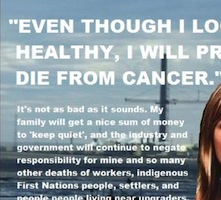 Do higher standards apply to advertising by industry than apply to advertising by nonprofits? Is it fair to fight fire with fire? Do two wrongs make a right?
See this item, by Kevin Libin, writing for National Post: Yogourt fuels oil-sands war.
Here’s what is apparently intolerable to certain environmental groups opposed to Alberta’s oil sands industry: an advertisement that compares the consistency of tailings ponds to yogourt.
Here’s what is evidently acceptable to certain environmental groups opposed to Alberta’s oil sands industry: an advertisement warning that a young biologist working for Devon Energy named Megan Blampin will “probably die from cancer” from her work, and that her family will be paid hush money to keep silent about it….
It’s worth reading the rest of the story to get the details. Basically, the question is about the standards that apply to advertising by nonprofit or activist groups like the Sierra Club and Greenpeace. But it’s also more specifically about whether it’s OK for such groups to get personal by including in their ads individual employees of the companies they are targeting.
A few quick points:
- Many people think companies deserve few or no protections against attacks. Some people, for example, think companies should not even be able to sue for slander or libel. Likewise, corporations (and other organizations) do not enjoy the same regulatory protections and ethical standards that protect individual humans when they are the subjects of university-based research. Corporations may have, of necessity, certain legal rights, but not the same list (and not as extensive a list) as the list of rights enjoyed by human persons. So people are bound to react differently when activist groups attack (or at least name) individual human persons, as opposed to “merely” attacking corporations.
- Complicating matters is the fact that the original ads (by Canadian Association of Petroleum Producers, or CAPP) themselves featured those same individual employees. So the employees had presumably already volunteered to be put in the spotlight. But of course, they volunteered to be put in the spotlight in a particular way.
- For many people, the goals of the organizations in question will matter. So the fact that Greenpeace and the Sierra Club are trying literally to save the world (rather than aiming at something more base, like filthy lucre) might be taken as earning them a little slack. In other words, some will say that the ends justify the means. On the other hand, the particular near-term goals of those organizations are not shared by everyone. And not everyone thinks that alternative goals (like making a profit, or like keeping Canadians from freezing to death in winter) are all that bad.
- Others might say that, being organizations explicitly committed to doing good, Greenpeace and the Sierra Club ought to be entirely squeaky-clean. If they can’t be expected to keep their noses clean, who can? On the other hand, some might find that just a bit precious. Getting the job done is what matters, and it’s not clear that an organization with noble goals wins many extra points for conducting itself in a saintly manner along the way.
(I’ve blogged about the tar sands and accusations of greenwashing, here: Greenwashing the Tar Sands.)
—
Thanks to LW for sending me this story.
Top Blog Entries of 2010
Here are my 10 most popular blog entries of the year.* Not surprisingly, the top end of the list is dominated by 2 entries about the BP oil spill fiasco.
- #1. BP and Corporate Social Responsibility. This entry used the BP oil spill as an example to illustrate what I take to be the proper scope of the term “CSR” — i.e., something considerably more narrow than most people take its scope to be.
- #2. Boycotting BP is Futile and Unethical. The title of this one is self-explanatory. I argued that the call to boycott BP was perhaps well-intentioned, but a bad idea. The boycott of BP’s retail outlets was much more likely to do serious damage to innocent franchisees than it was even to be noticed at BP’s head office. (Say, how did that whole boycott thing turn out, anyway?)
- #3. Wall Street (1987) — “Greed is Good.” This one was basically a debunking of the standard assumptions about the significance of Michael Douglas character, Gordon Gekko’s, famous “Greed is Good” speech in the original Wall Street movie. Turns out, if you listen to (or read) the whole speech, most of it isn’t about greed, it’s about good corporate governance and crazy executive salaries.
- #4. Should Trapped Miners Be Paid? This one brought together hard questions about employee safety, social justice, and whether the government (i.e., the public) ought to clean up a corporation’s mess when that corporation is unable to do so.
- #5. Can Employers Tell Employees What to Eat? This one (about a Montreal handbag company that wants employees not to eat meat on the premises) struck a nerve, and brought out very different intuitions from different readers.
- #6. Business Ethics in China. This entry explores the relationship between ethics and economic growth, in the context of an economy that is both struggling, and at the same time one of the world’s largest.
- #7. Ethics of Hiring Illegal Immigrants. This entry was bound to draw fire, given that it’s about an issue at the intersection of business and politics.
- #8. Facebook and Dangerous Ideas. This blog entry was about the ideas that drive companies, and which ideas are dangerous ones. Plenty of people assume that the dangerous idea is the idea that companies must maximize profits. Here, I argue that there are other ideas, including some that seem to drive Facebook boss Mark Zuckerberg, that are far more dangerous.
- #9. Competence, Ethics & HP’s Board. It was a rough year for Hewlett-Packard board of directors. This blog entry explores the extent to which a board’s failure to do a good job at governance becomes a matter of ethical failure. And finally…
- #10. Chilean Miners: What is Rescue Worth? A mine rescue is heart-wrenching, and expensive. And every dollar spent on rescue is a dollar not spent on something else — perhaps spent more efficiently on achieving other socially-good objectives. In that context, how much it is worth spending is a difficult ethical question.
*Actually, it’s not quite true that this is a list of the year’s top 10. I moved my blog from one blogging service to another in the summer, and so I lost stats for the first part of the year. I’m pretty sure my January blog entries on the crisis in Haiti are among my most popular of the year, but the data are lost. Here they are:
- Cruise Ships and the Crisis in Haiti
- Haitian Tourism: The Role of the Profit Motive in Development
- Business As Usual (plus Price Gouging) in Parts of Haiti
- Haiti, Credit Cards, and Charitable Donations
Thank you all for reading and commenting in 2010, and for your continued support. Suggestions for improvement are always welcome. You can email me at chris@businessethicsblog.com. Happy New Year!



 The Business Ethics Blog